XRing O1

Search documents
China's Xiaomi tells CNBC it's planning a yearly smartphone chip release and its own AI assistant for overseas
CNBC· 2026-03-04 10:58
Core Insights - Xiaomi plans to launch a new smartphone processor chip annually, indicating its ambition to delve into more advanced technology sectors [1][3] - The company is preparing to introduce its own AI assistant for international markets, complementing its existing AI assistant, Xiao AI, used in China [2][7] Group 1: Chip Development - Xiaomi's first custom system-on-chip (SoC), the XRing O1, was launched last year using a 3 nanometer manufacturing process, a rarity among smartphone manufacturers [2][9] - The company aims to release yearly upgrades to its SoC, aligning with industry leaders like Apple, which has a history of annual chip releases [5][9] - The integration of a custom SoC with Xiaomi's HyperOS operating system is expected to differentiate its products from competitors [6][9] Group 2: AI Assistant Strategy - Xiaomi's AI assistant, Xiao AI, is currently focused on the Chinese market, but the company plans to launch an AI assistant for international markets alongside its electric vehicles (EVs) in 2027 [7][8] - The company is likely to partner with Google to utilize its Gemini models for the overseas AI assistant, similar to strategies employed by other smartphone manufacturers [8] - The goal is to have the AI assistant integrated across both smartphones and cars, enhancing the user experience [8]


Canalys:华为二季度重夺中国手机市场桂冠,苹果(AAPL.US)跌至第五
智通财经网· 2025-07-29 12:12
Group 1 - Huawei regained the top position in China's smartphone market in Q2 2025 with a shipment of 12.2 million units, a year-on-year increase of 15%, capturing an 18% market share [1] - Vivo followed closely with 11.8 million units shipped, holding a 17% market share, but experienced a 10% decline compared to 13.1 million units in Q2 2024 [1] - OPPO (including OnePlus) ranked third with 10.7 million units shipped, representing a 16% market share, while Xiaomi achieved 10.4 million units, marking its eighth consecutive quarter of year-on-year growth [1] Group 2 - Apple ranked fifth with 10.1 million units shipped, reflecting a 4% year-on-year growth, but faced initial growth challenges due to high pricing of the new iPhone 16 series not meeting national subsidy standards [2] - The overall smartphone market in mainland China saw a 4% year-on-year decline in Q2, attributed to the diminishing effects of earlier subsidy policies [2] - Canalys expects moderate growth in the Chinese smartphone market for the year, with potential to surpass global market growth in 2025, as consumer confidence is anticipated to recover in the second half of the year [2]

Canalys:第二季度中国大陆智能手机市场同比下降4%
智通财经网· 2025-07-28 01:18
Core Insights - The Chinese smartphone market is expected to see a year-on-year decline of 4% in Q2 2025, as the effects of earlier government subsidy policies begin to wane [1][3] - Huawei regained the top position in the market with a shipment of 12.2 million units, capturing 18% market share, followed closely by vivo and OPPO [1][5] - Despite the market slowdown, consumer demand remains strong, with overall shipments showing slight growth in the first half of the year [3][5] Market Performance - In Q2 2025, the total smartphone shipments in mainland China reached 67.8 million units, down from 70.5 million units in Q2 2024, reflecting a 4% decline [5] - The market shares of major manufacturers in Q2 2025 are as follows: Huawei (18%), vivo (17%), OPPO (16%), Xiaomi (15%), and Apple (15%) [5] Manufacturer Strategies - Major manufacturers are adopting differentiated strategies in software, self-developed technologies, and product release schedules to maintain competitiveness [3] - Huawei's launch of the Nova 14, featuring HarmonyOS 5.0, aims to expand its independent ecosystem and enhance user experience [3] - Xiaomi is focusing on self-developed technology with the introduction of its XRing O1 chip in flagship products, while also expanding offline retail [3] Future Outlook - The Chinese smartphone market is projected to experience slight growth in 2025, outperforming the global market, driven by resilient consumer confidence and careful channel strategies [5] - Manufacturers will need to focus on product innovation and differentiation to sustain replacement demand, as the effects of earlier subsidies may lead to challenges in the second half of the year [5]

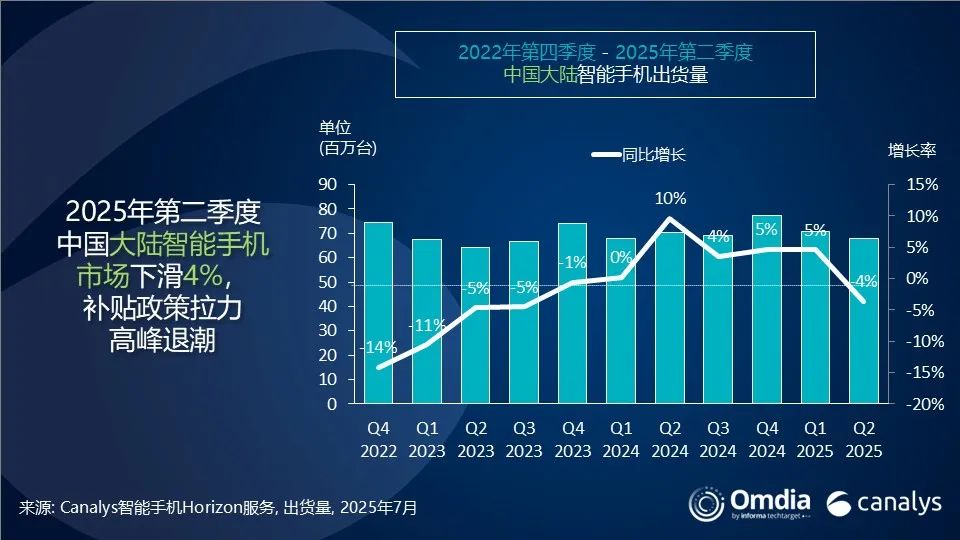
2025年第二季度,中国大陆智能手机市场下滑4%,华为重夺市场第一
Canalys· 2025-07-25 13:17
Core Viewpoint - The Chinese smartphone market is experiencing a year-on-year decline of 4% in Q2 2025, primarily due to the waning effects of earlier government subsidy policies, despite a slight overall increase in shipment volume in the first half of the year [1][2]. Market Performance - Huawei regained the top position in the market with a shipment of 12.2 million units, capturing an 18% market share. Vivo followed closely with 11.8 million units (17% share), while OPPO ranked third with 10.7 million units (16% share). Xiaomi achieved a shipment of 10.4 million units, marking its eighth consecutive quarter of year-on-year growth, and Apple rounded out the top five with 10.1 million units [1][6]. Market Dynamics - The market adjustment in Q2 2025 is attributed to changes in shipment rhythm caused by the government subsidy program initiated at the beginning of the year. Despite the slowdown, consumer demand remains robust, prompting major e-commerce platforms and manufacturers to launch promotional activities ahead of the "618" shopping festival [2][5]. Product Innovation and Strategy - Companies are focusing on differentiated strategies in software, self-developed technologies, and product release schedules. Huawei's launch of the Nova 14, featuring HarmonyOS 5.0, aims to expand its independent ecosystem. Vivo is diversifying its product releases to reach a broader consumer base, while Xiaomi is emphasizing its self-developed chip, XRing O1, in its flagship products [2][3]. Future Outlook - The Chinese smartphone market is expected to see slight growth in 2025, outperforming the global market. Factors contributing to this include resilient economic conditions and cautious channel strategies by manufacturers, maintaining healthy inventory levels. However, challenges remain due to the earlier release of demand caused by subsidy programs [5][6].