autoresearch

Search documents
AI两天推翻20年工作习惯!Karpathy百行代码开源项目“封神”,AI替你通宵肝研究、战绩可查
AI前线· 2026-03-16 10:42
Core Insights - The article discusses the autoresearch project launched by Andrej Karpathy, which allows AI agents to autonomously conduct deep learning research without human intervention, achieving significant improvements in training efficiency [2][4][5]. Group 1: Project Overview - The autoresearch project has gained significant attention, with 36.9k stars on GitHub and over 10.6 million views, aiming to create AI agents that can continuously advance research at high speed without human involvement [4][12]. - The project consists of only 630 lines of Python code, where the AI agent modifies code, trains for 5 minutes, evaluates results, and iterates autonomously [7][8]. - The design allows the AI agent to complete approximately 12 experiments per hour, totaling around 100 experiments overnight, with a focus on maintaining comparability across different model modifications [8][9]. Group 2: Performance and Results - In a recent experiment, the autoresearch project successfully reduced the training time for a model from 2.02 hours to 1.80 hours, achieving an 11% improvement in performance [15][16]. - The AI agent autonomously identified about 20 modifications that lowered the model's validation loss, demonstrating the effectiveness of the autonomous tuning process [15][16]. Group 3: Future Aspirations - Karpathy envisions the next step for autoresearch to involve asynchronous large-scale collaboration among multiple agents, simulating a complete research community rather than just a single researcher [12][13]. - The project aims to explore new collaborative models where agents can independently contribute to various research directions and share their findings, potentially revolutionizing the way AI research is conducted [13][17].


卡帕西630行代码炸出81个智能体,4天协作跑2333次实验,公布预训练十大发现
量子位· 2026-03-15 06:30
Core Insights - The article discusses the autoresearch project initiated by Karpathy, which allows AI to autonomously conduct experiments and improve language model training efficiency by approximately 11% without human intervention [1][5] - The project evolved from a single AI conducting experiments to a distributed community of AIs collaborating on research, running over 2000 experiments in just four days [2][10] - A self-organized peer review system emerged among the AIs, indicating a significant advancement in how AI can simulate a research community [4][12] Group 1: Project Development - The autoresearch project initially consisted of 630 lines of Python code and was designed to simulate an entire research community rather than just a single PhD student [1][5] - The number of AIs involved in the project expanded from 13 to over 80 within a week, demonstrating rapid growth and collaboration [10] - A variety of roles emerged among the AIs, including experimenters, verifiers, statisticians, and meta-analysts, all without pre-assigned tasks [11][13] Group 2: Experimental Findings - A significant finding was that many claimed improvements in model performance were often just noise, with one AI discovering that seed variance accounted for approximately 0.002 BPB, which is the same magnitude as many reported improvements [25][26] - The optimal architecture identified by the AIs was unexpectedly small, consisting of 12 layers, a dimension of 512, and an aspect ratio of 40 [23] - Several well-regarded techniques failed dramatically, leading to significant performance degradation, which was documented in a shared memory system to prevent future AIs from repeating the same mistakes [27][28] Group 3: Knowledge Sharing and Optimization - The collective memory of the AIs accelerated the discovery process, allowing new AIs to build on existing knowledge rather than starting from scratch [31][32] - AIs demonstrated the ability to learn from past experiments, avoiding redundancy and enhancing the efficiency of research [9][12] - The project also highlighted the importance of adjustable parameters over fixed constants, with many improvements resulting from replacing static values with learnable parameters [21][22] Group 4: Broader Implications - The findings suggest that the most significant breakthroughs may not lie in model architecture but rather in data scheduling and pipeline management, as indicated by over 1000 hypotheses generated by meta-AIs [29][30] - The autoresearch framework has implications for future AI research, showcasing the potential for AIs to autonomously explore and optimize not just models but also scientific discovery processes [33][36] - The project has sparked interest in the broader AI community, emphasizing the need for collaboration and shared knowledge in advancing AI research [38][41]

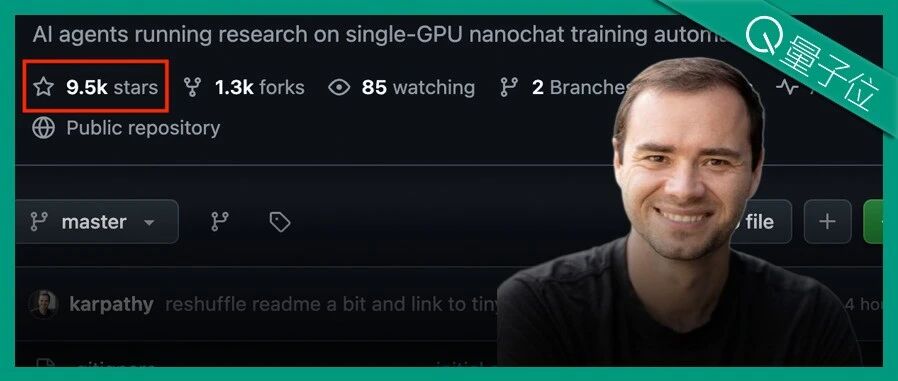
卡帕西开源Agent自进化训练框架,5分钟一轮实验,48h内揽星9.5k
量子位· 2026-03-09 06:05
Core Insights - The article discusses a new open-source project called autoresearch, developed by Karpathy, which enables AI to autonomously conduct research by following instructions written in Markdown documents [2][5]. - The framework is designed to be lightweight, consisting of only 630 lines of code, and can run on a single GPU [3][16]. - The project has gained significant attention, achieving over 9.5k stars on GitHub within two days of release [6]. Project Overview - Autoresearch automates the AI training loop, allowing the AI to modify code, run short experiments lasting five minutes, and evaluate results to determine the next steps [13][14]. - The system operates under two main rules: each experiment has a fixed training time of five minutes, and it evaluates based on the val_bpb metric, where lower values indicate better model performance [15]. Technical Structure - The project relies on three core files: prepare.py for setting constants and tools, train.py for AI modifications, and program.md for human-written instructions [20][24]. - The AI modifies train.py based on instructions from program.md, runs experiments, and decides whether to keep or discard changes based on performance metrics [30][32]. Future Aspirations - Karpathy envisions a future where thousands of AI agents collaborate asynchronously across numerous branches, enhancing research efficiency through collective intelligence [5][35]. - He draws parallels to the SETI@home project, aiming to create a decentralized, distributed exploration model for AI research [38][41]. Research Methodology - The autoresearch process involves AI iterating through modifications, training, evaluation, and decision-making, achieving a high efficiency that surpasses human capabilities [29][32]. - The project aims to shift the research paradigm from a linear, centralized approach to a more flexible, experience-based model that accommodates diverse research paths [49].