cuTile Python

Search documents
英伟达自毁CUDA门槛,15行Python写GPU内核,性能匹敌200行C++
3 6 Ke· 2025-12-08 07:23
Core Insights - NVIDIA has released CUDA 13.1, marking the most significant advancement since its inception in 2006, introducing the new CUDA Tile programming model that allows developers to write GPU kernels in Python, achieving performance equivalent to 200 lines of CUDA C++ code in just 15 lines [1][13]. Group 1: CUDA Tile Programming Model - The traditional CUDA programming model has been challenging, requiring developers to manually manage thread indices, thread blocks, shared memory layouts, and thread synchronization, which necessitated deep expertise [4]. - The CUDA Tile model changes this by allowing developers to organize data into Tiles and define operations on these Tiles, with the compiler and runtime handling the mapping to GPU threads and Tensor Cores automatically [5]. - This new model is likened to how NumPy simplifies array operations in Python, significantly lowering the barrier to entry for GPU programming [6]. Group 2: Compatibility and Performance Enhancements - NVIDIA has built two core components: CUDA Tile IR, a new virtual instruction set that ensures code written with Tiles can run on different generations of GPUs, and cuTile Python, an interface that allows developers to write GPU kernels directly in Python [8]. - The update includes performance optimizations for the Blackwell architecture, such as cuBLAS introducing FP64 and FP32 precision simulation on Tensor Cores, and a new Grouped GEMM API that can achieve up to 4x acceleration in MoE scenarios [10]. Group 3: Industry Implications - Jim Keller, a notable figure in chip design, questions whether NVIDIA has undermined its competitive advantage by making the Tile programming model accessible to other hardware manufacturers like AMD and Intel, as it allows for easier portability of AI kernels [3][11]. - While the CUDA Tile IR provides cross-generation compatibility, it primarily benefits NVIDIA's own GPUs, meaning that code may still require rewriting to run on competitors' hardware [12]. - The reduction in programming complexity means that a larger pool of data scientists and AI researchers can now write high-performance GPU code without needing HPC experts for optimization [14].


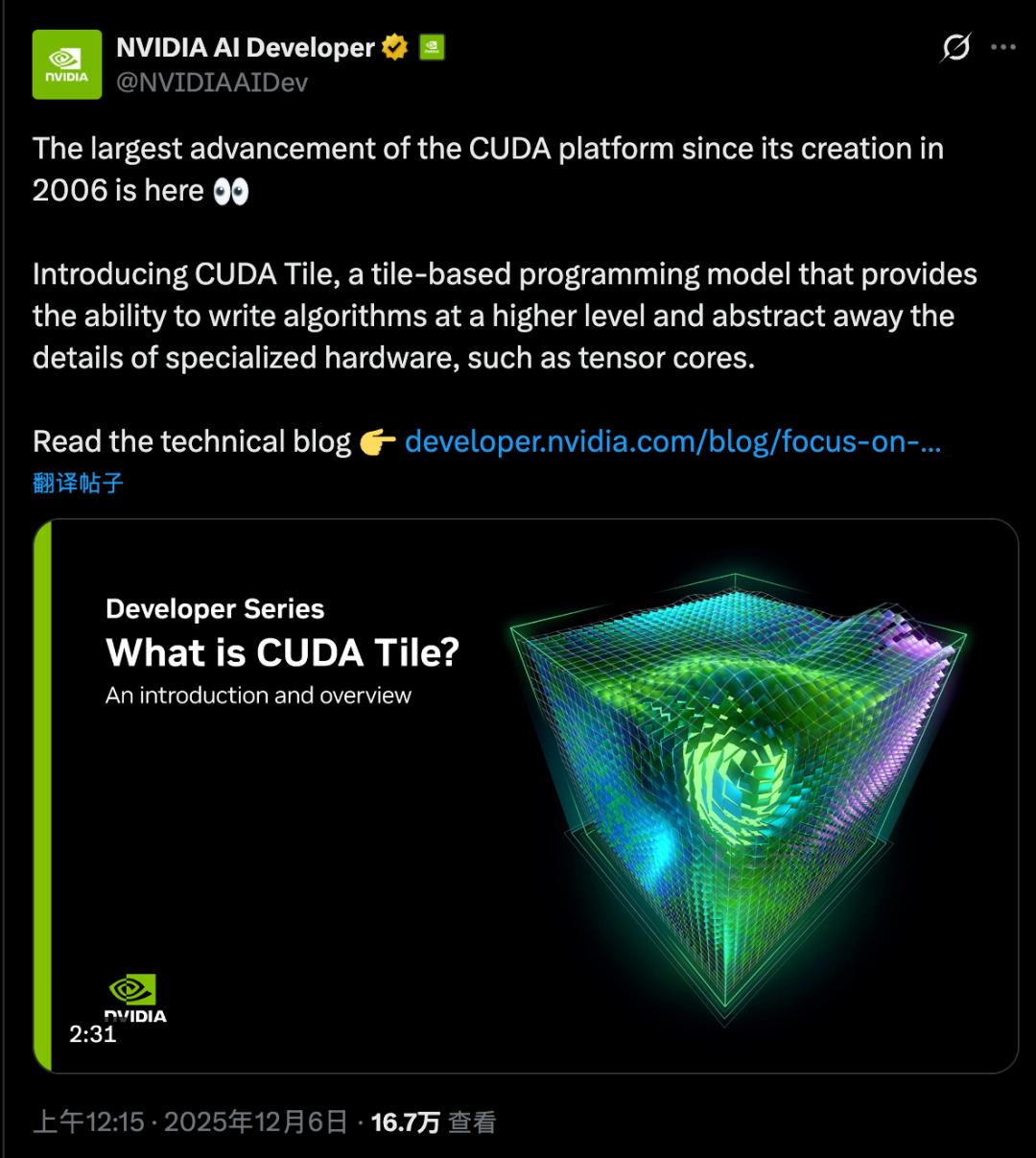
英伟达自毁CUDA门槛!15行Python写GPU内核,性能匹敌200行C++
量子位· 2025-12-08 04:00
Core Viewpoint - NVIDIA's latest CUDA 13.1 release is described as the most significant advancement since its inception in 2006, introducing a new CUDA Tile programming model that allows developers to write GPU kernels in Python, achieving performance equivalent to 200 lines of CUDA C++ code with just 15 lines [2][3][22]. Group 1: Changes in CUDA Programming - The traditional CUDA programming model, based on SIMT (Single Instruction Multiple Threads), required developers to manually manage thread indices, thread blocks, shared memory layouts, and thread synchronization, making it complex and demanding [6][7]. - The new CUDA Tile model allows developers to organize data into Tiles and define operations on these Tiles, with the compiler and runtime handling the mapping to GPU threads and Tensor Cores automatically [8][11]. - This shift is likened to the ease of using NumPy in Python, significantly lowering the barrier for entry into GPU programming [9]. Group 2: Components and Optimizations - NVIDIA has introduced two core components: CUDA Tile IR, a new virtual instruction set that ensures compatibility across different generations of GPUs, and cuTile Python, an interface that enables developers to write GPU kernels directly in Python [11][12]. - The update includes performance optimizations specifically for the Blackwell architecture, focusing on AI algorithms, with plans for future expansion to more architectures and a C++ implementation [14]. Group 3: Industry Implications - Jim Keller raises concerns that lowering the programming barrier could undermine NVIDIA's competitive advantage, as the Tile programming model is not exclusive to NVIDIA and can be supported by AMD, Intel, and other AI chip manufacturers [15]. - While the new model makes code easier to migrate within NVIDIA's GPU generations, it does not facilitate easy migration to competitors' hardware, which still requires code rewriting [20][21]. - The reduction in programming complexity means that a larger pool of data scientists and AI researchers can now write high-performance GPU code without needing HPC experts for optimization [22][23].