GPU编程

Search documents
Jim Keller:英伟达“自毁”CUDA护城河
半导体芯闻· 2025-12-09 10:36
Core Viewpoint - NVIDIA's significant upgrade to its CUDA software stack, particularly the introduction of CUDA Tile, may signal the end of its software exclusivity, as suggested by chip architect Jim Keller [2][4]. Group 1: CUDA Tile Introduction - CUDA Tile represents a major advancement in NVIDIA's CUDA 13.1, introducing a new virtual instruction set for tile-based parallel programming, allowing developers to focus more on algorithm design rather than hardware specifics [6][9]. - The new tile-based programming model simplifies the coding process, enabling broader user access to GPU programming by abstracting complex GPU details [4][6]. Group 2: Impact on Code Portability - Jim Keller believes that CUDA Tile will simplify the process of porting code to other GPUs, such as AMD's, due to the commonality of the tile-based approach in the industry [5]. - While code migration may become easier, the proprietary technology behind CUDA Tile, like Tile IR, is optimized for NVIDIA hardware, potentially maintaining NVIDIA's competitive edge [5]. Group 3: Programming Paradigm Shift - The introduction of CUDA Tile allows for a higher level of abstraction in programming, enabling developers to write more advanced code with minimal modifications for efficient execution across multiple GPU generations [9][12]. - CUDA Tile IR serves as the underlying interface for most programmers interacting with tile programming, facilitating the development of domain-specific languages and compilers [12]. Group 4: Coexistence of Programming Models - The tile programming paradigm does not require a choice between SIMT and tile programming; both can coexist, allowing developers to utilize the most suitable method for their specific needs [10].



英伟达自毁CUDA门槛,15行Python写GPU内核,性能匹敌200行C++
3 6 Ke· 2025-12-08 07:23
Core Insights - NVIDIA has released CUDA 13.1, marking the most significant advancement since its inception in 2006, introducing the new CUDA Tile programming model that allows developers to write GPU kernels in Python, achieving performance equivalent to 200 lines of CUDA C++ code in just 15 lines [1][13]. Group 1: CUDA Tile Programming Model - The traditional CUDA programming model has been challenging, requiring developers to manually manage thread indices, thread blocks, shared memory layouts, and thread synchronization, which necessitated deep expertise [4]. - The CUDA Tile model changes this by allowing developers to organize data into Tiles and define operations on these Tiles, with the compiler and runtime handling the mapping to GPU threads and Tensor Cores automatically [5]. - This new model is likened to how NumPy simplifies array operations in Python, significantly lowering the barrier to entry for GPU programming [6]. Group 2: Compatibility and Performance Enhancements - NVIDIA has built two core components: CUDA Tile IR, a new virtual instruction set that ensures code written with Tiles can run on different generations of GPUs, and cuTile Python, an interface that allows developers to write GPU kernels directly in Python [8]. - The update includes performance optimizations for the Blackwell architecture, such as cuBLAS introducing FP64 and FP32 precision simulation on Tensor Cores, and a new Grouped GEMM API that can achieve up to 4x acceleration in MoE scenarios [10]. Group 3: Industry Implications - Jim Keller, a notable figure in chip design, questions whether NVIDIA has undermined its competitive advantage by making the Tile programming model accessible to other hardware manufacturers like AMD and Intel, as it allows for easier portability of AI kernels [3][11]. - While the CUDA Tile IR provides cross-generation compatibility, it primarily benefits NVIDIA's own GPUs, meaning that code may still require rewriting to run on competitors' hardware [12]. - The reduction in programming complexity means that a larger pool of data scientists and AI researchers can now write high-performance GPU code without needing HPC experts for optimization [14].
英伟达自毁CUDA门槛!15行Python写GPU内核,性能匹敌200行C++
量子位· 2025-12-08 04:00
Core Viewpoint - NVIDIA's latest CUDA 13.1 release is described as the most significant advancement since its inception in 2006, introducing a new CUDA Tile programming model that allows developers to write GPU kernels in Python, achieving performance equivalent to 200 lines of CUDA C++ code with just 15 lines [2][3][22]. Group 1: Changes in CUDA Programming - The traditional CUDA programming model, based on SIMT (Single Instruction Multiple Threads), required developers to manually manage thread indices, thread blocks, shared memory layouts, and thread synchronization, making it complex and demanding [6][7]. - The new CUDA Tile model allows developers to organize data into Tiles and define operations on these Tiles, with the compiler and runtime handling the mapping to GPU threads and Tensor Cores automatically [8][11]. - This shift is likened to the ease of using NumPy in Python, significantly lowering the barrier for entry into GPU programming [9]. Group 2: Components and Optimizations - NVIDIA has introduced two core components: CUDA Tile IR, a new virtual instruction set that ensures compatibility across different generations of GPUs, and cuTile Python, an interface that enables developers to write GPU kernels directly in Python [11][12]. - The update includes performance optimizations specifically for the Blackwell architecture, focusing on AI algorithms, with plans for future expansion to more architectures and a C++ implementation [14]. Group 3: Industry Implications - Jim Keller raises concerns that lowering the programming barrier could undermine NVIDIA's competitive advantage, as the Tile programming model is not exclusive to NVIDIA and can be supported by AMD, Intel, and other AI chip manufacturers [15]. - While the new model makes code easier to migrate within NVIDIA's GPU generations, it does not facilitate easy migration to competitors' hardware, which still requires code rewriting [20][21]. - The reduction in programming complexity means that a larger pool of data scientists and AI researchers can now write high-performance GPU code without needing HPC experts for optimization [22][23].

刚刚,英伟达CUDA迎来史上最大更新!
机器之心· 2025-12-06 04:08
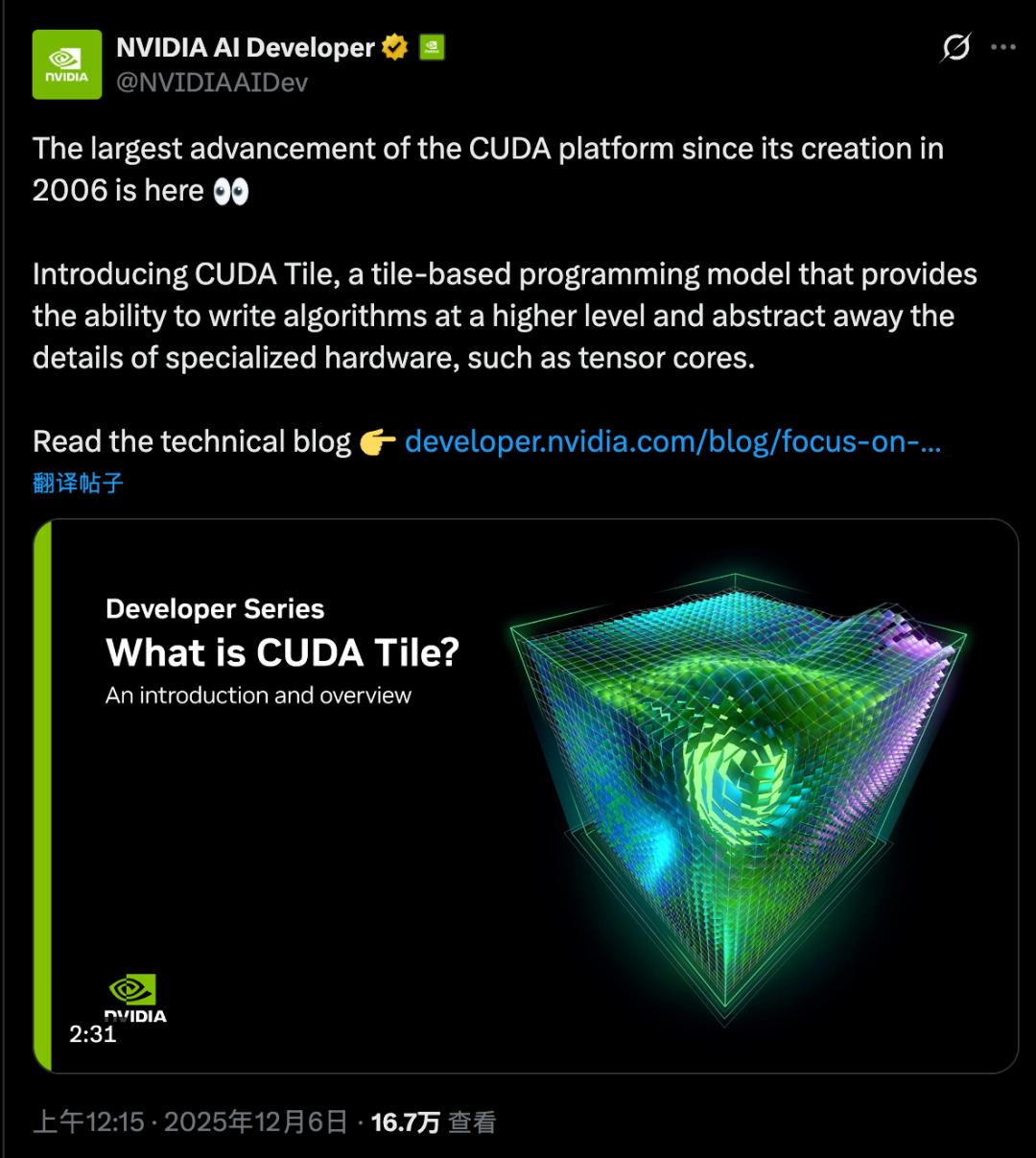
Core Insights - NVIDIA has officially released CUDA Toolkit 13.1, marking the largest update in 20 years since the inception of the CUDA platform in 2006 [2] - The update introduces CUDA Tile, a new programming model that allows developers to write algorithms at a higher abstraction level, simplifying the use of specialized hardware like Tensor Cores [4][5] Summary by Sections CUDA Tile - CUDA Tile is the central update in NVIDIA CUDA Toolkit 13.1, enabling developers to abstract specialized hardware details and write GPU kernel functions at a higher level than the traditional SIMT (Single Instruction Multiple Threads) model [4][6] - The Tile model allows developers to specify data blocks called "Tiles" and the mathematical operations to be performed on them, with the compiler automatically managing workload distribution across threads [7][8] - CUDA 13.1 includes two components for Tile programming: CUDA Tile IR, a new virtual instruction set architecture, and cuTile Python, a domain-specific language for writing array and Tile-based kernel functions in Python [9] Software Updates - The update introduces support for Green Contexts, which are lightweight contexts that allow for finer-grained GPU resource allocation and management [19][20] - CUDA 13.1 also features a customizable split() API for building SM partitions and reducing false dependencies between different Green Contexts [21] - The Multi-Process Service (MPS) has been enhanced with memory locality optimization partitions (MLOPart) and static SM partitioning for improved resource allocation and isolation [23][28] Developer Tools - New developer tools include performance analysis tools for CUDA Tile kernel functions and enhancements to Nsight Compute for better analysis of Tile statistics [32] - The NVIDIA Compute Sanitizer has been updated to support compile-time patching for improved memory error detection [33] Mathematical Libraries - The core CUDA toolkit's mathematical libraries have received performance updates for the new Blackwell architecture, including enhancements to cuBLAS and cuSOLVER for better matrix operations [37][41] - New APIs have been introduced for cuBLAS and cuSPARSE, providing improved performance for specific operations [40][46]

GPU编程“改朝换代”:英伟达终为CUDA添加原生Python支持,百万用户变千万?
3 6 Ke· 2025-04-08 11:28
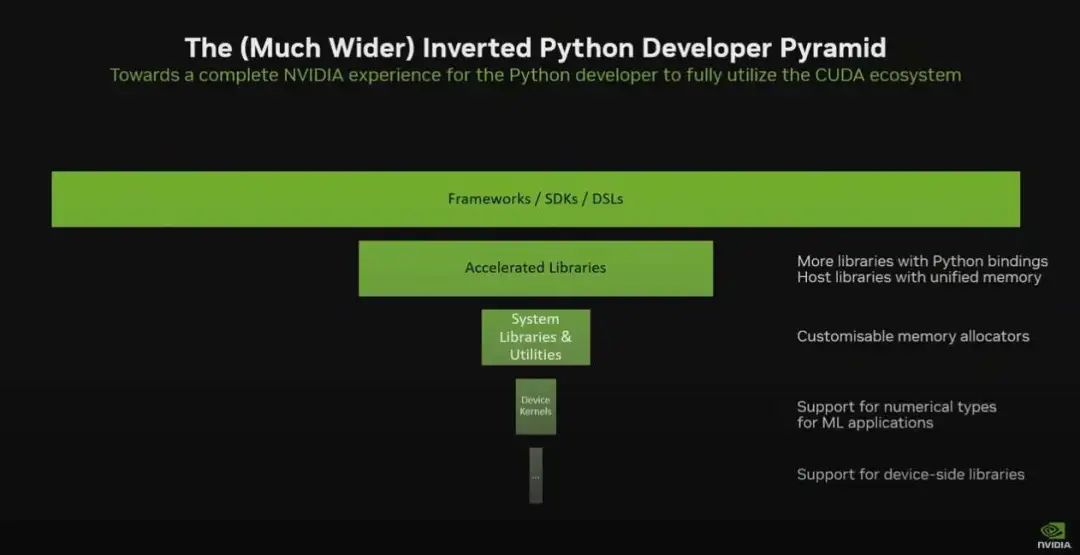
Core Insights - NVIDIA is fully committed to making Python a first-class citizen in the CUDA parallel programming framework, marking a significant shift in its approach to GPU programming [1][4] - The company aims to enhance the developer experience by integrating native Python support into its CUDA toolkit, allowing developers to execute algorithmic computations directly on GPUs using Python [1][5] Group 1: Native Python Support - NVIDIA has announced that its CUDA toolkit will provide native support for Python, which has been lacking for many years, thus allowing developers to use Python for GPU programming without needing to learn C or C++ [1][2] - The year 2025 is designated by NVIDIA as the "Year of CUDA Python," indicating a strategic focus on integrating Python into its ecosystem [1][3] Group 2: Developer Ecosystem Expansion - NVIDIA is not abandoning C++ but is expanding its support for the Python community, significantly increasing its investment in this area [4][5] - The introduction of higher-level abstractions like CuTile and Python versions of libraries such as Cutlass allows developers to work in Python without needing to write C++ code, thus democratizing GPU programming [5][6] Group 3: Programming Model and Performance - The CuTile programming model is designed to align better with Python's characteristics, focusing on arrays rather than threads, which simplifies the coding process for developers [15][16] - NVIDIA emphasizes that the performance of GPU computations will remain high while making the code easier to understand and debug [16][17] Group 4: Strategic Vision - NVIDIA's overall vision is to provide a complete experience for Python developers within the CUDA ecosystem, ensuring seamless interoperability across various layers of the technology stack [3][9] - The company is actively recruiting programmers to support additional programming languages like Rust and Julia, indicating a broader strategy to enhance its development ecosystem [8]