iQOO系列

Search documents
TrendForce:第三季全球智能手机生产数按季增9% 达3.28亿支
智通财经网· 2025-12-04 06:03
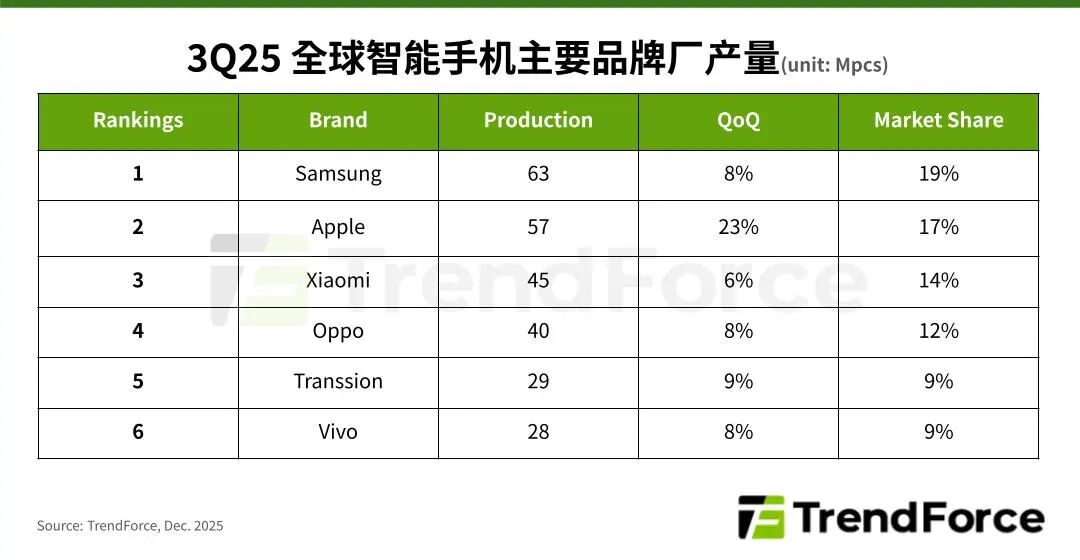
Core Viewpoint - The global smartphone production is expected to increase by 9% quarter-on-quarter and 7% year-on-year in Q3 2025, reaching 328 million units, driven by seasonal demand and new product launches from brands [1]. Group 1: Market Trends - The fourth quarter will see flagship brands launching new models, supported by global e-commerce promotions, although tight memory supply and rising prices may compress profit margins for low-end smartphones [1]. - The overall smartphone production forecast for 2025 is projected to grow by 1.6% year-on-year, with potential downward adjustments due to memory supply issues [1]. Group 2: Regional Performance - In China, subsidy policies significantly boosted consumption in Q1, with an expected slight year-on-year sales increase of 2%, maintaining a 23% market share as the largest consumer market [1]. - India ranks second with a 13% market share, benefiting from recovering demand, with a projected 2% year-on-year sales growth [1]. - North America, the third-largest market, is expected to see a 1% year-on-year sales decline, with a market share of 11% due to slowed demand in the second half of the year [1]. Group 3: Brand Production Performance - Samsung produced approximately 63 million units in Q3, an 8% increase, maintaining a 19% market share as the leading brand [3]. - Apple achieved a production of about 57 million units in Q3, the highest for that quarter historically, securing the second position with a 17% market share [4]. - Xiaomi's production reached nearly 45 million units in Q3, a 6% increase, placing it third in the market [5]. - OPPO produced around 40 million units in Q3, an 8% increase, benefiting from sales recovery in India, Southeast Asia, and Latin America [6]. - Transsion's production exceeded 29 million units in Q3, a 9% increase, driven by growth in emerging markets in Africa and Asia [7]. - Vivo's production totaled approximately 28 million units in Q3, with an increase of over 8%, closely competing with Transsion [8].



研报 | 传统旺季与新品带动,2025年第三季度全球智能手机产量季增9%
TrendForce集邦· 2025-12-04 05:50
Core Insights - The global smartphone production is expected to increase by 9% quarter-over-quarter and 7% year-over-year in Q3 2025, reaching 328 million units, driven by seasonal demand and new product launches [2] - Despite the growth, the tightening supply and rising prices of memory components may compress profit margins for low-end smartphones, potentially offsetting some growth momentum [2] - The overall smartphone production forecast for 2025 is projected to grow by 1.6% year-over-year, with a possibility of downward revision due to memory supply issues [2] Regional Market Performance - In China, the subsidy policy significantly boosted consumption in Q1, with an estimated annual sales growth of 2%, maintaining a 23% market share as the largest consumer market [2] - India ranks second with a 13% market share, benefiting from recovering demand, with an expected annual sales growth of 2% [2] - North America, the third-largest consumer market, is projected to see a 1% decline in annual sales due to a slowdown in demand after preemptive stocking by brands in the first half of the year, holding an 11% market share [2] Brand Production Rankings - Samsung leads with a production of approximately 63 million units, an 8% increase quarter-over-quarter, maintaining a 19% market share [3][5] - Apple follows with a production of about 57 million units, marking the highest production for Q3 in its history, benefiting from successful pricing and capacity upgrades of the iPhone 17 [3][6] - Xiaomi ranks third with nearly 45 million units produced, a 6% quarter-over-quarter increase, driven by new product launches and festive season stocking [3][7] - OPPO, in fourth place, produced around 40 million units, an 8% increase, supported by sales recovery in India, Southeast Asia, and Latin America [3][8] - Transsion ranks fifth with over 29 million units produced, a 9% increase, primarily driven by emerging markets in Africa and Asia [3][9] - Vivo, in sixth place, produced approximately 28 million units, with a growth of over 8%, aided by demand for mid-to-high-end models [3][10]