iShares MSCI Brazil ETF (EWZ)

Search documents
Small Cap Bargains in Brazil
Daily Reckoning· 2026-02-25 23:00
Core Thesis - Brazilian stocks, particularly small caps, are expected to experience significant upside as the market transitions from fixed income to equities, driven by a favorable economic environment and declining interest rates [3][8][17] Investment Performance - The Brazilian ETF EWZ has increased by 54% over the past year, indicating strong market performance [1] - Duquesne Family Office acquired approximately 3.5 million shares of the iShares MSCI Brazil ETF, valued at around $112 million, signaling confidence from prominent investors [2] Market Conditions - Brazilian investors currently have only 9% exposure to stocks, with a staggering 91% in fixed income, due to historical underperformance of stocks and high inflation rates [7] - The central bank's interest rate is expected to begin easing in March, making stocks more attractive to local investors [8] Earnings Growth Potential - Brazilian companies are projected to see earnings per share (EPS) growth of 11% annually through 2035, which could lead to a re-rating of Brazilian valuations [13] Small Cap Opportunities - The iShares small cap ETF EWZS, which includes 70 smaller Brazilian companies, is trading at low valuations with an average P/E ratio of 9 and a price/book ratio of 1.1, compared to higher ratios in U.S. small cap indices [15] - Small caps are positioned to benefit from the economic rebound in Brazil, making them an attractive investment option [16][17]


Global Market | Global cash is fuelling LatAm stock rally
The Economic Times· 2026-02-23 00:32
Market Overview - Latin American equity markets are experiencing significant inflows, marking the strongest start to the year since 1991, with the MSCI EM Latin America Index reaching an eleven-year high and increasing over 20% in 2026 [1][17] - Investors are recalibrating their focus on Latin America ahead of presidential elections in Brazil and Colombia, anticipating potential local policy shifts and lower interest rates [1][17] Investment Trends - The buying spree is evident in US-listed exchange-traded funds (ETFs), with BlackRock's iShares Latin America 40 ETF attracting over $1 billion in January, raising total assets to approximately $4.3 billion [6][17] - The iShares MSCI Brazil ETF (EWZ) saw its strongest monthly inflows in over a decade in January, becoming a preferred tool for exposure to Brazilian equities [7][17] Political Landscape - In Brazil, the potential for a political shift in the upcoming October election is influencing investment decisions, with some investors betting on the opposition's victory over President Luiz Inacio Lula da Silva [8][17] - In Colombia, political divisions among candidates are creating uncertainty ahead of the May presidential election, with the leading leftist contender raising concerns about asset price stability [12][17] Foreign vs. Local Investment - Foreign investors are increasingly purchasing directly in local markets, with January seeing the highest foreign buying in at least four years across Brazilian, Mexican, and Colombian markets [13][17] - Local investors remain cautious due to political uncertainties, contrasting with foreign investors who are more focused on potential returns [14][17] Central Bank Policies - Expectations are building for Brazil's central bank to lower the benchmark Selic rate from 15%, its highest in nearly two decades, starting in March [15][17] - In Mexico, the central bank maintained its benchmark interest rate at 7%, pausing an easing cycle that began nearly two years ago [15][17] Overall Sentiment - The overall sentiment towards Latin America remains positive, driven by potential rate cuts, favorable political changes, and commodity tailwinds [16][17]

Global cash is fueling a historic start for Latin America stocks
Yahoo Finance· 2026-02-22 13:30
Core Insights - Global investors are increasingly investing in Latin American stocks, leading to significant market gains and pushing the MSCI EM Latin America Index to an eleven-year high, with a rise of over 20% in 2026, marking the strongest start to the year since 1991 [1] Group 1: Market Trends - The surge in overseas buying in Brazil, Colombia, and Mexico indicates a renewed investor interest in the region, particularly ahead of upcoming presidential elections, which may lead to local policy shifts and lower interest rates [1][2] - The recent decision by the US Supreme Court to strike down President Trump's global tariffs is seen as a positive factor for Latin American equity markets, providing additional momentum for the ongoing rally [1][2] Group 2: Investment Flows - The buying trend is reflected in US-listed exchange-traded funds (ETFs), with BlackRock's iShares Latin America 40 ETF attracting over $1 billion in January, raising its total assets to approximately $4.3 billion [3] - The iShares MSCI Brazil ETF (EWZ) experienced its strongest monthly inflows in over a decade in January, becoming a favored option for investors seeking exposure to Brazil's market, with notable investments from high-profile investors like Stanley Druckenmiller [4]
巴西股市被热捧:1月大涨17%、外资流入超去年全年、投资大佬重仓
Hua Er Jie Jian Wen· 2026-02-22 08:26
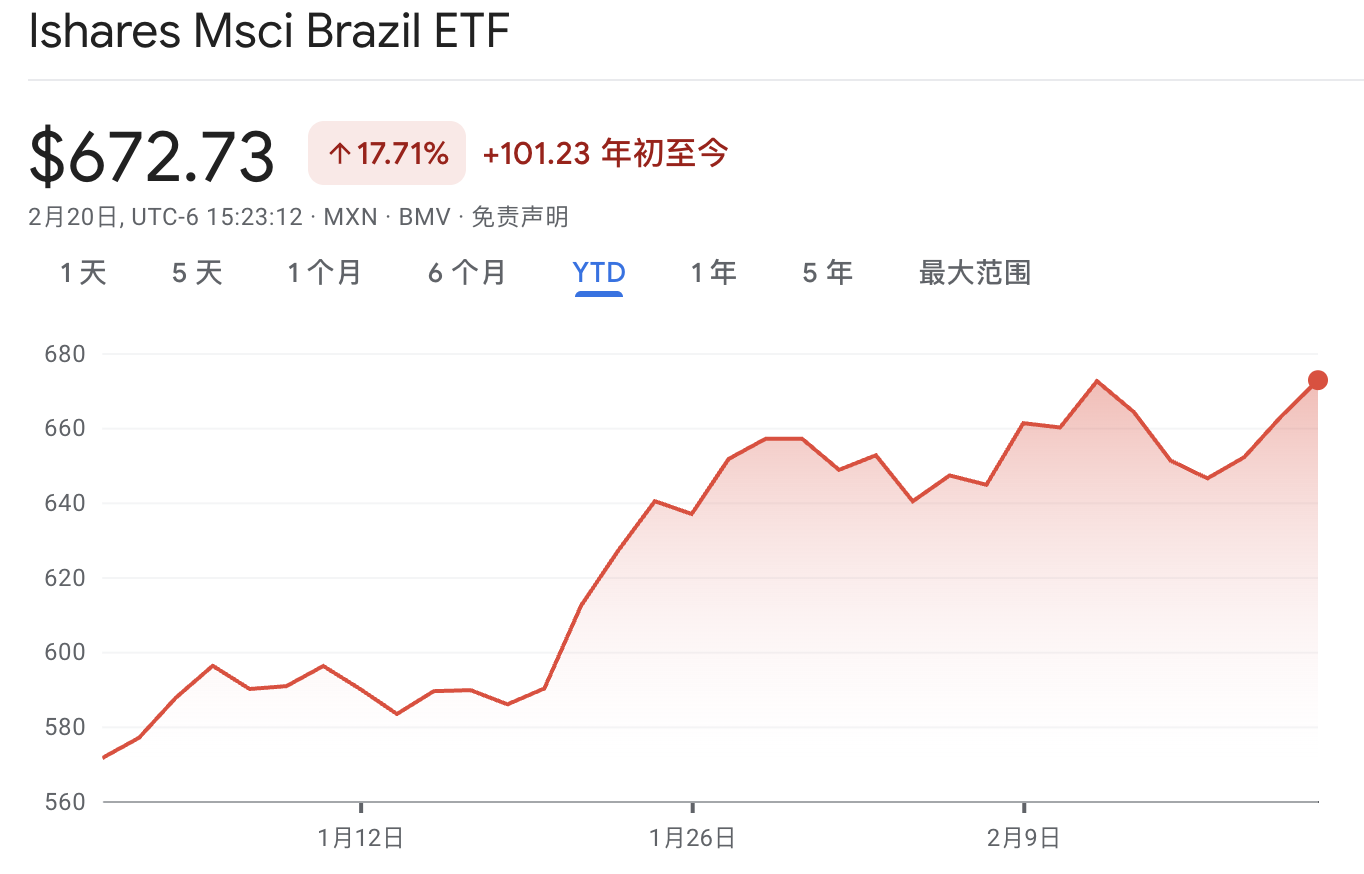
Core Insights - Brazil's stock market has become a hotspot for global capital, driven by improving fundamentals and a shift in global asset allocation, with significant inflows from top hedge funds [1][4][7] - Billionaire investor Stanley Druckenmiller's Duquesne Family Office made a substantial investment in Brazil, buying approximately 3.5 million shares of the iShares MSCI Brazil ETF and bullish options, anticipating a market surge [1][5] - The iShares MSCI Brazil ETF saw a 17% increase in January, marking its best monthly performance since 2020, largely due to a weaker dollar and rising commodity prices [1][6] Investment Trends - Foreign investors have injected over 34 billion Brazilian Reais (BRL) into the Brazilian stock market this year, indicating a strong demand for Brazilian equities [4][7] - Global fund managers are shifting from an "underweight" position in Latin America to seeking diversification in emerging markets, particularly in Brazil [4][8] - Institutional optimism remains high, with about 64% of surveyed Latin American fund managers expecting the Ibovespa index to rise above 190,000 points by the end of 2026, suggesting further upside potential [8] Market Dynamics - The recent rally in the Brazilian stock market is led by large-cap stocks favored by foreign investors, supported by a favorable macroeconomic environment [6] - A weaker dollar has alleviated currency pressures on emerging markets, while strong commodity prices have boosted valuations of Brazil's core resource assets [6] - Expectations of an interest rate cut in Brazil are enhancing the attractiveness of equity assets, contributing to overall market valuation recovery [6][9]
Emerging Market Currencies Emerge as “Unusual Haven” Amid Weakening Dollar and Commodity Surge
Stock Market News· 2026-02-15 14:08
Core Insights - Emerging-market currencies and equities have become an unexpected haven for global investors in early 2026, driven by a weakening U.S. dollar, resilient commodity prices, and significant capital inflows into developing economies [2] Market Performance - The MSCI Emerging Markets Index (IEMG) has gained approximately 7% to 8% year-to-date, following a remarkable 33.5% return in 2025, while U.S. mega-cap technology stocks have started to lag as investors shift towards undervalued international markets [3][10] Dollar Dynamics - The U.S. Dollar Index (DXY) has softened, falling 1.4% in January 2026 after a nearly 10% decline in the previous year, which alleviates the burden of dollar-denominated debt for emerging nations and enhances the local-currency value of their exports [4][10] Commodity Influence - Strong commodity prices have provided a crucial support for resource-rich nations, with Latin American equities rising nearly 14% year-to-date, particularly highlighted by the performance of the iShares MSCI Peru ETF (EPU) and iShares MSCI Brazil ETF (EWZ) [6][10] Capital Inflows - Record capital inflows into emerging markets have been reported, with JPMorgan Chase noting significant weekly inflows, including over $6.5 billion into the iShares Core MSCI Emerging Markets ETF (IEMG) in January, contributing to a total of $20.6 billion for the month [8][10] Growth Projections - Emerging market earnings are expected to grow by 29% in 2026, significantly outpacing the 14% growth projected for the S&P 500, prompting global fund managers to rebalance portfolios towards emerging markets at a 40% valuation discount [9][10] Technical Outlook - The MSCI EM Index has cleared major resistance levels from its 2021 highs, indicating a constructive technical backdrop for the rally, with broad participation from countries like South Korea and Taiwan [11]

The ‘Brazil Trade’ Is Back — Why Analysts See More Upside Ahead - iShares MSCI Peru and Global Exposure ETF (ARCA:EPU), iShares MSCI South Korea ETF (ARCA:EWY)
Benzinga· 2026-01-27 21:53
Core Viewpoint - Brazilian equities are experiencing a significant resurgence, driven by rising commodity prices, a weakening U.S. dollar, and a shift towards emerging markets, with the iShares MSCI Brazil ETF (EWZ) outperforming U.S. equities by 17 percentage points in one month, marking its strongest performance in over four years [1][2]. Group 1: Performance Metrics - The iShares MSCI Brazil ETF (EWZ) has increased approximately 20% month-to-date, while the SPDR S&P 500 ETF Trust (SPY) has gained just under 3% [1]. - EWZ ranks as the third best-performing U.S.-listed country ETF over the past month, following the iShares MSCI Peru and Global Exposure ETF (EPU) and the iShares MSCI South Korea ETF (EWY) [2]. Group 2: Market Dynamics - The relative performance of EWZ compared to SPY has broken above a long-term downtrend, indicating a potential technical breakout that could attract more investment into Brazilian equities [2]. - Historical data shows that during the last major commodity supercycle from October 2002 to May 2008, Brazilian equities outperformed the S&P 500 by over 1,000%, highlighting their sensitivity to resource-driven bull markets [3]. Group 3: Expert Insights - Brazilian macro analyst Otavio Tavi Costa suggests that the breakout of Brazilian equities is part of a larger global market shift, emphasizing the connection to the recent decline of the U.S. dollar [6][8]. - Analysts at 22V Research express a bullish outlook on Brazil, favoring emerging markets driven by commodities and materials sectors, and highlighting the continued weakness of the U.S. dollar as a catalyst for outperformance [9][10]. Group 4: Sector Composition and Investment Sentiment - The sector composition of EWZ aligns with favored investment themes, particularly in materials, energy, and banks, which are expected to benefit from the current market dynamics [12]. - Brazil has been structurally underowned and underperforming, creating a potential for significant momentum as capital begins to flow back into the market [13].