LangChain

Search documents
How We Built it: Clay - Fireside Chat with CEO Kareem Amin
LangChain· 2025-10-08 20:57
Clay's Core Offering & Vision - Clay is a creative tool designed to help companies turn growth ideas into reality, functioning as an IDE for revenue generation [1] - Clay's vision is to empower users to leverage data about companies and people to find new customers or expand existing accounts [1] - Clay positions itself as providing tools for users to get data, experiment, and review it quickly, rather than guaranteeing data correctness [2] - Clay emphasizes the importance of flexibility in data analysis, allowing users to ask any question about a company or person and get an answer, leveraging LLMs [2] GTM Engineer & Go-to-Market Strategy - Clay created the role of the GTM (Go-To-Market) engineer, an AI-native role that treats go-to-market activities like an engineer would, focusing on systems, data, and tactics [1] - The go-to-market strategy emphasizes being unique and constantly changing tactics to maintain an edge, as success raises the baseline [1] - The new go-to-market playbook involves finding a go-to-market alpha by implementing a strategy specific to the company quickly, emphasizing hyper-specificity in customer targeting [11][12] Clay's Technology & Architecture - Clay's architecture is built for integrations, treating them as first-class citizens, with integrations living in AWS Lambda functions for on-demand spin-up [1] - Clay uses agents like Legent (account researching agent) and Navigator (computer user agent) to interact with the web and gather information [1] - Clay's architecture allows users to bring their own API keys, which can lead to complexities in calculating rate limits for LLM runs and debugging issues [3] Product Development & User Experience - Clay prioritizes shipping and iterating quickly, focusing on what works now to build momentum for future developments [3] - Session replay is a key feature, allowing users to see how the agent obtained information, identify errors, and provide feedback [2][3] - Clay's user experience is designed around the principle that data is not always accurate, providing tools to review and improve it [2][3] New Products & Features - Clay introduced "Audiences," which treats companies and people as first-class citizens, aggregating signals on them [3] - Clay launched its own sequencer designed to send AI-made messages with spot-checking capabilities [3] - Clay released Sculptor, an agent that helps users build things in Clay and answer questions about tables built in Clay, understanding business context from sources like Notion and CRM [3][4] Metrics & Evaluation - Clay tracks metrics such as the number of Plagent runs, which are on track to reach 2 billion this year, and the usage distribution across integrations [4][5] - Clay categorizes customers by use case and creates health scores to identify expansion opportunities [5]


Getting Started with LangSmith (3/8): Debugging with Studio
LangChain· 2025-09-29 04:28
Core Functionality of Langsmith Studio - Langsmith Studio is an IDE for building and debugging AI agents, compatible with any Langraph agent [1] - It provides a visual representation of the agent's structure and execution flow [5] - Users can interact with agents by sending messages and observing real-time execution [6][7] - Studio allows for debugging through trace view, showing the Langchain trace generated by each call [7] Debugging Capabilities - Studio facilitates debugging by allowing users to step through the execution path and identify issues in each step [10][11] - It supports hot reloading, enabling quick testing of changes made to the application [8][14] - Interrupts (breakpoints) can be set to inspect the state of the agent at specific points during execution [15] - Forking allows users to go back to previous steps, edit the state, and rerun the execution from that point with modified data [17][18] Practical Applications and Problem Solving - The platform can identify problems such as overly complex language in AI responses and address them by modifying prompts [9][10][12][13] - It helps diagnose issues related to flaky tools that intermittently fail to return results [3][15][16][19]
Getting Started with LangSmith (2/8): Types of Runs
LangChain· 2025-09-29 04:27
Hi, welcome back. In this video, we're going to talk about the types of runs you can create while tracing in Linksmith. We'll then show how these runs can help you understand your application's execution.Traces can be thought of as logs for your application. And the Langrain team has put a lot of effort into the UX for displaying traces. This is because traditional logs can be difficult to parse for LLM applications.If you've ever had to dig through huge unforatted stack traces for an LLM application, you k ...
LangChain Academy New Course: Deep Agents with LangGraph
LangChain· 2025-09-18 15:56
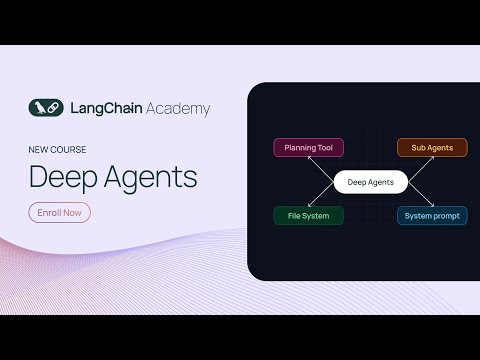
Anthropic's Claude Code, OpenAI's Deep Researcher, and Manus's general purpose agent have demonstrated that agents can be amazingly effective on complex, long-running tasks. We call these Deep Agents because they have a few key differentiators from earlier forms of agents. In our new LangChain Academy course, Deep Agents with LangGraph, you'll learn their key characteristics and how to implement them in your own Deep Agent.So what makes these agents different. Under the hood, they use a simple ReAct tool-ca ...
How PagerDuty Built AI Agents with LangGraph to Transform Incident Management
LangChain· 2025-09-15 14:30
Product & Solution - Pedi offers an enterprise-grade AI-powered incident management solution to help organizations transform critical operations [1] - The AI agent assists teams in understanding incidents through chat platforms like Slack or MS Teams, eliminating the need to navigate dashboards [2] - Langraph structures the AI agent with memory, decision-making, and fallbacks, parsing questions and devising plans to find answers [3] - Langraph provides full control over the agent's behavior, enabling debugging, error handling, and output analysis [4] Benefits & Impact - The AI agent saves engineers hours per week and reduces context switching [6] - Internal use of the AI agent provides learnings and a framework for developing more AI agents for customers [6] - Engineers use it for retrospectives, product managers use it to understand service stability, and executives use it to ask about incident and service health metrics [5] Technology & Architecture - Langraph helps maintain context throughout conversations, facilitating faster insights from incidents [3] - Langraph is flexible, open, well-documented, and integrates with Langchain and other observability tools [7] - Langraph enables the building of reliable and thoughtful AI agents that involve reasoning, data access, or coordination between steps [6][7]

Deep Agents JS
LangChain· 2025-08-18 16:19
Deep Agent Architecture - Deep agents utilize a planning tool to strategize task execution [4][5] - They employ a file system for organized context and information management, preventing context window overload [5] - Deep agents leverage specialized sub-agents to execute specific tasks, such as research or critique [5][6][18] - A detailed system prompt guides the overall operation of agents and sub-agents [6][10] Implementation and Usage - The process involves cloning the deep agents JS repository and the deep agents UI repository [7][13][14][19] - Configuration requires setting up environment variables, including API keys for web search (Tilli API key) and LLM provider (Anthropic API key), as well as specifying the Langraph server URL and agent ID [8][15][16][19] - The deep agent is instantiated using the `create deep agent` function, which requires a list of tools, instructions, and optionally, sub-agents [9][10] - The Langraph server is initiated using the command `npx langchain langraph cli dev` [8][13] - The deep agents UI runs on localhost 3000, allowing users to interact with the agent [16]
LangChain Academy New Course: Deep Research with LangGraph
LangChain· 2025-08-14 16:08
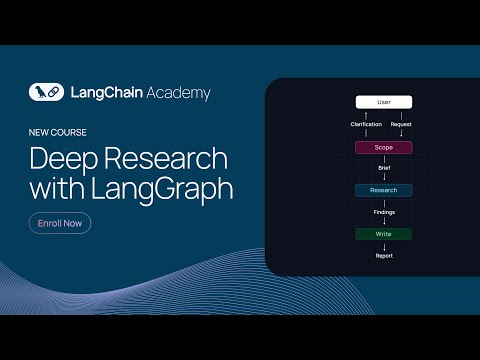
Course Overview - LangChain Academy launches "Deep Research with LangGraph" course, teaching users to build deep research agents from scratch [1] - The course focuses on multi-agent architecture and prompting techniques to improve performance and decision-making insights [2] - Participants will learn to build agents that interact with users, access tools, and manage multiple research agents [6] - The course emphasizes using LangSmith for observability and evaluation of agent components during development and deployment [5][7] Technological Focus - LangGraph, an agent orchestration framework, is highlighted for its suitability in building structured agentic applications [4] - The framework's built-in persistence layer is beneficial for tracking progress of multiple agents over extended periods [5] - Context engineering techniques are recommended to improve research results, such as focusing researchers on specific areas [3][4] Industry Application - Deep research is identified as a popular agent application, with major AI labs developing their own comprehensive report-generating products [2] - Companies are increasingly building their own deep research agents for use cases requiring high agency and decision-making [3] - The course aims to provide a working deep research agent adaptable to various user needs and use cases [7][8]
Getting Started with LangChain Education
LangChain· 2025-08-14 05:51
Educational Offerings - LangChain Education provides various learning methods, including courses, YouTube videos, and documentation [1] - LangChain Academy offers three types of courses: Foundational, Project, and Quickstart [1] Course Types - Foundational courses offer methodical learning from introduction to mastery and require more time to complete [2] - Project courses guide users through building specific projects, such as a Deep Research agent, and can typically be completed in a few hours [2] - Quickstart courses provide a quick introduction or review of a topic [2] Additional Resources - LangChain publishes educational videos on YouTube covering current topics, product features, and in-depth series [3] - LangChain provides extensive documentation with examples and step-by-step instructions [3]
Deep Agents UI
LangChain· 2025-08-13 16:47
Deep Agents Overview - Deep agents are agents that plan, reason, and act over longer time horizons [1][2] - Deep agents can plan their work, delegate tasks to sub-agents, use a file system, and have detailed system prompts [3] - Setting up a deep agent involves cloning a repository, installing dependencies, and specifying API keys [4] UI Setup and Functionality - The UI displays the agent's plan, file system status, and sub-agents [1] - Setting up the UI requires cloning the UI repository and configuring variables like the deployment URL and agent ID [5][6] - The UI workspace pane is connected to the agent's to-do list and file system [7] - The agent writes the user's question to its file system for later reference [7] - Sub-agents can be spawned to handle complex tasks, and their inputs and outputs can be viewed [8] - A critique agent can critique the final report, and the agent can edit specific lines in the file system [9] Key Steps for Implementation - Fork the open-source repository and set environment variables to point to the agent server [10]
Testing Driving GPT 5
LangChain· 2025-08-08 16:04
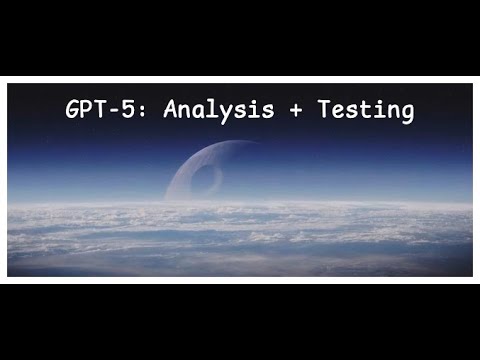
Model Performance & Capabilities - GBD5 excels in coding and agent development, demonstrating competitive pricing [1][3][8][11] - The model sets a new Pareto frontier for intelligence versus price, outperforming Gemini in this aspect [1][2][4][22] - While not a dramatic leap from GBD4, GBD5 is a strong daily driver, particularly for building agents and coding [3][8][11] - GBD5 shows state-of-the-art tool calling capabilities, especially for long-running agents [9][11] - Testing indicates a performance increase in deep research tasks when using GBD5 as a researcher agent, achieving 49.4% performance on deep research bench [18] Pricing & Availability - GBD5 is priced competitively, even lower than GPT-4 and GPT-4.01 at $1.25 per million input tokens [3][4] - Through the API, different models are available (main, mini, thinking, pro), while the Chat GBT app uses a router to automatically select the model [5] Limitations & Considerations - GBD5 is considered weaker at writing compared to GPT-40, GPT-41, and GPT-45, being more practical but less conversational [1][7][13][15] - Initial confusion existed in the open SDK regarding model names, but this is expected to be resolved [5][6]