AMD

Search documents
Sam Altman, OpenAI
AMD· 2025-07-01 21:00
Backstage with Sam Altman at #AdvancingAI. The future of AI is developer-first and open. *** Subscribe: https://bit.ly/Subscribe_to_AMD Join the AMD Red Team Discord Server: https://discord.gg/amd-red-team Like us on Facebook: https://bit.ly/AMD_on_Facebook Follow us on Twitter: https://bit.ly/AMD_On_Twitter Follow us on Twitch: https://Twitch.tv/AMD Follow us on LinkedIn: https://bit.ly/AMD_on_Linkedin Follow us on Instagram: https://bit.ly/AMD_on_Instagram ©2025 Advanced Micro Devices, Inc. AMD, the AMD A ...


Tareq Amin, HUMAIN CEO
AMD· 2025-07-01 14:30
To truly innovate AI at scale, you need the full stack. Listen to Tareq Amin, CEO of HUMAIN, to see how together we’re building state-of-the-art AI factories and data centers with the power, connectivity, and chipsets to lower infrastructure costs and accelerate global innovation. #AdvancingAI *** Subscribe: https://bit.ly/Subscribe_to_AMD Join the AMD Red Team Discord Server: https://discord.gg/amd-red-team Like us on Facebook: https://bit.ly/AMD_on_Facebook Follow us on Twitter: https://bit.ly/AMD_On_Twit ...

Advanced Insights S2E4: Deploying Intelligence at Scale
AMD· 2025-06-25 17:00
AI Infrastructure & Market Perspective - Oracle views AI at an inflection point, suggesting significant growth and change in the industry [1] - The discussion highlights that it's a great time to be an AI customer, implying increased options and competitive pricing [1] - Enterprise AI adoption is underway, but the extent of adoption is still being evaluated [1] - The future of AI training and inference is a key area of focus, indicating ongoing development and innovation [1] Technology & Partnerships - Oracle emphasizes making AI easy for enterprise adoption, suggesting user-friendly solutions and services [1] - AMD and Oracle have a performance-driven partnership, indicating collaboration to optimize AI infrastructure [1] - Cross-collaboration across the AI ecosystem is considered crucial for advancement [1] - Co-innovation on MI355 and future roadmaps between AMD and Oracle is underway [1] - Openness and freedom from lock-in are promoted, suggesting a preference for flexible and interoperable AI solutions [1] Operational Considerations - Training large language models at scale requires evolving compute needs and energy efficiency [1] - Operating in a scarce environment is a challenge, potentially referring to resource constraints like compute power or data [1] - Edge inference can be enabled with fewer GPUs, suggesting advancements in efficient AI deployment [1] Ethical & Societal Impact - Societal impact, guardrails, and responsibility are important considerations in the development and deployment of AI [1]



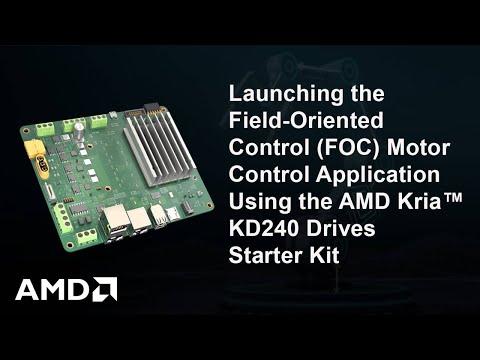
Field-Oriented Control (FOC) Motor Control Application Using the AMD Kria™ KD240 Drives Starter Kit
AMD· 2025-06-24 16:30
Overview of AMD Kria KD240 Drive Starter Kit - The AMD Kria KD240 Drive Starter Kit serves as an evaluation platform for the K24 SOM, focusing on motor control and power conversion applications [3] - The kit supports user customization through the AMD Vitis Unified IDE, acceleration overlays, and AMD Vivado Design Suite hardware board files [4][37] - The Field-Oriented Control (FOC) motor control application demonstrates inverter and motor control examples using AMD standard IP and libraries [4][38] FOC Motor Control Methods - Torque control maximizes motor torque output consistency by optimizing the quadrature Q vector and minimizing the direct D vector component [6] - Speed control is implemented via an additional PI controller that adjusts motor torque to maintain a constant speed [6] - Field weakening control increases motor speed by adjusting the relationship between the Q vector and D vector in the FOC [7] Hardware and Software Components - The KD240 utilizes an ADC hub for motor voltage and current feedback and a QEI encoder for RPM feedback [8] - Soft IPs are supported by kernel drivers using the industrial IIO framework, simplifying hardware configuration and usage [10] - The system uses a generic PWM block to provide on-off commands for each switch of a three-leg inverter [8] Motor Control Application and Dashboard - A motor control application library integrated with device drivers enables seamless operation across different modes [10] - The dashboard GUI allows users to control set points, gain parameters, and observe live plots of key metrics [11] - The dashboard allows users to select motor control modes: speed, torque, or open loop [28] - In torque mode, the valid range for torque set point is negative 250% to 250% amps [30] - In speed mode, the valid range for speed set point is negative 10,000 to 10,000 RPMs [30]
Rethinking Phishing Protection with BUFFERZONE and AMD Ryzen AI PRO
AMD· 2025-06-24 16:21
Solution Overview - BUFFERZONE NoCloud AI Anti-Phishing Solution utilizes local AI processing for faster and more accurate detection of harmful websites [1] - The solution leverages AMD's NPU hardware and Ryzen AI PRO systems for local hardware processing [1] Performance and Efficiency - AMD hardware enables BUFFERZONE to optimize for low-power analysis, preserving CPU and GPU resources for user tasks [2] - Local security task execution eliminates latency associated with cloud-based services, enabling real-time threat detection [2] Privacy and Cost - AMD's NPU hardware ensures browsing data remains local, enhancing privacy management [2] - By reducing cloud-based operational expenses, BUFFERZONE offers an affordable solution for personal and enterprise users [3] - AMD Ryzen AI PRO systems facilitate cloudless security, improving user privacy and digital safety [3]

AMD Red Team Celebrates Pride Month
AMD· 2025-06-23 17:00
Being a part of the LGBTQ+ community, there are a lot of challenges. It's really easy to feel othered, especially in spaces like the internet and gaming, just because there are a lot of unsafe spaces out there. So when we see people like us on stages or in video games or on the front page of big websites, it really does make us feel like we belong here.Finding yourself is such a hard journey, and having people in your corner makes that journey a little bit easier. Having someone be there for you when you co ...

Advanced Flow for AMD Versal™ Devices
AMD· 2025-06-23 16:43
Overview of Advanced Flow - AMD Vivado Design Suite 2024.2 introduces Advanced Flow for Versal devices, featuring new place and route algorithms for faster design performance and improved routability [5] - Advanced Flow aims to reduce compile times for larger, more complex AMD Versal adaptive SoCs, offering up to 2X speedup for Versal SSIT devices and 1.7X for Versal monolithic devices [9] - The Advanced Flow is integrated into the Vivado IDE, maintaining familiar design processes and Tcl scripting [8] Key Features and Architecture - Advanced Flow includes automatic partitioning to divide large designs into smaller problems solvable in parallel, along with new infrastructure for efficient parallel compilation [10] - The new architecture uses leaner data structures for storage and retrieval of physical design information, improving place and route speed, checkpoint handling, and memory footprint [10][11] - A new timing engine optimized for the placer's data structures helps quickly evaluate the timing impact of placement changes [11] - The placer reduces routing congestion, and the clock region placer's capacity is increased for better handling of complex designs with many global clocks [12] Directives and Subdirectives - The Advanced Flow simplifies placer directives to five basic options: Quick, RuntimeOptimized, Default, Explore, and AggressiveExplore [18] - A new placer option, Subdirective, provides finer-grained control over different phases of placement, allowing multiple subdirectives to be applied simultaneously [20] - Subdirectives unlock more combinations and allow exploration of different options at each placer phase, covering more solution space than original directive options [25] Implementation and Migration - AMD recommends a methodical approach to timing closure, starting with Default, Explore, and AggressiveExplore strategies, then combining the best directive with key subdirectives [32][33] - Migrating to Advanced Flow requires archiving the project, as the migration is not reversible and resets runs and options to Advanced Flow place and route [37] - Projects from pre-2024.2 Vivado versions cannot reuse place and route data in Advanced Flow due to a new database structure [41]
Segmented Configuration: Booting the Processing System (PS) First
AMD· 2025-06-23 12:31
Overview of Segmented Configuration - The industry focuses on faster software boot processes and updates to meet growing demands [2] - Segmented configuration is introduced as a new approach to align solutions with silicon features and boundaries, aiming for faster boot times [10][11] - The primary goal is to boot processors, memory, and OS before loading the PL, offering flexibility in PL configuration [12] Technical Details - Segmented configuration splits the booting process into two phases: PS/boot PDI and PL PDI [11][17] - PS/boot PDI configures the PS, PMC, DDR, CPM, and horizontal NoC [17] - PL PDI configures the user design, vertical NoC, transceivers, I/O, and hardened blocks in the PL [17] - The flow allows dynamic reloading of the PL configuration, enabling on-the-fly changes in the PL domain [29] Implementation and Consistency - Enabling segmented configuration in Vivado leads to a "Zynq MPSoC-like" deployment of the PL [20] - The tool requires identification of necessary NoC connectivity for the initial boot image [21] - Consistency between implementation runs is ensured by locking the NoC solution and exporting/importing it using Tcl commands [30][31] PL Reconfiguration - PL reconfiguration requires pausing activity between the PS and PL and flushing any remaining transactions from the NMU [38] - Users need to unload/load drivers as needed before or after PL reconfiguration, applying device tree overlays [39] - The PL PDI can be fetched by the software application and loaded using high-speed interfaces [40]
Reducing Clock Skew in AMD Versal™ Devices
AMD· 2025-06-19 21:30
Versal Clocking Architecture Enhancements - AMD Versal devices feature a segmented clocking structure, utilizing global clocking with regional or global load placement for efficient resource utilization and improved clock characteristics [4][5] - Versal architecture introduces BUFG Fabric for high-fanout routing with predictable delay and MBUFG for fast division of global clocks, reducing skew between synchronous clock domains [6][7] - Clock trees are more flexible for targeted skew reduction in multi-SLR devices, with calibrate deskew tuning clock distribution at startup [7][8] Clock Routing and Deskew Schemes - Versal employs a Vertical H-tree to minimize clock skew in both vertical and horizontal directions [12] - Basic deskew minimizes insertion delay, suitable for I/O interfaces and synchronous CDC paths with parallel BUFG [18] - Calibrated deskew, used in Versal SSIT devices, balances programmable delays during startup to minimize skew across the clock network [19][32] Calibrated Deskew Considerations - Calibrated deskew is off by default and should be enabled based on timing report analysis, particularly for large skew issues and maximizing SLR crossing performance [39][40] - Calibrated deskew is more beneficial in larger Versal SSIT devices with higher performance clocks (over 350 MHz) and numerous clock loads spanning all SLRs [42] - Avoid using calibrated deskew if synchronous CDC clocks employ parallel clock buffers, BUFG_FABRIC drives high fanout control signals, I/O interface clocks are used, or the clock root is in the GT column or VNOC columns [43]
Independent Control of AMD Versal™ AI Engine Partitions
AMD· 2025-06-19 21:30
Hello, and welcome to the presentation on Independent Control of AI Engine Partitions. In this Tech module, we’ll start with an introduction to AI Engine independent partitioning. Next, we’ll cover the AI Engine kernel workflow, detailing the process of compilation, linking, and packaging.We’ll then dive into modular control over partition management and reloading, discussing the flexibility it offers for efficient development. After that, we’ll go through key system considerations, highlighting what’s avai ...