AMD

Search documents
AMD - YOUR BUSINESS "MULTIPLIER"
AMD· 2026-01-15 02:30
Every idea begins with an individual. But advanced by AMD. One turns into many.Each discovery multiplied by intelligence delivers breakthrough performance. Each creation multiplied by imagination delivers seamless productivity. Each system multiplied by innovation delivers multi-level security, performance and efficiency. Each decision multiplied by insight delivers secure transformation.In a world that demands more, I have a performance multiplier in AMD. AMD PRO Technology, where performance connects and ...



Innovating with SICK
AMD· 2026-01-14 18:00
SICK is quite unique as a company. We develop a wide range of sensors for industrial markets, specifically for production and logistics. We chose AMD as a partner because they provide high-performance, low-power solutions.You find SICK products in warehouses, fulfillment centers, in mobile robots, a wide range of different places. Our cooperation with AMD is fundamental in providing AI-based solutions for our customers. SICK's approach to AI is to use it for making efficient decisions and classification tas ...

IMSA delivers next-level motor racing experience with AMD
AMD· 2026-01-12 15:00
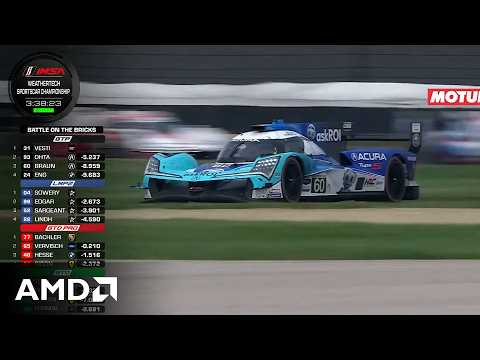
A fan at home who's maybe just watching the race, it looks like the cars are going around, and yeah, you know what position they're in, but there's just so much more that goes into it. It's a mix of speeds, mix of classes, Corvettes, Porsches, Ferraris. The exciting parts of, of IMSA racing is things happen, yellow flags.The weather changes. You just got to adapt. These cars are so sophisticated now, you really can't drive them without having the live telemetry streams, the deeper, real -intense data.-We're ...
AMD at CES® 2026 Replay
AMD· 2026-01-07 16:01
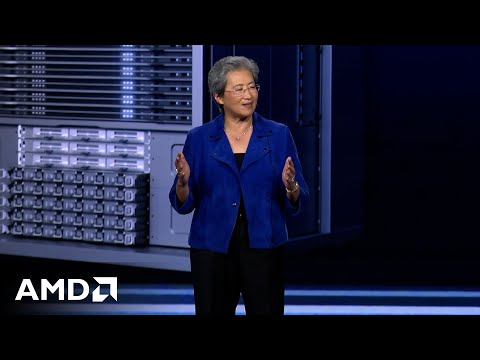
AMD Chair and Chief Executive Officer, Dr. Lisa Su keynote at CES 2026, the most powerful technology event in the world. Dr. Su returns to the CES stage in Las Vegas to highlight, alongside partners and customers, the AMD vision for delivering future AI solutions – from cloud to enterprise, edge and devices. Discover more: https://www.amd.com/en/corporate/events/ces.html 00:00:00 Introduction 00:02:56 Welcome by Dr. Lisa Su, Chair and CEO, AMD 00:08:41 Cloud is the Foundation of AI 00:18:36 Greg Brockman, P ...
AMD 2026 CES Day Zero Opening Video
AMD· 2026-01-06 15:24
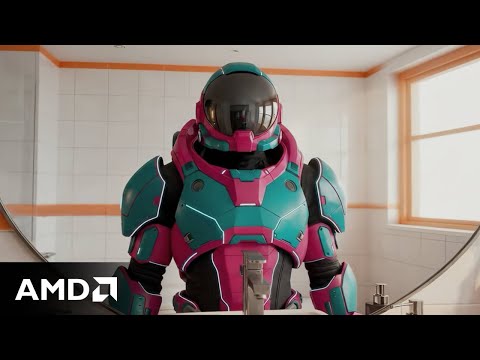
Hello, and welcome to this unique moment in human history. A moment where what's possible, makes me forget what's impossible. Where any game you play, now has the power to play by your rules.Where AI not only helps model the possibilities of what a city can be, but makes sure our kids never forget what our cities used to be. A moment where no hope meets the treatment plans of AI mapped genomes. Where no driver officially has better reflexes than any driver who's ever lived.And where no signal can no longer ...
Transforming Automotive, Industrial, and Beyond
AMD· 2026-01-06 03:30
Introducing the AMD Ryzen AI Embedded P100 Series. Transforming in-vehicle experiences by enabling multiple high-res displays, AI-powered voice and gesture controls, and personalized experiences for every passenger. Offering advanced performance in automotive and beyond.The AMD Ryzen AI Embedded P100 Series. AMD. Together we advance. ...
AMD at CES® 2026
AMD· 2025-12-19 23:06
Join AMD Chair and Chief Executive Officer, Dr. Lisa Su, for her keynote at CES 2026, the most powerful technology event in the world. Dr. Su returns to the CES stage in Las Vegas to highlight, alongside partners and customers, the AMD vision for delivering future AI solutions – from cloud to enterprise, edge and devices. Discover more: https://www.amd.com/en/corporate/events/ces.html *** Subscribe: https://bit.ly/Subscribe_to_AMD Join the AMD Gaming Discord Server: https://discord.gg/amd-gaming Visit the A ...
Accelerate creativity with Blackmagic Design™ and AMD Ryzen™ AI PRO processors
AMD· 2025-12-19 18:00
Blackmagic Design™ AI Editing in DaVinci Resolve Studio highlights fast editing workflows and creator productivity, powered by AMD Ryzen™ AI PRO processors. Discover more: https://www.amd.com/en/ecosystem/isv/commercial-partners.html *** Subscribe: https://bit.ly/Subscribe_to_AMD Join the AMD Gaming Discord Server: https://discord.gg/amd-gaming Visit the AMD Gaming Community Website: https://www.amdgaming.com/ Like us on Facebook: https://bit.ly/AMD_on_Facebook Follow us on Twitter: https://bit.ly/AMD_On_Tw ...
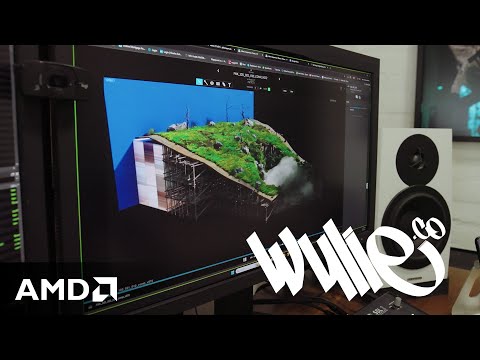
Wylie Co. Creates Award-Winning Visual Effects with Ryzen™ Threadripper™ PRO
AMD· 2025-12-19 17:00
Visual Effects Company Overview - Specializes in complex, high-end visual effects work, despite being a small company [1] - Competes with larger companies and produces world-renowned, Oscar-winning work [1] - Emphasizes the importance of believable simulations and visual effects, especially in complex shots involving digital doubles and set collapses [2] Production Workflow & Challenges - Faced challenges on "The Studio" project, particularly with long takes or "oners" [1] - One particular sequence involved approximately 20 CG digi-doubles [2] Resource Optimization & Efficiency - Relies on efficient resource utilization due to limited budget for processors and render nodes [3] - Finds Threadripper and Lenovo workstations to be effective solutions for crushing 3D renders [3] - Threadripper hardware effectively doubles the render pool by enabling simultaneous GPU and CPU rendering [4] - Efficiency is defined as saving time to invest in the finishing touches, resulting in high-quality, lasting work [4]
CES AMD STREAM REHERSAL
AMD· 2025-12-18 16:39
General Overview - The document is an internal test stream [1]