PETROCHINA(00857)

Search documents
杭品生活科技(01682.HK)拟出售最多33.5万股中国海洋石油、90.8万股中国石油及71...



Xin Lang Cai Jing· 2026-01-02 15:18
Core Viewpoint - The company, Hangpin Life Technology (01682.HK), has announced its intention to seek pre-approval for the sale of shares in China National Offshore Oil Corporation, China National Petroleum Corporation, and China Construction Bank, allowing the board to sell up to all potential shares during the authorization period [1] Group 1 - The company holds potential shares of 335,000 in China National Offshore Oil Corporation [1] - The company holds potential shares of 908,000 in China National Petroleum Corporation [1] - The company holds potential shares of 711,000 in China Construction Bank [1]
杭品生活科技拟出售最多33.5万股中国海洋石油、90.8万股中国石油及71...
Xin Lang Cai Jing· 2026-01-02 15:17
Core Viewpoint - The company, Hangpin Life Technology (01682.HK), has announced its intention to seek pre-approval for the sale of shares in China National Offshore Oil Corporation, China National Petroleum Corporation, and China Construction Bank, allowing the board to sell up to all potential shares during the authorized period [1] Group 1 - The company holds potential shares of 335,000 in China National Offshore Oil Corporation [1] - The company holds potential shares of 908,000 in China National Petroleum Corporation [1] - The company holds potential shares of 711,000 in China Construction Bank [1]
杭品生活科技(01682)拟出售中国海洋石油、中国石油及建设银行股份
智通财经网· 2026-01-02 15:15
Core Viewpoint - Hangpin Life Technology (01682) has announced a proposal to obtain pre-sale authorization for the potential sale of shares in China National Offshore Oil Corporation, China National Petroleum Corporation, and China Construction Bank [1] Group 1 - The company intends to allow its board to sell up to all potential sale shares during the authorization period [1] - The potential shares include 335,000 shares of China National Offshore Oil Corporation, 908,000 shares of China National Petroleum Corporation, and 711,000 shares of China Construction Bank [1]
杭品生活科技(01682.HK)拟出售最多33.5万股中国海洋石油、90.8万股中国石油及71.1万股建设银行股票
Ge Long Hui· 2026-01-02 15:08
Core Viewpoint - The company, Hangpin Life Technology (01682.HK), has announced its intention to seek pre-authorization for the sale of shares in China National Offshore Oil Corporation, China National Petroleum Corporation, and China Construction Bank, allowing the board to sell up to all potential shares during the authorization period [1] Group 1 - The company holds potential shares of 335,000 in China National Offshore Oil Corporation [1] - The company holds potential shares of 908,000 in China National Petroleum Corporation [1] - The company holds potential shares of 711,000 in China Construction Bank [1]
杭品生活科技拟出售最多33.5万股中国海洋石油、90.8万股中国石油及71.1万股建设银行股票
Ge Long Hui· 2026-01-02 15:05
Group 1 - The company, Hangpin Life Technology (01682.HK), announced its intention to seek pre-authorization for the sale of shares in China National Offshore Oil Corporation, China National Petroleum Corporation, and China Construction Bank [1] - The authorization will allow the board to sell up to all potential shares held by the group, which includes 335,000 shares of China National Offshore Oil Corporation, 908,000 shares of China National Petroleum Corporation, and 711,000 shares of China Construction Bank [1]
35人次!“三桶油”2025年控股上市公司人事调整汇总
Sou Hu Cai Jing· 2026-01-02 08:42
Group 1 - The "Three Oil Giants" refer to China National Petroleum Corporation (CNPC), Sinopec Limited, and China National Offshore Oil Corporation (CNOOC), which are the main state-owned enterprises in China's oil exploration, extraction, refining, and supply sectors [1] - A total of 35 personnel changes occurred across 9 listed companies controlled by Sinopec, CNPC, and CNOOC, with 6 companies experiencing changes at the chairman, general manager, and vice chairman levels [3] - Sinopec saw significant personnel changes, including the resignation of Chairman Ma Yongsheng and the appointment of Liu Qiang as General Manager and Vice Chairman [4][5] Group 2 - CNPC experienced personnel adjustments with 14 changes across 3 listed companies, including the resignation of Vice Chairman Hou Qijun and President Huang Yongzhang, with Ren Lixin appointed as the new President [13][14] - CNOOC had 4 personnel changes, including the resignation of Chairman Wang Dongjin and the appointment of Zhang Chuanjiang as the new Chairman [20][21] - The personnel changes reflect a broader trend of leadership transitions within major state-owned enterprises in China's oil and gas sector [3][19]





每周股票复盘:中国石油(601857)股东增持3000万股,机构净卖出5.25亿
Sou Hu Cai Jing· 2026-01-01 17:22
Group 1 - The core stock price of China Petroleum (601857) closed at 9.85 yuan on December 26, 2025, reflecting a 2.07% increase from the previous week's closing price of 9.65 yuan [1] - The highest intraday price reached 9.98 yuan on December 23, 2025, while the lowest was 9.64 yuan on December 22, 2025 [1] - The total market capitalization of China Petroleum is currently 1,905.248 billion yuan, ranking 1st in the refining and trading sector and 5th among all A-shares [1] Group 2 - On December 29, 2025, a block trade occurred with institutional investors net selling 525 million yuan [2][3] - From April 8, 2025, to December 29, 2025, the controlling shareholder, China National Petroleum Corporation, increased its holdings by 30 million A-shares, representing 0.0164% of the total share capital, during which the stock price rose by 37.06% [2] - The company announced plans for further share buybacks, with a minimum investment of 2.8 billion yuan and a maximum of 5.6 billion yuan for A-shares and H-shares over the next 12 months [2]
中国石油申请钻井液失效风险动态预测方法专利,实现对钻井液失效风险的精准预测和分级预警
Sou Hu Cai Jing· 2026-01-01 07:07
Group 1 - The core viewpoint of the news is the application for a patent by China National Petroleum Corporation (CNPC) and China Petroleum Group Engineering Technology Research Institute for a dynamic prediction method and system for drilling fluid failure risk [1] - The patent, titled "A Dynamic Prediction Method and System for Drilling Fluid Failure Risk," aims to enhance drilling technology by providing real-time data collection and analysis to predict and warn about drilling fluid failure risks [1] - The method involves the use of a mixed prediction model based on a CNN-BiGRU architecture, integrating multi-source data from downhole sensors and surface detection equipment to achieve precise risk prediction and classification [1] Group 2 - China National Petroleum Corporation, established in 1990, is primarily engaged in oil and gas extraction, with a registered capital of 48.69 billion RMB and has invested in 107 companies [2] - The company has participated in 5,000 bidding projects and holds 1,447 trademark records and 5,000 patent records, along with 28 administrative licenses [2] - China Petroleum Group Engineering Technology Research Institute, founded in 2006, focuses on research and experimental development, with a registered capital of approximately 570.39 million RMB and has invested in 4 companies [2] - The institute has participated in 571 bidding projects, holds 23 trademark records and 2,198 patent records, and possesses 8 administrative licenses [2]
中国石油申请生产井油水两相产出情况评价方法及系统专利,可获取目标生产井每一段的产液量、产油量、产水量和含水率
Sou Hu Cai Jing· 2026-01-01 03:56
Group 1 - The core point of the article is that China National Petroleum Corporation (CNPC) has applied for a patent for a method and system to evaluate the oil-water two-phase output situation in production wells, indicating advancements in oil exploration technology [1] Group 2 - The patent application, published under CN121235503A, was filed on June 2024 and involves a method that utilizes temperature and pressure profile testing data to assess the output of oil and water in production wells [1] - The evaluation model developed in the patent aims to determine the liquid production, oil production, water production, and water cut for each segment of the target production well [1] Group 3 - CNPC, established in 1999 and headquartered in Beijing, primarily engages in oil and natural gas extraction, with a registered capital of 18,302,097 million RMB [1] - The company has invested in 1,296 enterprises, participated in 443 bidding projects, and holds 38 trademark records and 5,000 patent records, along with 168 administrative licenses [1]
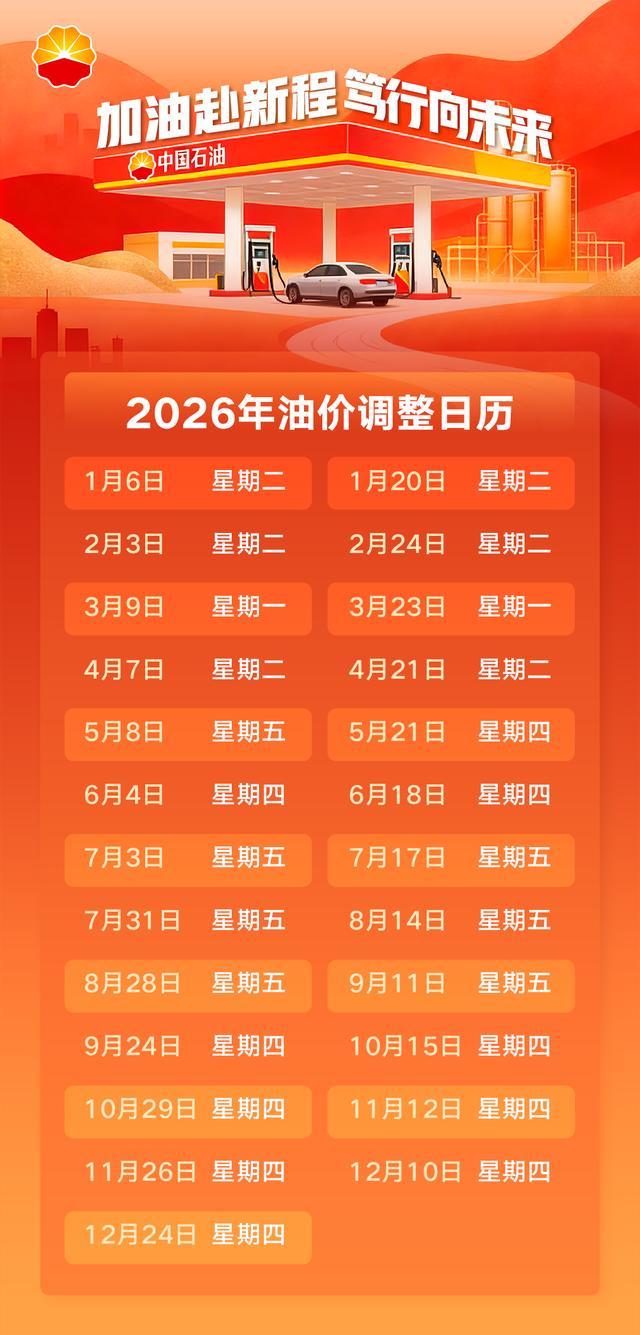
中国石油发布2026全年油价调整时间表:1月6日将迎来第一次调整
Zhong Guo Neng Yuan Wang· 2026-01-01 03:46
Group 1 - The core point of the article is that China National Petroleum Corporation has announced the oil price adjustment schedule for the year 2026, with the first adjustment set to occur on January 6, 2026 [1]