
PETROCHINA(00857)

Search documents
Two must-own China stocks poised to rally on higher oil prices
Invezz· 2026-03-09 04:16
Core Viewpoint - The article highlights two Chinese energy stocks, CNOOC and PetroChina, as prime investment opportunities due to the rising oil prices driven by geopolitical tensions, particularly the US-Iran conflict, which has pushed oil prices past $115 [1]. Group 1: CNOOC - CNOOC is well-positioned to benefit from the rising oil prices due to its focus on exploration and production, allowing it to capture price increases quickly [1]. - Goldman Sachs estimates that even if Brent crude averages around $85, CNOOC's full-year cash flow could increase by over 10% [1]. - CNOOC's stock is considered relatively discounted compared to developed market peers like Exxon and Chevron, making it an attractive investment option [1]. Group 2: PetroChina - PetroChina offers a diversified and integrated approach to the energy crisis, managing both domestic extraction and extensive refining and distribution networks [1]. - The company is expected to see double-digit growth in free cash flow, even if oil prices stabilize below current highs [1]. - Unlike CNOOC, PetroChina does not face US investment restrictions, making it a more accessible option for investors looking to capitalize on Asian energy growth [1].



油气、化工板块逆势大涨
第一财经· 2026-03-09 03:50
Market Overview - The A-share market experienced a significant downturn, with the Shanghai Composite Index down 1.13%, the Shenzhen Component Index down 2.14%, and the ChiNext Index down 2.42% as of midday trading [3][5]. - The total trading volume in the Shanghai and Shenzhen markets reached 1.79 trillion yuan, an increase of 403.1 billion yuan compared to the previous trading day, with over 4,500 stocks declining [5]. Sector Performance - The computing hardware industry chain saw a broad pullback, with sectors such as CPO and high-speed copper connections leading the decline. Notably, semiconductor, humanoid robotics, commercial aerospace, and consumer electronics themes also experienced significant drops [4][12]. - Conversely, the oil, coal, and electricity sectors showed strength, with stocks in these areas performing well. The photovoltaic and artificial intelligence concept stocks were notably active [4]. Notable Stock Movements - The electric grid equipment sector saw a surge, with companies like Guodian Nanzi and Sanbian Technology hitting their daily limit up and reaching historical highs. Other companies such as Pino Technology also touched the daily limit up [6]. - In the energy sector, WTI crude oil futures surged over 30%, reaching $118.7 per barrel, marking a 75% increase for the month, the highest since June 2022 [8][19]. International Market Impact - The KOSPI index in South Korea experienced a significant drop of 7%, heavily influenced by declines in major storage companies like Samsung Electronics and SK Hynix, which both opened down over 7% [13][20]. - The Hang Seng Index opened down 2.65%, with technology stocks facing widespread declines, while oil stocks saw substantial gains [14][15].




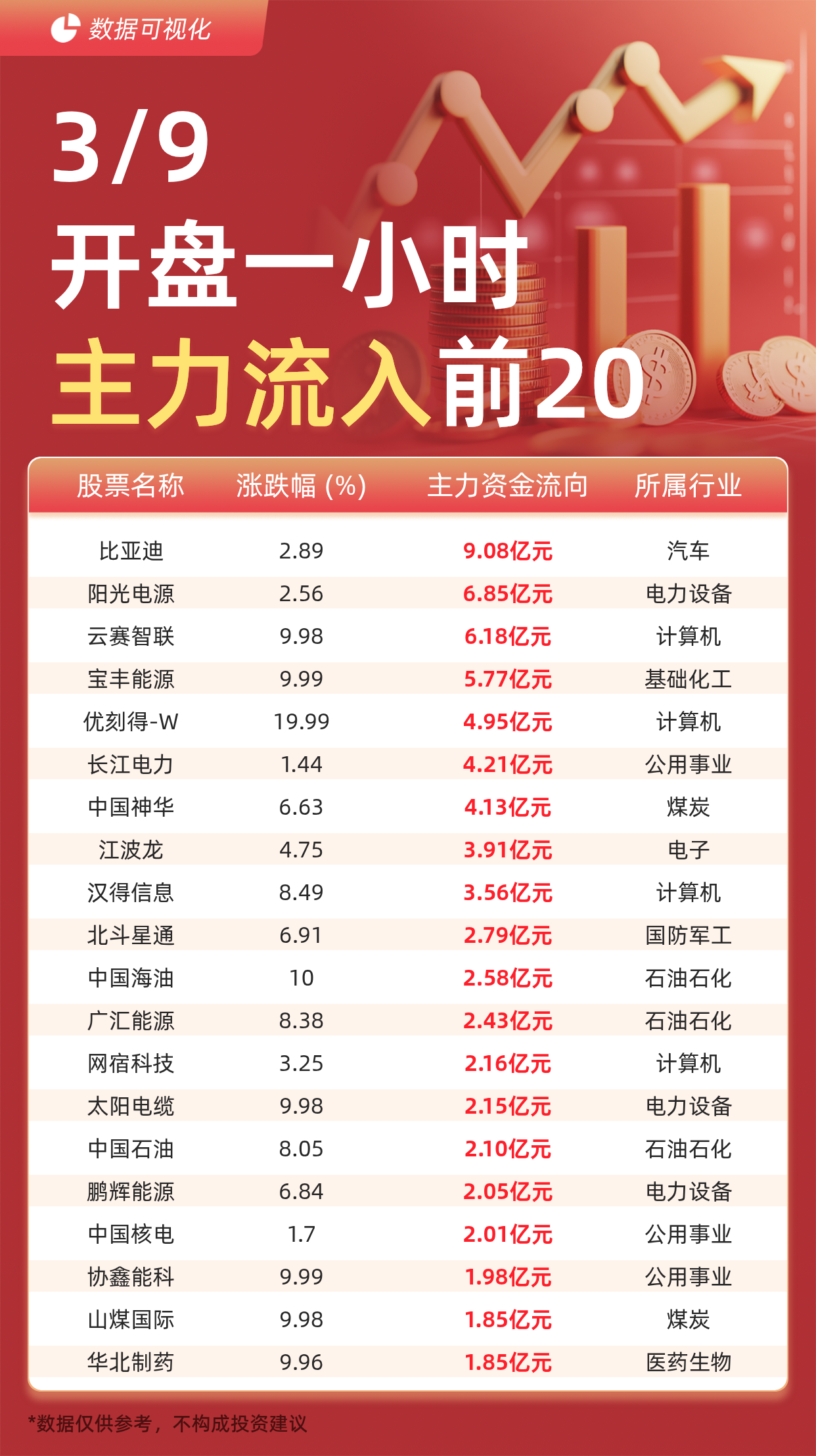
主力资金流入前20:比亚迪流入9.08亿元、阳光电源流入6.85亿元
Jin Rong Jie· 2026-03-09 02:41
Group 1 - The main stocks with significant capital inflow include BYD (9.08 billion), Sungrow Power (6.85 billion), and YunSai ZhiLian (6.18 billion) [1] - The top performing stocks by percentage increase are Baofeng Energy (9.99%), YK Technology-W (19.99%), and YunSai ZhiLian (9.98%) [2][3] - The sectors represented in the top inflow stocks include automotive, power equipment, computer, and coal [2][3] Group 2 - BYD leads with a capital inflow of 9.08 billion and a price increase of 2.89% [2] - Sungrow Power has a capital inflow of 6.85 billion with a price increase of 2.56% [2] - The total capital inflow for the top 20 stocks reflects strong investor interest across various sectors [1]




石油化工行业周报第 441 期(20260302—20260308):美伊冲突持续背景下,如何看待石化化工板块投资机会?-20260307
EBSCN· 2026-03-07 13:10
Investment Rating - The report maintains an "Overweight" rating for the petrochemical sector [5] Core Viewpoints - The ongoing US-Iran conflict is expected to significantly impact global oil prices, with Brent and WTI crude oil prices rising by 53% and 59% respectively since the beginning of the year, reaching $93.32 and $91.27 per barrel [9][10] - The geopolitical tensions are likely to reshape the supply-demand dynamics in the petrochemical sector, with a focus on three main investment themes: continued optimism for the oil and gas sector, the restructuring of chemical supply-demand due to geopolitical conflicts, and the potential of coal chemical alternatives [10][11] Summary by Sections Oil and Gas Sector - The geopolitical conflict is anticipated to alleviate concerns regarding oil supply-demand, leading to sustained high oil prices. The "Big Three" oil companies in China are expected to maintain high capital expenditures and enhance their market presence in natural gas and refining sectors, which will support long-term growth [12][11] - The oil service sector is projected to benefit from increased upstream capital expenditures, with major oil service companies showing improved operational quality as overseas business begins to contribute to earnings [12][11] Chemical Supply-Demand Dynamics - The ongoing conflict is expected to tighten the supply of chemical products from Iran and other Middle Eastern countries, leading to increased prices for chemicals such as methanol, urea, and potassium fertilizers. European chemical production may also face challenges due to high energy costs, potentially leading to reduced production capacity [14][18] - The report highlights the importance of monitoring chemical products with significant production capacity in the Middle East and Europe, as their supply constraints could lead to price increases [14][18] Coal Chemical Sector - The coal chemical sector is gaining investment value due to its cost advantages in a high oil price environment. The report suggests that coal chemicals can provide a stable cost base while benefiting from rising product prices, thus enhancing profitability [19][4] - The report emphasizes the clear upward momentum for the coal chemical sector, making it a focal point for investment [19]



A股油气股领跌,洲际油气跌超7%,高盛称油价或突破100美元
21世纪经济报道· 2026-03-06 02:42
Market Overview - International oil prices experienced a decline after a previous surge, with WTI crude oil dropping over 3.4% at one point, and later narrowing the loss to approximately 2%, following a cumulative increase of over 18% in the previous week [1] - ICE Brent crude also saw a decrease of more than 1.5% [1] Futures Market - In the domestic futures market, the main crude oil futures contract fell over 4%, while the shipping index (European line) initially dropped over 8%, with losses narrowing to 3.5% and 6.5% respectively by the time of reporting [2] Stock Market Performance - The A-share oil and gas sector led the decline, with Intercontinental Oil and Gas falling over 7%, and the "Big Three" oil companies each dropping over 3% [3] - In the Hong Kong stock market, the "Big Three" oil companies also experienced declines of over 1%, with Zhongcheng Energy dropping nearly 4% [3] Geopolitical Factors - Ongoing tensions in the Middle East continue to affect investor sentiment, with reports indicating that Iran has not closed the Strait of Hormuz, asserting its right to control passage during wartime [4] - A facility of the Bahrain National Oil Company was reportedly hit by an Iranian missile, causing a fire, but operations at the refinery, which has a crude processing capacity of 267,000 barrels per day, are continuing [5] - Goldman Sachs warned that developments in the coming weeks could significantly influence international oil prices, suggesting that prolonged closure of the Strait of Hormuz could push prices above $100 per barrel [5]




两会政府工作报告学习解读与投资看点
2026-03-06 02:02
Summary of Key Points from the Conference Call Industry Overview - The conference call primarily discusses the macroeconomic outlook and government policies impacting various sectors, particularly focusing on the construction, energy, and real estate industries. Core Insights and Arguments 1. **GDP Growth Target**: The GDP growth target for 2026 is set at 4.5%-5.0%, aligning with expectations. However, there is a notable gap in fiscal spending versus debt increase, necessitating reliance on tax revenue recovery and central government support for local tax sources [1][2][3]. 2. **Dual Carbon Policy**: The dual carbon policy has shifted from "energy consumption control" to "carbon emission control," enhancing quantitative constraints. This is expected to benefit sectors like carbon accounting software, carbon trading, smart grids, and hydrogen energy [1][4]. 3. **Coal Sector Outlook**: The coal sector is viewed as having a "second growth curve," driven by AI-related electricity demand growth, which offsets dual carbon pressures. Domestic and import supply reductions are anticipated, with coal prices expected to rise from a bottoming phase, suggesting over 50% upside potential for coal stocks [1][20][21]. 4. **Debt Market Expectations**: The bond market has already priced in the subdued fiscal expectations, with a short-term forecast for 10-year government bond yields to retreat to 1.85%-1.9%. There remains room for interest rate cuts throughout the year [1][12][14]. 5. **Construction and Building Materials**: The focus is on major projects under the "15th Five-Year Plan," with significant investment opportunities in western development, major canals, and high-standard farmland construction. The construction materials sector is nearing a profitability inflection point, with leading companies like Oriental Yuhong expected to benefit [1][22][26]. 6. **Consumer Sector Trends**: Consumer spending is expected to show a "high-low" rhythm, with potential weakness in Q2. Opportunities in high-end travel and service consumption are highlighted, particularly with the expansion of spring break trials [2][15]. 7. **Investment Directions**: The report emphasizes investment in new infrastructure, urbanization, and livelihood improvements, with a focus on projects like major railways and hydropower. The total investment in these areas is projected to exceed 8 trillion yuan [22][24]. 8. **Real Estate Policy Changes**: The real estate sector's focus has shifted from risk prevention to stabilizing the market, with a new emphasis on a "people-centered" approach. The reform of housing provident funds is highlighted as a key support mechanism [27][30][31]. Other Important but Potentially Overlooked Content 1. **Tax Revenue Recovery**: The anticipated recovery in tax revenue due to price increases and economic expansion is crucial for addressing the fiscal gap [2][3]. 2. **AI and Energy Demand**: The demand for coal is expected to increase due to AI-driven electricity needs, indicating a shift in energy consumption patterns [20]. 3. **Urban Renewal Initiatives**: The report outlines significant urban renewal projects, with a focus on old neighborhood renovations and infrastructure safety, potentially driving demand for construction materials [23][34]. 4. **Green Energy Initiatives**: The introduction of "green fuels" and a multi-energy approach is noted, with major state-owned enterprises involved in clean energy projects [24]. 5. **Market Sentiment**: The overall market sentiment reflects cautious optimism, with expectations for gradual recovery in various sectors, particularly in construction and real estate [1][10][12]. This summary encapsulates the key points discussed in the conference call, providing insights into the macroeconomic environment and sector-specific developments that may influence investment strategies moving forward.




中国石油股份(00857) - 截至二零二六年二月二十八日止月份股份发行人的证券变动月报表
2026-03-05 10:14
FF301 股份發行人及根據《上市規則》第十九B章上市的香港預託證券發行人的證券變動月報表 截至月份: 2026年2月28日 狀態: 新提交 致:香港交易及結算所有限公司 公司名稱: 中國石油天然氣股份有限公司(於中華人⺠共和國註册成立之股份有限公司) I. 法定/註冊股本變動 | 1. 股份分類 | 普通股 | 股份類別 | H | | 於香港聯交所上市 (註1) | | 是 | | | --- | --- | --- | --- | --- | --- | --- | --- | --- | | 證券代號 (如上市) | 00857 | 說明 | | | | | | | | | | 法定/註冊股份數目 | | | 面值 | | 法定/註冊股本 | | | 上月底結存 | | 21,098,900,000 | | RMB | 1 | RMB | | 21,098,900,000 | | 增加 / 減少 (-) | | | 0 | | | RMB | | 0 | | 本月底結存 | | | 21,098,900,000 | RMB | | 1 RMB | | 21,098,900,000 | | 2. 股份分 ...
2026年“两会”政府工作报告石化化工行业学习体会:聚焦能源及粮食安全与“双碳”,新兴产业与AI赋能化工新格局
EBSCN· 2026-03-05 09:35
Investment Rating - The report maintains an "Overweight" rating for the basic chemical industry [1] Core Insights - The report emphasizes the strategic importance of energy security, food security, carbon peak and neutrality, and the development of emerging industries and AI in the chemical sector [3][4] - It highlights the government's commitment to enhancing energy supply capabilities and achieving a comprehensive production capacity of 5.8 billion tons of standard coal by 2026, up from 4.6 billion tons by the end of the 14th Five-Year Plan [4] - The report discusses the ongoing geopolitical risks affecting energy security, particularly the high dependence on foreign oil and gas, and the role of major state-owned oil companies in ensuring energy supply [5] - It outlines the government's focus on food security, with a target of 1.4 trillion jin of grain production by 2026, which will drive demand for high-quality agricultural inputs [6][7] - The report indicates a shift towards carbon emission control, with a target to reduce carbon emissions per unit of GDP by 3.8% in 2026, marking a significant policy transition towards carbon management [8][9] - It addresses the need for anti-"involution" measures to improve market competition and prevent excessive capacity expansion in the chemical industry [10][11] - The report identifies emerging industries such as integrated circuits, aerospace, and biomedicine as key growth areas, driven by advancements in technology and innovation [11][12] Summary by Sections Energy Security - The government aims to enhance energy supply capabilities, with a target of 5.8 billion tons of standard coal by 2026, reflecting a strong commitment to domestic energy security [4] - Major oil companies are expected to maintain high capital expenditures in exploration and development, benefiting related service companies [5] Food Security - The report emphasizes the importance of food production, with a target of 1.4 trillion jin of grain by 2026, which will increase demand for fertilizers and pesticides [6][7] - The agricultural sector is expected to shift towards higher quality inputs, benefiting companies with strong R&D capabilities [7] Carbon Peak and Neutrality - The report outlines a target to reduce carbon emissions per unit of GDP by 3.8% by 2026, indicating a stricter regulatory environment for high-emission industries [8][9] - The transition to a dual control system for carbon emissions will significantly impact the chemical industry, pushing for cleaner production methods [9] Anti-"Involution" - The government plans to implement measures to curb excessive competition and capacity expansion in the chemical sector, which will favor leading companies [10][11] Emerging Industries - The report highlights the growth potential in sectors like integrated circuits and biomedicine, driven by technological advancements and domestic demand [11][12] - The focus on AI integration in the chemical industry is expected to enhance operational efficiency and innovation [13] Investment Recommendations - The report suggests focusing on major oil companies for energy security, leading agricultural input firms for food security, and top chemical companies for carbon management and anti-involution strategies [14][15]
China Tells Top Refiners to Halt Diesel and Gasoline Exports
Yahoo Finance· 2026-03-05 09:34
Group 1 - China's government has instructed top oil refiners to suspend exports of diesel and gasoline due to disruptions in crude oil supply from the Persian Gulf amid escalating conflict [1][2] - The National Development and Reform Commission (NDRC) has called for an immediate temporary suspension of refined product shipments, reflecting a broader trend in Asia to prioritize domestic needs during the Middle East crisis [2][3] - Refiners were directed to halt new contracts and negotiate cancellations of existing shipments, with exceptions for jet and bunker fuel in bonded storage and supplies to Hong Kong and Macau [3] Group 2 - Major companies involved in fuel exports, such as PetroChina, Sinopec, CNOOC Ltd., Sinochem Group, and Zhejiang Petrochemical Co., typically obtain export quotas from the government, which has not responded to inquiries regarding the recent changes [5] - China employs a quota system for refined product exports, allowing the Ministry of Commerce to select a limited number of large refiners and traders, which serves to balance domestic supply and demand [5][6] - Since the onset of Russia's invasion of Ukraine in 2022, China has frequently reduced export quotas or delayed allocations, indicating a strategy to prioritize internal stability and energy security amid geopolitical volatility [7]

能源ETF广发(159945)开盘跌1.76%,重仓股中国神华跌1.00%,中国石油跌4.46%
Xin Lang Cai Jing· 2026-03-05 02:55
Group 1 - The core viewpoint of the article highlights the performance of the Energy ETF Guangfa (159945), which opened down by 1.76% at 1.506 yuan on March 5 [1] - Major holdings within the Energy ETF include China Shenhua, which fell by 1.00%, China Petroleum down by 4.46%, and China Sinopec down by 2.03% [1] - The fund's performance benchmark is the CSI All Share Energy Index, managed by Guangfa Fund Management Co., with a return of 54.06% since its inception on June 25, 2015, and a return of 17.14% over the past month [1] Group 2 - The article provides specific stock performance details, indicating that Shaanxi Coal Industry dropped by 1.03%, CNOOC by 1.98%, and Yanchang Petroleum by 3.59% [1] - Other notable movements include Jereh's stock rising by 2.07%, while Guohui Energy and Shanxi Coking Coal fell by 3.20% and 1.08%, respectively [1]
