
PSBC(01658)

Search documents
事关消费贷贴息,农行、中行、交行、邮储银行率先响应!
Jin Rong Shi Bao· 2026-01-21 07:52
Core Viewpoint - The Ministry of Finance, the People's Bank of China, and the Financial Regulatory Administration have extended the implementation period of the personal consumption loan interest subsidy policy until the end of 2026, including credit card installment payments in the support scope [1] Group 1: Policy Implementation - The personal consumption loan interest subsidy policy will now be effective from September 1, 2025, to December 31, 2026, with credit card installment subsidies effective from January 1, 2026, to December 31, 2026 [1] - Agricultural Bank of China has announced that customers who have already processed credit card installments between January 1, 2026, and the policy announcement date can apply for subsidies [1] Group 2: Changes in Subsidy Standards - The policy removes the restriction on consumption transactions of 50,000 yuan and above, allowing these transactions to qualify for subsidies regardless of their category [2] - The annual subsidy rate is set at 1%, with a maximum subsidy of 3,000 yuan per borrower for all personal consumption loans and credit card installments combined [2] - The policy eliminates the previous limits on single transaction subsidies and the cumulative subsidy cap for loans below 50,000 yuan [2] Group 3: Application Process and Monitoring - Customers can apply for personal consumption loan subsidies through standard loan processes, and banks will calculate subsidies based on actual consumption [2] - If the system cannot identify the loan usage, customers can provide proof of consumption for manual review [3] - Banks are required to monitor loan usage and fund flow, with strict penalties for fraudulent activities or misuse of funds [3]




消费贷贴息新政“加速度”!怎么办?5家银行连夜发指引
Nan Fang Du Shi Bao· 2026-01-21 03:40
Core Viewpoint - The Ministry of Finance, the People's Bank of China, and the Financial Regulatory Administration jointly issued a notice to optimize the implementation of personal consumption loan interest subsidy policies, extending the policy duration, expanding the subsidy scope, and adjusting subsidy standards [2][4]. Policy Adjustments - The personal consumption loan interest subsidy policy now covers the period from September 1, 2025, to December 31, 2026, with a new specific implementation period for credit card bill installment subsidies from January 1, 2026, to December 31, 2026 [5]. - The previous restriction on key areas for consumption loans of 50,000 yuan and above has been lifted, allowing consumers to enjoy subsidies for all areas of personal consumption loans [7]. - The subsidy standards have been adjusted to unify the annual subsidy cap for each borrower at 3,000 yuan, with the subsidy shared between personal consumption loans and credit card installment loans [7]. Bank Responses - Major state-owned banks and representative joint-stock banks, including Bank of China, Agricultural Bank of China, Postal Savings Bank, and China Merchants Bank, have quickly responded by issuing detailed implementation guidelines and customer FAQs [2][5]. - Banks have emphasized the convenience of the application process, with various banks providing different channels for customers to apply for subsidies, such as mobile banking and customer service hotlines [8][10]. Implementation and Compliance - Existing customers who have already applied for subsidies will automatically benefit from the new policy without needing to re-sign agreements [9]. - Banks have committed to a "direct deduction" model for subsidy funds, ensuring that no additional fees are charged and that all processes are handled through official channels [10]. - Consumers are warned against fraudulent activities related to subsidy applications, with strict penalties for violations [10].


邮储银行优化个人消费贷款财政贴息服务 信用卡分期纳入支持范围
Sou Hu Cai Jing· 2026-01-21 03:36
Group 1 - The core viewpoint of the announcement is to enhance consumer spending and expand domestic demand by optimizing personal consumption loan fiscal subsidy services, including credit card bill installments [1][2] - The policy will be effective from January 1, 2026, covering personal consumption loans issued between September 1, 2025, and December 31, 2026, as well as new credit card bill installments throughout 2026 [1] - The policy removes restrictions on single transactions of 50,000 yuan and above, allowing loans for daily consumption, home decoration, cultural tourism, and more to enjoy subsidies [1][2] Group 2 - The subsidy standard is calculated at an annual rate of 1 percentage point, with a maximum limit of 50% of the annual interest rate of the loan contract or installment agreement [1] - Each borrower can receive a maximum annual subsidy of 3,000 yuan, with the previous limits of 500 yuan per single subsidy and 1,000 yuan for loans below 50,000 yuan removed [1] - The process for obtaining subsidies has been simplified, allowing for automatic identification and direct deduction of the subsidy amount during interest settlement, enhancing convenience for consumers [1][2]
个人消费贷贴息政策“延期扩围”,大行股份行快速跟进,新入围地方银行:客户流失担忧消除
Xin Lang Cai Jing· 2026-01-21 02:48
Core Viewpoint - The newly revised consumer loan interest subsidy policy is expected to stimulate domestic consumption recovery by encouraging banks to increase consumer loan issuance [1][7]. Group 1: Policy Implementation - Major state-owned banks and joint-stock banks, including Agricultural Bank of China, Bank of China, and Postal Savings Bank, have promptly responded to the new consumer loan interest subsidy policy [1][7]. - Postal Savings Bank announced that from September 1, 2025, to December 31, 2026, personal consumption loans used for actual consumption will be eligible for interest subsidies, with credit card bill installments also included in the subsidy scope [2][8]. - The policy removes the previous restriction on single transactions of 50,000 yuan or more for eligible consumption transactions [2][8]. Group 2: Operational Procedures - China Merchants Bank outlined that customers must follow specific procedures to apply for the consumer loan interest subsidy, including signing a supplementary agreement during or after the loan issuance [3][9]. - The bank will calculate the subsidy amount based on the agreed-upon subsidy ratio and cap, directly deducting the subsidy from the interest charged to customers [3][9]. Group 3: Inclusion of More Financial Institutions - The latest policy expansion includes city commercial banks, foreign banks, and consumer finance institutions, which were previously excluded from the interest subsidy program [4][10]. - This expansion aims to enhance fairness and inclusivity in the financial system, encouraging local banks to actively participate in consumer loan issuance [4][10]. - Industry insiders expressed optimism about the inclusion of more consumer finance companies, indicating readiness to implement the policy effectively [5][11].
大行回应!消费贷贴息政策升级,这些细节已明确
Di Yi Cai Jing· 2026-01-20 15:26
Core Viewpoint - The personal consumption loan interest subsidy policy is undergoing significant upgrades, with the implementation period extended to the end of 2026 and the inclusion of credit card installment payments in the subsidy scope [1][2]. Group 1: Policy Implementation Details - The new policy will be effective from January 1, 2026, and will cover personal consumption loans issued from September 1, 2025, to December 31, 2026, including credit card installment payments [2]. - Several major banks, including Agricultural Bank of China, Bank of China, and Postal Savings Bank, have confirmed their commitment to implementing the new policy and addressing common customer inquiries [1][2]. Group 2: Scope of Subsidy - The subsidy range has been expanded to include credit card installment payments, and previous restrictions on consumption categories have been lifted, allowing for broader eligibility [4][6]. - The previous limit of 50,000 yuan for single transactions has been removed, enabling consumers to benefit from subsidies regardless of the consumption category [4][6]. Group 3: Changes in Subsidy Amounts - The new policy eliminates the previous cap of 500 yuan on single transaction subsidies and the 1,000 yuan cumulative limit for loans under 50,000 yuan, while maintaining an annual cap of 3,000 yuan per borrower [6]. - The annual subsidy rate remains at 1% of the eligible loan amount, with a maximum of 50% of the loan contract interest rate applicable [6]. Group 4: Application Process for Subsidy - Customers can apply for the subsidy when signing loan contracts or credit card installment agreements, with banks required to verify transaction information for subsidy eligibility [7][8]. - If the system fails to recognize transactions, customers can provide proof of consumption for manual review and approval of the subsidy [7]. Group 5: Important Considerations - Banks emphasize that fraudulent activities or misrepresentation in loan applications will result in disqualification from receiving subsidies and potential legal consequences [10]. - Customers are advised that there are no fees associated with the subsidy application process, and banks will not engage third parties for processing [10].
信用卡账单分期纳入贴息!多家大行新政落地,这些红利可享
2 1 Shi Ji Jing Ji Bao Dao· 2026-01-20 15:06
Core Insights - The Chinese government is implementing a series of fiscal policies aimed at boosting domestic demand and promoting high-quality economic development, with a focus on six new policies, particularly two interest subsidy policies for the service sector and personal consumption loans [2][4]. Group 1: Policy Duration and Implementation - The personal consumption loan interest subsidy policy will be uniformly executed by Agricultural Bank of China, Bank of China, and Postal Savings Bank from September 1, 2025, to December 31, 2026 [5]. - The service sector loan interest subsidy policy, currently announced by Agricultural Bank of China, will also extend to December 31, 2026, with existing loans issued between March 16, 2025, and December 31, 2025, continuing under previous regulations [5]. Group 2: Optimized Subsidy Scope - The new policy includes credit card bill installment payments as part of the subsidy scope, effective from January 1, 2026, to December 31, 2026, with a subsidy rate of 1% per annum, capped at 50% of the agreed annualized interest rate [6]. - Adjustments in personal consumption loan subsidies include the removal of a 500 yuan cap on single transaction subsidies, elimination of a 1,000 yuan cap for cumulative transactions under 50,000 yuan, while maintaining a 3,000 yuan annual cap for all personal consumption loans [7]. - The service sector loan subsidy now includes three new categories: digital, green, and retail consumption, and increases the maximum subsidy per loan from 1 million yuan to 10 million yuan, significantly reducing financing costs for large loans [7]. Group 3: Important Considerations - Fraudulent activities to obtain funds will be legally addressed, with banks retaining the right to recover subsidies if fraudulent behavior is detected [8]. - Banks will not charge any fees for processing loans or subsidies and will not engage third parties for these services, emphasizing the prohibition of fraudulent practices [9]. - Overdue loans will not qualify for interest subsidies, and borrowers must settle all outstanding debts before being eligible for subsidies [9].
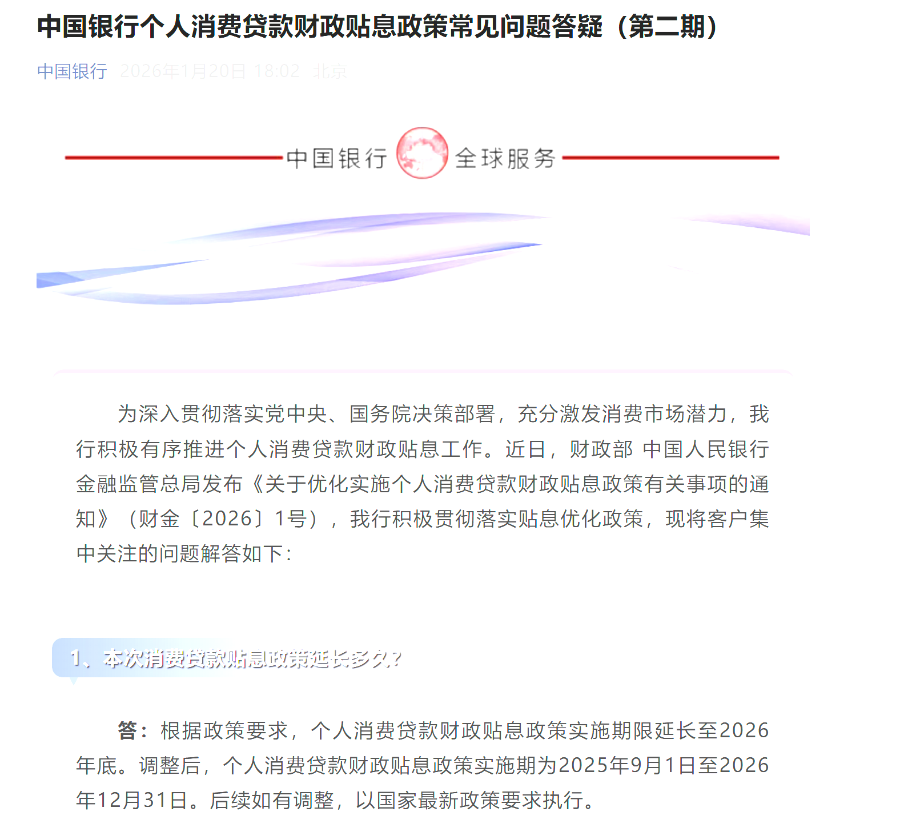
信用卡分期纳入贴息,多家国有大行火速公布细则
21世纪经济报道· 2026-01-20 14:43
Core Viewpoint - The article discusses the recent announcement by the Ministry of Finance regarding a package of policies aimed at stimulating domestic demand and promoting high-quality economic development, with a focus on two key interest subsidy policies for the service industry and personal consumption loans [1][4]. Group 1: Policy Duration - The personal consumption loan interest subsidy policy will be uniformly implemented by Agricultural Bank of China, Bank of China, and Postal Savings Bank from September 1, 2025, to December 31, 2026 [5]. - The service industry loan interest subsidy policy, currently announced only by Agricultural Bank, will also be effective until December 31, 2026, with existing loans issued between March 16, 2025, and December 31, 2025, continuing under previous regulations [5]. Group 2: Subsidy Scope Optimization - The inclusion of credit card business: Credit card bill installment plans are now part of the subsidy scope, applicable for new applications from January 1, 2026, to December 31, 2026, with a subsidy rate of 1% per annum, capped at 50% of the agreed annualized interest rate [6]. - Adjustments in personal consumption loan standards include the removal of a 500 yuan cap on single transaction subsidies, elimination of a 1,000 yuan cap for cumulative transactions under 50,000 yuan, while maintaining a 3,000 yuan annual cap for all personal consumption loans [6]. - For service industry loans, three new categories—digital, green, and retail—are added to the existing eight categories, and the maximum subsidy per loan is increased from 1 million yuan to 10 million yuan [6]. Group 3: Important Considerations - Fraudulent activities are strictly prohibited, and any misuse of funds will be legally addressed, with banks retaining the right to recover subsidies already granted [7]. - No fees will be charged during the loan and subsidy processes, and banks will not engage third parties for these services [7]. - Overdue loans will not qualify for subsidies, and borrowers must settle all outstanding principal and interest before being eligible for the subsidy [7]. Group 4: Inquiry Channels - Customers can check subsidy details through bank SMS, mobile banking apps, physical branches, or customer service hotlines, with specific business details to be confirmed through official channels [8].

涉信贷业务内控管理不到位等,邮储银行泉州市分行被罚280万元
Bei Jing Shang Bao· 2026-01-20 11:05
Core Viewpoint - The Quanzhou Financial Regulatory Bureau has imposed a total fine of 2.8 million yuan on Postal Savings Bank's Quanzhou branch due to inadequate internal control in credit business and negligence in pre-loan investigations and post-loan management [1] Group 1: Regulatory Actions - The Quanzhou branch of Postal Savings Bank was fined 2.8 million yuan for violations related to credit business management [1] - Several individuals, including Cai Xiaohua, Su Liansheng, Li Yan, Wu Chao, Guo Zongyuan, Zhuang Gengquan, Wang Jiaping, Fu Guolong, and Su Weimin, received warnings for their roles in the violations [1] - Wang Jiangang and Wu Zhenyue were given warnings and fined 50,000 yuan each for their involvement [1]
邮储银行许昌市分行:“精准滴灌”助企纾困
Huan Qiu Wang· 2026-01-20 05:23
Core Viewpoint - The article highlights the proactive measures taken by Postal Savings Bank of China (PSBC) in Xuchang to enhance financial services for small and micro enterprises, particularly through the promotion of the "Science and Technology Loan" product to support business development and reduce financing costs [1] Group 1: Financial Support Initiatives - PSBC Xuchang branch is actively promoting the "Science and Technology Loan" to increase credit support for small and micro enterprises and lower their financing costs [1] - A local high-quality new materials enterprise faced a funding challenge due to an upcoming credit loan maturity and rising raw material prices, requiring 2 million yuan in working capital [1] - Upon learning of the enterprise's difficulties, PSBC Xuchang initiated a rapid response mechanism, sending a customer manager to conduct an on-site visit to assess the business situation [1] Group 2: Service Efficiency and Outcomes - After a thorough evaluation, the bank confirmed that the enterprise met the criteria for the "Science and Technology Loan" policy support [1] - The bank optimized the entire process to maximize service efficiency, completing all procedures within one week, resulting in a successful disbursement of 5 million yuan in credit loans [1] - This financial support not only enabled the enterprise to stock up on raw materials in a timely manner but also helped save on financing costs [1] Group 3: Commitment to Local Economic Development - PSBC Xuchang branch positions itself as a key player in supporting local economic development by adhering to the inclusive finance philosophy and addressing the financing challenges faced by small and micro enterprises [1] - The bank plans to continue optimizing the supply of "Science and Technology Loan" and other specialized products while deepening financial relief measures to assist local small and micro enterprises in achieving stable growth [1]
四部门:扩大设备更新贷款财政贴息支持范围
Bei Jing Shang Bao· 2026-01-20 05:08
Core Viewpoint - The Chinese government has announced a policy to optimize the implementation of financial subsidies for equipment renewal loans, aimed at supporting various industries and promoting technological innovation and modernization [1][2]. Group 1: Policy Details - The central government will provide a subsidy of 1.5% on the principal of fixed asset loans for equipment renewal projects, applicable for a maximum period of 2 years from the loan issuance date [1]. - The policy will include new technology innovation loans issued by banks starting in 2026, expanding the scope of financial support [1]. - The implementation of this policy is set to last until December 31, 2026, with the possibility of extension based on future evaluations [1]. Group 2: Supported Industries - The policy expands support beyond existing sectors such as industrial, energy, transportation, and tourism to include construction, municipal services, energy equipment, aviation materials, electronic information, safety production, and more [1]. - Additional focus areas for support include high-end, intelligent, green, and digital equipment updates, as well as sectors like artificial intelligence, elderly care, and waste recycling [1]. Group 3: Participating Banks - A total of 26 banks are designated to handle the subsidized loans, including major state-owned and commercial banks such as the China Development Bank, Agricultural Bank of China, and Industrial and Commercial Bank of China [2].
