
SIA(600009)

Search documents
上海机场(600009):中免和杜福睿入驻上海机场 收费模式优化有望提升盈利能力
Xin Lang Cai Jing· 2025-12-30 06:29
Core Viewpoint - Shanghai Airport has officially introduced a new duty-free agreement with China Duty Free Group and Dufry, which is expected to enhance the competitiveness of its duty-free business and stabilize non-aeronautical revenue growth starting from 2026 [1][2]. Group 1: New Duty-Free Agreement - The new duty-free agreement features a revenue model of "fixed rent + sales commission + 49% joint venture dividends," which is anticipated to motivate operators and improve the long-term competitiveness of the duty-free business [1][2]. - Dufry has obtained the duty-free operating rights for the international areas of Terminal 1 and Satellite Hall S1 at Pudong Airport, while China Duty Free Group has secured rights for Terminal 2 and Satellite Hall S2, as well as the corresponding rights at Hongqiao Airport [1]. Group 2: Financial Projections - The fixed fee for the new agreement is estimated to be approximately 760 million yuan for the year 2026, with potential fluctuations of ±20% based on international and regional passenger traffic changes compared to 2024 [2]. - The new commission rates for sales at Pudong and Hongqiao airports range from 8% to 24% and 8% to 22%, respectively, which is a decrease from the previous rates of 18% to 36% [2]. - Under the new model, the airport's total duty-free revenue is projected to reach approximately 1.5 billion yuan, an increase of 290 million yuan and 250 million yuan compared to 2024 and 2025, respectively [2]. Group 3: Investment and Operational Strategy - The company plans to invest up to 98 million yuan to establish two joint venture companies with Dufry and China Duty Free Group, holding a 49% stake in each [3]. - Based on a projected annual revenue of 7.5 billion yuan and a net profit margin of approximately 5%, the company could achieve an investment return of about 180 million yuan, significantly higher than the previous investment returns from its partnership with Japan Duty Free [3]. - The introduction of differentiated operators and a new incentive mechanism is expected to enhance operational quality and competitiveness in the duty-free sector, leading to sustainable and elastic growth in non-aeronautical revenue for the airport [3]. Group 4: Long-term Outlook - The ongoing recovery of international travel demand and the implementation of the new duty-free agreement are expected to significantly enhance the company's non-aeronautical revenue elasticity [4]. - The projected net profits for the company are estimated to be 2.1 billion yuan, 2.6 billion yuan, and 2.9 billion yuan for the years 2025, 2026, and 2027, respectively, with corresponding PE ratios of 39, 32, and 28 times [4]. - Shanghai Airport's strategic location as a key international hub is expected to unlock commercial potential and drive high-quality growth in non-aeronautical business, contributing to sustained profitability [4].

浦东机场货站获得国际航协CEIV航空货运全品类认证
Xin Lang Cai Jing· 2025-12-30 04:38
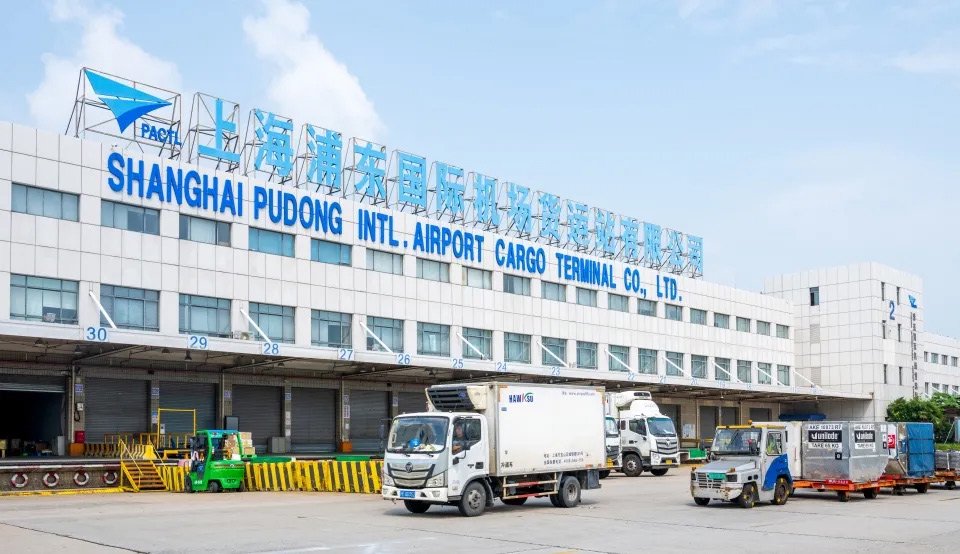
Core Insights - Shanghai Airport Logistics Company’s Pudong Airport Cargo Terminal (PACTL) has received the International Air Transport Association (IATA) Center of Excellence for Independent Validators (CEIV) certification for live animals, making it the first cargo terminal in China to achieve full-category CEIV certification for pharmaceuticals, lithium batteries, perishable goods, and live animals [2] Group 1: Certification Details - CEIV is a global standard certification system established by IATA to enhance the quality and safety of air cargo services in specific professional fields [2] - The certification for pharmaceuticals requires precise temperature control and traceability throughout the transportation process [2] - The certification for lithium batteries mandates the establishment of standards for classification, packaging, labeling, and emergency management across the entire supply chain [2] - The certification for perishable goods necessitates efficient sorting, storage, and full-process temperature and humidity control capabilities [2] - The certification for live animals includes detailed requirements for transportation environment, loading methods, and emergency response [2] Group 2: Operational Excellence - PACTL's achievement of full-category CEIV certification demonstrates its comprehensive alignment with international standards in operational processes, personnel training, infrastructure, and emergency response [2] - This certification enables PACTL to effectively meet the transportation needs of domestic and international customers for various categories of goods [2]

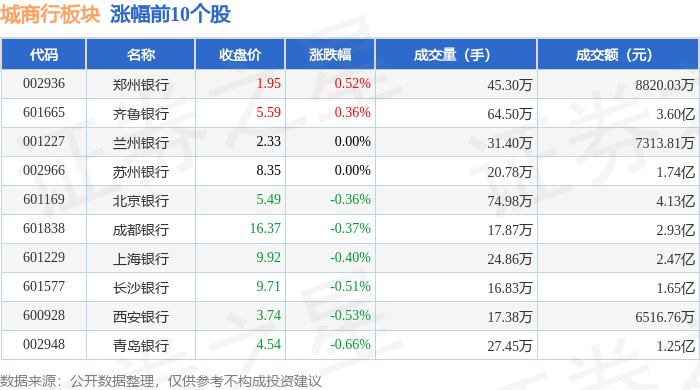
城商行板块12月26日跌0.67%,厦门银行领跌,主力资金净流出5996.58万元
Zheng Xing Xing Ye Ri Bao· 2025-12-26 09:07
Core Viewpoint - The city commercial bank sector experienced a decline of 0.67% on December 26, with Xiamen Bank leading the drop, while the Shanghai Composite Index rose by 0.1% and the Shenzhen Component Index increased by 0.54% [1] Group 1: Market Performance - The closing price of Xiamen Bank was 7.56, reflecting a decrease of 2.45% with a trading volume of 139,200 shares and a transaction amount of 106 million yuan [2] - Other notable banks included Guizhou Bank at 5.90 (-1.17%), Ningbo Bank at 28.00 (-1.10%), and Chongqing Bank at 10.85 (-0.91%) [2] - The overall city commercial bank sector saw a net outflow of 59.97 million yuan from main funds, while retail funds experienced a net outflow of 80.69 million yuan [2] Group 2: Fund Flow Analysis - Hangzhou Bank had a main fund net inflow of 11.5 million yuan, but retail funds saw a net outflow of 76.27 million yuan [3] - Ningbo Bank recorded a main fund net inflow of 56.33 million yuan, while retail funds had a net outflow of 6.51 million yuan [3] - The overall trend indicates that while some banks attracted main fund inflows, retail investors were largely withdrawing their investments [3]






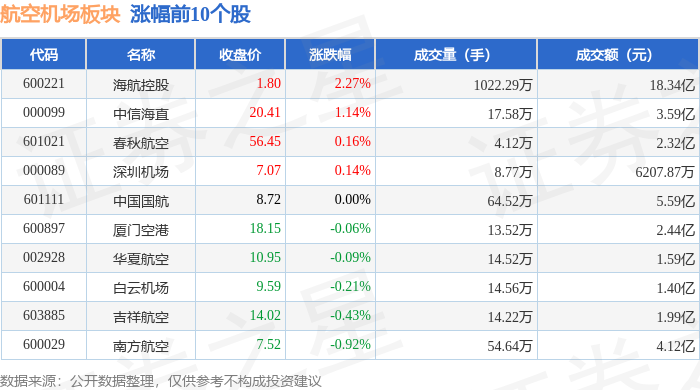
航空机场板块12月26日涨2.8%,海航控股领涨,主力资金净流出3.13亿元
Zheng Xing Xing Ye Ri Bao· 2025-12-26 09:07
Core Viewpoint - The aviation and airport sector experienced a 2.8% increase on December 26, with HNA Holding leading the gains, while the overall market indices showed modest increases [1]. Group 1: Market Performance - The Shanghai Composite Index closed at 3963.68, up 0.1%, and the Shenzhen Component Index closed at 13603.89, up 0.54% [1]. - HNA Holding's stock price rose by 2.27% to 1.80, with a trading volume of 10.22 million shares and a transaction value of 1.834 billion [1]. - Other notable performers included CITIC Offshore Helicopter, which increased by 1.14%, and Spring Airlines, which saw a slight increase of 0.16% [1]. Group 2: Stock Performance Summary - The table of stock performance shows various companies in the aviation sector, with HNA Holding leading in percentage increase, while several companies like China Eastern Airlines and Shanghai Airport experienced declines [2]. - The overall aviation and airport sector saw a net outflow of 313 million in main funds, while retail investors contributed a net inflow of 340 million [2]. Group 3: Fund Flow Analysis - HNA Holding had a net inflow of 18.76 million from main funds, but a net outflow of 17.27 million from retail investors [3]. - China Eastern Airlines experienced a significant net outflow of 26.35 million from main funds, while retail investors contributed a net inflow of 60.68 million [3]. - The analysis indicates that retail investors are actively participating in the market, contrasting with the outflows from institutional and speculative funds [3].





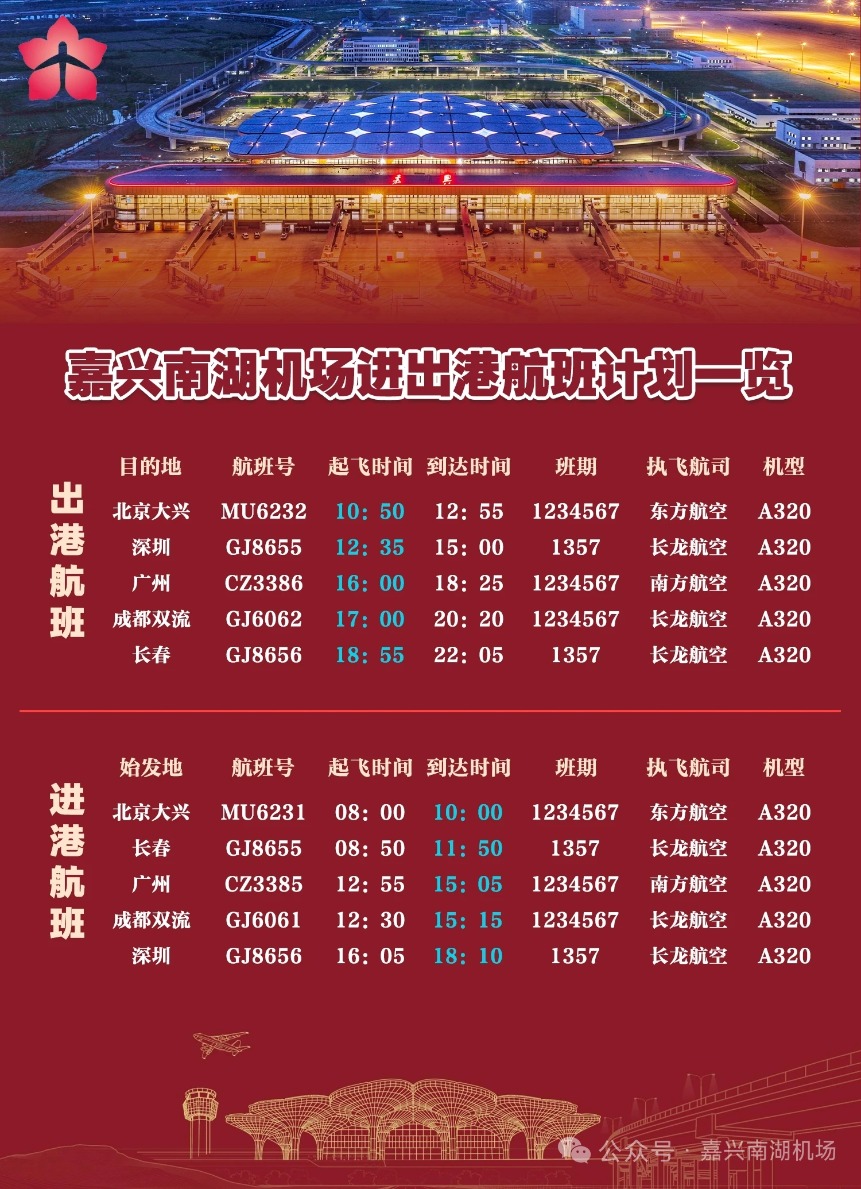
长三角又多了一座新机场 但不是苏州
Di Yi Cai Jing· 2025-12-26 04:40
Core Viewpoint - The opening of Jiaxing Nanhu Airport marks the establishment of a new airport in the Yangtze River Delta, focusing on both passenger and cargo transport, with a primary emphasis on cargo operations [5][6]. Group 1: Airport Operations - Eastern Airlines, Southern Airlines, and Changlong Airlines have commenced operations at Jiaxing Nanhu Airport, with initial flights to cities including Guangzhou, Shenzhen, Chengdu, and Changchun [1][5]. - The airport features a terminal area of 25,900 square meters and has a flight area classification of 4E, with 56 parking positions, of which 33 are dedicated to cargo [5]. Group 2: Cargo Focus - Jiaxing Nanhu Airport is positioned as a professional air cargo hub, with a planned annual passenger throughput of 1.8 million and a cargo throughput of 1.1 million tons [5]. - YTO Express is expected to play a significant role in the airport's cargo operations, having established a global logistics hub at the airport and collaborating with the Jiaxing government to develop surrounding logistics infrastructure [5][6]. Group 3: Regional Connectivity - The airport's strategic location allows for a one-hour connection to major cities in the Yangtze River Delta, enhancing regional logistics and transportation efficiency [6][8]. - The airport is designed to support a multi-modal transport system, facilitating access to international markets within 10 hours [6]. Group 4: Comparison with Suzhou - Suzhou, despite its economic prominence, lacks its own airport, with ongoing discussions and planning since 2018 failing to yield results, while other airports in the region are advancing [10][11]. - The development of Jiaxing Nanhu Airport may alleviate some of the transportation pressures in the region, as it provides an alternative for Suzhou residents [8][10].



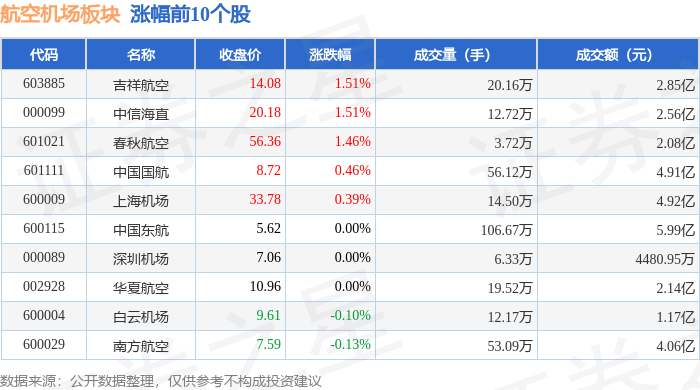
航空机场板块12月25日涨0.17%,吉祥航空领涨,主力资金净流出3.36亿元
Zheng Xing Xing Ye Ri Bao· 2025-12-25 09:07
Core Viewpoint - The aviation and airport sector experienced a slight increase of 0.17% on December 25, with significant contributions from airlines like Juneyao Airlines, while the overall market indices also showed positive movements [1]. Group 1: Market Performance - The Shanghai Composite Index closed at 3959.62, up by 0.47%, and the Shenzhen Component Index closed at 13531.41, up by 0.33% [1]. - Juneyao Airlines led the aviation sector with a closing price of 14.08, reflecting a rise of 1.51% [1]. - Other notable performers included CITIC Offshore Helicopter and Spring Airlines, both showing increases of 1.51% and 1.46% respectively [1]. Group 2: Stock Performance and Trading Volume - The trading volume for Juneyao Airlines was 201,600 shares, with a transaction value of 285 million yuan [1]. - China Southern Airlines and China Eastern Airlines remained stable, with no change in their stock prices, while Shanghai Airport and Air China saw minor increases of 0.39% and 0.46% respectively [1]. - The overall trading volume in the aviation sector indicated a mixed performance, with some stocks experiencing declines [2]. Group 3: Capital Flow Analysis - The aviation sector saw a net outflow of 336 million yuan from institutional investors, while retail investors contributed a net inflow of 388 million yuan [2]. - The capital flow data indicated that Shanghai Airport had a net inflow of 27.85 million yuan from institutional investors, despite a net outflow from retail and speculative investors [3]. - Conversely, Air China experienced significant net outflows from institutional investors amounting to 60.80 million yuan, while retail investors showed a net inflow of 65.73 million yuan [3].


在沪开航20年,欧美航司之中首家入驻上海机场苏州城航楼——专访英航中东、非洲和亚太区总经理海伦·奥康纳
Zhong Guo Min Hang Wang· 2025-12-25 07:47
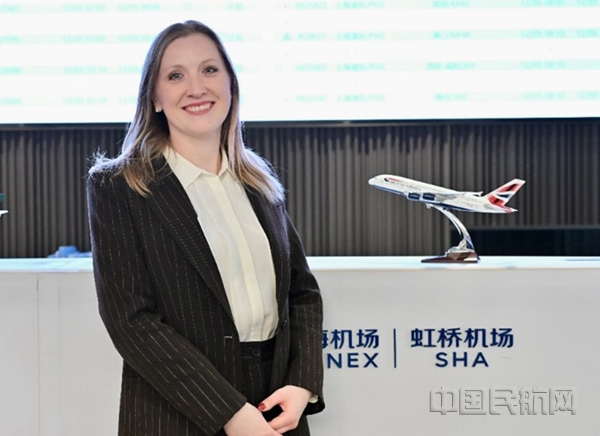
Core Viewpoint - British Airways is enhancing its services in the Chinese market by introducing innovative travel solutions, such as remote check-in at the Suzhou City Terminal, to improve the travel experience for passengers flying between Shanghai and London [1][3]. Group 1: Service Innovations - British Airways is the first European and American airline to offer remote check-in services at the Suzhou City Terminal, allowing passengers to check in and drop off luggage in Suzhou before traveling to Pudong Airport [1][3]. - The airline has also introduced the latest business class product, Club Suite, on the Shanghai-London route, providing passengers with a more comfortable and private flying experience [5]. - The Club Suite is part of a £7 billion fleet upgrade plan, with 71% of flights to London Heathrow already equipped with this new business class [5]. Group 2: Market Expansion and Partnerships - British Airways is expanding its operations in the Chinese market, having established a joint venture with China Southern Airlines, allowing passengers to connect to 12 additional Chinese cities from Shanghai [7]. - The airline is also collaborating with other international carriers to facilitate seamless travel experiences, such as allowing passengers to check in luggage directly to their final destination when transferring between flights [7]. Group 3: Cultural Integration - The airline emphasizes the importance of cultural connection, with a focus on providing personalized service through Chinese-speaking cabin crew on flights between Shanghai and London [5][8]. - British Airways aims to strengthen the cultural and opportunity bridge between China and the UK, reflecting its long-term commitment to the Chinese market [8].
从“包租公”到“合伙人”,上海机场凭免税新约能否开启盈利修复?
市值风云· 2025-12-23 09:10
Core Viewpoint - The article discusses the revenue structure of airports, highlighting the importance of non-aeronautical income, particularly from duty-free shops, which significantly contributes to profitability [3][4]. Group 1: Revenue Sources - Airports primarily earn revenue from aircraft landing fees, parking fees, and passenger bridge fees, which are essential aviation service charges [3]. - In addition to these, airports have developed commercial leasing, logistics, and advertising as non-aeronautical income sources, which can rival the scale of their core aviation business [3]. Group 2: Duty-Free Shops - Among non-aeronautical businesses, duty-free shops are noted for their high-profit margins and are often the most significant contributors to airport profitability [4]. - Shanghai Airport has recently completed a new round of duty-free shop bidding, which includes updates on operator selection, duty-free area planning, and settlement models, expected to have a substantial impact on the company's operations [5]. Group 3: Passenger Traffic Recovery - In 2024, passenger throughput at Shanghai Pudong and Hongqiao airports is projected to reach 125 million, surpassing the pre-pandemic level of 122 million in 2019, marking a historical high [6]. - The recovery of international passenger traffic is lagging but is nearing pre-pandemic levels, with a total of 35.02 million international and regional passengers expected in 2024, recovering to approximately 84% of the 2019 figures [6]. - By the first half of 2025, this figure is anticipated to rise to 19.86 million, further increasing the recovery rate to about 94% [6].
研报掘金丨长江证券:维持中国中免“买入”评级,中标上海机场免税项目,深化利益绑定
Ge Long Hui A P P· 2025-12-23 08:13
Group 1 - The core viewpoint of the article highlights that China Duty Free Group (CDFG) has won the bid for the Shanghai Airport duty-free project, which deepens the binding of interests between CDFG and Shanghai Airport [1] - Under the new model, Shanghai Airport's shareholding in the duty-free store has increased from 16% to 49%, enhancing the alignment of interests and facilitating the growth of Gross Merchandise Value (GMV) [1] - CDFG is recognized as a leading enterprise in China's duty-free industry, having developed core competitive advantages in channels, scale, refined operational management, and branding over 40 years [1] Group 2 - The sales revenue from Hainan's offshore duty-free market has stabilized and is expected to continue growing as outbound tourism increases, particularly at airport ports [1] - The projected net profits attributable to the parent company for CDFG from 2025 to 2027 are estimated to be 3.69 billion, 4.27 billion, and 4.97 billion yuan, respectively, with corresponding price-to-earnings ratios of 46, 40, and 34 times based on the current stock price [1] - The report maintains a "buy" rating for CDFG, indicating a positive outlook for the company's future performance [1]

中国中免(601888):上海机场免税店招标落地 关注市内免税店推进
Xin Lang Cai Jing· 2025-12-23 06:38
Core Insights - The company has won bids for duty-free shops at Shanghai Pudong Airport T2 and S2 satellite hall, as well as at Shanghai Hongqiao Airport T1, with an operational period of 5+3 years from January 1, 2026, to December 31, 2033 [1] Group 1: Project Details - The operational entity for the project is a joint venture between China Duty Free Group and Shanghai Airport, with China Duty Free holding a 51% stake and Shanghai Airport holding 49% [2] - The new contract stipulates a monthly fixed fee of 36.744 million, with commission rates for different categories ranging from 8% to 24% for segment two and 8% to 22% for segment three [3] Group 2: Financial Impact - The company is expected to experience a neutral impact from the new contract; while the reduction in operational scope at Pudong Airport may affect revenue, the overall effect on profit is anticipated to be smaller due to lower commission rates and the introduction of a sales incentive mechanism [4] - The company forecasts net profits of 3.72 billion, 3.89 billion, and 4.27 billion for 2025-2027, with year-on-year changes of -13%, +4.6%, and +9.8% respectively, and corresponding EPS of 1.80, 1.88, and 2.06 [5]