SUMEC(600710)

Search documents
苏美达:公司大型柴油发电机组业务目前未在北美市场开展
Zheng Quan Ri Bao Wang· 2025-11-13 12:41
Core Viewpoint - The company Sumeida (600710) has confirmed that its large diesel generator set business primarily targets domestic markets and regions in Southeast Asia, the Middle East, and Africa, with no current operations in the North American market [1]. Group 1 - The company's large diesel generator set business is focused on domestic and international markets, specifically Southeast Asia, the Middle East, and Africa [1]. - The company has not entered the North American market for its diesel generator sets [1].

苏美达(600710.SH):大型柴油发电机组业务目前主要市场为国内和东南亚、中东、非洲市场 未在北美市场开展
Ge Long Hui· 2025-11-13 11:42
Group 1 - The core business of the company in large diesel generator sets is primarily focused on domestic markets and Southeast Asia, the Middle East, and Africa [1] - The company has not yet entered the North American market for its large diesel generator sets [1]
苏美达跌2.07%,成交额1.29亿元,主力资金净流出2051.15万元
Xin Lang Cai Jing· 2025-11-10 05:17
Core Viewpoint - Sumeida's stock price has shown a year-to-date increase of 26.97%, but it has recently experienced a slight decline in the last five trading days, indicating potential volatility in the market [2]. Company Overview - Sumeida Co., Ltd. is located at 198 Changjiang Road, Nanjing, Jiangsu Province, established on June 24, 1996, and listed on July 1, 1996. The company operates in two main business segments: industrial chain and supply chain [3]. - The industrial chain includes sectors such as consumer goods and environmental protection, with key products/services including textiles, home power products, environmental engineering, clean energy, and shipbuilding [3]. - The supply chain segment focuses on integrated services for bulk commodity operations and import of electromechanical equipment [3]. Financial Performance - For the period from January to September 2025, Sumeida achieved a revenue of 874.23 billion, reflecting a year-on-year growth of 0.56%. The net profit attributable to shareholders was 11.04 billion, marking a 10.25% increase [4]. - The company has distributed a total of 24.74 billion in dividends since its A-share listing, with 13.05 billion distributed over the past three years [5]. Shareholder Information - As of September 30, 2025, Sumeida had 32,600 shareholders, a decrease of 16.35% from the previous period. The average circulating shares per person increased by 19.55% to 40,079 shares [4]. - The third-largest circulating shareholder is Hong Kong Central Clearing Limited, holding 53.48 million shares, which is a decrease of 3.10 million shares compared to the previous period [5]. Market Activity - On November 10, Sumeida's stock price fell by 2.07%, trading at 11.34 yuan per share with a total transaction volume of 1.29 billion and a turnover rate of 0.86%. The total market capitalization stood at 148.19 billion [1]. - The net outflow of main funds was 20.51 million, with significant selling pressure observed in large orders [1].
南京进博会上“链”全球
Nan Jing Ri Bao· 2025-11-10 02:13
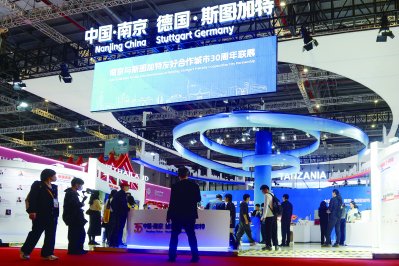
Group 1 - The 8th China International Import Expo is held in Shanghai from November 5 to 10, showcasing Nanjing's high-level openness through various economic and cultural exchange activities [1] - The "Nanjing and Stuttgart Friendly Cooperation City 30th Anniversary Exhibition" attracts numerous visitors [3] - The Jiangsu Cultural Exchange Exhibition area features the "Su Chao" championship trophy, drawing attention [5] Group 2 - Siemens showcases a 3D collaboration and verification platform using AI and digital twin technology, engaging visitors with a mechanical arm puzzle [7] - Su Mei Da Co., Ltd. presents a manned aircraft at the technology equipment exhibition area, capturing audience interest [9] - The exhibition area for friendly cities features Nanjing and Stuttgart, highlighting 30 years of cooperation in trade, technology, and culture under the theme "Double City Craftsmanship, Win-Win Future" [12] Group 3 - The Jiangsu Cultural Exchange Exhibition area prominently features Nanjing's traditional crafts, with seven time-honored brands showcasing new products and interactive experiences [15] - Nanjing Yunjin Research Institute presents innovative works that blend traditional craftsmanship with modern technology, demonstrating the heritage and evolution of Chinese intangible cultural heritage [17] - The "Jinling Elegance" section of the Jiangsu exhibition showcases the cultural charm and consumer trends of the ancient capital, with local enterprises presenting high-end equipment and AI technology [19]


进博特写:从组团到“单飞” 展商展现“看得见”的成长
Zheng Quan Shi Bao Wang· 2025-11-09 11:30
Group 1 - The eighth China International Import Expo (CIIE) saw participation from nearly 200 Canadian companies, a significant increase from the previous year, with approximately 30 companies from Ontario and British Columbia each [1] - The Canada International Trade Promotion Association (CITPA) has been organizing Canadian enterprises to participate in the CIIE for several years, focusing on supporting small and medium-sized enterprises [1] - Canadian brand Savor North introduced a unique type of sea cucumber to the Chinese market, aiming to provide consumers with different choices [1] Group 2 - Many companies that initially participated in the CIIE with CITPA have since become independent exhibitors, showcasing significant growth in their exhibition space [2] - One company expanded its exhibition area from 18 square meters to 72 square meters in the health products section, indicating successful growth [2] Group 3 - Su Mei Da Hong Kong participated again this year, featuring a mix of long-term partners and new brands, highlighting the growth of exhibitors [3] - The "first launch area" at Su Mei Da's booth showcased innovative products, including a plasma continuous annealing line from Plasmait, which is the only company globally to commercialize this technology [4] Group 4 - New Zealand's dairy company Fonterra not only exhibited but also played a role as an organizer, bringing 26 New Zealand companies to the CIIE this year, up from 12 and 21 in previous years [4] - The collaborative approach of Fonterra allows multiple industries in New Zealand to benefit from participation in the CIIE, with many companies transitioning to independent exhibitions over time [4]
进博会上,高端设备首发首秀、数字赋能开放合作——
Nan Jing Ri Bao· 2025-11-07 03:09
Group 1 - The eighth China International Import Expo is taking place in Shanghai, showcasing high-end equipment, AI technology, and cross-border service platforms from various companies, particularly highlighting the innovative capabilities from Nanjing [1][2] - Sumida Holdings, a key member of the China National Machinery Industry Corporation, has set up two booths at the expo, displaying globally launched new products in high-end equipment and home textiles, covering an area of 1,240 square meters [1][2] - The China-Central Asia Trade Facilitation Cooperation Platform, developed by Suhao Holdings and Nanjing Xuanwu District, features immersive "cloud shopping" technology, creating a digital space that synchronizes with physical exhibitions, enhancing trade facilitation and cross-regional cooperation [3][4] Group 2 - Plasmait, a well-known brand in the plasma heat treatment sector from Austria, launched its plasma annealing system in China, designed for stainless steel and alloy materials, which significantly improves mechanical processing performance while reducing energy consumption [2] - Sumida Holdings has introduced over ten new products and brand collaborations in the consumer goods section, including smart temperature-controlled home textile products, showcasing innovation in the textile industry [2] - Siemens has presented over ten industrial AI products and solutions at the expo, emphasizing the importance of deep integration of AI into industrial scenarios, and plans to establish an open platform for industrial digitalization and smart city applications in the Yangtze River Delta region [4]
在宁企业秀出“向新力”,向世界递出“开放名片”
Nan Jing Ri Bao· 2025-11-07 02:35
Core Insights - The eighth China International Import Expo (CIIE) is showcasing high-end equipment, AI technologies, and cross-border service platforms from Nanjing enterprises, emphasizing innovation and openness to the world [1][2][3] Group 1: Company Highlights - Sumeida Hong Kong Co., Ltd. has set up two exhibition areas at the CIIE, showcasing global first releases in high-end equipment and consumer goods, covering a total area of 1,240 square meters [1][2] - The company has organized four themed exhibition areas, including a "First Release Zone" for global innovations and sections focusing on high-end manufacturing and future industries like AI and low-altitude economy [2] - Sumeida's new plasma annealing system, designed for stainless steel and alloy materials, was highlighted for its innovative technology that enhances mechanical processing performance while significantly reducing energy consumption [2] Group 2: Digital and Trade Innovations - Sumeida is leveraging its "Sumeida Da Tianxia" global equipment trading service platform to connect over a hundred high-end equipment manufacturers, enhancing trade efficiency through digital exhibition methods [3] - The China-Central Asia Trade Smooth Cooperation Platform, developed by Suhao Holdings and Nanjing's Xuanwu District, allows for immersive online experiences, breaking traditional exhibition limitations and facilitating trade between China and Central Asia [3] Group 3: Industry Trends - The CIIE has been instrumental in promoting trade and cooperation, with a diverse range of products from various countries, including agricultural goods from Southeast Asia and health products from Kazakhstan, being well-received [4] - Siemens is actively participating in the CIIE, showcasing over ten industrial AI products and solutions, and plans to establish a service center in Nanjing focused on industrial digitalization and smart city development [5]
关税缓和,看好跨境电商
Orient Securities· 2025-11-06 15:25
Investment Rating - The industry investment rating is "Positive (Maintain)" [5] Core Viewpoints - The report emphasizes the long-term nature of overseas expansion, highlighting the increasing penetration rate of cross-border e-commerce in foreign trade and maintaining a positive outlook on leading companies with strong performance resilience and those with marginal performance improvements [3] - The report notes that the recent easing of tariffs and the ongoing strong growth trend in cross-border e-commerce are expected to enhance the ability of Chinese foreign trade enterprises to respond to external shocks and improve their global layout [7] Summary by Sections Cross-Border E-Commerce Performance - In the first three quarters of 2025, the cross-border e-commerce sector achieved revenue of 56.09 billion yuan, a year-on-year increase of 22.6%, with a three-year CAGR of 24.5%. The net profit attributable to shareholders was 3.59 billion yuan, up 20.2% year-on-year, with a three-year CAGR of 20.2% [7] - The revenue growth rate slightly slowed due to trade friction and increased competition, but the net profit growth rate showed significant improvement [7] - In Q3 2025, the sector's revenue grew by 14.3% year-on-year, and net profit increased by 29.6%, indicating operational resilience and improved cost management despite rising tariff costs [7] Market Outlook - The report anticipates strong performance during the upcoming Black Friday and Cyber Monday shopping events, with consumers showing early planning, trust, and value-seeking behaviors [7] - Online sales during the 2025 holiday shopping season in the U.S. are expected to reach $253.4 billion, a year-on-year increase of 5.3% [7] - The report highlights that cross-border e-commerce companies leverage China's efficient industrial clusters to export competitively priced products, with some transitioning from Amazon brands to multi-channel brands [7] Investment Recommendations - The report recommends focusing on resilient leading companies and those with improving performance in the cross-border e-commerce sector, with specific stock suggestions for both B2B and B2C segments [3]




贸易板块11月6日涨1.84%,中信金属领涨,主力资金净流入1.53亿元
Zheng Xing Xing Ye Ri Bao· 2025-11-06 08:51
Market Overview - The trade sector increased by 1.84% on November 6, with CITIC Metal leading the gains [1] - The Shanghai Composite Index closed at 4007.76, up 0.97%, while the Shenzhen Component Index closed at 13452.42, up 1.73% [1] Stock Performance - CITIC Metal (601061) closed at 15.04, rising by 8.59% with a trading volume of 925,600 shares and a turnover of 1.374 billion [1] - Wuhuan Development (600058) closed at 9.66, up 5.23%, with a trading volume of 390,800 shares and a turnover of 375 million [1] - Sumec (600710) closed at 12.15, increasing by 3.05%, with a trading volume of 263,600 shares and a turnover of 320 million [1] - Other notable stocks include Yiatong (002183) with a 1.54% increase and Jiangsu Guotai (002091) with a 0.87% increase [1] Capital Flow - The trade sector saw a net inflow of 153 million from institutional investors, while retail investors experienced a net outflow of 1.65 billion [2] - Major stocks like CITIC Metal and Wuhuan Development attracted significant net inflows from institutional investors, with 63.23 million and 62.05 million respectively [3] - Retail investors showed a negative net flow in several stocks, including CITIC Metal and Wuhuan Development, indicating a divergence in investment behavior [3]


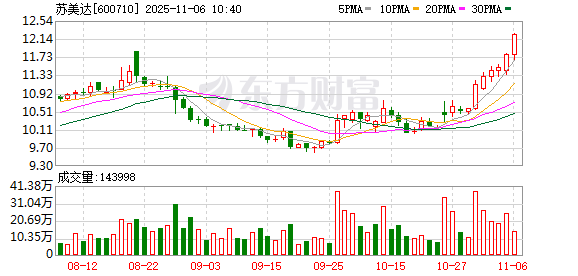
苏美达涨2.88%,股价创历史新高
Zheng Quan Shi Bao Wang· 2025-11-06 02:39
Core Viewpoint - Su Mei Da's stock price reached a historical high, reflecting positive market sentiment and performance in the retail sector [2] Company Summary - As of 9:43, Su Mei Da's stock increased by 2.88%, reaching a price of 12.13 yuan, with a trading volume of 5.0088 million shares and a transaction amount of 59.9987 million yuan, resulting in a turnover rate of 0.38% [2] - The latest total market capitalization of Su Mei Da in A-shares is 15.851 billion yuan, with the same amount for circulating market capitalization [2] - The company's Q3 report indicates a total operating revenue of 87.423 billion yuan for the first three quarters, a year-on-year increase of 0.52%, and a net profit of 1.104 billion yuan, reflecting a year-on-year growth of 10.03% [2] - Basic earnings per share are reported at 0.8400 yuan, with a weighted average return on equity of 14.00% [2] Industry Summary - The overall decline in the retail trade industry is recorded at 0.62%, with 11 stocks experiencing price increases, including Su Mei Da, which ranks among the top gainers [2] - Other notable gainers in the industry include Zhongxin Metal and Ruoyu Chen, with respective increases of 6.64% and 1.70% [2] - Conversely, 83 stocks in the industry have seen declines, with Sanjiang Shopping, Guoguang Chain, and Zhongbai Group leading the losses at 7.97%, 4.52%, and 3.32% respectively [2] - As of November 5, the latest margin trading balance for Su Mei Da is 139 million yuan, with a financing balance of the same amount, showing a decrease of 11.9106 million yuan over the past 10 days, representing a 7.90% decline [2]