AikoSolar(600732)

Search documents
光伏股再度走低 白银涨价挤压光伏企业利润 多家公司发布盈警公告
Zhi Tong Cai Jing· 2026-01-30 03:24
Core Viewpoint - The photovoltaic sector is experiencing a decline, with several key companies reporting significant losses for 2025, primarily attributed to rising silver prices impacting production costs [1] Group 1: Company Performance - Rainbow New Energy (00438) shares fell by 6.45%, trading at HKD 2.03 [1] - Flat Glass (601865) shares decreased by 5.76%, trading at HKD 10.97 [1] - Xinyi Solar (00968) shares dropped by 4.29%, trading at HKD 3.35 [1] - New Special Energy (01799) shares declined by 3.54%, trading at HKD 7.64 [1] Group 2: Financial Forecasts - Tongwei Co. (600438), Longi Green Energy (601012), and Aiko Solar (600732) all issued profit warnings for 2025, indicating expected losses [1] - Longi Green Energy cited significant increases in silver paste and silicon material costs as a major factor for the anticipated losses [1] - Tongwei Co. also mentioned that the continuous rise in prices of core raw materials, including silver, is contributing to their financial difficulties [1] Group 3: Industry Insights - Silver paste is a critical material in solar panels, used for creating conductive contacts to transmit electricity generated by the cells [1] - The current usage of silver in battery cells accounts for 29% of the total cost of components, a significant increase from 3.4% in 2023 and 14% last year [1] - The photovoltaic industry is actively seeking to mitigate the impact of rising silver prices by accelerating plans to replace silver with cheaper materials like copper [1]




“能源绿色低碳转型”看山东之济南新旧动能转换起步区:场景创新和产业导入协同推进
Zhong Guo Fa Zhan Wang· 2026-01-29 14:53
Core Viewpoint - The Jinan New and Old Kinetic Energy Conversion Pilot Zone is committed to promoting green, low-carbon, and high-quality development by focusing on the "dual carbon" goals and exploring innovative reforms in the energy sector [1] Group 1: Energy Transition Initiatives - The pilot zone is recognized as the only pilot unit in Jinan for energy green and low-carbon transition, establishing a collaborative work mechanism among multiple departments to ensure the implementation of pilot projects [1] - A detailed construction plan for the energy green low-carbon transition pilot for 2025 has been issued, outlining annual goals, key tasks, and project lists to enhance policy support and resource allocation [1] Group 2: Collaborative Development Models - The green low-carbon vehicle network interactive charging and swapping demonstration station has been developed through collaboration between Jinan Power Supply Company and local government, featuring advanced technology and comprehensive facilities [2] - The station includes 123 charging and swapping spots, with 104 charging piles, and integrates various elements such as photovoltaic, energy storage, and V2G technologies [2] Group 3: Clean Energy Utilization - The pilot zone is actively promoting photovoltaic power generation integrated with buildings, achieving a total installed capacity of approximately 49,000 kW and an annual power generation of 57 million kWh [3] - Geothermal energy utilization projects have been developed, covering a heating area of about 220,000 square meters, leveraging the region's rich geothermal resources [3] - Hydrogen energy applications are being expanded, with over 100 hydrogen-powered vehicles promoted for urban construction and logistics [3] Group 4: Advanced Technology and Equipment - The Aiko Solar high-efficiency battery module project has been established, with a production capacity of 3 GW and an expected full production by 2026, featuring innovative ABC photovoltaic battery components [4] - A 350 million yuan investment project for perovskite solar cells is underway, focusing on high-efficiency and stable production processes [4] Group 5: Comprehensive Smart Energy Development - A "1+4" planning system has been established to manage electricity supply, heating, and comprehensive smart energy services, with a draft plan already in progress [5] - A multi-energy integrated management system is being constructed, incorporating various energy forms and advanced technologies for better control and visibility [5] Group 6: Project Implementation - Ongoing projects include the construction of integrated heating and cooling systems, green electricity supply for industrial parks, and hydrogen energy pilot projects, leveraging the demonstration effects of the low-carbon vehicle network interactive charging station [6]
多数光伏企业2025年延续亏损状态,部分企业锚定2026年业绩扭亏
第一财经· 2026-01-27 12:49
Core Viewpoint - The photovoltaic (PV) industry in A-shares is facing significant losses, with many leading companies projecting substantial pre-loss figures for 2025 due to a challenging operating environment and supply-demand imbalances [2][3]. Group 1: Financial Performance and Projections - Major PV companies are expected to report significant pre-loss figures for 2025, including Tongwei Co. with a projected loss of 9 to 10 billion yuan, LONGi Green Energy with 6 to 6.5 billion yuan, and JinkoSolar with 5.9 to 6.9 billion yuan [2]. - The overall operating environment remains difficult, with many companies experiencing nine consecutive quarters of losses since Q4 2023, driven by price declines and insufficient end-demand [3]. Group 2: Industry Dynamics - The PV module prices are under pressure due to "involutionary competition" and a lack of terminal demand, with market transaction prices around 0.6 yuan per watt expected in mid-2025 [3]. - The industry is witnessing a supply surplus, with production rates declining across various segments, while core material prices, such as silver, continue to rise [3]. Group 3: Recovery Efforts and Future Goals - Some companies are beginning to emerge from the loss cycle, with LONGi Green Energy projecting a maximum reduction in losses of 30.38% and Aiko Solar up to 77.44% compared to 2024 [4]. - The China Photovoltaic Industry Association noted a 16.9% year-on-year decline in revenue for the main industry chain in the first three quarters of 2025, but an improvement in gross margins to 3.64% [4]. - Several leading PV companies have set profit targets for 2026, with Trina Solar aiming for a net profit of no less than 200 million yuan and LONGi Green Energy targeting positive net profits in subsequent years [5].





多数光伏企业2025年延续亏损状态,部分企业锚定2026年业绩扭亏
Di Yi Cai Jing· 2026-01-27 10:56
Core Viewpoint - The keyword "pre-loss" has become prominent in the 2025 performance forecasts of various photovoltaic companies, indicating that most firms continue to face losses due to operational challenges and supply-demand imbalances in the industry [1] Group 1: Financial Performance - Leading photovoltaic companies are forecasting significant losses for 2025, with Tongwei Co. expecting a loss of 9 to 10 billion yuan, LONGi Green Energy forecasting a loss of 6 to 6.5 billion yuan, and JinkoSolar projecting a loss of 5.9 to 6.9 billion yuan [1] - The overall photovoltaic industry has experienced nine consecutive quarters of losses since Q4 2023, driven by a decline in component prices due to intense competition and insufficient end-user demand [1][2] Group 2: Industry Challenges - The photovoltaic industry is facing a supply surplus, with core raw material prices rising while product prices continue to decline, leading to significant operational pressure on companies [2] - The ongoing low operating rates and the deepening market reforms in the domestic electricity sector, along with increasing trade barriers abroad, have created a complex and challenging operating environment for photovoltaic companies [2] Group 3: Recovery Efforts - Some companies are beginning to emerge from the loss cycle, with LONGi Green Energy expecting to reduce losses by up to 30.38% and Aiko Solar by up to 77.44% compared to 2024 [2] - The China Photovoltaic Industry Association reported a 16.9% year-on-year decline in revenue for the main industry chain in the first three quarters of 2025, although gross margins improved to 3.64% [2] Group 4: Future Goals - Companies like Trina Solar have set profit targets for 2026, aiming for a net profit of no less than 200 million yuan, with increasing targets for subsequent years [3] - LONGi Green Energy's employee stock ownership plan also includes targets for positive net profit in 2026, with specific profit goals for 2027 and 2028 [3] Group 5: Price Adjustments - Trina Solar has raised its component prices three times this month, with prices now ranging from 0.88 to 0.92 yuan per watt, reflecting a response to industry self-discipline [4] - Major component manufacturers are increasing prices by 0.02 to 0.04 yuan per watt, and there is a growing willingness among intermediate suppliers to support price increases [4]
连年巨亏 光伏业如何逃出“血海”
经济观察报· 2026-01-25 10:54
Core Viewpoint - The photovoltaic industry is undergoing a brutal survival elimination race and a deep restructuring of the industrial pattern, with the next phase expected to be redefined after this intense reshuffle [2][4]. Group 1: Industry Performance and Losses - In 2025, major companies in the photovoltaic sector are expected to report significant losses, with JinkoSolar forecasting a net loss of 5.9 billion to 6.9 billion yuan, Trina Solar predicting a loss of 6.5 billion to 7.5 billion yuan, and Tongwei expecting a loss of 9 billion to 10 billion yuan [2][6]. - The total expected losses from leading companies amount to hundreds of billions, indicating that the photovoltaic industry is still mired in a loss-making situation [2][5]. - The industry has shifted from a phase of rapid expansion to a deep adjustment period, with companies generally operating at a loss to maintain operations, severely squeezing overall profitability [7][12]. Group 2: Causes of the Crisis - The root cause of the current industry crisis is attributed to aggressive expansion in the past, leading to severe structural oversupply and intense price competition [3][6]. - The prices of key materials such as silicon have plummeted from 300,000 yuan per ton in 2022 to around 55,000 yuan per ton, while silver prices have nearly doubled in recent months, further exacerbating the challenges faced by companies [4][10]. Group 3: Strategic Responses and Industry Restructuring - In response to the crisis, leading companies are turning to mergers and acquisitions to strengthen competitiveness or are extending into related fields such as energy storage and hydrogen energy to seek strategic breakthroughs [4][12]. - TCL Zhonghuan announced plans to invest in a new energy technology company to enhance its integrated strategy and expand battery and module production capacity [12]. - The industry is experiencing a "淘汰赛" (elimination race), with smaller companies likely to exit the market or seek mergers as the competitive landscape narrows [13][14]. Group 4: Future Outlook and Recovery Potential - Companies like Tongwei have seen some operational profitability in the latter half of 2025, but overall losses are expected to continue due to declining sales prices and rising raw material costs [9][10]. - The recovery of profitability is contingent on the overall price recovery across the supply chain and the expansion of photovoltaic application scenarios, which could provide significant growth opportunities [9][10]. - The photovoltaic industry is witnessing a recent increase in component prices, with some manufacturers raising prices by 0.04 to 0.15 yuan per watt, indicating a potential shift in market dynamics [18][19].
太空光伏为产业链带来新机遇,宁德时代推出天行II方案
GOLDEN SUN SECURITIES· 2026-01-25 08:33
Investment Rating - The report maintains an "Overweight" rating for the power equipment sector [6] Core Insights - The report highlights new opportunities in the photovoltaic industry driven by space solar power initiatives and rising prices of battery components [1][17] - It emphasizes the importance of supply-side reforms and technological advancements in creating long-term growth opportunities within the industry [1][19] - The report identifies key companies to watch in various segments, including supply chain price increases, new technology growth, and perovskite solar cell developments [1][19][21] Summary by Sections Photovoltaics - The price of multi-crystalline silicon n-type raw materials remains stable, with an average transaction price of 59,200 RMB per ton [17] - N-type battery cell prices have increased to 0.42 RMB per watt, with a price range of 0.40-0.43 RMB per watt [17] - The report notes that rising silver prices have led to increased component costs, with distributed component prices now ranging from 0.70 to 0.80 RMB per watt [17] - SpaceX and Tesla plan to achieve a combined solar manufacturing capacity of 200GW annually in the U.S. within three years, with 40GW dedicated to space solar power [1][18] - Key companies to focus on include Tongwei Co., GCL-Poly, LONGi Green Energy, JA Solar, and Trina Solar for supply-side reform opportunities [1][19] Wind Power & Grid - The Netherlands will launch a 1GW offshore wind project tender in September 2026, with a subsidy budget of approximately 32.45 billion RMB [19][20] - Turkey plans to initiate its first offshore wind tender by the end of 2026, aiming for 5GW of installed capacity by 2035 [19][20] - Southern Power Grid has set a fixed asset investment of 180 billion RMB for 2026, focusing on new power system construction and strategic emerging industries [20] - Companies to watch include Goldwind, Yunda, Mingyang Smart Energy, and Sany Heavy Energy in the wind turbine sector [20] Hydrogen Energy - A ceremony for the operation of 300 hydrogen fuel heavy trucks was recently held, showcasing advancements in hydrogen energy technology [3][21] - The trucks are equipped with a 130kW fuel cell system and can achieve a range of over 600 kilometers [3][21] - Key companies in this sector include Shuangliang Energy, Huadian Heavy Industry, and Shenghui Technology [3][21] Energy Storage - The report forecasts that new energy storage installations in China will reach 58.6GW/175.3GWh in 2025, a year-on-year increase of 38%/60% [4][22] - The average bid price for 2-hour energy storage systems is projected to be 0.55 RMB/Wh in 2025, down 16.9% from 2024 [4][22] - Companies to focus on include Sungrow Power, Canadian Solar, and Kehua Data for large-scale energy storage opportunities [4][22] New Energy Vehicles - CATL launched the "Tianxing II" series solutions for light commercial vehicles, including the industry's first intelligent battery management application [5][27] - The solutions cater to various scenarios, including high-frequency urban distribution and extreme temperature conditions [5][27] - Key companies in the battery sector include CATL, Penghui Energy, and Guoxuan High-Tech [5][29]





光伏设备板块1月23日涨9.05%,连城数控领涨,主力资金净流入89.98亿元
Zheng Xing Xing Ye Ri Bao· 2026-01-23 09:12
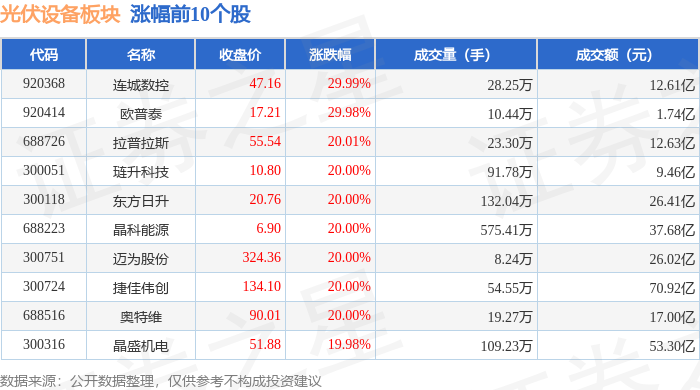
Core Viewpoint - The photovoltaic equipment sector experienced a significant increase of 9.05% on January 23, with Liancheng CNC leading the gains. The Shanghai Composite Index closed at 4136.16, up 0.33%, while the Shenzhen Component Index closed at 14439.66, up 0.79% [1]. Group 1: Stock Performance - Liancheng CNC (code: 920368) closed at 47.16, with a remarkable increase of 29.99% and a trading volume of 282,500 shares, resulting in a transaction value of 1.261 billion yuan [1]. - Oputai (code: 920414) also saw a significant rise of 29.98%, closing at 17.21 with a trading volume of 104,400 shares and a transaction value of 174 million yuan [1]. - Other notable performers included Laplace (code: 688726) with a 20.01% increase, closing at 55.54, and a transaction value of 1.263 billion yuan [1]. Group 2: Capital Flow - The photovoltaic equipment sector saw a net inflow of 8.998 billion yuan from main funds, while retail funds experienced a net outflow of 3.626 billion yuan [2]. - The main funds showed a significant presence in stocks like Longi Green Energy (601012), which had a net inflow of 2.692 billion yuan, accounting for 28.66% of the total [3]. - In contrast, retail investors showed a net outflow from several stocks, including TCL Zhonghuan (002129) and Aiko Solar (600732), indicating a shift in investor sentiment [3].



1月23日主题复盘 | 太空光伏掀涨停潮,航天连续反弹,锂电池也表现不俗
Xuan Gu Bao· 2026-01-23 08:51
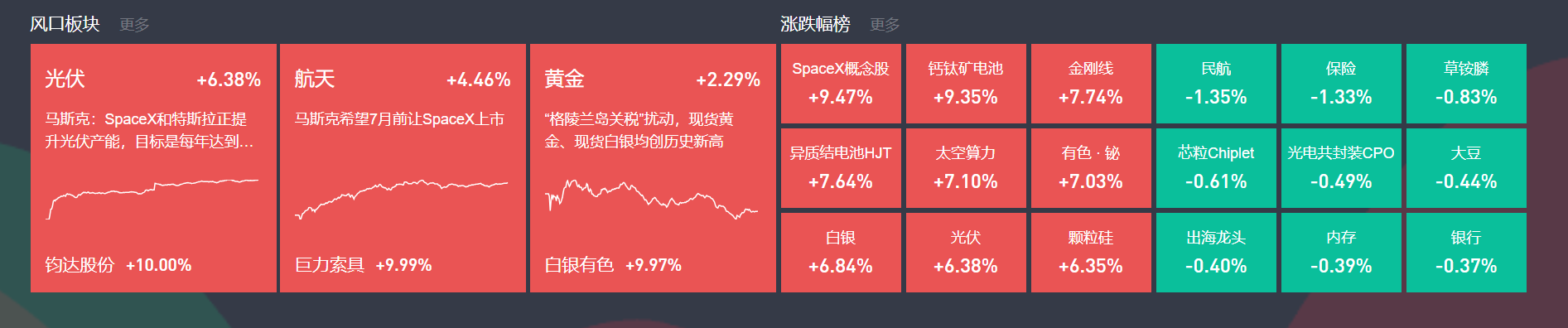
Market Overview - The market opened high and fluctuated throughout the day, with all three major indices rising collectively. The trading volume reached 3.12 trillion [1] - The photovoltaic sector saw a significant surge, with over 30 stocks including Longi Green Energy and Aiko Solar hitting the daily limit [1] - The commercial aerospace concept continued its strong performance, with nearly 20 stocks including Goldwind Technology and Aerospace Electronics also reaching the daily limit [1] - The precious metals sector remained strong, with stocks like China Gold and Silver Nonferrous hitting the daily limit [1] - In contrast, CPO concept stocks fell, with New Yisheng, Zhongji Xuchuang, and Tianfu Communication dropping over 5% [1] Photovoltaic Sector - The photovoltaic sector experienced a wave of limit-up stocks, with JunDa Co., Shuangliang Energy, Maiwei Co., and Saiwu Technology among those hitting the limit [4] - Elon Musk announced that SpaceX and Tesla are increasing solar energy production capacity, aiming for an annual target of 100GW [5] - JunDa Co. achieved a two-day limit-up, with a latest price of 99.44 and a 10% increase, while Shuangliang Energy rose by 9.94% to 7.85 [5] Aerospace Sector - The aerospace sector continued to rebound significantly, with stocks like Jieli Rigging and West Materials hitting the daily limit [7] - A press conference for the "Space Tourism Global Launch" was held, showcasing China's first commercial manned spacecraft, "Chuan Yue Zhe No. 1" [7] - Blue Arrow Aerospace's IPO status changed to "inquiry" on the Shanghai Stock Exchange [7] Lithium Battery Sector - The lithium battery sector saw a substantial increase, with stocks like Dazhong Mining and Weiling Co. hitting the daily limit [10] - Lithium carbonate futures surged by 5.47%, with a cumulative increase of over 20% in the past four trading days [10] - The market is experiencing a phase of supply-demand mismatch, with strong demand for lithium carbonate driven by battery exports and inventory shortages [11] Future Outlook - According to Citic Futures, the lithium market is expected to transition from slight oversupply to tight balance by 2026, with demand growth projected at 30% and supply growth at 25% [13] - The aerospace industry is anticipated to enter a low-cost era with the successful implementation of reusable rocket technology, benefiting upstream sectors such as high-temperature alloys and special materials [9]



光伏板块,大面积涨停
Di Yi Cai Jing Zi Xun· 2026-01-23 05:33
Core Viewpoint - The solar photovoltaic sector has experienced significant gains, with the Wind Solar Index rising over 9% as of the report's publication [1]. Group 1: Stock Performance - Liancheng CNC reached a 30% limit-up, while Maiwei Technology, Laplace, Aotwei, and Dongfang Risheng all hit a 20% limit-up [3]. - Over 20 stocks in the sector saw gains exceeding 10%, including Junda Co., GCL-Poly, and LONGi Green Energy [3]. - Specific stock price movements include: - Liancheng CNC at 47.16, up 29.99% - Laplace at 55.54, up 20.01% - Maiwei Technology at 324.36, up 20.00% - Aotwei at 90.01, up 20.00% [4]. Group 2: Additional Stock Gains - Other notable stock performances include: - JinkoSolar at 6.88, up 19.65% - Trina Solar at 20.49, up 14.53% - Longi Green Energy at 19.35, up 10.01% [5][6]. - A total of over 10 stocks achieved limit-up status, indicating strong market interest and investment in the solar sector [3]. Group 3: Industry Developments - Elon Musk announced during the World Economic Forum that SpaceX and Tesla are working to enhance solar energy production capacity, targeting an annual output of 100 GW [6].


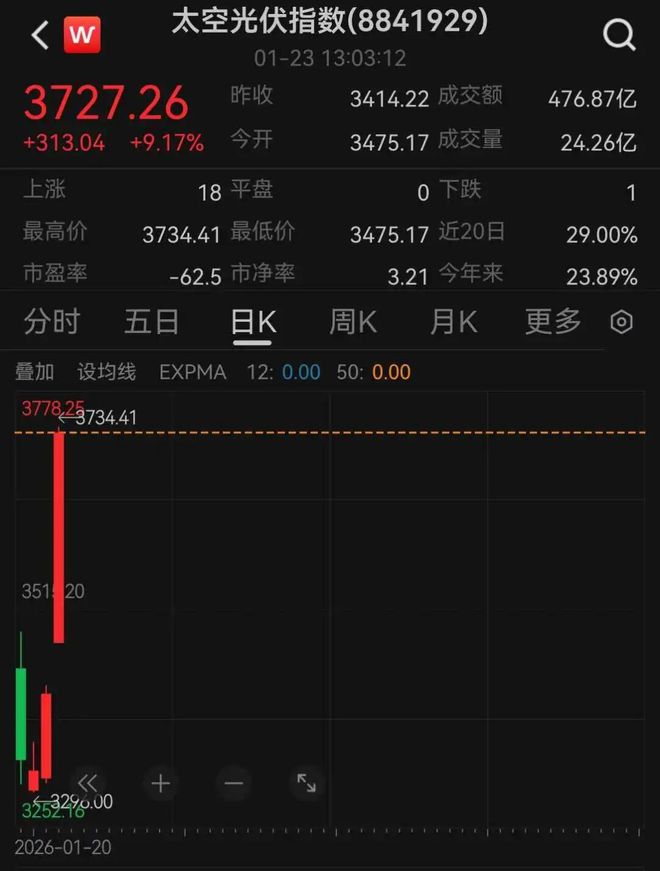
光伏产业链股爆发,迈为股份20%涨停,捷佳伟创等大涨
Zheng Quan Shi Bao Wang· 2026-01-23 03:01
Group 1 - The photovoltaic industry chain stocks experienced significant gains, with companies like Maiwei Co., Ltd., Laplace, and Aotwei reaching a 20% limit up, and Jiejia Weichuang rising over 18% [1] - The acceleration of commercial space development and low Earth orbit satellites has become a focal point in US-China competition, leading to rapid growth and potential upgrades in supporting energy systems [1] - Traditional fossil energy sources face high storage risks and supply difficulties in space, while nuclear energy has high technical complexity and strict safety controls, making large-scale application challenging [1] Group 2 - HJT and perovskite technologies are viewed as preferred solutions for extreme space environments, benefiting related battery component manufacturers and equipment producers [2] - SpaceX has confirmed the P-type HJT battery technology route for large-scale economic production of space solar cells, having tested over 10,000 P-type HJT batteries since 2023 [1] - The industry consensus is that perovskite tandem batteries will become the mainstream route for future space photovoltaics [1]