
AikoSolar(600732)

Search documents
爱旭股份股东义乌奇光减持1.13%股份
Bei Jing Shang Bao· 2026-02-04 12:26
公告显示,本次权益变动后,义乌奇光持有公司股份数量由1.69亿股减少至1.45亿股,持股比例由 7.96%减少至6.83%。 爱旭股份表示,本次权益变动为义乌奇光履行此前披露的减持计划,不触及要约收购,不会导致公司控 股股东、实际控制人发生变化。 北京商报讯(记者 马换换 李佳雪)2月4日晚间,爱旭股份(600732)披露公告称,公司接到持股5%以 上非控股股东义乌奇光股权投资合伙企业(有限合伙)(以下简称"义乌奇光")的通知,义乌奇光于 2025年12月30日至2026年2月4日期间通过集中竟价交易和大宗交易方式合计减持公司股份约2390.37万 股,占公司总股本的1.13%。 ...

爱旭股份(600732.SH):义乌奇光合计减持1.13%公司股份
Ge Long Hui A P P· 2026-02-04 12:21
格隆汇2月4日丨爱旭股份(600732.SH)公布,公司于2026年2月4日接到持股5%以上非控股股东义乌奇光 股权投资合伙企业(有限合伙)(以下简称"义乌奇光")的通知,义乌奇光于2025年12月30日至2026年 2月4日期间通过集中竟价交易和大宗交易方式合计减持公司股份2390.37万股,占公司总股本的1.13%。 本次权益变动后,义乌奇光持股比例由7.96%减少至6.83%,权益变动触及1%的整数倍刻度。 ...
爱旭股份(600732) - 关于持股5%以上非控股股东权益变动触及1%刻度的提示性公告
2026-02-04 11:17
证券代码:600732 证券简称:爱旭股份 公告编号:2026-004 上海爱旭新能源股份有限公司 关于持股 5%以上非控股股东权益变动触及 1%刻度 的提示性公告 义乌奇光股权投资合伙企业(有限合伙)保证向本公司提供的信息真实、准确、完整,没 有虚假记载、误导性陈述或重大遗漏。 本公司董事会及全体董事保证公告内容与信息披露义务人提供的信息一致。 重要内容提示: | 权益变动方向 | 比例增加□ | | 比例减少 | | --- | --- | --- | --- | | 权益变动前合计比例 | 7.96% | | | | 权益变动后合计比例 | 6.83% | | | | 本次变动是否违反已作出的承诺、意向、计划 | 是□ | 否 | | | 是否触发强制要约收购义务 | 是□ | 否 | | 一、信息披露义务人及其一致行动人的基本信息 1. 身份类别 | | □控股股东/实际控制人及其一致行动人 | | --- | --- | | 投资者及其一致行动人 | 其他 5%以上大股东及其一致行动人 | | | □合并口径第一大股东及其一致行动人(仅适用于无控股股东、实际 | | 的身份 | | | | ...
爱旭股份:持股5%以上非控股股东减持1.13%股份
Xin Lang Cai Jing· 2026-02-04 10:42
爱旭股份公告称,2025年12月30日至2026年2月4日,持股5%以上非控股股东义乌奇光通过集中竞价和 大宗交易,合计减持公司股份2390.37万股,占总股本的1.13%。本次权益变动后,义乌奇光持股比例由 7.96%降至6.83%。本次减持是履行此前披露的减持计划,不触及要约收购,不会导致实控人变化。截 至公告披露日,义乌奇光仍处于减持计划实施期。 ...
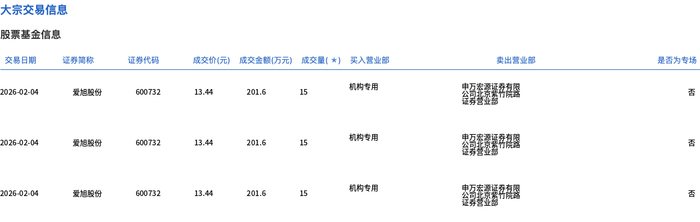
爱旭股份今日大宗交易折价成交600万股,成交额8064万元
Xin Lang Cai Jing· 2026-02-04 09:35
| 交易日期 | 适券简称 | 证券代码 | | | 成交价(元) 成交金额(万元) 成交量(*) 买入营业部 | | 类出营业部 | 是否为专场 | | --- | --- | --- | --- | --- | --- | --- | --- | --- | | 2026-02-04 | 爱旭股份 | 600732 | 13.44 | 201.6 | 15 | 机构专用 | 容量: | 143 | | 2026-02-04 | 爱想脸份 | 600732 | 13.44 | 201.6 | 15 | 机构专用 | 2017 - 12 | る | | 2026-02-04 | 爱旭股份 | 600732 | 13.44 | 201.6 | 15 | 机构专用 | 藝百年最大學 | 중 | 2月4日,爱旭股份大宗交易成交600万股,成交额8064万元,占当日总成交额的6.13%,成交价13.44 元,较市场收盘价14.77元折价9%。 | 交易日期 | 证券間称 | 证券代码 | | | 成交价(元) 成交金额(万元) 成交量(*) 买入营业部 | | 类出管业部 | 是否为专场 | | --- | --- ...

航天+AI跨界整合引爆赛道,SpaceX合并xAI打开太空光伏增量,中国企业凭硬核实力扩份额,出海提速筑牢2026增长根基
Xin Lang Cai Jing· 2026-02-03 12:52
Group 1 - Company Sunlight Power (300274) is a leading domestic enterprise in photovoltaic inverters, covering the entire industry chain including energy storage systems and photovoltaic power station development [1][43] - The company has strong technical capabilities in power electronics and system integration, with products suitable for various applications including residential, commercial, and large-scale ground power stations [1][43] - In the space photovoltaic and computing power sector, Sunlight Power's technology can be adapted for space applications, providing stable power support for space computing centers [1][43][44] Group 2 - Longi Green Energy (601012) is a leading domestic photovoltaic company focusing on the research and production of monocrystalline silicon rods and wafers, with a complete vertical integration in the industry chain [2][45] - The company excels in new generation high-efficiency battery technologies such as N-type TOPCon and HJT, with significant cost control and technical advantages [2][45] - Longi's ultra-thin silicon wafer technology meets the stringent requirements for space photovoltaic components, enabling reduced weight and improved energy efficiency for space computing centers [2][45] Group 3 - Tongwei Co., Ltd. (600438) is a dual leader in photovoltaic silicon materials and battery production, with a strong focus on high-purity crystalline silicon and photovoltaic battery manufacturing [3][46] - The company has a high market share in high-purity silicon production and is well-positioned to meet the rigorous standards required for space photovoltaic components [3][46] - Tongwei's efficient battery technology can enhance power generation in space photovoltaic applications, positioning the company as a key supplier in the space photovoltaic supply chain [3][46] Group 4 - Deye Technology (605117) is a quality enterprise with core businesses in dehumidification equipment and photovoltaic energy storage systems, excelling in household and commercial energy storage solutions [4][43] - The company's energy storage technology is crucial for providing stable energy supply in space photovoltaic applications, addressing intermittent power generation issues [4][43][44] - Deye's experience in developing equipment for extreme environments positions it well to adapt products for space applications [4][43] Group 5 - Jingcheng Machinery (300316) is a leading domestic enterprise in photovoltaic crystal growth equipment, focusing on high-end equipment for photovoltaic manufacturing [5][6] - The company's technology supports the production of high-purity silicon crystals and ultra-thin silicon wafers, essential for space photovoltaic components [5][6] - As the space photovoltaic industry matures, Jingcheng is expected to provide core manufacturing equipment for the space photovoltaic supply chain [5][6] Group 6 - Maiwei Co., Ltd. (300751) is a leading enterprise in photovoltaic battery equipment, specializing in HJT and perovskite tandem battery technologies [7][41] - The company's equipment is crucial for the mass production of high-efficiency batteries that meet the stringent requirements of space photovoltaic applications [7][41] - Maiwei's technology can support the development of space-specific battery manufacturing equipment, enhancing energy system efficiency for space computing centers [7][41] Group 7 - Foster (603806) is a global leader in photovoltaic packaging materials, focusing on EVA and POE films, with a strong market presence [8][43] - The company's packaging materials are essential for ensuring the durability and performance of photovoltaic components in extreme space environments [8][43] - Foster aims to develop specialized packaging materials for space applications, enhancing the reliability of space photovoltaic systems [8][43] Group 8 - JinkoSolar (002459) is a global leader in photovoltaic modules, with a comprehensive business model covering silicon wafers, battery cells, and modules [10][43] - The company has a strong technical foundation and global production capabilities, allowing it to meet diverse application needs [10][43] - JinkoSolar's module manufacturing technology is well-suited for space applications, with the potential to become a core supplier for space photovoltaic systems [10][43] Group 9 - TCL Zhonghuan (002129) is a core enterprise in the silicon wafer sector, focusing on monocrystalline silicon materials and semiconductor materials [12][43] - The company's high-purity silicon technology is critical for space photovoltaic components, meeting the stringent requirements for purity and performance [12][43] - TCL Zhonghuan is positioned to develop space-specific silicon products, enhancing its role in the space photovoltaic supply chain [12][43] Group 10 - Aerospace Electromechanical (600151) is a leading enterprise in the integration of aerospace and photovoltaic technologies, covering the entire industry chain from component manufacturing to power station operation [19][43] - The company's aerospace power technology can be directly applied to space photovoltaic systems, providing essential energy management solutions [19][43] - With its experience in satellite systems, Aerospace Electromechanical is well-positioned to participate in the development of space computing centers [19][43]




A股异动丨太空光伏概念走强,福斯特涨停,钧达股份涨超7%
Sou Hu Cai Jing· 2026-02-03 03:46
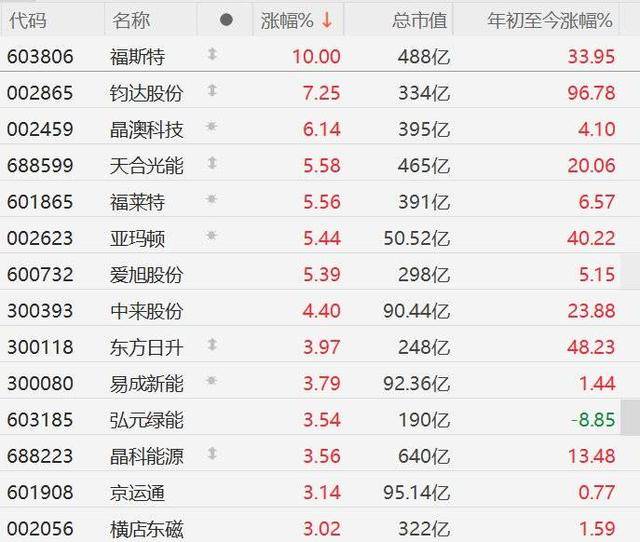
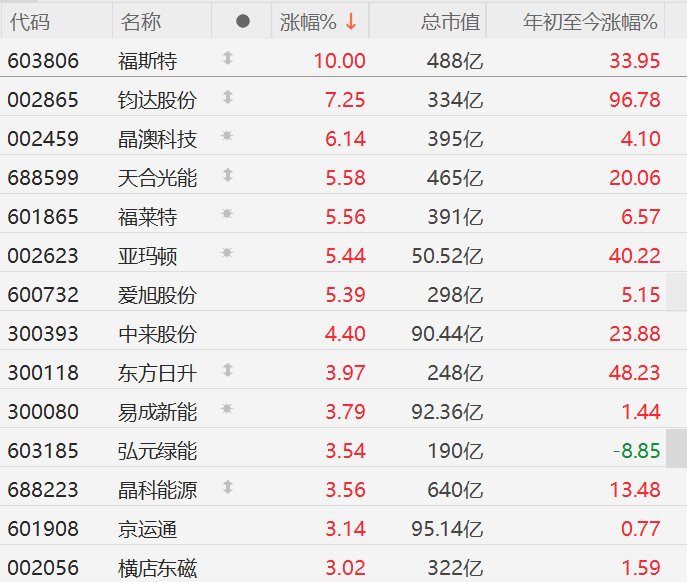
Core Viewpoint - The A-share market is witnessing a surge in space photovoltaic concept stocks, driven by the strategic importance of space-based artificial intelligence and the global competition for low Earth orbit resources [1] Group 1: Market Performance - Foster (福斯特) reached a limit-up increase of 10%, with a total market value of 48.8 billion and a year-to-date increase of 33.95% [2] - Junda Co. (钧达股份) rose by 7.25%, with a market value of 33.4 billion and a year-to-date increase of 96.78% [2] - JA Solar Technology (晶澳科技) increased by 6.14%, with a market value of 39.5 billion and a year-to-date increase of 4.10% [2] - Trina Solar (天合光能) saw a rise of 5.58%, with a market value of 46.5 billion and a year-to-date increase of 20.06% [2] - Other notable increases include: - Flat Glass Group (福莱特) at 5.56% [2] - Yamaton (亚玛顿) at 5.44% [2] - Aiko Solar (爱旭股份) at 5.39% [2] - Zhonglai Co. (中来股份) at 4.40% [2] Group 2: Industry Insights - CITIC Securities emphasizes that space photovoltaics are not merely speculative but are on the verge of large-scale deployment, driven by new demands from "space computing power + AI" and the ongoing competition for low Earth orbit resources [1] - The development of space photovoltaics is linked to national strategic needs for satellite deployment, communication capabilities, and the integration of computing power and AI [1] - CICC notes that with the booming commercial space sector, space photovoltaics are becoming a core direction for upgrading power systems, moving towards a new phase of technological advancement and industrial delivery [1]


太空光伏概念走强,福斯特涨停,钧达股份涨超7%
Ge Long Hui· 2026-02-03 02:32
2月3日,A股市场太空光伏(核心股)概念股走强,其中,福斯特涨停,钧达股份涨超7%,晶澳科技 涨超6%,天合光能、福莱特、亚玛顿、爱旭股份涨超5%,中来股份涨超4%。SpaceX称,基于太空的 人工智能是扩大该技术规模的唯一途径。 中信证券指出,太空光伏(核心股)并非炒作,正在进入规模化部署的前夜。太空光伏的爆发,不仅源 于"太空算力(核心股)+AI"的新需求,更深层的驱动力,是全球正在激烈上演的"低轨轨道资源争夺 战"。中国加速部署卫星星座,首先是战略占轨,其次是构建通信能力,最后才是在此基础上叠加算力 与AI。太空光伏它始于国家战略的紧迫占轨,成于通信星座的大规模部署,爆发于AI算力的能源革 命。这不是PPT故事,而是一条清晰的"轨道→通信→算力"演进链条。 中金指出,商业航天(核心股)蓬勃发展背景下,太空光伏(核心股)作为其电源系统升级的核心方 向,在星座批量组网的牵引下正迈向技术路线升级与产业化交付的新阶段。随着我国低轨星座进入密集 部署期、单星功率持续上行叠加太空算力(核心股)等新应用场景推进探索,建议把握太空光伏带来的 全产业链变革,持续关注制造产业端落地密集催化。 | 代码 | 名称 | | 涨 ...



潍柴“第二增长曲线”:破界崛起!
Sou Hu Cai Jing· 2026-02-02 14:33
Core Viewpoint - Weichai Group has achieved a remarkable performance with a total revenue of 355 billion yuan in 2025, marking a 14% year-on-year increase and setting a new historical high despite industry cycle adjustments and intensified global competition [1] Group 1: Revenue Growth and Business Structure - The revenue growth is driven by a "dual-engine" model, where traditional power continues to provide stable support while new business segments have emerged as strong growth engines [1][3] - The power energy business, centered on SOFC and high-end power generation, has positioned itself in the global market through advanced technology [3][5] Group 2: Strategic Developments - The strategic rise of Weichai's power energy business has been recognized as the seventh strategic segment of Shandong Heavy Industry Group, indicating its importance as a core growth driver for the future [5] - Weichai has established two high-value pillars: SOFC distributed energy for future needs and high-end power for data centers, leveraging its traditional advantages [5][7] Group 3: Market Opportunities and Innovations - The breakthroughs in SOFC technology and high-capacity diesel generators have capitalized on the global demand for efficient, low-carbon, and stable power solutions, particularly in the data center sector [7][9] - Weichai's sales of power generation products exceeded 100,000 units, placing it among the top three globally, demonstrating the effectiveness of its new business strategies [9] Group 4: Competitive Advantages and Systematic Solutions - Weichai's competitive advantage is shifting from providing single high-performance products to developing high-barrier systematic solution capabilities, built on decades of core competencies in the power sector [10] - The integration of SOFC technology with data center solutions and the establishment of a smart monitoring platform have created a feedback loop that enhances service value and product iteration [9][10] Group 5: Future Directions and Industry Impact - Weichai's strategic new business initiatives are not only creating a growth curve that transcends cycles but also exploring new pathways for value enhancement in the Chinese commercial vehicle industry [10] - The ultimate goal is to cultivate a globally competitive leader in energy and power system technologies from the largest commercial vehicle market [10]
港股异动 | 光伏股再度走低 白银涨价挤压光伏企业利润 多家公司发布盈警公告
智通财经网· 2026-01-30 03:25
Core Viewpoint - The photovoltaic sector is experiencing a decline, with several key companies reporting significant losses for 2025, primarily attributed to rising silver prices impacting production costs [1] Group 1: Company Performance - Companies such as Rainbow New Energy, Flat Glass Group, Xinyi Solar, and New Special Energy have seen their stock prices drop significantly, with declines ranging from 3.54% to 6.45% [1] - Tongwei Co., Longi Green Energy, and Aiko Solar have all issued profit warnings for 2025, indicating a loss due to increased costs associated with silver and other raw materials [1] Group 2: Cost Factors - Longi Green Energy highlighted that the costs of silver paste and silicon materials surged in Q4, leading to increased production costs for silicon wafers, batteries, and modules [1] - Tongwei Co. also cited the continuous rise in prices of core raw materials, including silver, as a reason for their anticipated losses [1] Group 3: Industry Response - The photovoltaic industry is actively seeking to mitigate the impact of rising silver prices by accelerating plans to replace silver with cheaper materials like copper [1] - Silver paste currently accounts for 29% of the total cost of solar modules, a significant increase from 3.4% in 2023 and 14% the previous year [1]
