
AikoSolar(600732)

Search documents
马斯克力挺!太空光伏概念暴涨,爱旭股份、钧达股份等涨停
Ge Long Hui· 2026-01-23 02:42
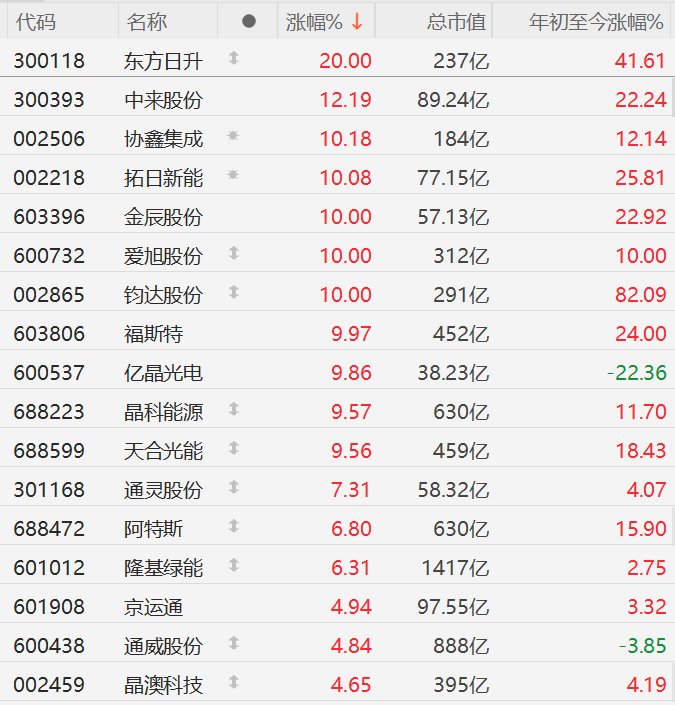
Group 1 - The core viewpoint of the news is the significant surge in A-share market stocks related to space photovoltaic concepts, driven by Elon Musk's support for space solar energy during the World Economic Forum [1][2] - Tesla and SpaceX aim to achieve an annual solar manufacturing capacity of 100GW within the next three years, indicating a strong commitment to solar energy production [1] - The space photovoltaic energy sector is seen as a strategic solution for commercial aerospace and high-end applications, marking a pivotal moment for the industry [1][2] Group 2 - Over 200,000 satellite constellation applications have been submitted in China, signaling a new phase of large-scale deployment in commercial aerospace, which will boost long-term demand for space photovoltaic technology [2] - The technology evolution in space photovoltaic is expected to progress from high-efficiency gallium arsenide to scalable silicon-based HJT, and eventually to perovskite tandem cells [2] Group 3 - Notable stock performances include: - Dongfang Risen (300118) with a 20% increase and a market cap of 23.7 billion [3] - Zhonglai Co. (300393) rising by 12.19% with a market cap of 8.9 billion [3] - Xiexin Integration (002506) up by 10.18% with a market cap of 18.4 billion [3] - Other companies like Tuo Ri New Energy (002218) and Jin Da Co. (002865) also saw significant gains [3]


A股异动丨马斯克力挺!太空光伏概念暴涨,爱旭股份、钧达股份等涨停
Ge Long Hui A P P· 2026-01-23 02:42
Group 1 - The A-share market has seen a significant surge in space photovoltaic concept stocks, with companies like Maiwei Co., Ltd. and Dongfang Risheng hitting the daily limit of 20%, while Zhonglai Co., Ltd. rose over 12% [1] - Tesla CEO Elon Musk expressed strong support for space photovoltaics during a discussion at the World Economic Forum, revealing plans for a solar manufacturing capacity of 100GW annually within three years [1] - Huaxi Securities highlighted that space photovoltaic energy involves utilizing solar technology in outer space to supply energy, marking a strategic solution for commercial aerospace and high-end applications [1] Group 2 - Shenwan Hongyuan's report indicated that over 200,000 satellite constellation applications have been submitted in China, signaling a new phase of large-scale deployment in commercial aerospace, which will drive long-term demand for space photovoltaics [2] - The technology evolution path for space photovoltaics is expected to transition from high-efficiency gallium arsenide to large-scale silicon-based HJT, and eventually to perovskite tandem cells [2] Group 3 - A detailed table of stock performance shows significant gains for various companies, with Dongfang Risheng at a 20% increase and a total market value of 23.7 billion, while Zhonglai Co., Ltd. has a market value of 8.9 billion and a year-to-date increase of 22.24% [3] - Other notable performers include Xiexin Integration with a 10.18% increase and a market value of 18.4 billion, and Tuorich New Energy with a 10.08% increase and a market value of 7.7 billion [3] - The overall trend indicates a positive momentum in the sector, with many companies experiencing substantial year-to-date gains, reflecting investor optimism in the space photovoltaic market [3]


光伏产业链延续强势,迈为股份等多只个股涨停
Mei Ri Jing Ji Xin Wen· 2026-01-23 02:25
Group 1 - The photovoltaic industry chain continues to show strong performance, with Maiwei Co., Ltd. (300751) hitting a 20% limit up [1] - JunDa Co., Ltd. (002865), Aisxu Co., Ltd. (600732), and Foster (603806) also reached a 10% limit up [1] - Jiejia Weichuang (300724) increased by over 17%, while Jingsheng Mechanical and Electrical (300316) rose by over 13% [1]


光伏龙头企业“亏损潮”延续,专家:2026年三四月份有望迎来拐点
Hua Xia Shi Bao· 2026-01-22 09:35
Core Viewpoint - The photovoltaic industry is experiencing significant losses across all major segments, with a call for recovery and improvement in profitability by 2026, focusing on asset management and pricing power [2][11]. Group 1: Industry Performance - The photovoltaic sector is in a "dark moment," with all major segments, including silicon materials, wafers, cells, and modules, reporting losses [2]. - The overall performance of the industry is characterized by high inventory and weak demand, despite some signs of recovery in silicon material prices [3]. - The integrated companies face significant pressure, with a notable decline in profitability due to rising costs of key materials like silver paste [3][6]. Group 2: Company-Specific Insights - Daqo New Energy forecasts a net loss of 1 to 1.3 billion yuan for 2025, but with a reduced loss margin of 52.17% to 63.21% year-on-year due to improved operational efficiency [3]. - Longi Green Energy expects a net loss of 6 to 6.5 billion yuan, a reduction of over 2 billion yuan compared to the previous year, driven by increased production efficiency [5]. - Junda Co. anticipates a net loss of 1.5 to 1.2 billion yuan, significantly higher than the previous year's loss of 590 million yuan, citing supply-demand imbalance and price transmission issues [4]. Group 3: Component and Equipment Sector - Companies focusing on Bifacial (BC) modules, such as Aiko Solar, are seeing a significant reduction in losses, with expected losses narrowing from 5.319 billion yuan to between 1.9 billion and 1.2 billion yuan [5]. - The equipment sector, represented by Aotai Technology, is also facing declines, with expected revenue dropping by 26.71% to 30.50% year-on-year [8]. - Silver paste manufacturer Dike Co. is projected to shift from profit to loss, with expected losses of 200 to 300 million yuan due to rising silver prices [9]. Group 4: Future Outlook - The industry is still in a phase of "deleveraging and capacity reduction," but there are signs of recovery in upstream segments, with discussions about potential profitability improvements in 2026 [11][12]. - Aiko Solar reports that its ABC module sales volume is expected to double, indicating a positive trend despite overall losses [12]. - Analysts predict that the industry may see a shift from supply-demand pricing to cost-based pricing by early 2026, potentially improving profit margins significantly [12].




行业寒冬叠加银价暴击,12家光伏龙头集体“失血”超500亿
Xin Lang Cai Jing· 2026-01-22 08:03
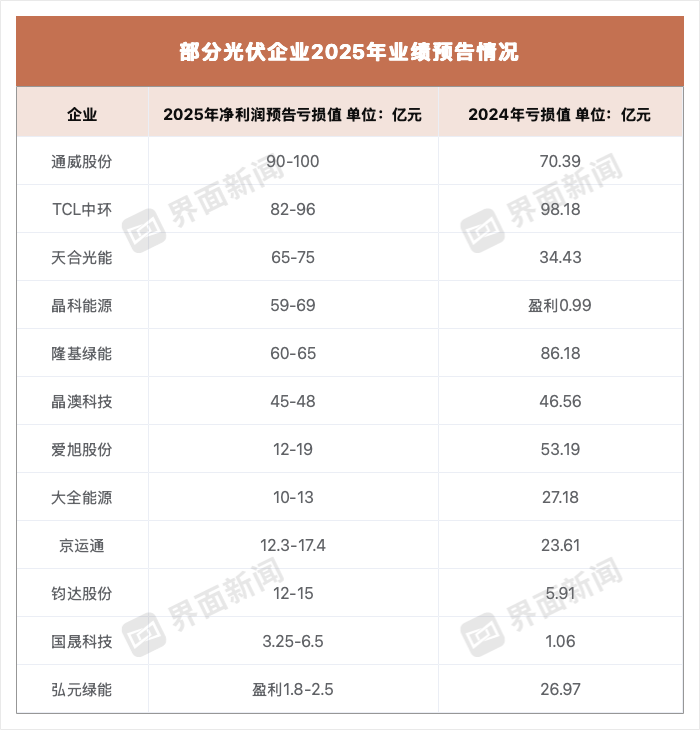
Core Viewpoint - The photovoltaic industry continues to face significant challenges, with major companies reporting substantial losses, totaling over 500 billion yuan, except for Hongyuan Green Energy, which is the only profitable entity among the analyzed firms [1][2]. Group 1: Financial Performance - Among 12 major photovoltaic companies, only Hongyuan Green Energy reported a profit, while the others collectively faced losses exceeding 500 billion yuan [1]. - Tongwei Co. is projected to incur the largest loss in 2025, estimated between 90-100 billion yuan, followed by TCL Zhonghuan and Trina Solar, with losses of 82-96 billion yuan and 65-75 billion yuan, respectively [2]. - JinkoSolar is expected to report a loss of 59-69 billion yuan for the previous year, while it anticipates a slight profit in 2024 [6][8]. Group 2: Cost Pressures - The rising prices of silver and silicon materials have significantly increased production costs for photovoltaic companies, with silver paste becoming a major cost component, accounting for approximately 17% of module costs [3][5]. - Silver prices have surged over 230% since the beginning of 2025, contributing to the financial strain on companies like Longi Green Energy and Trina Solar [5]. Group 3: Company Strategies and Developments - Longi Green Energy and TCL Zhonghuan have shown the most significant reduction in losses among leading firms, with Longi reducing its losses by nearly 20 billion yuan due to improved production yields and the development of alternative materials [10]. - Hongyuan Green Energy has successfully turned a profit, projecting a net profit of 1.8-2.5 billion yuan for 2025, attributed to its vertically integrated supply chain strategy [14][15]. - JinkoSolar and Trina Solar have both highlighted advancements in their energy storage businesses, indicating a potential area for growth despite current losses [8].





“印钞机”变“碎钞机”,光伏集体巨亏
投中网· 2026-01-22 06:06
Core Viewpoint - The photovoltaic industry is undergoing a significant restructuring, with major companies expected to report substantial losses in 2025 due to overcapacity, price wars, and rising raw material costs [5][10][12]. Group 1: Industry Overview - Trina Solar forecasts a loss of 65-75 billion yuan for 2025, contributing to a total expected loss of over 600 billion yuan across the photovoltaic sector [5][10]. - The entire industry chain, from upstream silicon materials to downstream components, is experiencing collective losses, with the gross profit margin for polysilicon dropping to -6.30% in the first half of 2025, compared to 73% in 2022 [12][13]. - The price of silver has surged by 140% over two years, further compressing profits as component prices have fallen below cash cost levels [6][14][16]. Group 2: Key Indicators for Industry Restructuring - Analysts suggest monitoring three key indicators for the industry's clearing process: energy consumption, conversion efficiency, and profit margins [7][19]. - The industry is expected to enter a brutal elimination phase in 2026, focusing on energy efficiency, technology, and cost [8][18]. Group 3: Company Performance and Differentiation - Major companies like LONGi Green Energy and Tongwei Co. are projected to incur significant losses, but some are showing signs of reduced losses compared to previous years [21]. - TCL Zhonghuan is facing challenges due to high energy consumption and outdated production processes, leading to a decline in competitiveness [21][23]. - Companies are investing in new technologies, such as LONGi's focus on BC cell technology and Tongwei's optimization of silicon material costs, to prepare for the upcoming technological competition in 2026 [25].


爱旭股份跌2.03%,成交额6713.24万元,主力资金净流出281.78万元
Xin Lang Cai Jing· 2026-01-22 01:57
Core Viewpoint - Aixiang Co., Ltd. has experienced a decline in stock price and significant changes in shareholder structure, while showing strong revenue growth but negative net profit for the year 2025 [1][2]. Group 1: Stock Performance - As of January 22, Aixiang's stock price fell by 2.03% to 13.00 CNY per share, with a trading volume of 67.13 million CNY and a turnover rate of 0.28%, resulting in a total market capitalization of 27.524 billion CNY [1]. - Year-to-date, Aixiang's stock has decreased by 2.99%, with a 4.13% drop over the last five trading days, a 0.08% change over the last 20 days, and a 13.04% decline over the last 60 days [1]. Group 2: Financial Performance - For the period from January to September 2025, Aixiang reported a revenue of 11.597 billion CNY, representing a year-on-year growth of 46.86% [2]. - The company recorded a net profit attributable to shareholders of -532 million CNY, which is an increase of 81.20% compared to the previous period [2]. Group 3: Shareholder Structure - As of September 30, 2025, Aixiang had 70,700 shareholders, a decrease of 9.57% from the previous period, with an average of 22,418 circulating shares per shareholder, an increase of 10.58% [2]. - The top ten circulating shareholders include Hong Kong Central Clearing Limited as the third-largest shareholder with 36.76 million shares, an increase of 3.73 million shares, and Invesco Great Wall New Energy Industry Stock A as the fourth-largest with 26.22 million shares, an increase of 675,920 shares [3].
中信建投:预计白银供需长期紧平衡 银价高企倒逼产业变革
Zhi Tong Cai Jing· 2026-01-22 01:52
Core Viewpoint - The recent increase in silicon and silver prices has intensified profit pressure on photovoltaic (PV) cell and module companies, making the reduction of silver consumption a pressing issue for these firms [1][3]. Supply and Demand Analysis - Silver has been in a supply-demand gap since 2019, with a long-term expectation of tight balance due to rigid supply and emerging applications [2]. - The supply side is constrained by limited mining output and slow growth in recycling, with over 80% of silver supply coming from mining [2]. - On the demand side, the resilience of photovoltaic demand, along with growth in AI computing and automotive electronics, is expected to influence silver supply-demand balance significantly [2]. Cost Pressure and Alternatives - The cost of silver paste has reached 19.3% of module costs, making it the largest cost component [2]. - Copper is identified as the most suitable alternative to silver, although challenges such as oxidation and diffusion need to be addressed [3][4]. - Current advancements in silver-coated copper and electroplated copper are promising, with silver-coated copper showing rapid progress and lower capital expenditure [4][5]. Technological Developments - Silver-coated copper has been successfully tested in HJT cells, reducing metallization costs significantly [5]. - The TOPCon cell technology is exploring a dual printing and sintering approach to mitigate the risks associated with high-temperature processes [5]. - Electroplated copper technology is advancing, with significant production progress reported by leading companies [6]. Investment Opportunities - The rapid increase in the penetration of silver-coated copper and copper paste is expected to provide substantial profit elasticity for paste and metal powder companies [7]. - Companies like Juhua Materials and Dike Co., which focus on silver paste, are well-positioned to benefit from the transition to copper alternatives [8]. - Metal powder companies such as BQian New Materials are also expected to see significant growth due to their unique offerings in the copper powder market [8].


【转|太平洋新能源-光伏26年度策略】反内卷加速供需重塑,重视新技术、新场景
远峰电子· 2026-01-21 13:02
Group 1 - The core viewpoint of the article emphasizes that the "anti-involution" trend is reshaping supply and demand in the photovoltaic (PV) industry, accelerating the parity of solar storage in core markets and opening up new scenarios for future demand [1][3][5] - Global demand for solar energy is expected to grow significantly, with projected new installations of approximately 600GW in 2025 and 610GW in 2026, reflecting year-on-year growth rates of about 13.21% and 1.67% respectively [3][6] - The domestic and overseas production capacity is rapidly increasing, leading to a significant oversupply in the PV industry, which has resulted in continuous price declines and losses for many companies [5][6] Group 2 - The penetration rate of low-silver and silver-free technologies is expected to rise quickly, with leading companies likely to recover profitability ahead of the industry [1][22] - The article highlights that the profitability of auxiliary material companies is expected to improve as they diversify their business, with a focus on non-PV sectors [1][36] - The article identifies key beneficiaries in the market, including companies that lead in low-silver and silver-free technology iterations, such as Longi Green Energy and JinkoSolar, which are expected to benefit from cost advantages [1][46] Group 3 - The article discusses the impact of rising silver prices on the cost structure of solar cell manufacturers, indicating that the cost of silver paste is becoming a critical factor for cost reduction [22][23] - The introduction of new technologies, such as high-copper and pure copper solutions, is accelerating in the industry, which is expected to enhance efficiency and reduce costs [25][27] - The demand for space photovoltaics is anticipated to grow due to an increase in space launch missions, with a projected 263 launches in 2024, indicating a strong short-term demand for solar wings in low Earth orbit [29] Group 4 - The article notes that the profitability of battery materials is expected to improve as the pressure from the main chain eases, with low-silver and silver-free iterations likely to bring new benefits [36][39] - The photovoltaic glass sector is also expected to see a recovery in profitability due to industry self-discipline and a reduction in supply, with prices showing signs of recovery [41][46] - The article concludes with investment recommendations, suggesting that companies leading in low-silver and silver-free technology, as well as those involved in energy storage, are well-positioned to benefit from the ongoing market changes [46]

光伏行业遭遇寒冬,触底反弹“风向标”何在?
Guo Ji Jin Rong Bao· 2026-01-20 14:20
Industry Overview - The photovoltaic industry is facing a financial crisis, with nearly ten leading companies reporting significant losses for 2025, indicating a downturn across the entire supply chain [1] - The industry is experiencing overcapacity and intense competition, leading to a decline in profitability despite a surge in installation capacity driven by policy changes [1][8] - The cancellation of export tax rebates starting April 1, 2026, is expected to increase cost pressures on companies, intensifying competition and survival challenges [1][10] Company-Specific Insights - Tongwei Co., Ltd. anticipates a net loss of 90 to 100 billion yuan for 2025, marking a significant increase from a loss of 70.39 billion yuan in the previous year, potentially making it the largest loss among disclosed forecasts [3] - Longi Green Energy expects a net loss of 60 to 65 billion yuan for 2025, showing signs of recovery compared to a loss of 85.92 billion yuan the previous year [6] - JA Solar Technology is projected to incur a net loss of 45 to 48 billion yuan, which may impact its employee incentive plans due to a significant gap between performance targets and actual results [4] - Aiko Solar anticipates a reduced loss of 12 to 19 billion yuan for 2025, down from 53.19 billion yuan, attributed to increased sales of high-value products [6] - Daqo New Energy expects a net loss of 10 to 13 billion yuan, while other companies like Junda and Shichuang Energy also project losses due to supply-demand imbalances [7] Market Dynamics - The solar power sector's new installations reached 274.89 GW from January to November 2025, nearing the total for 2024, with expectations to exceed 300 GW for the year [2] - The industry is witnessing a trend of mergers and acquisitions as companies face survival pressures due to limited funding sources [2][12] - The overall industry is characterized by a significant mismatch between supply and demand, with production capacity far exceeding actual market needs [8] Future Outlook - Analysts predict that the cancellation of export tax rebates will lead to increased operational pressures in the short term but may encourage a shift towards value competition in the long term [10][11] - The industry is expected to undergo a significant restructuring phase in 2026, with potential for a rebound if excess capacity is reduced and supply-demand balance is restored [12][13]
