Industrial Securities(601377)

Search documents
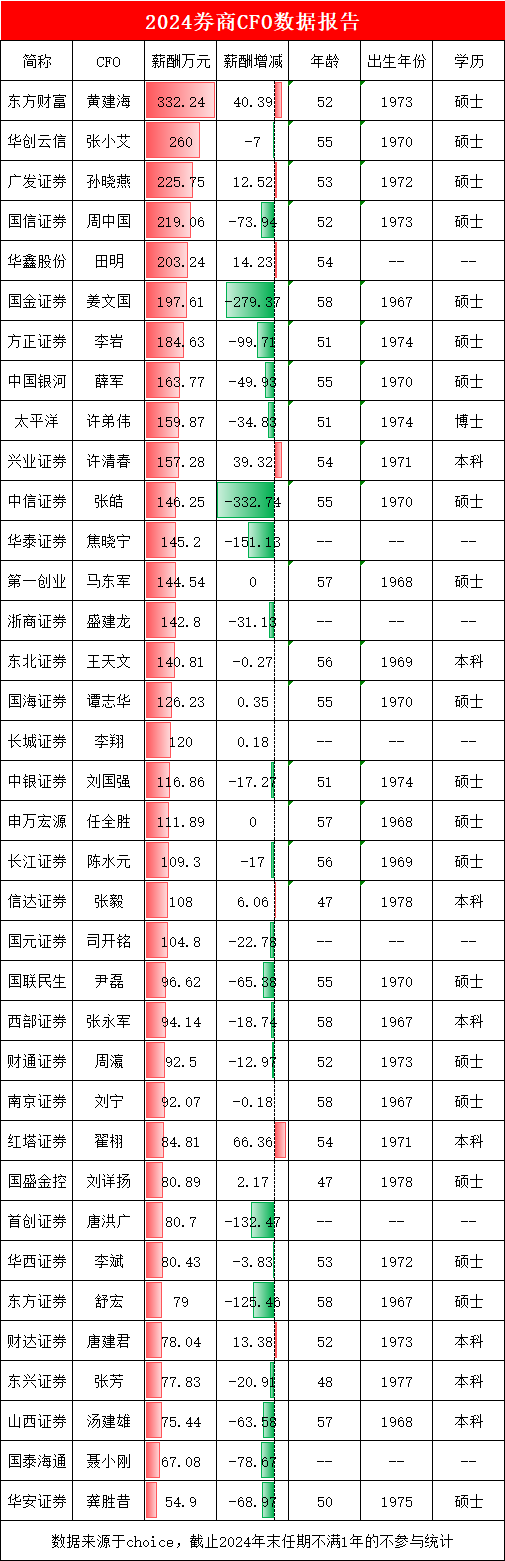
券商CFO盘点:兴业证券财务总监许清春本科学历同行中并列最低,年薪157万比中信证券财务负责人张皓高11万
Xin Lang Zheng Quan· 2025-08-04 05:38
Core Insights - The total salary of CFOs in A-share listed companies for 2024 reached 4.27 billion yuan, with an average annual salary of 814,800 yuan [1] - The highest-paid CFO in the securities industry is Huang Jianhai from Dongfang Caifu, earning 3.32 million yuan, while the lowest is Gong Shengxi from Huazhong Securities, earning 549,000 yuan [3][4] Summary by Category CFO Salary Overview - The total salary for CFOs in A-share listed companies is 4.27 billion yuan, with an average salary of 814,800 yuan [1] - In the securities sector, the top ten CFOs have varying salaries, with the highest being 3.32 million yuan and the lowest at 549,000 yuan [3][4] Individual CFO Profiles - Xu Qingchun, CFO of Industrial Securities, has a salary of 1.57 million yuan, ranking tenth in the industry [1] - Xu Qingchun holds a bachelor's degree, which is the lowest educational qualification among the top ten CFOs, yet his salary exceeds that of Zhang Hao from CITIC Securities by 110,000 yuan [1][2] Salary Changes and Trends - The salary of Huang Jianhai increased by 40.39% compared to the previous year, while Zhang Xiaai from Huachuang Yuxin saw a decrease of 7% [3] - The salary of the CFOs in the top ten positions reflects significant fluctuations, with some experiencing substantial increases while others faced declines [3][4]



现代投资银行进化系列之二:海外投行参与数字金融启示录
Guoxin Securities· 2025-08-04 02:23
Investment Rating - The report maintains an "Outperform" rating for the industry [3][5]. Core Insights - The overseas investment banks are increasingly participating in digital finance, with emerging models continuously surfacing. The focus is on the issuance and trading of digital assets, particularly Real World Assets (RWA), which signify a transformation of traditional investment banking into the digital finance realm. The RWA market has grown from approximately $5 billion in 2022 to about $25.2 billion by July 2025, indicating a shift from experimental stages to large-scale promotion [1][12]. - The RWA market is projected to reach $16 trillion by 2030, accounting for about 10% of global GDP, driven by factors such as rising global interest rates, institutional involvement in crypto assets, and improving regulatory policies [1][17]. Summary by Sections RWA: Bridging On-chain Funds and Real Assets - RWA represents tangible or traditional financial assets on blockchain networks, enhancing liquidity and enabling fractional ownership, thus democratizing access to previously high-barrier investments [12][16]. - The RWA market has seen rapid growth, with a total market size reaching $25.4 billion by mid-2025, driven by technological advancements and traditional financial institutions' involvement [12][13]. RWA Token Types and Development Momentum - The RWA token landscape includes various types, with U.S. Treasury tokens being a significant category due to their low-risk profile and established legal framework. The market for tokenized U.S. Treasuries grew from $100 million in January 2023 to $6.74 billion by July 2025 [22][23]. - Private credit tokens have emerged as the largest segment within RWA, with a market size of $15 billion as of July 2025, driven by their high yield and low correlation with other asset classes [27][28]. - Commodity tokens, particularly gold tokens, dominate the commodity tokenization market, which reached $1.75 billion by July 2025 [31][32]. Stock Tokens: Comparison of Tokenization Models - Stock tokenization is rapidly evolving, with platforms like Robinhood and xStocks offering different models. Robinhood's model is based on derivative contracts, while xStocks provides direct ownership representation through compliant third-party custodians [39][50]. - The largest stock token, EXOD, represents a company specializing in crypto wallets, with a market cap of approximately $277.1 million [41]. Investment Recommendations - The report suggests that Robinhood's approach to virtual asset-related business could serve as a reference for Chinese brokerage firms entering this space. The rapid development of RWA may catalyze further market activity in the brokerage sector, indicating potential for significant returns [3][4].





关于代销机构兴业证券暂停销售农银汇理旗下 部分基金的公告
Zhong Guo Zheng Quan Bao - Zhong Zheng Wang· 2025-08-03 23:15
Group 1 - The company, Agricultural Bank of China Asset Management Co., Ltd., has reached an agreement with Industrial Securities Co., Ltd. to suspend the sale of specific money market funds starting from August 4, 2025 [1] - The affected funds include Agricultural Bank of China Tianli Money Market Fund Class D (Fund Code 023796) and Agricultural Bank of China Money Market Securities Investment Fund Class C (Fund Code 022752) [1] - The suspension also includes the halt of regular investment and conversion services for the mentioned funds [1] Group 2 - The company will provide further announcements regarding the resumption of sales in the future [1] - Investors can consult for more details through the customer service hotline of Industrial Securities or Agricultural Bank of China Asset Management [1]
【十大券商一周策略】“慢牛”行情趋势不变,新一轮行情随时可能启动
券商中国· 2025-08-03 14:52
Group 1 - The core viewpoint is that market trends dictate the behavior of dominant funds, which in turn influences the structure and model of rising industries, with a historical tendency for concentrated leading industries rather than high-cut low-rotation [2] - Recent market performance has shown a gradual focus on trend-based sectors such as AI, innovative pharmaceuticals, resources, and technology innovation board [2] - The market is expected to experience a cooling period as incremental liquidity slows down, which is necessary for stable long-term growth [2] Group 2 - In July, market risk appetite continued to recover, but high-dividend sectors were dragged down by banks, leading to a mixed performance within major indices [3] - Some stable and potential high-dividend stocks have become attractive due to their current yield, indicating a gradual emergence of configuration value [3] - The focus for August is on cyclical high-dividend stocks that are expected to perform well due to improved supply-demand structures [3] Group 3 - The market is currently undergoing a short-term adjustment after a previous breakout, with a need to refocus on main lines as the market stabilizes [4] - The adjustment phase is expected to digest economic growth rate expectations and policy shifts aimed at structural adjustments [4] Group 4 - The market is anticipated to return to a volatile state in August, with potential upward movements before the September 3 military parade [5] - Key sectors to watch include AI, robotics, and advanced manufacturing, which are expected to lead the market back to a strong mid-term position [5] Group 5 - The core logic supporting the current market trend remains intact despite recent fluctuations, with several potential catalysts on the horizon [6] - Upcoming events such as the release of GPT-5 and the September 3 military parade are expected to positively influence market sentiment [6] Group 6 - The overall bullish logic driven by liquidity remains unbroken, with expectations for the market to maintain strength in August [7] - The recommended sector focus includes undervalued large-cap tech growth, innovative pharmaceuticals, and global pricing resources [7] Group 7 - The market is expected to exhibit a rotation and supplementary rise, with particular attention on machinery and electrical equipment sectors [8] - Long-term focus areas include consumption, technological independence, and high-quality dividend stocks [8] Group 8 - The likelihood of A-shares reaching new highs in August is considered high, with a potential upward trend resuming after mid-August [9][10] - The market is expected to benefit from improved free cash flow and continued inflow of external capital [10] Group 9 - The market is currently in a phase of adjustment but remains on an upward trend, with support from various technical indicators [13] - Recommended sector allocation includes a balanced approach focusing on financials and technology growth sectors [13]

兴业证券7月美国非农点评:美国就业崩了吗?
智通财经网· 2025-08-02 23:21
Core Viewpoint - The recent non-farm payroll data indicates a decline in employment market resilience, suggesting a potential for the Federal Reserve to lower interest rates in September if inflation does not exceed expectations in the coming months [1][5]. Employment Data Analysis - The significant downward revisions of employment numbers for May and June were attributed to seasonal adjustments and new feedback from surveyed companies, with May's employment revised down by 125,000 to 19,000 and June's by 133,000 to 14,000, marking the largest revision since the pandemic [1][2]. - The employment growth is primarily supported by the education and healthcare sectors, with July adding 79,000 jobs in these areas, while other sectors showed negative growth, particularly in leisure, hospitality, and manufacturing, which lost 11,000 jobs [3][4]. Labor Market Dynamics - The duration of unemployment has increased, with a notable rise in the number of individuals receiving unemployment benefits and those unemployed for over 27 weeks since 2025, indicating a growing challenge in job recovery [3][4]. - The labor force participation rate has declined due to reduced immigration, contributing to a lower unemployment rate despite weak job growth, as the labor supply has tightened [4]. Wage Growth and Economic Outlook - Wage growth remains resilient, with average hourly earnings in the private sector increasing both year-on-year and month-on-month in July, alongside a 0.9% rise in the labor cost index for Q2 [4]. - The weak employment data enhances the feasibility of interest rate cuts, with market expectations for rate reductions increasing to approximately 2.7 times within the year, influenced by the recent employment figures and manufacturing PMI [5].
南向通扩容下的海外债新机遇
INDUSTRIAL SECURITIES· 2025-08-01 15:06
1. Report Industry Investment Rating No industry investment rating is provided in the report. 2. Core Viewpoints of the Report - The expansion of Southbound Connect and the improvement of its operating mechanism will provide new channels for domestic institutional investors to allocate overseas bonds. The expansion of participants and the improvement of the mechanism will bring new opportunities for domestic institutional investors to invest in overseas bonds. - The expansion of domestic institutional investors in Southbound Connect is expected to alleviate the unmet demand of non - bank institutions for overseas bond allocation. Non - bank institutions will have more channels to invest in overseas bonds, and the overseas bond market may see more capital inflows into high - coupon bonds such as Chinese - funded US dollar bonds and Dim Sum bonds, which may lead to a further decline in bond yields [91][92]. 3. Summary by Directory 3.1 Recent Development of Bond "Southbound Connect" - **Background and Purpose**: Southbound Connect aims to facilitate domestic institutional investors to allocate offshore bonds by strengthening the cooperation between bond market infrastructure institutions in the Mainland and Hong Kong [11]. - **Regulatory Policy Development**: It has gone through three stages: policy preparation (2017 - 2020), policy launch (2021 - 2022), and deep - opening (2023 - present). In 2025, it is proposed to expand the scope of domestic investors to non - bank institutions and improve relevant mechanisms [13][16][17]. 3.2 Operating Mechanism and Participation Methods of Southbound Connect - **Business Operation and Regulatory Mechanism**: The scope of domestic investors is currently limited to 41 banks and QDII/RQDII - qualified institutions. Investors need to open accounts through designated domestic custodian banks or bond registration and settlement institutions and open accounts in the CMU system of the Hong Kong Monetary Authority for cross - border custody. The total annual quota for all participating institutions is 500 billion yuan, and the daily quota is 20 billion yuan [24][33]. - **Current Domestic Investors Participating in Southbound Connect**: As of July 2025, the expansion policy has not been fully implemented. The investors are still limited to primary dealers (excluding non - bank institutions and rural commercial banks) and QDII/RQDII - qualified institutional investors [32]. - **Participation Process**: It includes qualification approval and account opening, and the bidding process (viewing quotation intentions, sending quotation requests, receiving responses from quotation providers, and confirming transactions). Currently, investors mainly prefer investment - grade Chinese - funded US dollar bonds and high - rated Dim Sum bonds, and the expansion of investors may change the investment preference [38][40]. 3.3 Current Investment Opportunities in Southbound Connect - **Overall Situation of Southbound Connect Sector**: The investable bonds include offshore RMB bonds (Dim Sum bonds), Hong Kong dollar bonds, and G3 currency bonds. As of July 29, 2025, the total scale of tradable bonds in the Hong Kong market was 1.2052 trillion US dollars, with 5,892 bonds. Chinese - funded US dollar bonds and Dim Sum bonds accounted for more than 70% of the investable bonds in Southbound Connect [54]. - **Focus on Dim Sum Bonds**: The scale of Dim Sum bonds has expanded significantly since 2023. As of July 17, 2025, there were 3,099 outstanding Dim Sum bonds with a total scale of 1.5449 trillion yuan. The financial services and sovereign debt sectors have a large scale. Dim Sum bonds have a higher coupon rate than domestic bonds, especially in the urban investment, real estate, and bank sectors. However, attention should be paid to their subsequent performance as the yields have declined significantly in recent months [63][64][67]. - **Focus on Chinese - funded US dollar bonds**: As of early July 2025, there were 2,009 outstanding Chinese - funded US dollar bonds with a total scale of 666.7 billion US dollars. The real estate, internet media, bank, and urban investment sectors have a large scale. The issuance of Chinese - funded US dollar bonds has slowed down since 2023, and the newly issued bonds are mainly unrated. Chinese - funded US dollar bonds have a higher coupon rate than domestic bonds, especially in the urban investment and real estate sectors. Attention should be paid to high - quality individual bonds and short - term risks [71][74][83]. 3.4 Impact of the Expansion of Domestic Institutional Investors in Southbound Connect - **For Non - bank Institutions**: The expansion of participants is expected to alleviate the unmet demand of non - bank institutions for overseas bond allocation. They can invest in overseas bonds through the Southbound Connect channel in addition to using QDII quotas [91]. - **For the Overseas Bond Market**: Non - bank institutions have a relatively more active risk preference. High - risk - return bonds such as the real estate and urban investment sectors of Chinese - funded US dollar bonds and the urban investment sector of Dim Sum bonds may receive more attention and capital inflows, which may lead to a further decline in bond yields [92].
兴业证券:“反内卷”下 哪些细分行业已经改善?
智通财经网· 2025-08-01 08:33
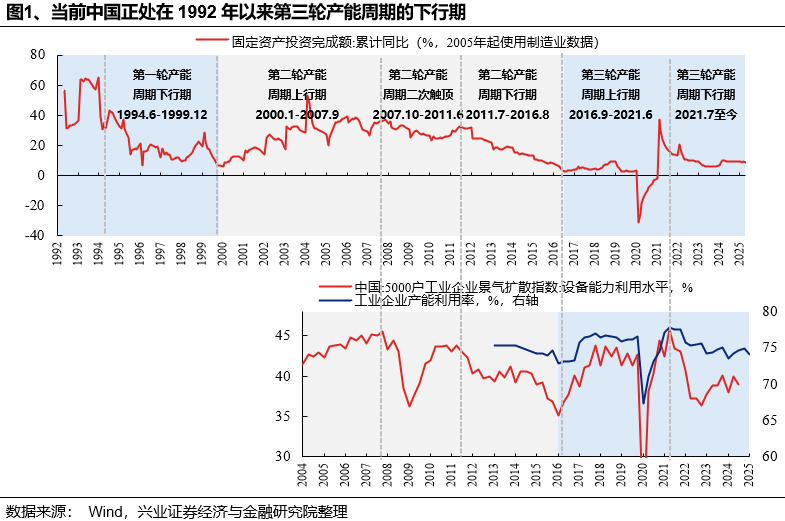
Core Viewpoint - The report from Industrial Securities emphasizes the importance of regulating low-price disorderly competition in enterprises as a key focus of recent "anti-involution" policies, highlighting the negative impact of excessive competition on prices, as evidenced by the persistent negative Producer Price Index (PPI) since October 2022 [1][23]. Group 1: Current Economic Conditions - China's current economic environment is characterized by a third round of capacity cycle downturn, having declined for approximately four years since the previous peak, with significant industry differentiation due to factors such as the pandemic and trade friction [2][8]. - The industrial capacity utilization rate has been on a downward trend since June 2021, reflecting a weakening in fixed asset investment growth in the manufacturing sector [2][8]. Group 2: Price and Capacity Dynamics - The report indicates that the current supply-side state shows clear differentiation among industries, with black metals and non-metallic minerals experiencing low capacity, output, and price levels, while emerging sectors like electrical machinery and automotive manufacturing still maintain relatively high capacity and output levels despite low price indicators [12][20]. - The "anti-involution" policy aims to break the negative cycle of "price for volume" and guide industries back to a normal capacity cycle, with two potential paths: either a slight price increase leading to natural demand decline or significant demand stimulation with substantial price increases [21][23]. Group 3: Recent Price Trends - Recent data shows that low-priced goods below historical median prices have seen significant price increases, particularly in sectors such as black metals (coking coal, steel), new energy (polysilicon, lithium), and chemicals [28][29]. - Specific price changes include coking coal increasing by 36.6% over the past month and polysilicon rising by 23.2%, indicating a recovery in certain sectors [29]. Group 4: Policy Implications - The report outlines recent policy measures aimed at preventing low-cost competition, including the introduction of a price law amendment and the emphasis on market regulation to maintain fair competition and quality standards [25][23]. - The focus on price mechanisms and the establishment of benchmark costs in key industries is expected to support the recovery of prices and stabilize market conditions [23][25].
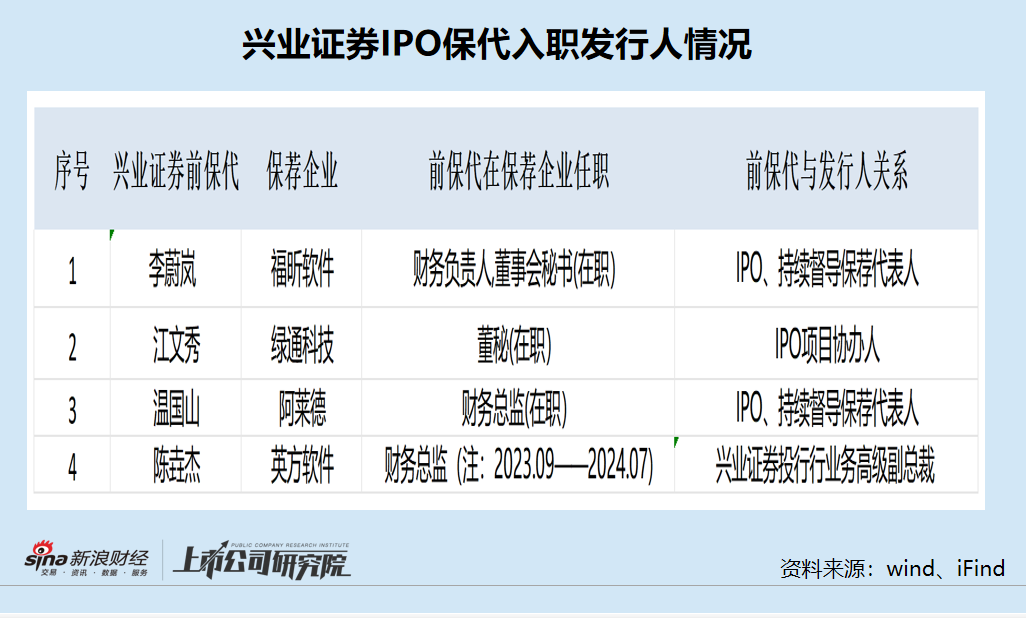
兴业证券保荐“旋转门”:频现保代火速入职问题发行人 内控“三道防线”有效性待考
Xin Lang Zheng Quan· 2025-08-01 04:52
Core Viewpoint - The recent trend of multiple investment bankers from Industrial Securities taking high-level positions in companies they previously sponsored for IPO raises concerns about the effectiveness of internal controls and the potential for financial fraud in these companies [1][3][4]. Group 1: Issues with Investment Banking Practices - Several investment bankers from Industrial Securities have joined companies they sponsored for IPOs shortly after the listings, which raises questions about the integrity of the IPO process and the effectiveness of ongoing supervision [2][3][4]. - Notable cases include Li Weilan, who became CFO and Secretary of the Board at Foxit Software shortly after its IPO, and Wen Guoshan, who took a similar role at Alade [2][3][6][7]. - The phenomenon of investment bankers transitioning to executive roles in their sponsored companies is not common, particularly within the supervision period, highlighting potential conflicts of interest [3][8]. Group 2: Financial Performance Concerns - Companies like Foxit Software and Green通科技 experienced significant profit increases before their IPOs, followed by drastic declines in performance post-listing, raising doubts about the authenticity of their financial data [9][18][21]. - For instance, Green通科技's revenue and net profit saw substantial growth from 2019 to 2022, but both metrics dropped significantly in the years following its IPO [10][11][12]. - Foxit Software's IPO was marked by a high issuance price and significant overfunding, yet it has reported continuous losses since its second year post-IPO [18][21]. Group 3: Regulatory and Internal Control Implications - The rapid movement of investment bankers to executive roles in their sponsored companies during the supervision period poses challenges to the independence of ongoing oversight and raises concerns about potential collusion [23]. - The China Securities Regulatory Commission (CSRC) has issued warnings to Industrial Securities regarding deficiencies in their internal control processes, particularly in project initiation and quality control [23]. - The CSRC's actions indicate that the effectiveness of the internal control "three lines of defense" at Industrial Securities is under scrutiny, suggesting a need for improved governance and compliance measures [23].
兴业证券股价下跌2.4% 网传收集员工子女985录取信息引争议
Jin Rong Jie· 2025-07-31 19:14
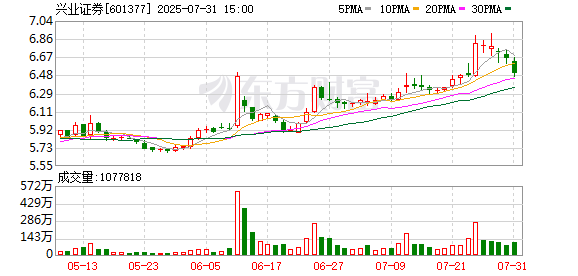
Group 1 - The stock price of Industrial Securities on July 31 was 6.50 yuan, down 0.16 yuan or 2.40% from the previous trading day [1] - The trading volume on that day was 1.0778 million hands, with a transaction amount of 706 million yuan [1] - Industrial Securities is a comprehensive securities company based in Fuzhou, Fujian Province, with business areas including securities brokerage, asset management, and investment banking [1] Group 2 - The company achieved an operating income of 12.354 billion yuan in 2024, and the net profit in the first quarter of 2025 increased by 57.32% year-on-year [1] - There are recent allegations regarding the company collecting information on employees' children admitted to 985 universities, raising concerns about potential academic discrimination [1] - As of the end of June, the company completed a change in leadership, with Su Junliang replacing Yang Huahui as the new chairman [1] Group 3 - On July 31, the net outflow of main funds from Industrial Securities was 85.7301 million yuan, accounting for 0.15% of the circulating market value [1]
传兴业证券收集员工子女985录取情况,被指反内卷言行不一
Nan Fang Du Shi Bao· 2025-07-31 14:52
近日,网传消息称兴业证券内部收集员工子女985院校录取信息,引发争议。 从网传截图来看,上述通知表明收集员工子女985院校录取信息,系"集团从组织关怀角度"的考虑。对 此,有网友吐槽说,子女不是985不值得关怀?同时,也有网友质疑,兴业证券此举或涉嫌学历歧视。 目前,兴业证券并未确认网传截图中通知的真实性,但若该通知属实,此举则显得与时下"反内卷"呼声 有些格格不入。 网传截图显示,兴业证券发布了一则内部通知,要求员工在得知子女高考录取信息后,需填写一份《员 工子女985院校录取情况收集表》并反馈至公司。 网传截图 对此,南都·湾财社记者尝试联系兴业证券,但截至发稿,未获回复。 截图称"从组织关怀的角度" 网友:子女考不上985不值得关怀? 进入2025年,一季度兴业证券营业收入达27.92亿元,同比增长17.48%;归母净利润达5.16亿元,同比 增长57.32%。 南都·湾财社记者注意到,关于"反内卷"的问题治理贯穿了2025年的时间线。在今年政府工作报告中, 就首次提出"综合整治'内卷式'竞争",此后的高层会议也多次将"内卷式竞争""低价无序竞争"等问题摆 上台面。 在高层定调"反内卷"的大背景下,不少 ...