YOFC(601869)

Search documents
港股光通讯股走强 长飞光纤光缆涨近4%
Mei Ri Jing Ji Xin Wen· 2026-01-16 01:40
Group 1 - The stock price of Changfei Optical Fiber and Cable (06869.HK) increased by 3.77% [2] - The stock price of Huiju Technology (01729.HK) rose by 1.68% [2]


通信设备板块1月15日涨0.88%,神宇股份领涨,主力资金净流出10.58亿元
Zheng Xing Xing Ye Ri Bao· 2026-01-15 08:58
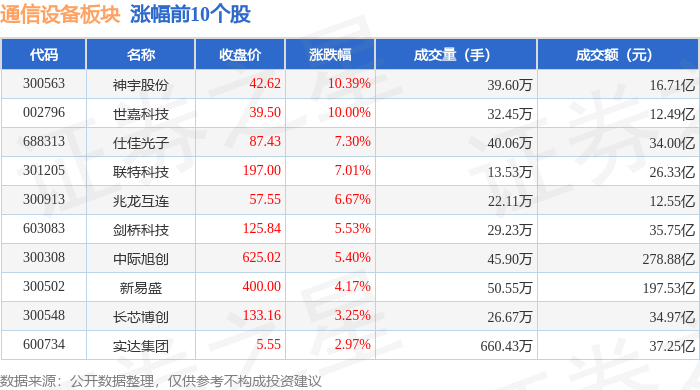
Core Viewpoint - The communication equipment sector experienced a mixed performance, with a slight overall increase of 0.88% on January 15, while the Shanghai Composite Index fell by 0.33% and the Shenzhen Component Index rose by 0.41% [1]. Group 1: Stock Performance - Shenyu Co., Ltd. led the gains in the communication equipment sector with a closing price of 42.62, reflecting a rise of 10.39% and a trading volume of 396,000 shares, amounting to a transaction value of 1.671 billion [1]. - Other notable performers included: - Sega Technology with a closing price of 39.50, up 10.00% [1]. - Shijia Photon with a closing price of 87.43, up 7.30% [1]. - Lian Te Technology with a closing price of 197.00, up 7.01% [1]. - Zhaolong Interconnect with a closing price of 57.55, up 6.67% [1]. Group 2: Declining Stocks - The sector also saw significant declines, with Guangha Communication dropping 17.15% to a closing price of 28.98 [2]. - Other stocks that faced losses included: - Fujida down 10.68% to 44.90 [2]. - Xinkemobile down 10.66% to 17.76 [2]. - Huanghuo Communication down 10.01% to 43.07 [2]. Group 3: Capital Flow - The communication equipment sector experienced a net outflow of 1.058 billion from institutional investors and 2.280 billion from retail investors, while retail investors saw a net inflow of 3.338 billion [2]. - The capital flow for specific stocks indicated: - Zhongji Xuchuang had a net inflow of 1.832 billion from institutional investors [3]. - Xinyi Sheng saw a net inflow of 1.208 billion [3]. - Shijia Photon had a net inflow of 516 million [3].



长飞光纤涨2.09%,成交额9.37亿元,主力资金净流入167.18万元
Xin Lang Cai Jing· 2026-01-14 06:02
Company Overview - Changfei Optical Fiber is located in Wuhan, Hubei Province, and was established on May 31, 1988, with its listing date on July 20, 2018. The company focuses on the telecommunications industry, particularly in areas related to telecom operators and data communication, and is dedicated to the R&D and manufacturing of optical fiber preforms, optical fibers, and cables, forming a complete industrial chain with diversified and international business models [1][2]. Financial Performance - As of September 30, 2025, Changfei Optical Fiber achieved operating revenue of 10.275 billion yuan, representing a year-on-year growth of 18.18%. However, the net profit attributable to shareholders decreased by 18.02% to 470 million yuan [2]. - Since its A-share listing, the company has distributed a total of 2.129 billion yuan in dividends, with 943 million yuan distributed over the past three years [3]. Stock Performance - On January 14, the stock price of Changfei Optical Fiber increased by 2.09%, reaching 109.44 yuan per share, with a trading volume of 937 million yuan and a turnover rate of 2.15%. The total market capitalization is 90.606 billion yuan [1]. - Year-to-date, the stock price has decreased by 5.95%, with a 7.07% decline over the last five trading days, a 15.02% increase over the last 20 days, and a 32.93% increase over the last 60 days [1]. Shareholder Information - As of September 30, 2025, the number of shareholders for Changfei Optical Fiber reached 48,200, an increase of 112.91% compared to the previous period. The average circulating shares per person remained at 0 shares [2]. - Among the top ten circulating shareholders, Debon Xinxing Value A (001412) is the sixth largest with 3.7323 million shares, while Hong Kong Central Clearing Limited is the seventh largest with 3.1874 million shares, having decreased by 2.7622 million shares compared to the previous period [3].
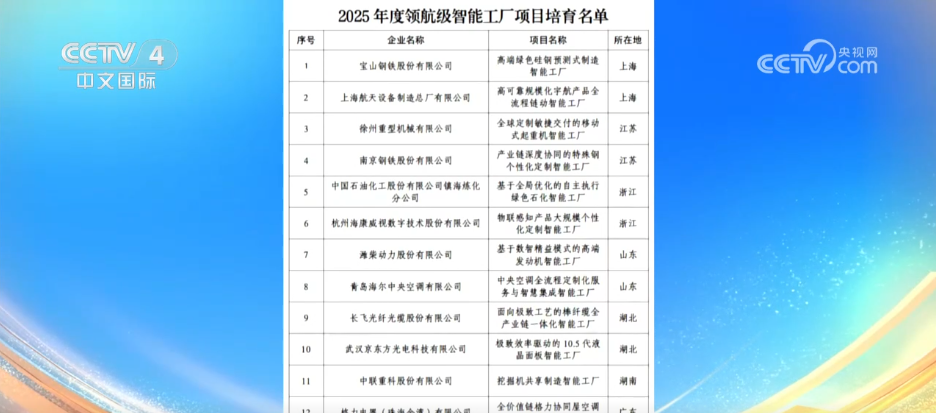
打造世界级标杆!“领航级”工厂如何实现“领跑”中国智造?
Yang Shi Wang· 2026-01-13 08:42
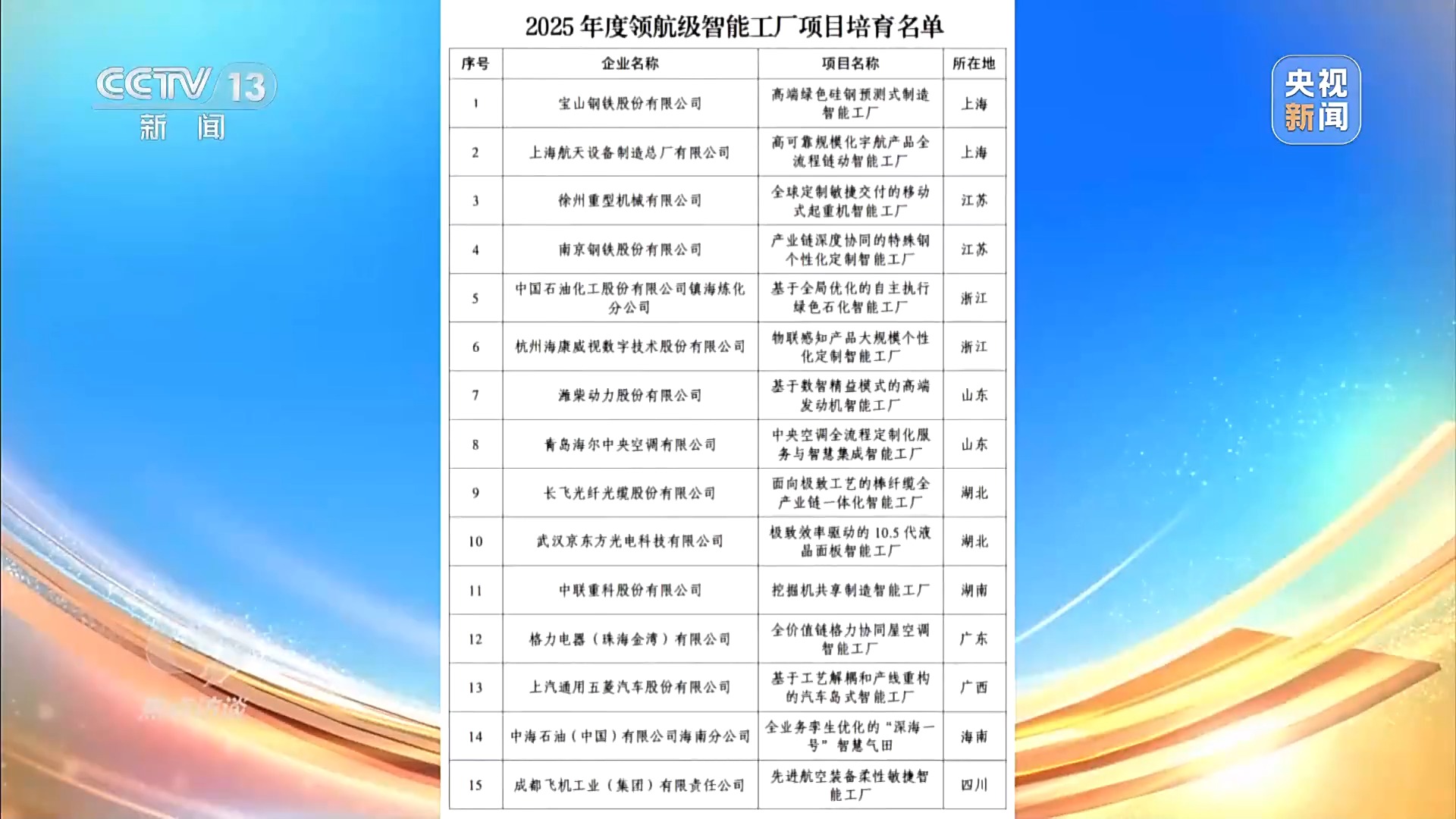
Core Viewpoint - "Smart" manufacturing is the core engine for high-quality development in the manufacturing industry, marking a critical leap from digitalization and networking to intelligence in China's manufacturing sector [1][3]. Group 1: Overview of Leading Smart Factories - The Ministry of Industry and Information Technology and five other departments announced the first batch of 15 leading smart factories, covering key industries such as equipment manufacturing, raw materials, and electronic information [1][2]. - These factories represent the highest level of "intelligent" manufacturing in China and signify a transition towards a more advanced manufacturing model [1][3]. Group 2: Characteristics of Leading Smart Factories - Leading smart factories are characterized by the integration of advanced manufacturing technologies, next-generation information technologies, and lean management concepts, forming the pinnacle of China's manufacturing intelligence pyramid [3][5]. - They aim to be "hexagonal warriors" with six leading identities, focusing on industry, application of AI technology, innovation in smart manufacturing models, performance, replication, and cultivation plans [5]. Group 3: Notable Examples - Changfei Fiber Optic, recognized as a benchmark for intelligent transformation in the electronic information sector, has integrated AI algorithms throughout its production process, achieving a drawing speed of 3,500 meters per minute, the highest globally, without human intervention [7]. - The company has mastered three major mainstream technologies for fiber optic preform preparation, leading to the largest diameter of preforms globally and maintaining the top market share in the fiber optic industry for nine consecutive years [7]. Group 4: Strategic Alignment - The development of leading smart factories aligns with the "14th Five-Year Plan" for intelligent manufacturing and the "15th Five-Year Plan" for building a modern industrial system centered on advanced manufacturing [5][9]. - These factories facilitate collaborative innovation across the industry chain, connecting with national strategic deployments such as "Artificial Intelligence+" and promoting the replication of successful models [9].
瞄准全球领先、深化AI融合,领航级工厂领跑中国“智造”
Bei Jing Wan Bao· 2026-01-13 06:16
Core Viewpoint - Smart manufacturing is the core engine for high-quality development in the manufacturing industry, marking a critical leap from digitalization and networking to intelligence in China's manufacturing sector [1][5]. Group 1: Overview of Leading Smart Factories - The Ministry of Industry and Information Technology and five other departments announced the first batch of 15 leading smart factories, covering key industries such as equipment manufacturing, raw materials, and electronic information [1][4]. - These leading factories represent the highest level of smart manufacturing in China and showcase the breadth and depth of the country's intelligent manufacturing development [4][5]. Group 2: Classification and Development of Smart Factories - A four-tier system for smart factory cultivation has been established: foundational, advanced, excellent, and leading levels, with 35,000 foundational, over 7,300 advanced, 500 excellent, and 15 leading smart factories built to date [7]. - The leading level aims for global leadership and deep integration of AI, while the excellent level requires at least 20% AI application scenarios [7]. Group 3: Key Elements for Leading Smart Factories - Six key elements define a leading smart factory: industry leadership, AI technology application, innovative smart manufacturing models, performance leadership, replication leadership, and nurturing plans [10][12]. - Longfei Optical Fiber exemplifies these elements by integrating AI throughout its production process, achieving a global record in fiber drawing speed and precision [12][13]. Group 4: Case Studies of Leading Smart Factories - Weichai Power has implemented a digital twin technology that reduces R&D cycles by 20% and enhances production flexibility through AI-driven systems [20][21]. - Baosteel is innovating with AI-driven predictive manufacturing, aiming to establish 1,200 AI scenarios and 25 benchmark production lines by 2027, while also investing in talent development [25][27]. Group 5: Future Manufacturing Models - The exploration of future manufacturing models focuses on high customization, complex product production, and efficient supply chain organization, aiming to enhance China's position in the global supply chain [17][29]. - The emergence of these leading smart factories not only represents individual breakthroughs but also reflects a systemic transformation in China's manufacturing industry, providing replicable and scalable models for industry upgrades [29].



2025年1-11月中国光电子器件产量为17318.1亿只(片、套) 累计增长9.7%
Chan Ye Xin Xi Wang· 2026-01-13 03:03
Core Viewpoint - The report highlights the growth trajectory of China's optoelectronic device industry, projecting significant production increases and market potential from 2025 to 2032 [1] Group 1: Industry Overview - In November 2025, China's optoelectronic device production is expected to reach 164.5 billion units, reflecting a year-on-year growth of 9.1% [1] - Cumulatively, from January to November 2025, the total production of optoelectronic devices in China is projected to be 1,731.81 billion units, marking a cumulative growth of 9.7% [1] Group 2: Market Research - The report titled "2026-2032 China Optoelectronic Device Industry Market Survey and Future Trend Forecast" was published by Zhiyan Consulting, a leading industry consulting firm in China [1] - Zhiyan Consulting has over a decade of experience in industry research, providing comprehensive reports and tailored services to support investment decisions [1]



焦点访谈|领航时代 “智造”未来 探秘领航级工厂的跃升密码
Yang Shi Wang· 2026-01-12 13:37
Core Viewpoint - Smart manufacturing is identified as the core engine for high-quality development in the manufacturing industry, marking a significant transition from digitalization and networking to intelligent manufacturing in China [1][15]. Group 1: Overview of Smart Factories - The Ministry of Industry and Information Technology, along with five other departments, announced the first batch of 15 leading smart factories, covering key industries such as equipment manufacturing, raw materials, and electronic information [1][3]. - These leading factories represent the highest level of intelligent manufacturing in China and showcase a broad and deep development of smart manufacturing across various regions [1][3]. - The four-tier system for smart factory cultivation includes foundational, advanced, excellent, and leading levels, with specific requirements for each tier [3]. Group 2: Key Elements of Leading Smart Factories - To qualify as a leading smart factory, six key elements are required: industry leadership, AI technology application, innovative smart manufacturing models, performance leadership, replication leadership, and nurturing plans [3][5]. - Longfei Optical Fiber exemplifies an industry leader by integrating AI throughout its production process, achieving a pulling speed of 3,500 meters per minute with no human intervention [5][6]. - Weichai Power demonstrates performance leadership by reducing maintenance costs by 30% through its engine health management system, showcasing the effectiveness of its smart manufacturing practices [10]. Group 3: Future Manufacturing Models - The exploration of leading smart factories aims to create a flexible and efficient supply network capable of high customization and rapid iteration in production [8][16]. - Baosteel is innovating with AI-driven predictive manufacturing, moving away from traditional order-based production to proactively managing supply chains and production resources [11][13]. - The establishment of at least 1,200 AI scenarios and 25 benchmark production lines by Baosteel by 2027 reflects a commitment to integrating AI into manufacturing processes [13]. Group 4: Systemic Transformation in Manufacturing - The emergence of the first batch of leading smart factories signifies a systemic transformation in China's manufacturing sector, with a focus on technological breakthroughs, efficiency improvements, and green transitions [16]. - The experiences and models developed by these leading factories are expected to be replicable and promote the digital transformation of more manufacturing enterprises [16].
通信行业双周报(2025、12、26-2026、1、8):商用航天建设持续推进-20260109
Dongguan Securities· 2026-01-09 09:31
Investment Rating - The report maintains an "Overweight" rating for the communication industry, expecting the industry index to outperform the market index by more than 10% in the next six months [2][44]. Core Insights - The commercial aerospace sector is showing significant momentum both domestically and internationally, shifting focus from mere technological breakthroughs to the integration of technology, ecosystem development, and market applications. Leading companies are enhancing their commercialization capabilities [3][39]. - The report anticipates that the communication industry will experience a period of technological iteration and policy dividends in 2025, with new growth drivers emerging from AI, quantum communication, and low-altitude economy sectors. The recovery of cellular IoT modules and ongoing construction of communication facilities are expected to create new demands for devices, equipment, and service operations [3][39]. Summary by Sections 1. Communication Industry Market Review - The communication sector index fell by 1.18% over the two weeks from December 26, 2025, to January 8, 2026, underperforming the CSI 300 index by 3.22 percentage points, ranking last among 31 sectors [11][12]. - In January 2026, the communication sector index increased by 0.85%, again underperforming the CSI 300 index by 1.48 percentage points [11][12]. 2. Industry News - The Ministry of Industry and Information Technology and seven other departments jointly issued the "Implementation Opinions on the Special Action of 'Artificial Intelligence + Manufacturing'" [15]. - The first offshore reusable rocket recovery base in China has commenced construction with a total investment of 5.2 billion yuan [21]. - SpaceX's Starlink has connected over 9 million active users across 155 countries, showcasing significant growth from 14.5 million users in December 2021 [22]. 3. Company Announcements - Feiling Kesi plans to indirectly invest in Nanfei Microelectronics, focusing on high-speed network communication interconnect chips, with a total investment of 40.8 million yuan [23][24]. - Guangku Technology expects a net profit growth of 152%-172% for 2025, driven by revenue growth and cost control measures [26]. 4. Industry Data Updates - As of November 2025, the mobile phone user base reached approximately 1.828 billion, a year-on-year increase of 2.20% [27]. - The total number of 5G base stations reached 4.83 million, with a net increase of 579,000 compared to the end of the previous year [36].



长飞光纤股价跌5.18%,广发基金旗下1只基金重仓,持有75.26万股浮亏损失459.09万元
Xin Lang Cai Jing· 2026-01-08 06:38
Group 1 - The core point of the article highlights the recent decline in the stock price of Changfei Fiber Optics, which fell by 5.18% to 111.66 yuan per share, with a trading volume of 1.516 billion yuan and a turnover rate of 3.30%, resulting in a total market capitalization of 92.444 billion yuan [1] - Changfei Fiber Optics Co., Ltd. is located in Wuhan, Hubei Province, and was established on May 31, 1988. The company focuses on the telecommunications industry, particularly in areas related to telecom operators and data communication, and has developed a complete industrial chain including preform, fiber, cable, and related products [1] - The company's main business revenue composition includes optical transmission products at 60.25%, optical interconnection components at 22.61%, and other products at 17.13% [1] Group 2 - From the perspective of fund holdings, data shows that one fund under GF Fund has a significant position in Changfei Fiber Optics. The GF Technology Power Stock Fund (005777) held 752,600 shares in the third quarter, accounting for 3.46% of the fund's net value, making it the seventh-largest holding [2] - The GF Technology Power Stock Fund (005777) was established on May 31, 2018, with a latest scale of 2.196 billion yuan. Year-to-date returns are at 7.99%, ranking 329 out of 5,493 in its category, while the one-year return is 67.6%, ranking 529 out of 4,197 [2]
2025年中国光模块市场需求分析 数据通信市场需求最大【组图】
Qian Zhan Wang· 2026-01-08 04:10
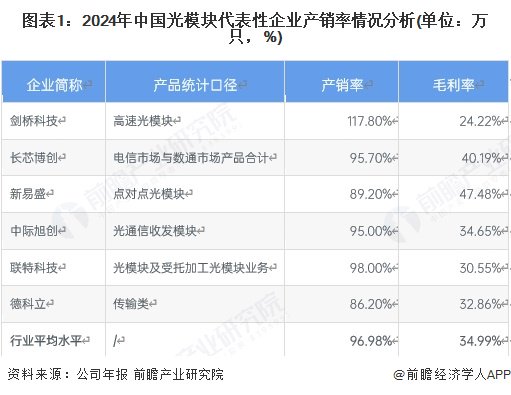
Core Insights - The report highlights the strong performance of China's optical module industry, with an average production and sales rate of 96.98% and an average gross profit margin of 34.99% for 2024, indicating overall good profitability [1] - The demand for optical modules in the telecommunications market is primarily driven by lower-speed modules, with significant growth in 5G base station construction projected for 2024 [2][4] - The data communication market is identified as the largest and fastest-growing segment for optical modules, fueled by increased data center traffic and evolving network architectures [7] Group 1: Optical Module Industry Overview - Major listed companies in the optical module industry include Guangxun Technology, Zhongji Xuchuang, Xinyi Sheng, Changxin Bochuang, Taicheng Guang, and others [1] - The average production and sales rate for representative optical module companies in China is projected to be 96.98% in 2024, with a gross profit margin of 34.99% [1] - Cambridge Technology has reported a production and sales rate exceeding 100% [1] Group 2: Telecommunications Market Demand - The telecommunications market is the origin of optical modules, with 5G transmission networks comprising front-haul, mid-haul, and back-haul segments [2] - In 2024, China is expected to build 874,000 new 5G base stations, bringing the total to 4.251 million by the end of the year [2] - The demand for optical modules is primarily for lower-speed modules, particularly in the front-haul subsystem, which has the highest demand due to its long-distance, high-density characteristics [2] Group 3: Capital Expenditure Trends - The capital expenditure of China's three major telecom operators is gradually shifting towards cloud computing and computing power networks as a second growth curve [4] - In 2023, the total fixed asset investment by major telecom companies and China Tower reached 420.5 billion yuan, with 5G investment accounting for 190.5 billion yuan, a year-on-year increase of 5.7% [4] - The overall market for optical modules is expected to show steady growth, supported by the expansion of fiber-to-the-home and the increase in 10G PON port numbers [4] Group 4: Data Communication Market Growth - The data communication market is currently the largest and fastest-growing market for optical modules, driven by significant increases in data center traffic and changes in network architecture [7] - By mid-2025, the total number of operational computing center racks in China is expected to reach 10.85 million standard racks [7] Group 5: Fixed Network Access Market - The "14th Five-Year" information and communication industry development plan aims to fully deploy gigabit optical fiber networks and accelerate the construction of gigabit cities [9] - By the end of 2025, the number of 10G PON ports is projected to grow from over 5 million at the end of 2021 to 12 million, with gigabit broadband users expected to increase nearly tenfold to 60 million [9] - The Ministry of Industry and Information Technology has initiated pilot projects for 10G optical networks to address key challenges and promote the development of a complete industrial chain [9]