Suzhou Rural Commercial Bank(603323)

Search documents
江苏苏州农村商业银行股份有限公司关于独立董事任职资格获核准的公告
Zhong Guo Zheng Quan Bao - Zhong Zheng Wang· 2025-10-28 20:22
Core Viewpoint - Jiangsu Suzhou Rural Commercial Bank has received approval for Mr. Shu Langen's qualification as an independent director, enhancing the governance structure of the bank [1] Group 1: Company Announcement - The bank's board and all directors ensure the announcement's content is free from false records, misleading statements, or significant omissions, taking legal responsibility for its authenticity, accuracy, and completeness [1] - The approval was granted by the Suzhou Financial Supervision Bureau, confirming Mr. Shu Langen's qualification to serve as an independent director [1] - Mr. Shu Langen's resume information is available on the Shanghai Stock Exchange website, published on July 1, 2025 [1]

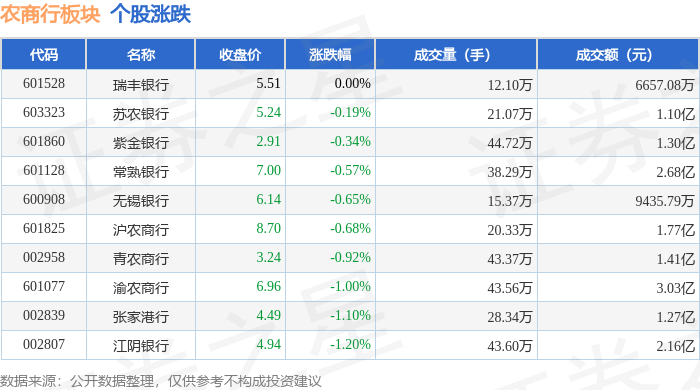
农商行板块10月28日跌0.75%,江阴银行领跌,主力资金净流入1650.52万元
Zheng Xing Xing Ye Ri Bao· 2025-10-28 08:40
Market Overview - The rural commercial bank sector experienced a decline of 0.75% on October 28, with Jiangyin Bank leading the drop [1] - The Shanghai Composite Index closed at 3988.22, down 0.22%, while the Shenzhen Component Index closed at 13430.1, down 0.44% [1] Individual Stock Performance - Key stock performances in the rural commercial bank sector included: - Ruifeng Bank: Closed at 5.51, unchanged - Sunong Bank: Closed at 5.24, down 0.19% - Zijin Bank: Closed at 2.91, down 0.34% - Changshu Bank: Closed at 7.00, down 0.57% - Yuanxi Bank: Closed at 6.14, down 0.65% - Hunan Rural Commercial Bank: Closed at 8.70, down 0.68% - Qingnong Bank: Closed at 3.24, down 0.92% - Yunnan Rural Commercial Bank: Closed at 6.96, down 1.00% - Zhangjiagang Bank: Closed at 4.49, down 1.10% - Jiangyin Bank: Closed at 4.94, down 1.20% [1] Capital Flow Analysis - The rural commercial bank sector saw a net inflow of 16.51 million yuan from institutional investors, while retail investors experienced a net outflow of 25.96 million yuan [1] - Detailed capital flow for selected banks included: - Sunong Bank: Net inflow of 13.07 million yuan from institutional investors, with a net outflow of 9.25 million yuan from retail investors [2] - Hunan Rural Commercial Bank: Net inflow of 13.06 million yuan from institutional investors, with a net outflow of 16.03 million yuan from retail investors [2] - Qingnong Bank: Net inflow of 7.95 million yuan from institutional investors, with a net outflow of 7.73 million yuan from retail investors [2] - Jiangyin Bank: Net outflow of 5.93 million yuan from institutional investors, with a net inflow of 8.14 million yuan from retail investors [2]





苏农银行(603323) - 苏农银行关于独立董事任职资格获核准的公告
2025-10-27 09:46
江苏苏州农村商业银行股份有限公司(以下简称"本行"或"公司")董事 会及全体董事保证本公告内容不存在任何虚假记载、误导性陈述或者重大遗漏, 并对其内容的真实性、准确性和完整性承担法律责任。 近日,本行收到《苏州金融监管分局关于束兰根苏州农村商业银行独立董事 任职资格的批复》(苏州金复〔2025〕198 号),核准束兰根先生担任本行独立董 事的任职资格。 束兰根先生的简历信息详见本行于 2025 年 7 月 1 日刊载于上海证券交易所 网站(www.sse.com.cn)的《苏农银行 2025 年第一次临时股东大会会议材料》。 特此公告。 江苏苏州农村商业银行股份有限公司董事会 2025 年 10 月 28 日 证券代码:603323 证券简称:苏农银行 公告编号:2025-034 江苏苏州农村商业银行股份有限公司 关于独立董事任职资格获核准的公告 ...
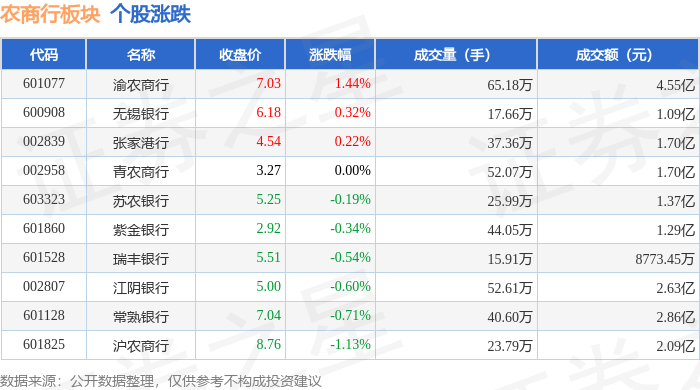
农商行板块10月27日跌0.13%,沪农商行领跌,主力资金净流入2473.66万元
Zheng Xing Xing Ye Ri Bao· 2025-10-27 08:25
Core Insights - The agricultural commercial bank sector experienced a slight decline of 0.13% on October 27, with the Shanghai Agricultural Commercial Bank leading the drop [1] - The Shanghai Composite Index closed at 3996.94, up 1.18%, while the Shenzhen Component Index closed at 13489.4, up 1.51% [1] Stock Performance - The closing prices and performance of key agricultural commercial banks are as follows: - Yunnan Agricultural Commercial Bank (601077) closed at 7.03, up 1.44% with a trading volume of 651,800 shares and a transaction value of 455 million [1] - Wuxi Bank (600908) closed at 6.18, up 0.32% with a trading volume of 176,600 shares and a transaction value of 109 million [1] - Zhangjiagang Bank (002839) closed at 4.54, up 0.22% with a trading volume of 373,600 shares and a transaction value of 170 million [1] - Other banks like Su Nong Bank (603323) and Zijin Bank (601860) saw declines of 0.19% and 0.34% respectively [1] Fund Flow Analysis - The agricultural commercial bank sector saw a net inflow of 24.73 million from institutional investors and 41.41 million from retail investors, while retail investors had a net outflow of 66.14 million [1] - Detailed fund flow for specific banks indicates: - Jiangyin Bank (002807) had a net inflow of 9.34 million from institutional investors and a net outflow of 18.65 million from retail investors [2] - Wuxi Bank (600908) had a net inflow of 8.72 million from institutional investors and a net outflow of 10.73 million from retail investors [2] - Other banks like Zijin Bank (601860) and Yunnan Agricultural Commercial Bank (601077) also experienced mixed fund flows with significant retail outflows [2]

行业深度报告:零售风险及新规影响有限,兼论信贷去抵押化
KAIYUAN SECURITIES· 2025-10-27 05:44
Investment Rating - The investment rating for the industry is "Positive" (maintained) [1] Core Insights - The report highlights that retail non-performing loan (NPL) rates and generation rates are currently high, indicating ongoing pressure on bank profitability. Despite a low overall NPL rate, the retail sector shows signs of risk, with a marginal increase in the NPL rate to 1.28% [14][15] - The transition period for new risk regulations is nearing its end, with concerns about the impact on banks' provisioning levels. However, the report suggests that the actual impact may be less severe than market expectations [16] - The trend of de-collateralization in bank lending is evident, driven by both business characteristics and strategic choices made by banks to reduce reliance on collateralized loans [17] Summary by Sections 1. Retail NPL and Generation Rates - The retail NPL rate has increased to 1.28%, with a steepening curve indicating ongoing risk. The generation rate for retail loans remains high, with significant increases noted in certain banks [14][18] - The report indicates that while the overall NPL rate is low, the divergence between overdue and NPL indicators suggests underlying risks in the retail sector [19] 2. Impact of New Risk Regulations - The new risk regulations will require banks to classify impaired loans as NPLs, potentially increasing reported NPL rates. However, the report anticipates that the actual provisioning pressure may be manageable [16][17] 3. De-Collateralization in Lending - The report notes a significant decline in the proportion of collateralized loans, with banks shifting towards non-collateralized lending strategies. This shift is influenced by the need to manage risk more effectively [17][18] 4. Investment Recommendations - The report recommends certain state-owned banks due to their customer base advantages and manageable retail risk pressures. It also highlights specific banks such as CITIC Bank and Agricultural Bank of China as beneficiaries of this trend [6]






本周聚焦:黄金波动下的机遇与挑战:银行贵金属业务有望成重要增长极
GOLDEN SUN SECURITIES· 2025-10-27 00:58
Investment Rating - The report maintains an "Accumulate" rating for the banking sector, indicating a positive outlook despite challenges in the gold market in 2025 [1]. Core Insights - The gold market is expected to present both opportunities and challenges for banks, with a trend towards deepening precious metal business driven by central bank purchases [1][2]. - The demand for gold bars and coins has increased significantly, reflecting a growing need for gold as a hedge and store of value among residents [4]. - The establishment of a market-making system for gold trading is anticipated to enhance market liquidity and stability, positioning listed banks as key players [3][4]. Summary by Sections 1. Policy and Market Environment - As of September 2025, China's official gold reserves reached 74.06 million ounces, marking an increase for 11 consecutive months [2]. - In Q2 2025, global central banks added 166 tons of gold to their reserves, with 95% of surveyed central banks expecting further increases in the next 12 months [2]. - New policies allowing insurance funds to invest in gold are expected to create new opportunities for banks to provide services to insurance institutions, enhancing their intermediary income [2]. 2. Business Dynamics and Revenue Contribution - In the first half of 2025, China's gold consumption was 505.205 tons, a year-on-year decrease of 3.54%, with significant growth in gold bar and coin consumption by 23.69% [4]. - The decline in gold jewelry consumption is prompting banks to shift focus from traditional jewelry sales to investment-oriented precious metal businesses [4]. - The growth in investment demand for gold bars and coins is expected to stabilize income from investment-related businesses, enhancing the profitability of the precious metals segment for banks [4]. 3. Industry Trends - The report highlights a structural shift in gold consumption, with investment demand rising while jewelry demand declines, indicating a need for banks to adapt their business strategies [4]. - The performance of the banking sector is expected to benefit from expansionary policies aimed at stabilizing the economy, with specific banks like Ningbo Bank and Jiangsu Bank recommended for investment due to positive fundamental changes [8]. 4. Key Data Tracking - The report includes various financial metrics, such as average daily trading volume and margin financing balances, which are essential for assessing market conditions [9][10].





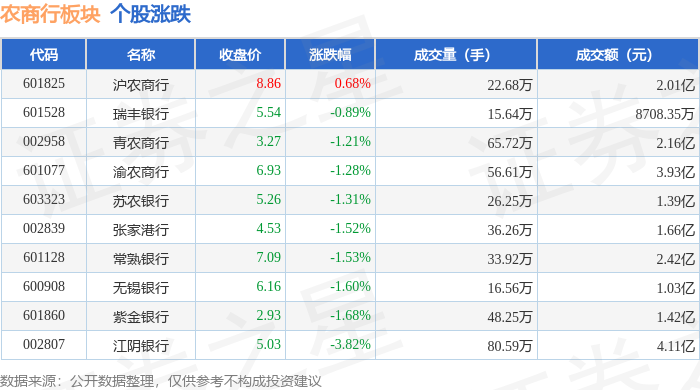
农商行板块10月24日跌0.82%,江阴银行领跌,主力资金净流出1.44亿元
Zheng Xing Xing Ye Ri Bao· 2025-10-24 08:27
Market Overview - The rural commercial bank sector experienced a decline of 0.82% on October 24, with Jiangyin Bank leading the drop [1] - The Shanghai Composite Index closed at 3950.31, up 0.71%, while the Shenzhen Component Index closed at 13289.18, up 2.02% [1] Individual Stock Performance - The closing prices and changes for key rural commercial banks are as follows: - Hu Nong Commercial Bank: 8.86, +0.68% - Ruifeng Bank: 5.54, -0.89% - Qingnong Commercial Bank: 3.27, -1.21% - Yunnan Commercial Bank: 6.93, -1.28% - Su Nong Bank: 5.26, -1.31% - Zhangjiagang Bank: 4.53, -1.52% - Changshu Bank: 7.09, -1.53% - Wuxi Bank: 6.16, -1.60% - Zijin Bank: 2.93, -1.68% - Jiangyin Bank: 5.03, -3.82% [1] Capital Flow Analysis - The rural commercial bank sector saw a net outflow of 144 million yuan from main funds, while retail funds experienced a net inflow of 63.71 million yuan [1] - The detailed capital flow for individual banks indicates: - Hu Nong Commercial Bank: Main funds net inflow of 6.22 million yuan, retail net outflow of 16.25 million yuan - Wuxi Bank: Main funds net outflow of 29.30 million yuan, retail net outflow of 0.99 million yuan - Jiangyin Bank: Main funds net outflow of 56.10 million yuan, retail net inflow of 36.93 million yuan [2]

A股银行股普跌,江阴银行跌超3%
Ge Long Hui A P P· 2025-10-24 03:12
Group 1 - The A-share market saw a general decline in bank stocks, with Jiangyin Bank dropping over 3%, and several other banks including Xi'an Bank, Chongqing Bank, and Yunnan Rural Commercial Bank falling more than 1% [1] - Agricultural Bank was an exception, experiencing a slight increase of 0.5% [1] - The year-to-date performance of various banks shows Jiangyin Bank with a 22.07% increase, while Xi'an Bank and Chongqing Bank have year-to-date increases of 17.17% and 14.57% respectively [2] Group 2 - Jiangyin Bank's market capitalization is reported at 12.5 billion, while Xi'an Bank's is at 18.4 billion, and Chongqing Bank's is at 35.4 billion [2] - Other banks such as Qingdao Bank and Su Nong Bank also experienced declines of nearly 1%, with market capitalizations of 30.2 billion and 10.7 billion respectively [2] - The overall trend indicates a mixed performance among bank stocks, with some showing significant year-to-date gains despite the recent declines [2]


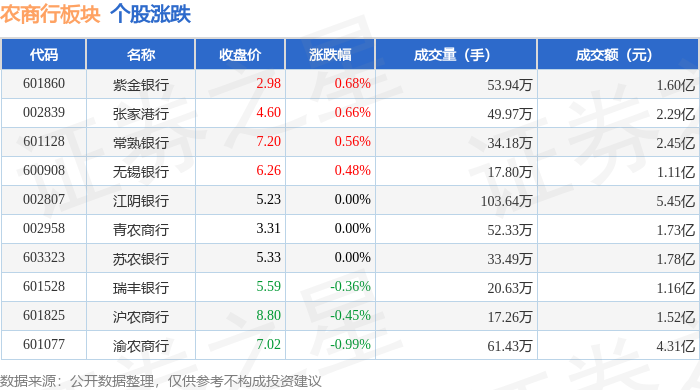
农商行板块10月23日跌0.27%,渝农商行领跌,主力资金净流出2.1亿元
Zheng Xing Xing Ye Ri Bao· 2025-10-23 08:21
Market Overview - The rural commercial bank sector experienced a decline of 0.27% on October 23, with Yunnan Rural Commercial Bank leading the drop [1] - The Shanghai Composite Index closed at 3922.41, up 0.22%, while the Shenzhen Component Index closed at 13025.45, also up 0.22% [1] Individual Stock Performance - Key stocks in the rural commercial bank sector showed varied performance, with Zijin Bank closing at 2.98, up 0.68%, and Yunnan Rural Commercial Bank closing at 7.02, down 0.99% [1] - The trading volume and turnover for several banks were significant, with Jiangyin Bank recording a turnover of 5.45 billion yuan [1] Capital Flow Analysis - The rural commercial bank sector saw a net outflow of 210 million yuan from institutional investors, while retail investors contributed a net inflow of 277 million yuan [1] - Detailed capital flow for individual banks indicated that Changshu Bank had a net inflow of 18.64 million yuan from institutional investors, while Yunnan Rural Commercial Bank had a net outflow of 17.66 million yuan [2]

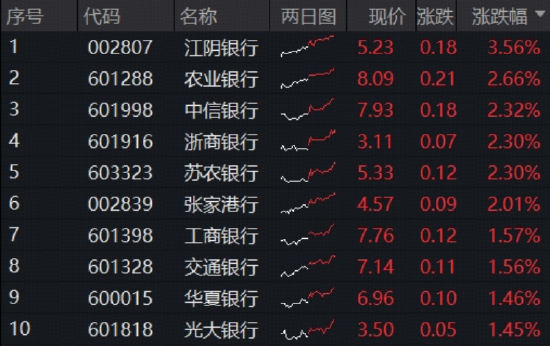
重要信号,银行向上逼近“牛熊分界线”!双百亿银行ETF(512800)逆市10连阳,农行涨2.6%再创新高!
Xin Lang Ji Jin· 2025-10-22 11:43
Group 1 - The core viewpoint of the articles highlights the strong performance of the banking sector in the A-share market, with 39 out of 42 bank stocks rising, including Agricultural Bank of China achieving a 14-day consecutive increase, reaching a historical high [1][4] - Jiangyin Bank saw a rise of over 3%, while other banks like CITIC Bank, Zheshang Bank, and others also reported gains exceeding 2% [1][2] - The banking ETF (512800) experienced a significant inflow of funds, with a total of 5.987 billion yuan accumulated in the last 10 days, indicating strong investor interest [4][5] Group 2 - The banking sector is characterized by high dividend yields and low valuations, with the China Securities Banking Index's price-to-book ratio (PB) at 0.71, placing it in the lower range of the past decade [3][4] - The sector's defensive attributes are becoming more attractive to investors amid rising market uncertainties, presenting a potential opportunity for allocation [3][4] - Historical data suggests that the banking sector tends to perform well at the end of the year, with a 70% probability of absolute returns in November-December and an 80% probability in January [4]