
Suzhou Rural Commercial Bank(603323)

Search documents
逾950家A股披露2025业绩预告,高增长赛道浮现!机构建议:2026年投资锁定这些方向→
Xin Lang Cai Jing· 2026-01-27 12:24
Market Overview - The A-share market exhibited a fluctuating and differentiated pattern last week, with major indices showing mixed performance and active rotation among hot sectors [1][7] - Institutions generally hold an optimistic outlook, believing the market is likely to trend upward [1][7] - As of January 25, over 950 companies have disclosed their 2025 earnings forecasts, with around 40% of these companies showing positive performance [1][7] Semiconductor Industry - The semiconductor industry, particularly companies related to artificial intelligence, data center construction, and domestic substitution, is expected to see strong earnings growth in 2025 [1][8] - Notable companies include: - Zhongwei Semiconductor expects revenue of approximately 1.122 billion yuan, a year-on-year increase of about 23%, and a net profit of 284 million yuan, up approximately 107% [8] - Juchip Technology anticipates revenue of 922 million yuan, a 41.44% increase, and a net profit of 204 million yuan, up 91.40% [2] - Baiwei Storage forecasts revenue between 10 billion to 12 billion yuan, a growth of 49.36% to 79.23%, and a net profit of 850 million to 1 billion yuan, a staggering increase of 427.19% to 520.22% [3][9] Pharmaceutical Industry - The pharmaceutical sector is experiencing a "polarized" performance, with over 60 companies disclosing earnings forecasts, about half of which are positive [1][9] - Key performers include: - Zhaoyan New Drug expects a net profit of approximately 233 million to 349 million yuan, a year-on-year increase of 214% to 371% [10] - Shanghai Yizhong anticipates a net profit of 6 million to 7 million yuan, a growth of 760.18% to 903.54% [10] - However, companies like Zhifei Biological are projected to incur significant losses, with an expected net loss of 10.7 billion to 13.7 billion yuan [10][5] Banking Sector - As of January 25, eight listed banks have released earnings reports, with all showing year-on-year growth in net profit [5][11] - Key statistics include: - China Merchants Bank's total assets surpassing 13 trillion yuan, and Industrial Bank exceeding 11 trillion yuan [11] - The highest net profit growth among these banks is from Hangzhou Bank at 12.05%, followed by Shanghai Pudong Development Bank at 10.52% [11] - The growth drivers for banks include improved cost of liabilities and rapid growth in intermediary business income, with Ningbo Bank's net income from fees and commissions increasing by 30.72% [12]



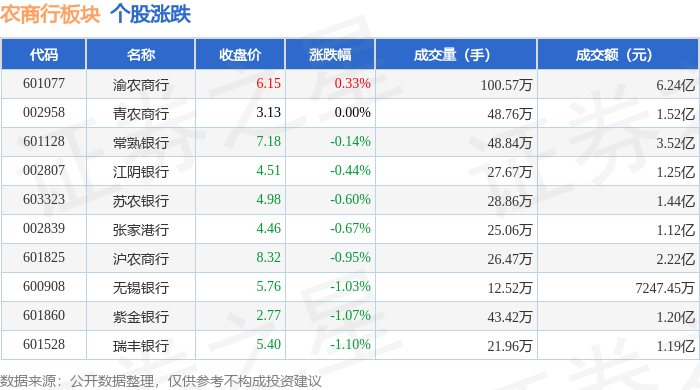
农商行板块1月27日跌0.47%,瑞丰银行领跌,主力资金净流入8828.82万元
Zheng Xing Xing Ye Ri Bao· 2026-01-27 09:06
Core Viewpoint - The rural commercial bank sector experienced a decline of 0.47% on January 27, with Ruifeng Bank leading the drop, while the Shanghai Composite Index rose by 0.18% and the Shenzhen Component Index increased by 0.09% [1] Group 1: Market Performance - The closing prices and changes for key rural commercial banks are as follows: - Yunnan Rural Commercial Bank (601077) closed at 6.15, up 0.33% - Qingnong Bank (002958) closed at 3.13, unchanged - Changshu Bank (601128) closed at 7.18, down 0.14% - Jiangyin Bank (002807) closed at 4.51, down 0.44% - Sunong Bank (603323) closed at 4.98, down 0.60% - Zhangjiagang Bank (002839) closed at 4.46, down 0.67% - Hunan Rural Commercial Bank (601825) closed at 8.32, down 0.95% - Wuxi Bank (600908) closed at 5.76, down 1.03% - Zijin Bank (601860) closed at 2.77, down 1.07% - Ruifeng Bank (601528) closed at 5.40, down 1.10% [1] Group 2: Capital Flow - The rural commercial bank sector saw a net inflow of 88.29 million yuan from institutional investors, while retail investors experienced a net outflow of 112 million yuan [1] - The capital flow for individual banks is as follows: - Hunan Rural Commercial Bank (601825) had a net inflow of 31.55 million yuan from institutional investors, but a net outflow of 54.50 million yuan from retail investors - Changshu Bank (601128) had a net inflow of 21.64 million yuan from institutional investors and a net inflow of 1.10 million yuan from retail investors - Yunnan Rural Commercial Bank (601077) had a net inflow of 18.99 million yuan from institutional investors, with a net outflow of 2.01 million yuan from retail investors - Other banks like Jiangyin Bank (002807) and Zijin Bank (601860) also showed mixed capital flows [2]

从数据治理到价值转化
Jiang Nan Shi Bao· 2026-01-27 00:17
Core Insights - Suzhou Rural Commercial Bank has been selected as one of the first three rural commercial banks in Jiangsu Province to enter the data enterprise cultivation database, highlighting the effectiveness of its "digital innovation" transformation strategy [1][3]. Group 1: Digital Transformation Strategy - The bank focuses on three key areas: data governance, digital innovation, and risk management, establishing a comprehensive digital system to support high-quality development [1]. - A full-process data quality control mechanism has been implemented, ensuring compliance from data entry through multi-dimensional automated verification rules and a dual-layer approval system for core indicators [1]. Group 2: Business Model Innovation - The bank has launched three platform projects: "Enterprise WeChat," "Jin Ke Tong," and "Knowledge Graph," transitioning its business model from "human-driven" to "data-driven" [2]. - The "Enterprise WeChat" initiative has established connections with over 210,000 retail customers, achieving a real-name registration rate of nearly 60% and significantly increasing the monthly activity rate of customer managers [2]. - The "Jin Ke Tong" marketing platform has introduced over 40 marketing scenarios, achieving a comprehensive reach rate of over 40% and a conversion rate of nearly 15% [2]. Group 3: Risk Management Enhancements - A comprehensive intelligent risk control system has been developed, integrating big data and machine learning into the credit process, allowing for automatic approval of small loans and rapid decision-making for larger loans [2]. - The bank has established over 1,300 warning signals for real-time risk control, replacing the traditional periodic post-loan monitoring approach [2]. Group 4: Marketing and Business Growth - The bank's product recommendation model, based on deep data asset operations, has achieved a fivefold increase in customer engagement and purchasing, contributing to over 10 billion in loan and deposit business [3]. - The bank aims to deepen its data governance and expand the boundaries of data value transformation, focusing on digital financial innovation and data security [3].
上市银行2025年业绩快报扫描:稳健增长与质量提升并行
Zhong Guo Zheng Quan Bao· 2026-01-26 20:54
Core Viewpoint - The overall performance of the eight banks in China for 2025 shows steady growth, with positive increases in operating income and net profit attributable to shareholders, alongside improvements in asset quality [1][2]. Group 1: Financial Performance - All eight banks reported positive year-on-year growth in net profit attributable to shareholders, with seven banks achieving both revenue and profit growth [1]. - Hangzhou Bank led with a 12.05% increase in net profit, while other notable performers included Ningbo Bank (8.13%) and Nanjing Bank (8.08%) [1]. - Among joint-stock banks, Shanghai Pudong Development Bank reported a 10.52% increase in net profit, while CITIC Bank, China Merchants Bank, and Industrial Bank showed modest growth rates of 2.98%, 1.21%, and 0.34%, respectively [1]. Group 2: Asset Quality - The asset quality of the banks has improved, with most banks reporting a decrease in non-performing loan (NPL) ratios [2]. - Specifically, Shanghai Pudong Development Bank's NPL ratio decreased by 0.10 percentage points to 1.26%, while CITIC Bank and China Merchants Bank's ratios fell to 1.15% and 0.94%, respectively [2]. - City commercial banks like Ningbo Bank and Hangzhou Bank maintained low NPL ratios of 0.76%, while Nanjing Bank's ratio was 0.83% [2]. Group 3: Cost Control and Profitability - Banks have successfully controlled funding costs, with Ningbo Bank reducing its deposit interest rate by 33 basis points through optimizing its deposit structure [2]. - The overall provisioning coverage ratio has slightly decreased but remains at a sufficient level, with Hangzhou Bank exceeding 500% and several others maintaining above 300% [2]. Group 4: Future Outlook - Analysts predict a gradual alleviation of interest margin pressure, which is expected to support performance improvements in 2026 [3]. - The banking sector is anticipated to benefit from a stable asset-liability structure and a reduction in credit costs, which will facilitate profit release [4]. - There is a strategic shift towards expanding non-interest income sources, with banks like Ningbo Bank reporting a 30.72% increase in net fee and commission income, indicating growth potential in intermediary businesses [4].



农商行板块1月26日跌0.27%,沪农商行领跌,主力资金净流入1.4亿元
Zheng Xing Xing Ye Ri Bao· 2026-01-26 09:34
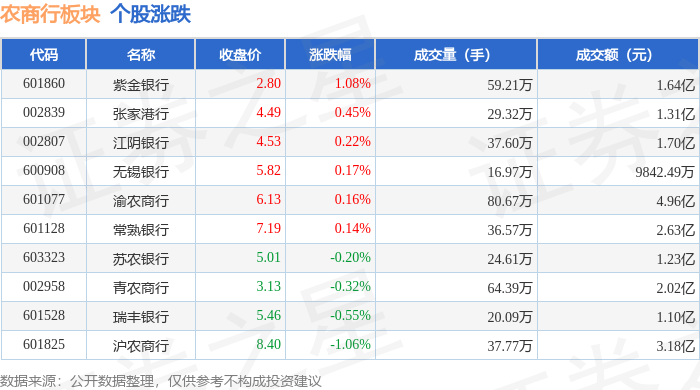
Core Viewpoint - The agricultural commercial bank sector experienced a decline of 0.27% on January 26, with the Shanghai Agricultural Commercial Bank leading the drop. The Shanghai Composite Index closed at 4132.61, down 0.09%, while the Shenzhen Component Index closed at 14316.64, down 0.85% [1] Group 1: Stock Performance - The closing prices and performance of key agricultural commercial banks are as follows: - Zijin Bank: Closed at 2.80, up 1.08% with a trading volume of 592,100 shares and a transaction value of 164 million yuan - Zhangjiagang Bank: Closed at 4.49, up 0.45% with a trading volume of 293,200 shares and a transaction value of 131 million yuan - Jiangyin Bank: Closed at 4.53, up 0.22% with a trading volume of 376,000 shares and a transaction value of 170 million yuan - Wuxi Bank: Closed at 5.82, up 0.17% with a trading volume of 169,700 shares and a transaction value of 98.42 million yuan - Chongqing Rural Commercial Bank: Closed at 6.13, up 0.16% with a trading volume of 806,700 shares - Changshu Bank: Closed at 7.19, up 0.14% with a trading volume of 365,700 shares - Su Nong Bank: Closed at 5.01, down 0.20% with a trading volume of 246,100 shares - Qing Nong Bank: Closed at 3.13, down 0.32% with a trading volume of 643,900 shares - Ruifeng Bank: Closed at 5.46, down 0.55% with a trading volume of 200,900 shares - Shanghai Agricultural Commercial Bank: Closed at 8.40, down 1.06% with a trading volume of 377,700 shares [1] Group 2: Capital Flow - On that day, the agricultural commercial bank sector saw a net inflow of 140 million yuan from institutional investors, while retail investors experienced a net outflow of 259 million yuan. The net inflow from speculative funds was 119 million yuan [1] - The detailed capital flow for specific banks is as follows: - Chongqing Rural Commercial Bank: Net inflow of 43.43 million yuan from institutional investors, 26.47 million yuan from speculative funds, and a net outflow of 69.89 million yuan from retail investors - Shanghai Agricultural Commercial Bank: Net inflow of 36.54 million yuan from institutional investors, 29.93 million yuan from speculative funds, and a net outflow of 66.47 million yuan from retail investors - Changshu Bank: Net inflow of 22.25 million yuan from institutional investors, 10.94 million yuan from speculative funds, and a net outflow of 33.19 million yuan from retail investors - Jiangyin Bank: Net inflow of 11.74 million yuan from institutional investors, 8.70 million yuan from speculative funds, and a net outflow of 20.44 million yuan from retail investors - Ruifeng Bank: Net inflow of 9.70 million yuan from institutional investors, 8.78 million yuan from speculative funds, and a net outflow of 18.48 million yuan from retail investors [2]

苏农银行“村改支”遭18%中小股东反对 总资产2311亿营收仅增0.41%
Chang Jiang Shang Bao· 2026-01-26 06:47
Core Viewpoint - The recent shareholder meeting of Su Nong Bank revealed significant dissent among minority shareholders regarding the bank's proposal to absorb and merge with Zhangjiagang Yunnong Commercial Village Bank, indicating a cautious attitude towards capital-consuming mergers in the changing market and regulatory environment [1][3][7]. Group 1: Shareholder Dissent - The proposal to absorb Zhangjiagang Yunnong Commercial Village Bank received 13.08% of votes against it, with 18.42% of minority shareholders (holding less than 5%) opposing the motion [1][4]. - Similar dissent has been observed in other banks' "village reform and branch" proposals, such as Guizhou Bank and Zhangjiagang Bank, reflecting a trend of increasing caution among minority shareholders [1][5]. Group 2: Financial Performance - As of the end of 2025, Su Nong Bank's total assets reached 231.1 billion yuan, an 8% increase from the beginning of the year [8]. - The bank's revenue for 2025 was 4.191 billion yuan, showing only a 0.41% year-on-year growth, while net profit attributable to shareholders was 2.029 billion yuan, up 7.58% [9]. - The bank's return on average equity was 10.84%, a decrease of 0.83 percentage points compared to the previous year [9]. Group 3: Market Performance - As of January 23, Su Nong Bank's A-share price was 5.02 yuan per share, down nearly 20% from its peak of 6.26 yuan on June 6, 2025, despite a cumulative increase of 10.75% over the year [2][11]. - The bank's stock performance reflects investor concerns regarding its revenue growth and the impact of mergers on short-term profitability [7]. Group 4: Asset Quality - Su Nong Bank maintained a stable asset quality with a non-performing loan ratio of 0.88%, a slight decrease of 0.02 percentage points from the beginning of the year [10]. - The bank's provision coverage ratio stood at 370.19%, indicating a strong position among listed rural commercial banks [10].
看好交投持续活跃下优质金融股机会
HTSC· 2026-01-26 02:45
Investment Rating - The report maintains an "Overweight" rating for the securities and banking sectors, while also recommending the insurance sector [8]. Core Insights - The market remains active with an average daily trading volume of 28 trillion yuan in A-shares, and the financing balance stabilizing at 2.7 trillion yuan. However, the ETF market has experienced significant volatility, with major outflows from core broad-based ETFs [11][16]. - The sentiment for market bullishness is strong, and the spring rally is expected to continue, particularly in the insurance sector where beta trading opportunities are anticipated [2][26]. - The central bank's governor indicated that there is still room for interest rate cuts, with the latest Loan Prime Rate (LPR) remaining unchanged for eight consecutive months [11][32]. Securities Sector Summary - The report highlights a positive outlook for the securities sector, with several brokerages reporting significant profit growth for 2025. The recommendation includes top brokerages such as CITIC Securities, Guotai Junan, and GF Securities [2][12]. - The average daily trading volume in the A-share market is noted at 28 trillion yuan, with a stable financing balance, indicating a recovery opportunity for the brokerage sector [11][12]. Insurance Sector Summary - The report suggests focusing on quality leading companies in the insurance sector, as the market sentiment remains strong and the spring rally is expected to continue [26][27]. - The insurance sector's fund holdings have increased, with major stocks like Ping An and China Life being highlighted for their significant market presence [27][31]. Banking Sector Summary - The banking sector is characterized by stable performance, with several banks reporting positive earnings forecasts for 2025. The report recommends quality individual stocks such as Nanjing Bank and Chengdu Bank [3][40]. - The central bank's comments on potential interest rate cuts and the expansion of wealth management products indicate a favorable environment for banks [32][33]. - The report notes a decline in bond allocations within bank wealth management products, with an increase in deposits and funds [37][34].



苏农银行“村改支”遭18%中小股东反对
Chang Jiang Shang Bao· 2026-01-26 02:13
Core Viewpoint - The integration of rural banks into larger banking institutions is facing significant dissent from minority shareholders, reflecting a cautious attitude towards capital-consuming mergers in the changing market and regulatory environment [1][8]. Group 1: Shareholder Discontent - At Su Nong Bank's recent shareholder meeting, 13.08% of votes were against the proposal to absorb and merge with Zhangjiagang Yurun Rural Commercial Bank, with 18.42% of minority shareholders voting against [1][3]. - Similar dissent has been observed in other banks, such as Guiyang Bank and Zhangjiagang Bank, indicating a trend of increasing caution among minority shareholders regarding such mergers [1][5]. Group 2: Financial Performance - Su Nong Bank's total assets are projected to reach 231.1 billion yuan by the end of 2025, reflecting an 8% increase from the beginning of the year [1][10]. - However, the bank faces challenges with revenue growth, achieving only a 0.41% increase in operating income to 4.191 billion yuan for 2025, while net profit grew by 7.58% to 2.029 billion yuan [10]. - The bank's return on average equity decreased by 0.83 percentage points to 10.84% [10]. Group 3: Market Performance - As of January 23, Su Nong Bank's A-share price was 5.02 yuan, down nearly 20% from its peak of 6.26 yuan in June 2025, despite a cumulative increase of 10.75% over the year [1][12]. - The bank's stock performance reflects investor concerns regarding its growth prospects and the impact of recent mergers on profitability [8][12]. Group 4: Asset Quality - Su Nong Bank maintains a stable asset quality with a non-performing loan ratio of 0.88%, a slight decrease from the beginning of the year [11]. - The bank's provision coverage ratio stands at 370.19%, indicating a strong position among listed rural commercial banks [11].
苏农银行“村改支”遭18%中小股东反对 推进区域扩张总资产2311亿营收仅增0.41%
Chang Jiang Shang Bao· 2026-01-26 00:32
Core Viewpoint - The recent shareholder meeting of Su Nong Bank revealed significant dissent among minority shareholders regarding the bank's proposal to absorb and merge with Zhangjiagang Yurun Rural Commercial Bank, indicating a cautious attitude towards capital-consuming mergers in the changing market and regulatory environment [1][6]. Group 1: Shareholder Disagreement - Su Nong Bank's proposal to absorb Zhangjiagang Yurun Rural Commercial Bank received 13.08% of votes against, with 18.42% of minority shareholders (holding less than 5%) opposing the plan [1][3]. - Similar dissent has been observed in other banks' "village to branch" proposals, such as Guizhou Bank and Zhangjiagang Bank, reflecting a trend of increasing caution among minority shareholders regarding mergers [1][4]. Group 2: Financial Performance - As of the end of 2025, Su Nong Bank's total assets reached 231.1 billion yuan, an 8% increase from the beginning of the year, while total loans and deposits also saw growth [7][8]. - However, the bank faced challenges with revenue growth, achieving only a 0.41% increase in operating income year-on-year, and a decline in the weighted average return on equity by 0.83 percentage points to 10.84% [8][9]. Group 3: Market Response - The bank's stock price closed at 5.02 yuan per share on January 23, reflecting a nearly 20% decline from its peak of 6.26 yuan on June 6, 2025, despite a cumulative annual increase of 10.75% [10]. - The market's reaction indicates concerns over the bank's short-term profitability and capital adequacy, as shareholders prioritize these factors over mere expansion [6][10].
盈利能力保持韧性 资产规模稳步扩张 首批8家上市银行2025年业绩预喜
Shang Hai Zheng Quan Bao· 2026-01-25 18:51
Core Viewpoint - The first batch of eight listed banks in China has reported their 2025 performance, showing overall positive growth in net profit and revenue, with a focus on optimizing business structures and enhancing risk management for 2026 [1][2]. Group 1: Financial Performance - All eight listed banks reported a year-on-year increase in net profit, with seven achieving both revenue and net profit growth [2] - Hangzhou Bank led with a 12.05% increase in net profit, while Ningbo Bank and Nanjing Bank reported growths of 8.13% and 8.08% respectively [2] - Among joint-stock banks, Pudong Development Bank saw a notable 10.52% increase in net profit, while CITIC Bank, China Merchants Bank, and Industrial Bank reported growths of 2.98%, 1.21%, and 0.34% respectively [2] - Seven banks achieved revenue growth, with only CITIC Bank experiencing a slight decline of 0.55% [2] - Ningbo Bank's revenue grew by 8.01% to 71.968 billion yuan, driven by a 30.72% increase in net income from fees and commissions [2] Group 2: Asset Expansion - Total assets of several banks have expanded significantly, with China Merchants Bank surpassing 13 trillion yuan and Industrial Bank reaching 11 trillion yuan [3] - Smaller banks like Nanjing Bank, Ningbo Bank, and Hangzhou Bank saw asset growth rates of 16.63%, 16.11%, and 11.96% respectively, focusing on technology finance, green finance, and inclusive finance [3] Group 3: Asset Quality - The asset quality indicators remain stable, with a decrease in non-performing loan (NPL) ratios for four banks and three remaining stable [4] - Pudong Development Bank reported a significant decrease in NPL ratio by 10 basis points to 1.26%, while CITIC Bank and China Merchants Bank saw declines of 1 basis point to 1.15% and 0.94% respectively [4] - The overall provision coverage ratio has slightly decreased but remains at a high level, with several banks maintaining coverage ratios above 300% [4] Group 4: Future Strategies - Many banks have outlined their 2026 operational focuses, emphasizing business structure optimization, expanding fee income sources, and strengthening risk management [5][6] - Bank of Beijing has set ten key initiatives for 2026, aiming for qualitative and quantitative growth through deepening specific banking services and ensuring compliance [6]