JRCB(002807)

Search documents
农商行板块1月12日跌0.14%,渝农商行领跌,主力资金净流出5928.29万元
Zheng Xing Xing Ye Ri Bao· 2026-01-12 09:04
Market Overview - The agricultural commercial bank sector experienced a decline of 0.14% on January 12, with Yunnan Agricultural Commercial Bank leading the drop [1] - The Shanghai Composite Index closed at 4165.29, up 1.09%, while the Shenzhen Component Index closed at 14366.91, up 1.75% [1] Individual Bank Performance - Zijin Bank closed at 2.79, with an increase of 0.72% and a trading volume of 386,600 shares, totaling a transaction value of 107 million yuan [1] - Su Nong Bank closed at 5.06, up 0.40%, with a trading volume of 204,900 shares, totaling 104 million yuan [1] - Ruifeng Bank closed at 5.51, up 0.36%, with a trading volume of 181,100 shares, totaling approximately 99.28 million yuan [1] - Qing Nong Bank closed at 3.11, up 0.32%, with a trading volume of 422,100 shares, totaling 131 million yuan [1] - Yunnan Agricultural Commercial Bank closed at 6.51, down 0.91%, with a trading volume of 690,100 shares [1] Capital Flow Analysis - The agricultural commercial bank sector saw a net outflow of 59.28 million yuan from institutional investors, while retail investors contributed a net inflow of 49.11 million yuan [1] - The table of capital flow indicates that Changshu Bank had a net inflow of 7.30 million yuan from institutional investors, while it faced a net outflow of 22.43 million yuan from speculative funds [2] - Yunnan Agricultural Commercial Bank experienced a net outflow of 21.20 million yuan from institutional investors, but a net inflow of 42.56 million yuan from speculative funds [2]






过渡期收官在即,银行业首席合规官密集就位
Mei Ri Jing Ji Xin Wen· 2026-01-11 12:29
Core Insights - The banking industry is undergoing a restructuring wave in risk and compliance systems due to tightening regulatory rules and a complex risk environment [1][2] - A surge in appointments for Chief Risk Officers (CROs) and Chief Compliance Officers (CCOs) is expected by the end of 2025 and early 2026, with over 20 banks and branches already approved for relevant positions since the beginning of 2025 [1][2] Regulatory Changes - The "Measures for Compliance Management of Financial Institutions" requires financial institutions to establish a CCO at their headquarters, who will be classified as a senior management position [2] - The transitional period for compliance with this regulation is set to expire one year after its implementation on March 1, 2025 [2] Appointment Trends - A variety of banks, including Ping An Bank, Industrial Bank, and Minsheng Bank, have announced the appointment of CCOs as the transitional deadline approaches [2] - The trend shows a mix of large, medium, and small institutions moving forward with these appointments [2] Governance Models - Two governance models are emerging: "one person holding multiple roles" and "independent separation" for CCOs and CROs [3] - The "one person holding multiple roles" model is prevalent among smaller banks, allowing for unified decision-making in risk and compliance management [3] - The "independent separation" model is more common in larger banks, emphasizing specialized development and independent oversight in risk management [3][4] Talent Acquisition Challenges - The establishment of CCO and CRO positions presents new challenges for talent acquisition, with a preference for candidates possessing a combination of frontline business experience, cross-regional vision, and professional qualifications [6] - Some banks are adopting market-based recruitment strategies for CCOs, breaking traditional selection models [6] Compensation Trends - The compensation for CCOs is rising, with annual total income expected to be no less than the average for senior management positions [6] - Reports indicate that the reference monthly salary for these positions can reach between 100,000 to 130,000 yuan [6] Compliance Management Evolution - Effective compliance management is evolving from a "cost center" to a "value guardian," playing a crucial role in mitigating credit, market, and liquidity risks [7] - The compliance governance system is expected to become more institutionalized and refined, with clearer responsibilities and a growing demand for composite compliance talent [7][8] Core Competencies for CCOs - The core competencies for CCOs are identified as business insight, regulatory interpretation, execution capability, and cross-departmental collaboration [8] - These competencies are essential for CCOs to effectively support governance and create compliance value [8]




过渡期收官在即,银行业首席合规官密集就位,如何推进从“被动遵循”到“主动治理”?
Mei Ri Jing Ji Xin Wen· 2026-01-09 10:51
Core Viewpoint - The tightening of regulatory rules and the complexity of the risk environment are driving a restructuring wave in the banking industry's risk and compliance systems [1][7]. Group 1: Appointment Trends - A surge in appointments for Chief Risk Officers (CROs) and Chief Compliance Officers (CCOs) is expected from late 2025 to early 2026, with nearly 10 banks increasing related personnel configurations in the past month [1][7]. - Since the beginning of 2025, over 20 banks and branches have had relevant qualifications approved by regulators [1][7]. - The trend is influenced by the impending expiration of a one-year transition period set by the "Financial Institutions Compliance Management Measures," which requires financial institutions to establish a CCO at their headquarters [1][7]. Group 2: Governance Models - The banking sector exhibits two governance models for CCOs and CROs: "one person holding both positions" and "independent separation" [2][9]. - The "one person holding both positions" model is prevalent, particularly in smaller banks, allowing for unified decision-making in risk and compliance management [2][9]. - Conversely, the "independent separation" model is more common in larger banks, enhancing professional checks and balances within the risk control system [3][10]. Group 3: Talent Acquisition and Challenges - The demand for composite talents is rising, with banks favoring candidates with extensive experience in finance or legal compliance [11][12]. - Some banks are adopting market-based recruitment methods for CCOs, breaking traditional selection models [11]. - Salary levels for CCO positions are increasing, with some banks offering monthly salaries between 100,000 to 130,000 yuan [11]. Group 4: Compliance Management Evolution - Effective compliance management is evolving from a "cost center" to a "value guardian," playing a crucial role in mitigating credit, market, and liquidity risks [12][13]. - The future of compliance governance in the banking industry is expected to become more institutionalized and refined, with clearer responsibilities and a focus on composite compliance talents [12][13]. - The core competencies for CCOs are expected to include deep business insight, precise regulatory interpretation, efficient execution, and strong cross-departmental collaboration [13].

江南水务:公司于2025年12月收到江阴银行中期分红款
Zheng Quan Ri Bao Wang· 2026-01-08 13:13
Core Viewpoint - Jiangnan Water (601199) announced on January 8 that it will receive a mid-term dividend payment from Jiangyin Bank (002807) in December 2025 [1] Group 1 - The company confirmed the receipt of dividend payments from Jiangyin Bank, indicating a positive cash flow outlook [1]

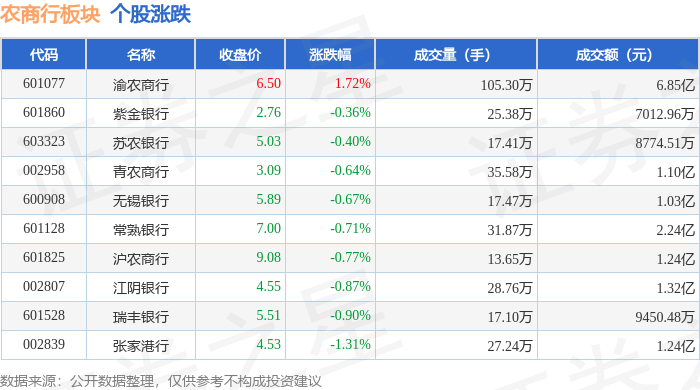
农商行板块1月8日跌0.18%,张家港行领跌,主力资金净流出3731.72万元
Zheng Xing Xing Ye Ri Bao· 2026-01-08 08:56
Core Viewpoint - The agricultural commercial bank sector experienced a slight decline of 0.18% on January 8, with Zhangjiagang Bank leading the drop [1] Group 1: Market Performance - The Shanghai Composite Index closed at 4082.98, down 0.07%, while the Shenzhen Component Index closed at 13959.48, down 0.51% [1] - The agricultural commercial bank sector's individual stock performance showed varied results, with Yunnan Agricultural Commercial Bank rising by 1.72% to a closing price of 6.50 [1] Group 2: Trading Volume and Turnover - The trading volume and turnover for various banks were reported, with Jiangyin Bank having a turnover of 1.32 billion and a trading volume of 287,600 shares [1] - The overall net outflow of main funds from the agricultural commercial bank sector was 37.32 million, while retail funds saw a net outflow of 18.16 million [1] Group 3: Fund Flow Analysis - The main fund inflow for Ruifeng Bank was 4.77 million, accounting for 5.04% of its total, while it faced a retail net outflow of 8.39 million [2] - Zhangjiagang Bank experienced a significant main fund outflow of 6.71 million, with retail investors also withdrawing 7.63 million [2]



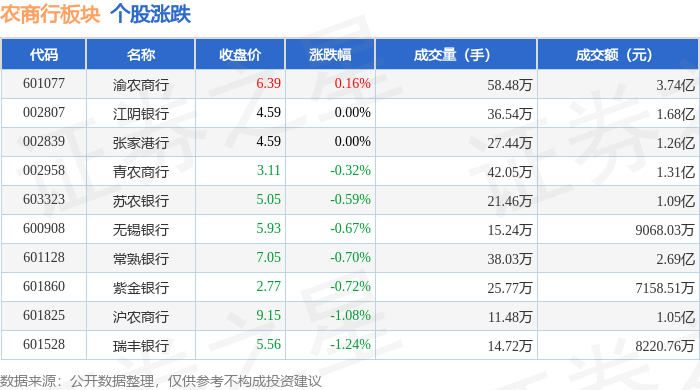
农商行板块1月7日跌0.57%,瑞丰银行领跌,主力资金净流入5042.72万元
Zheng Xing Xing Ye Ri Bao· 2026-01-07 08:58
Core Viewpoint - The rural commercial bank sector experienced a decline of 0.57% on January 7, with Ruifeng Bank leading the drop, while the Shanghai Composite Index rose by 0.05% and the Shenzhen Component Index increased by 0.06% [1] Group 1: Market Performance - The closing prices and performance of key rural commercial banks on January 7 are as follows: - Yunnan Rural Commercial Bank (601077) closed at 6.39, up by 0.16% - Jiangyin Bank (002807) closed at 4.59, unchanged - Zhangjiagang Bank (002839) closed at 4.59, unchanged - Qingnong Bank (002958) closed at 3.11, down by 0.32% - Sunan Bank (603323) closed at 5.05, down by 0.59% - Wuxi Bank (600908) closed at 5.93, down by 0.67% - Changshu Bank (601128) closed at 7.05, down by 0.70% - Zijin Bank (601860) closed at 2.77, down by 0.72% - Hunan Rural Commercial Bank (601825) closed at 9.15, down by 1.08% - Ruifeng Bank (601528) closed at 5.56, down by 1.24% [1] Group 2: Capital Flow - On January 7, the rural commercial bank sector saw a net inflow of 50.43 million yuan from main funds, while retail investors experienced a net outflow of 84.63 million yuan [1] - The capital flow for individual banks is as follows: - Zhangjiagang Bank (002839) had a main fund net inflow of 13.66 million yuan, but a retail net outflow of 13.84 million yuan - Changshu Bank (601128) had a main fund net inflow of 13.25 million yuan, with a retail net outflow of 22.78 million yuan - Qingnong Bank (002958) had a main fund net inflow of 12.24 million yuan, but a retail net outflow of 8.34 million yuan - Wuxi Bank (600908) had a main fund net inflow of 9.53 million yuan, with a retail net outflow of 6.99 million yuan [2]
已有十余家银行聘任首席合规官
Jin Rong Shi Bao· 2026-01-07 02:52
Core Viewpoint - The appointment of Chief Compliance Officers (CCOs) in banks is a response to increasing regulatory demands, aiming to enhance compliance management and integrate it into business processes [1][2]. Group 1: Appointment of Chief Compliance Officers - Zhangjiagang Rural Commercial Bank appointed Wu Kai as its Chief Compliance Officer, marking a trend where over ten banks have made similar appointments [1]. - In December 2025 alone, several banks, including Ping An Bank and Industrial Bank, approved the hiring of CCOs [1]. - The rapid appointment of CCOs aligns with the implementation of the "Financial Institutions Compliance Management Measures," which mandates the establishment of CCO positions at the headquarters of financial institutions [2]. Group 2: Responsibilities and Challenges - CCOs are expected to take on more responsibilities, including the formulation and supervision of compliance policies, ensuring that all business activities adhere to regulatory frameworks [5]. - There is a concern that an increase in executive positions may burden banks, particularly smaller financial institutions [2]. - Many currently appointed CCOs are existing senior executives, which helps mitigate potential operational burdens [3]. Group 3: Recruitment Trends - Some banks, such as Jiangxi Bank and Shangrao Bank, have publicly announced recruitment for CCO positions, indicating a proactive approach to compliance management [4].

江阴银行:截至2025年12月31日股东户数为47452户
Zheng Quan Ri Bao Wang· 2026-01-06 08:45
证券日报网讯1月6日,江阴银行(002807)在互动平台回答投资者提问时表示,截至2025年12月31日, 公司股东户数为47452户。 ...
开年首罚!建行、农行、浦发、江阴农商行等多家银行及负责人被罚,多人禁业!
Xin Lang Cai Jing· 2026-01-05 10:44
Core Viewpoint - The National Financial Supervision Administration has intensified its enforcement actions against multiple banks and responsible individuals for illegal and non-compliant business practices, reflecting a commitment to strengthen financial regulation and maintain market order [2][19]. Summary by Category Administrative Penalties - China Construction Bank's Gansu branch was fined RMB 300,000 for reporting errors in non-site supervision data, and the data management department head was fined RMB 50,000 and warned [2][20]. - Agricultural Bank of China's Fuzhou Taijiang branch was fined RMB 800,000 for illegally processing bank card business, with two individuals banned from the banking industry for five years [5][22]. - Agricultural Bank of China's Chongqing Dazhu branch was fined RMB 300,000 for inadequate loan "three checks," and the deputy branch manager was banned for life from the banking industry [6][23]. - Jiangyin Rural Commercial Bank's Suzhou branch was fined RMB 500,000 for lax ticket business review, with a total of RMB 21,284.75 in illegal gains confiscated [8][25]. - Bank of Communications' Taicang branch was fined RMB 350,000 for inadequate checks on working capital loans, and the deputy branch manager was fined RMB 70,000 [9][27]. - Shanghai Pudong Development Bank's Suzhou branch was fined RMB 1,100,000 for poor ticket business review and personal loan management, with multiple managers receiving warnings and fines [11][28]. - Postal Savings Bank's former employee was banned from the banking industry for five years due to serious misconduct in loan business [12][30]. - Agricultural Development Bank's Jingchuan branch was fined RMB 300,000 for inadequate project capital source review and loan condition enforcement [15][32]. Regulatory Trends - The series of penalties demonstrates a "penetrating supervision" and "accountability for negligence" approach, indicating a shift towards stricter regulatory oversight in the banking sector [17][34]. - Industry insiders suggest that regulatory authorities will maintain a high-pressure stance against financial violations, urging banks to enhance compliance awareness and internal control systems [17][34].




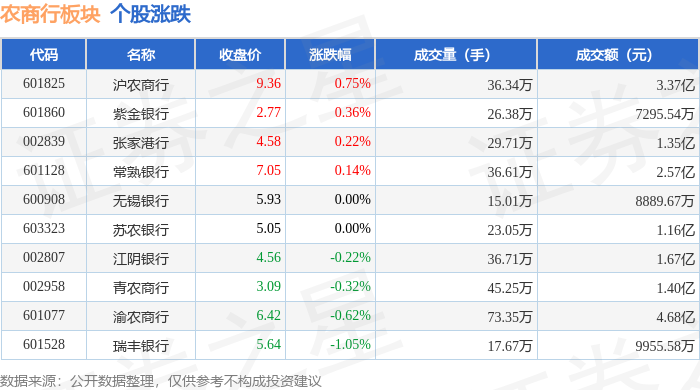
农商行板块1月5日涨0.09%,沪农商行领涨,主力资金净流入7699.1万元
Zheng Xing Xing Ye Ri Bao· 2026-01-05 09:09
Core Insights - The agricultural commercial bank sector experienced a slight increase of 0.09% on January 5, with Shanghai Agricultural Commercial Bank leading the gains [1] - The Shanghai Composite Index closed at 4023.42, up by 1.38%, while the Shenzhen Component Index closed at 13828.63, up by 2.24% [1] Stock Performance - Shanghai Agricultural Commercial Bank (601825) closed at 9.36, with a rise of 0.75% and a trading volume of 363,400 shares, totaling a transaction value of 337 million yuan [1] - Other notable banks include: - Zijin Bank (601860) at 2.77, up 0.36% with a transaction value of 72.96 million yuan [1] - Zhangjiagang Bank (002839) at 4.58, up 0.22% with a transaction value of 135 million yuan [1] - Changshu Bank (601128) at 7.05, up 0.14% with a transaction value of 257 million yuan [1] - Wuxi Bank (600908) remained unchanged at 5.93 with a transaction value of 88.9 million yuan [1] Capital Flow - The agricultural commercial bank sector saw a net inflow of 76.99 million yuan from institutional investors and 84.57 million yuan from retail investors, while individual investors had a net outflow of 162 million yuan [1] - Specific capital flows for key banks include: - Shanghai Agricultural Commercial Bank had a net inflow of 47.24 million yuan from institutional investors, but a net outflow of 54.86 million yuan from individual investors [2] - Changshu Bank saw a net inflow of 32.72 million yuan from institutional investors, with a net outflow of 33.53 million yuan from individual investors [2] - Suzhou Agricultural Bank had a net inflow of 13.51 million yuan from institutional investors, with a net outflow of 12.27 million yuan from individual investors [2]