
JRCB(002807)

Search documents
2026年2月社融前瞻:预计社融增速8.1%
GF SECURITIES· 2026-03-04 07:26
Investment Rating - The industry investment rating is "Buy" [5]. Core Viewpoints - The report forecasts a social financing growth rate of 8.1% for February 2026, with a total social financing increment of 2.1 trillion CNY, which is a year-on-year decrease of 0.1 trillion CNY [4][7]. - It is expected that the total outstanding social financing will reach 451.1 trillion CNY by the end of February, reflecting a year-on-year growth rate of 8.1% and a month-on-month decline of 0.07 percentage points [4][7]. - The report highlights that credit growth is anticipated to be lower year-on-year due to the impact of the Spring Festival, with corporate credit demand expected to remain flat and retail loans likely to decrease year-on-year [4][7]. Summary by Sections Social Financing Estimates - The estimated social financing stock for February 2026 is 451.1 trillion CNY, up from 449.1 trillion CNY in January 2026 and 417.3 trillion CNY in February 2025, showing a month-on-month increase of 2.0% and a year-on-year increase of 33.8% [7]. - The report predicts a decrease in new RMB loans for February 2026, estimating an increment of 0.5 trillion CNY, which is a year-on-year decrease of 0.1 trillion CNY [4][7]. Credit and Bond Financing - The report anticipates a decrease in government and credit bond net financing for February, with government bonds expected to net finance 1.4 trillion CNY, down 0.3 trillion CNY year-on-year [4][7]. - The report also notes that the demand for bank bills is expected to remain strong, with a decrease of 1,000 billion CNY in discounted bank acceptance bills, reflecting a year-on-year decrease of 2,000 billion CNY [4][7]. Monetary Growth - The report emphasizes the importance of M2 growth, which is expected to remain high at around 9.0% in February, supported by strong government bond financing and improved corporate cash flow [4][7]. - M1 growth is projected to rise to approximately 5.1%, influenced by a low base effect and the reduced impact of deposit migration [4][7].



汇率政策组合拳如何影响流动性?
GF SECURITIES· 2026-03-02 03:26
Investment Rating - The industry investment rating is "Buy" [2] Core Insights - The central theme of the report discusses the impact of recent currency policies on liquidity, specifically focusing on the People's Bank of China's (PBOC) measures to adjust the foreign exchange risk reserve ratio and its implications for cross-border liquidity [13][22] - The report highlights that the PBOC's recent policies aim to stabilize the RMB's exchange rate and enhance the liquidity of the offshore RMB market, which is expected to support the internationalization of the RMB [16][22] Summary by Sections 1. Current Observations: How Currency Policies Affect Liquidity - The PBOC introduced two key policies: a notification regarding RMB cross-border interbank financing and a reduction of the foreign exchange risk reserve ratio for forward foreign exchange transactions from 20% to 0% [13][18] - RMB cross-border interbank financing is crucial for providing RMB liquidity to offshore markets, with the potential net outflow limit estimated at approximately 1.79 trillion CNY, significantly higher than the current balance of about 1,942 billion CNY [16][17] 2. Forward Foreign Exchange Business - The adjustment of the foreign exchange risk reserve ratio is designed to lower the costs associated with forward foreign exchange transactions, thereby increasing demand in the forward market and countering expectations of RMB appreciation [18][19] 3. Outlook on Cross-Border Liquidity - The report anticipates that while speculative inflows may slow down, the demand for foreign investment in RMB-denominated assets will remain robust, driven by fundamentals, returns, and safety differentials [22][23] - It is expected that the increase in interbank lending will tighten liquidity in the banking sector, prompting the PBOC to potentially implement additional liquidity measures through government bond transactions and open market operations [23]

银行资负跟踪20260302:月末票据利率反弹,大行净买入同比增量回落
GF SECURITIES· 2026-03-02 03:06
Investment Rating - The industry investment rating is "Buy" [2] Core Views - The report highlights a rebound in month-end bill rates, with a significant decrease in net purchases by major banks year-on-year [1][14] - The central bank's operations included a total of CNY 16,410 billion in 7-day reverse repos at a rate of 1.40%, with a net withdrawal of CNY 4,614 billion [14] - The report anticipates continued flexibility in central bank operations to stabilize liquidity fluctuations, especially with important meetings approaching [14][21] Summary by Sections Section 1: Month-End Bill Rate Rebound - The overall liquidity in the market is balanced due to post-holiday fund recovery and tax payments [14] - Major banks' net purchases of bills have significantly decreased, with only an increase of approximately CNY 320 billion year-on-year as of February 27 [17] Section 2: Central Bank Dynamics and Market Rates - The central bank's MLF (Medium-term Lending Facility) increased by CNY 6,000 billion, continuing to inject long-term liquidity into the market [14] - The end-of-period rates for DR001 and DR007 were 1.32% and 1.50%, reflecting increases of 0.68bp and 18.23bp respectively [15] Section 3: Bank Financing Tracking - The total outstanding amount of interbank certificates of deposit (NCD) reached CNY 18.77 trillion, with a weighted average issuance rate of 1.59% [19] - The issuance of interbank certificates of deposit for the period was CNY 4,545 billion, with a completion rate of 93.3% [19]
银行业2025年四季度监管数据总结:利润增速回正,息差连续两季度企稳
GF SECURITIES· 2026-02-26 14:05
Investment Rating - The industry investment rating is "Buy" [2] Core Viewpoints - The banking industry has shown a recovery in profit growth, with net profit for commercial banks increasing by 2.33% year-on-year in 2025, reflecting a quarter-on-quarter improvement of 2.35 percentage points [13][14] - The overall asset growth of commercial banks continued, with total assets increasing by 9.01% year-on-year as of Q4 2025, while loan growth slightly decreased to 7.26% year-on-year [29][30] - Net interest margin stabilized for two consecutive quarters at 1.42%, with expectations for a gradual recovery in 2026 [54] Summary by Sections Performance - The net profit of commercial banks increased by 2.33% year-on-year in 2025, with state-owned banks, joint-stock banks, city commercial banks, and rural commercial banks showing growth rates of 2.25%, -2.84%, 12.87%, and 4.57% respectively [13][14] - The return on equity (ROE) and return on assets (ROA) for commercial banks were 7.78% and 0.60%, reflecting a year-on-year decline of 0.33 percentage points and 0.03 percentage points respectively [13] Scale - Total assets of commercial banks grew by 9.01% year-on-year as of Q4 2025, with state-owned banks showing a growth rate of 10.78% [29][30] - Loan growth for commercial banks was 7.26% year-on-year, with city commercial banks experiencing a counter-cyclical increase in loan growth [29][30] Interest Margin - The net interest margin for commercial banks was stable at 1.42%, with a year-on-year decline of 10.50 basis points [54] - Expectations for 2026 indicate potential downward pressure on net interest margins in Q1, but a gradual recovery is anticipated thereafter [54] Asset Quality - The non-performing loan ratio for commercial banks was 1.50%, showing a quarter-on-quarter decrease of 2.00 basis points, while the provision coverage ratio was 205.21% [54] Capital - The core Tier 1 capital adequacy ratio for commercial banks was 10.92%, reflecting a quarter-on-quarter increase of 0.05 percentage points [54]


银行经营周期如何定价各类资产?
GF SECURITIES· 2026-02-24 12:04
Investment Rating - The report assigns a "Buy" rating for the banking sector, indicating an expectation of stock performance exceeding the market by more than 10% over the next 12 months [58]. Core Insights - In 2025, the banking sector's asset growth is projected to be 8.01%, an increase from 6.52% in 2024, driven by factors such as fiscal stimulus, cross-border capital inflows, and the activation of maturing deposits [5][13]. - The report identifies two key cycles affecting asset pricing in banking: the bank expansion cycle and the interest margin cycle, suggesting a comprehensive analysis of these cycles [5][13]. - The debt cycle is characterized as a fundamental aspect of the bank expansion cycle, with a model proposed by Dalio outlining seven stages of a typical debt cycle, which can be influenced by external debt reliance [16][19]. - The report anticipates limited upward space for the debt cycle in 2026, with government leverage expected to increase by 5.89%, lower than the 7.6% projected for 2025 [35][36]. - The banking interest margin cycle is expected to stabilize in 2025, following two complete cycles since 2010, with a correlation observed between bank interest margins and the 30Y-10Y government bond spread [41][45]. Summary by Sections Bank Expansion Cycle - The asset growth rates for different types of banks in 2025 are projected as follows: state-owned banks at 11%, joint-stock banks at 4.74%, city commercial banks at 9.68%, and rural commercial banks at 5.17%, all exceeding the average growth rate [5][13]. - The report emphasizes the importance of understanding the relationship between bank assets and liabilities, highlighting that credit and debt expansion are cyclical and self-reinforcing [15][16]. Debt Cycle Analysis - The report outlines that the current debt cycle, which began in 2022, has lasted 16 quarters, surpassing previous cycles, and indicates a shift in leverage dynamics among enterprises, government, and households [35][36]. - The analysis includes a comparison of deflationary and inflationary debt cycles, noting that the U.S. faces greater inflationary pressures due to higher external debt reliance compared to China [21][19]. Interest Margin Cycle - The report notes that the banking interest margin has experienced significant fluctuations since 2010, with a stabilization phase expected to begin in 2025 [41][45]. - It highlights the impact of loan repricing cycles on interest margins, with a notable decline in loan rates observed in recent years [49][50].
江阴银行:截至2026年2月13日本行股东户数为47313户
Zheng Quan Ri Bao Wang· 2026-02-24 11:12
证券日报网讯2月24日,江阴银行(002807)在互动平台回答投资者提问时表示,截至2026年2月13日, 本行股东户数为47313户。 ...

2026年1月金融数据点评:存款搬家加速,M1、M2增速大幅回升
GF SECURITIES· 2026-02-14 05:23
Investment Rating - The industry rating is "Buy" [6] Core Insights - The overall social financing growth slightly declined to 8.2% in January, while M1 and M2 growth rates significantly rebounded, with M1 growing by 4.9% and M2 by 9.0% [6][16] - Government net financing increased significantly by 2,831 billion yuan year-on-year, contributing to the overall social financing growth [6][17] - The report indicates a shift in deposit structure due to accelerated deposit migration, impacting M1 negatively while having limited effect on M2 [6][16] Summary by Sections Overall Situation - Social financing growth decreased slightly to 8.2%, while M1 and M2 growth rates increased significantly [15][16] - M1 and M2 growth rates rose by 1.1 percentage points and 0.5 percentage points respectively compared to the previous month [6][16] Government Sector - Fiscal strength showed a year-on-year decline, impacting overall financing dynamics [39] Household Sector - Demand remained stable year-on-year, with short-term loan demand increasing [39] Corporate Sector - Short-term loan demand increased year-on-year, while bill financing saw a significant reduction [39] Non-Bank Sector - The acceleration of deposit migration was noted, with non-bank deposits increasing by 1.45 trillion yuan year-on-year [6][39]
丈量地方性银行(3):川渝132家区域性银行全梳理-20260212
GF SECURITIES· 2026-02-12 14:21
Investment Rating - The industry investment rating is "Buy" [2] Core Insights - The report analyzes 132 regional banks in the Sichuan-Chongqing area, highlighting the growth and structural changes in the banking sector [6][27] - The asset growth rates of major city commercial banks in the region are higher than those of listed city commercial banks, indicating a robust expansion [38] - Profitability metrics show that city commercial banks in the region have lower ROE compared to listed banks, while rural commercial banks outperform them [6][27] - Asset quality is slightly weaker in regional banks compared to listed banks, with higher non-performing loan ratios [6][27] Summary by Sections Economic Structure Analysis - Sichuan province is positioned as a key driver for western development, with a focus on enhancing the Chengdu-Chongqing economic circle [13][14] - In 2025, Chengdu's GDP is projected to account for 38.7% of the province's total, with significant growth in various sectors [15] Banking Sector Overview - The Sichuan-Chongqing region has 132 commercial banks, including 14 city commercial banks, 65 rural banks, and 51 rural commercial banks [27] - The asset growth rates for major city commercial banks in the region are 15.6% and 18.2%, surpassing the 14.2% growth of listed city commercial banks [38] Asset and Liability Structure - The proportion of loans to total assets has been increasing since 2016, with city commercial banks in Sichuan projected to have a loan ratio of 56.1% by 2024 [38][40] - The financial investment ratio for city commercial banks is on a downward trend, with a slight recovery noted in the first half of 2025 [40][46] Profitability and Asset Quality - The average ROE for city commercial banks in the region is 10.97%, lower than the 11.99% average for listed city commercial banks [6][27] - Non-performing loan ratios for city commercial banks in the region are higher than those of listed banks, indicating potential asset quality concerns [6][27] Capital Adequacy - Capital adequacy ratios for regional banks are comparable to those of listed banks, providing a safety margin for operations [6][27]
银行股集体下跌,重庆银行跌超2%
Ge Long Hui· 2026-02-12 02:37
Core Viewpoint - The A-share market for banks experienced a collective decline, with several banks showing significant drops in their stock prices on February 12 [1] Group 1: Stock Performance - Chongqing Bank saw a decline of 2.27%, with a total market value of 36 billion [2] - Agricultural Bank dropped by 1.62%, with a market capitalization of 2,337.9 billion [2] - CITIC Bank decreased by 1.57%, with a market value of 417.9 billion [2] - Xiamen Bank fell by 1.57%, with a market capitalization of 19.9 billion [2] - Qingnong Commercial Bank declined by 1.55%, with a market value of 17.6 billion [2] - Qingdao Bank decreased by 1.41%, with a market capitalization of 32.6 billion [2] - Qilu Bank fell by 1.18%, with a market value of 36.2 billion [2] - Xi'an Bank dropped by 1.30%, with a market capitalization of 16.9 billion [2] - China Construction Bank decreased by 1.23%, with a market value of 23,152 billion [2] - Everbright Bank fell by 1.19%, with a market capitalization of 195.6 billion [2] - Pudong Development Bank decreased by 1.18%, with a market value of 334.7 billion [2] - Industrial and Commercial Bank dropped by 1.10%, with a market capitalization of 25,697 billion [2] - Jiangyin Bank fell by 1.06%, with a market value of 11.5 billion [2] - Zijin Bank decreased by 1.05%, with a market capitalization of 10.3 billion [2] - Zhangjiagang Bank fell by 1.05%, with a market value of 11.5 billion [2] - China Merchants Bank decreased by 1.04%, with a market capitalization of 983.3 billion [2] Group 2: Year-to-Date Performance - Chongqing Bank has a year-to-date decline of 2.91% [2] - Agricultural Bank has seen a year-to-date drop of 13.02% [2] - CITIC Bank's year-to-date decline is 2.47% [2] - Xiamen Bank has a year-to-date increase of 2.59% [2] - Qingnong Commercial Bank's year-to-date increase is 2.26% [2] - Qingdao Bank has a significant year-to-date increase of 25.00% [2] - Qilu Bank has a year-to-date increase of 4.53% [2] - Xi'an Bank's year-to-date increase is 2.70% [2] - China Construction Bank has a year-to-date decline of 4.63% [2] - Everbright Bank's year-to-date decline is 2.26% [2] - Pudong Development Bank has a significant year-to-date decline of 19.21% [2] - Industrial and Commercial Bank has a year-to-date decline of 9.08% [2] - Jiangyin Bank has a year-to-date increase of 2.19% [2] - Zijin Bank's year-to-date increase is 4.03% [2] - Zhangjiagang Bank has a year-to-date increase of 3.06% [2] - China Merchants Bank has a year-to-date decline of 4.99% [2]




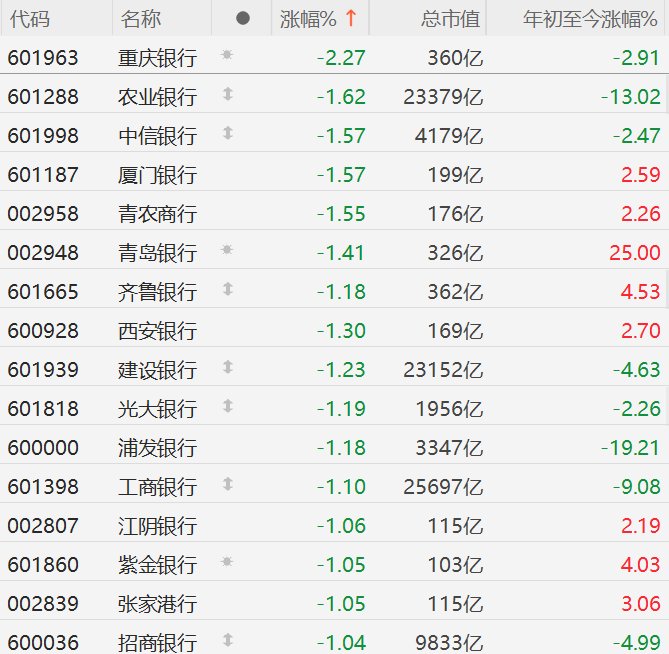
A股银行股集体下跌,重庆银行跌超2%
Ge Long Hui A P P· 2026-02-12 02:25
Group 1 - The A-share market saw a collective decline in bank stocks, with Chongqing Bank dropping over 2% and several other banks, including Agricultural Bank, CITIC Bank, and Xiamen Bank, falling more than 1% [1] - Chongqing Bank's stock decreased by 2.27%, with a total market capitalization of 36 billion and a year-to-date decline of 2.91% [2] - Agricultural Bank's stock fell by 1.62%, with a market cap of 2,337.9 billion and a year-to-date decline of 13.02% [2] Group 2 - CITIC Bank's stock decreased by 1.57%, with a market capitalization of 417.9 billion and a year-to-date decline of 2.47% [2] - Xiamen Bank's stock also fell by 1.57%, with a market cap of 19.9 billion and a year-to-date increase of 2.59% [2] - Qingnong Commercial Bank's stock dropped by 1.55%, with a market cap of 17.6 billion and a year-to-date increase of 2.26% [2] Group 3 - Other banks such as Qilu Bank, Xi'an Bank, and China Construction Bank experienced declines of 1.18% to 1.30%, with respective market caps of 36.2 billion, 16.9 billion, and 23,152 billion [2] - The stock of Industrial and Commercial Bank fell by 1.10%, with a market cap of 25,697 billion and a year-to-date decline of 9.08% [2] - China Merchants Bank's stock decreased by 1.04%, with a market cap of 98.33 billion and a year-to-date decline of 4.99% [2]