
Yangjie Technology(300373)

Search documents
2025年全球及中国汽车MOSFET行业发展背景、市场规模、企业格局及未来趋势研判:汽车已成为MOSFET最大应用领域,需求强劲驱动市场规模持续扩张[图]
Chan Ye Xin Xi Wang· 2025-12-23 01:09
Core Insights - The automotive sector has become the largest application area for MOSFETs, accounting for 33% of global MOSFET applications by 2024, driven by the growth of automotive electrification and intelligence [12][11] - The global automotive MOSFET market is projected to grow from 23.7 billion yuan in 2020 to 33.4 billion yuan in 2024, with a compound annual growth rate (CAGR) of 9.0% [12][11] - China, as the largest automotive market and electric vehicle producer, holds over 30% of the global automotive MOSFET market, with its market size expected to reach 12.27 billion yuan in 2024, growing by 11.9% year-on-year [12][11] Automotive MOSFET Industry Overview - MOSFET, or Metal-Oxide-Semiconductor Field-Effect Transistor, is essential in both analog and digital circuits, converting input voltage changes into output current changes [1][2] - In the automotive sector, MOSFETs are critical components, with applications in traditional fuel vehicles and electric vehicles [4][5] Industry Development Background - China's automotive industry has rapidly developed over the past few decades, maintaining its position as the world's largest automotive producer and seller [7][9] - The growth of the automotive industry has led to increased demand for upstream components, including automotive MOSFETs [7][9] Market Status 1. **Global Market** - The automotive sector has become the largest application area for MOSFETs, with a 33% share in 2024, followed by the industrial sector at 31% [12] - The global automotive MOSFET market is expected to grow from 23.7 billion yuan in 2020 to 33.4 billion yuan in 2024, achieving a CAGR of 9.0% [12] 2. **Chinese Market** - China's automotive MOSFET market surpassed 10 billion yuan in 2023 and is projected to reach 12.27 billion yuan in 2024, with an 11.9% year-on-year growth [12][11] 3. **Competitive Landscape** - The global automotive MOSFET market is competitive, with international firms like Infineon, ON Semiconductor, and Renesas dominating high-end markets due to their technological expertise [12][11] - Domestic companies such as Wentai Technology and Huazhong Microelectronics are accelerating the localization of automotive MOSFETs to meet domestic demand, although they primarily serve lower-end applications [12][11] Future Trends - The automotive MOSFET industry is expected to evolve towards higher performance, smaller sizes, and lower costs, with the increasing adoption of wide-bandgap semiconductor materials like SiC and GaN [15][16]


扬杰科技:截至11月28日公司股东总户数为56000余户
Zheng Quan Ri Bao· 2025-12-16 13:43
Group 1 - The core point of the article is that Yangjie Technology has reported its total number of shareholders as exceeding 56,000 as of November 28 [2]
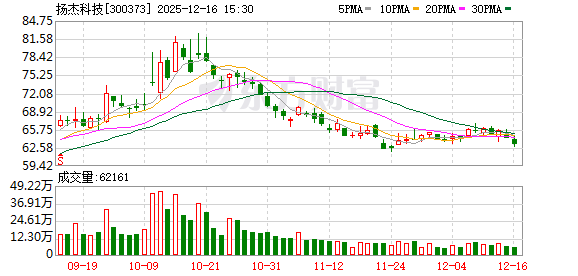
扬杰科技:截至11月30日收市公司股东总户数为56000余户
Zheng Quan Ri Bao Wang· 2025-12-16 13:40
Group 1 - The core point of the article is that Yangjie Technology (300373) has reported its total number of shareholders as exceeding 56,000 as of November 30 [1]
扬杰科技:截至12月10日收市股东总户数为57000余户
Zheng Quan Ri Bao· 2025-12-16 11:09
证券日报网讯 12月16日,扬杰科技在互动平台回答投资者提问时表示,截至12月10日收市,公司股东 总户数为57000余户。 (文章来源:证券日报) ...
打造“芯”高地 激发产业新动能
Xin Hua Ri Bao· 2025-12-15 21:38
Core Insights - The article highlights the rapid growth and development of the semiconductor industry in the Yangzhou Yiyang Economic Development Zone, showcasing its capabilities and achievements in producing power semiconductor devices [1][2]. Group 1: Industry Growth and Performance - The Yiyang Economic Development Zone has established itself as a core hub for the microelectronics industry, housing over 30 related enterprises and forming a complete industrial chain from chip design to manufacturing and testing [1][2]. - The semiconductor integrated circuit industry in the zone is projected to exceed 10.8 billion yuan in sales in 2024, accounting for 35% of the industrial sales, with an average annual growth rate of over 30% in the past three years [1]. - From January to November 2025, the industrial sales reached 12.45 billion yuan, marking a 29% year-on-year increase, with expectations to reach 15 billion yuan by the end of the year [1]. Group 2: Strategic Development Approaches - The development strategy focuses on the characteristics of the microelectronics industry, emphasizing "small but strong, small but beautiful, small but precise," and aims for deep cultivation of the industrial chain and full ecological empowerment [2]. - The zone employs a "chain leader" approach to consolidate industrial synergy and utilizes a dual-driven model of local cultivation and external investment to activate growth potential [2][4]. Group 3: Key Players and Innovations - Yangjie Technology, a leading company in the power semiconductor sector, has become a vertical leader in chip R&D, manufacturing, and testing, holding the largest market share in power diodes and rectifier bridges in China and globally [3]. - The company has over 900 R&D personnel and is recognized for its significant contributions to the industry, including being selected for the Ministry of Industry and Information Technology's excellent smart factory project [3]. Group 4: Investment and Infrastructure Development - The development zone has invested 2 billion yuan to enhance infrastructure, including the establishment of a microelectronics professional industrial park and a wastewater treatment plant [6]. - The zone has also implemented a "scene-based investment" strategy to attract projects that align with local market conditions, ensuring that new projects can land and develop successfully [5]. Group 5: Economic Impact and Future Outlook - The development zone achieved an industrial sales figure of 35.651 billion yuan from January to November, reflecting a 16.6% year-on-year growth, positioning it as the leading area in the Hanjiang District [7]. - The future focus will be on integrating the semiconductor industry chain and optimizing the business environment to establish a significant semiconductor and microelectronics production base in the Yangtze River Delta region [7].
扬杰科技:公司高度重视年度报告的信息披露工作
Zheng Quan Ri Bao· 2025-12-15 12:29
证券日报网讯 12月15日,扬杰科技在互动平台回答投资者提问时表示,公司高度重视年度报告的信息 披露工作,目前正在有序推进相关编制与准备工作,并将全力配合审计机构加快进程。年报的具体披露 时间需综合审计工作进展及公司内部程序最终确定,公司将严格按照深交所规定及时履行信息披露义 务,请关注后续公告。 (文章来源:证券日报) ...
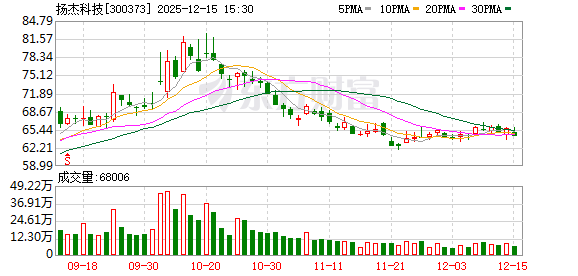
扬杰科技:第四季度,公司各产线均处于满负荷运转状态
Zheng Quan Ri Bao Wang· 2025-12-15 09:13
证券日报网讯12月15日,扬杰科技(300373)在互动平台回答投资者提问时表示,第四季度,公司各产 线均处于满负荷运转状态,生产经营有序高效。公司一直聚焦功率半导体领域,目前主要产能集中于5 吋、6吋、8吋等成熟特色工艺平台。未来,公司将继续围绕功率半导体核心赛道,结合客户需求与行业 发展,稳步推进技术升级与产能规划。 ...
扬杰科技:截至12月15日收市股东总户数为57000余户
Zheng Quan Ri Bao Wang· 2025-12-15 09:13
Group 1 - The core point of the article is that Yangjie Technology (300373) reported a total of over 57,000 shareholders as of the market close on December 15 [1]
扬杰科技(300373)12月8日主力资金净流入4893.56万元
Sou Hu Cai Jing· 2025-12-08 08:41
Group 1 - The core viewpoint of the news is that Yangjie Technology (300373) has shown positive financial performance and significant market activity as of December 8, 2025, with a stock price increase and notable net inflow of funds [1] - As of the latest quarterly report, the company reported total revenue of 5.348 billion yuan, a year-on-year increase of 20.89%, and a net profit attributable to shareholders of 974 million yuan, up 45.51% year-on-year [1] - The company's liquidity ratios are strong, with a current ratio of 1.700 and a quick ratio of 1.426, while the debt-to-asset ratio stands at 41.18% [1] Group 2 - Yangjie Technology has made investments in 28 companies and participated in 197 bidding projects, indicating active engagement in business expansion [2] - The company holds 5 trademark registrations and 773 patents, showcasing its commitment to innovation and intellectual property [2] - Additionally, Yangjie Technology possesses 234 administrative licenses, reflecting its compliance and operational capabilities [2]
中国功率半导体,逆袭
3 6 Ke· 2025-12-08 00:07
Core Viewpoint - The collaboration between global semiconductor giants and Chinese technology leaders signifies a profound industrial transformation, with Chinese companies rapidly advancing in the power semiconductor sector, moving from the periphery to the center of the global stage [1][2][3] Group 1: Collaborations and Partnerships - Onsemi and Innoscience have formed a deep collaboration to develop next-generation efficient power devices based on Innoscience's 8-inch silicon-based GaN technology, targeting markets such as industrial, automotive, telecommunications, consumer electronics, and AI data centers [1][3] - STMicroelectronics and Sanan Optoelectronics are jointly building a silicon carbide (SiC) manufacturing plant in Chongqing, with an expected annual capacity of hundreds of thousands of wafers, marking a significant investment of approximately 230 billion RMB [4][5] - Infineon has established long-term supply agreements with domestic companies for high-quality SiC substrates, ensuring a stable supply of materials for SiC semiconductor production [6][7] Group 2: Market Dynamics and Growth - The global power semiconductor market is projected to see GaN technology capture approximately $2.9 billion (11%) by 2030, with a compound annual growth rate of 42% from 2024 to 2030 [3] - China's power semiconductor industry is expected to reach a market size of 105.775 billion RMB in 2024, maintaining its position as the largest consumer market globally, with a domestic production rate exceeding 80% for low-end power devices [10][11] - Innoscience has achieved a global market share of over 42.4% in 2024, with cumulative shipments exceeding 2 billion chips, highlighting its significant position in the global semiconductor landscape [11] Group 3: Industry Trends and Future Outlook - The shift from passive following to active selection by international giants indicates a recognition of China's capabilities in core technology breakthroughs and market potential [8][9] - The rise of domestic companies in the power semiconductor sector is characterized by a combination of integrated device manufacturing (IDM) and specialized divisions, enhancing self-sufficiency and competitiveness [9][10] - The future landscape will require Chinese companies to focus on technological innovation, global expansion, and collaborative industry chain development to maintain their competitive edge [14][15]


