AstraZeneca(AZN)

Search documents
The Art of the Deal (and the Tariff, and the Tweet) on Wall Street
Stock Market News· 2025-09-19 06:00
Group 1: Market Reactions to Tariffs - The introduction of a 25% tariff on steel and aluminum imports in February 2025 led to modest gains in broader market indices, while domestic steel companies saw significant stock price increases [3] - Following the announcement of a doubling of tariffs to 50% in June 2025, futures markets dipped, but domestic steel companies like Cleveland-Cliffs and Nucor experienced substantial pre-market gains [3] - A proposed 100% tariff on foreign-made films in May 2025 resulted in immediate losses for major Hollywood players, highlighting the potential contradictions in tariff impacts on different sectors [4] Group 2: Impact on Pharmaceuticals and Semiconductors - Threats of tariffs on pharmaceuticals and semiconductors created volatility, with US-listed pharmaceutical stocks initially gaining but foreign counterparts suffering significant losses [5] - By April 2025, global pharmaceutical stocks experienced declines of 6% or more following tariff threats, indicating the broader market's sensitivity to trade policy [5] - President Trump's comments on drug pricing in May 2025 further impacted pharmaceutical stocks, demonstrating the uncertainty surrounding trade and policy [5] Group 3: Market Volatility and Recovery - The "Liberation Day" on April 2, 2025, led to a dramatic market crash, with the S&P 500 dropping nearly 20% and wiping out approximately $6.6 trillion from the US stock market [6] - A subsequent "tariff pause" announced on April 9, 2025, resulted in a market surge, indicating investor relief and the potential for negotiation in trade policies [7] - Despite ongoing tariff threats, the US stock market reached new record highs in September 2025, attributed to expectations of Federal Reserve rate cuts and significant gains in the semiconductor sector [11][12] Group 4: Influence of Digital Communication - President Trump's use of Truth Social has shown to influence market sentiment, as seen with a declaration of an Iran-Israel ceasefire that positively affected Indian markets [9] - Even casual musings on Truth Social regarding quarterly earnings reporting have contributed to the ongoing policy uncertainty affecting market dynamics [10] Group 5: Overall Market Trends - Despite challenges from tariffs and a weak manufacturing sector, the US stock market has managed to defy expectations, with indices closing at record highs in September 2025 [11] - Analysts estimate that changes to US trade policy could subtract 0.4% from global GDP in 2025, yet the market continues to reach new highs, suggesting a complex relationship between trade policy and market performance [12]



X @The Economist
The Economist· 2025-09-18 13:13
“Bad news for Britain, and it’s bad news for the NHS.” @VinjeruM tells “The Intelligence” why AstraZeneca has soured on the country and what that means for the “life sciences superpower” https://t.co/thnk8yD3Qu ...
Trump’s Market Maelstrom: Where Policy Meets Portfolio Pandemonium
Stock Market News· 2025-09-18 06:01
Group 1: Federal Reserve Actions - The Federal Reserve cut interest rates by a quarter-point on September 17, 2025, bringing the federal funds rate to a range of 4% to 4.25%, marking the first reduction since December 2024 [2] - Market reactions included a 1% initial surge in the Dow Jones Industrial Average, which settled at a 0.57% gain by the end of the day, while the S&P 500 and Nasdaq Composite experienced slight declines [2] Group 2: Presidential Influence on Monetary Policy - Donald Trump called for immediate and larger interest rate cuts just days before the Fed's announcement, highlighting the tension between political pressure and central bank independence [3] - Trump's ongoing demands for rate cuts since taking office in January 2025 reflect a unique dynamic where the market adapts to his influence on monetary policy [3] Group 3: Tariff Policies and Market Reactions - The Trump administration increased tariffs on steel and aluminum imports from Mexico to 50%, up from 25%, causing a 4.82% drop in the aluminum 6063 extrusion billet premium [4] - A significant 50% tariff was imposed on a broad range of Indian products, which, despite initial turbulence, did not prevent Indian stock markets from posting positive returns in 2025 [5] Group 4: Pharmaceutical Industry Impact - Trump threatened tariffs as high as 250% on pharmaceutical imports, prompting major companies like GSK to announce a $30 billion investment in U.S. manufacturing and R&D [6][7] - Other pharmaceutical giants, including Eli Lilly and Johnson & Johnson, also committed substantial investments in response to tariff pressures [7] Group 5: Corporate Governance and Reporting - Trump proposed that companies shift from quarterly to semi-annual earnings reports, arguing it would save money and improve management focus [8] - The suggestion received mixed reactions from Wall Street, with some analysts warning it could weaken market transparency while others supported the idea for its long-term strategic benefits [9] Group 6: Overall Market Volatility - Trump's policy shifts and rhetoric continue to inject volatility into the market, influencing sectors from pharmaceuticals to trade, and prompting companies to rethink their strategies [10] - The financial landscape remains dynamic, with Trump's influence ensuring that market headlines are consistently engaging and unpredictable [10]


AstraZeneca's Fasenra Falls Short In Smoker's Lung Trial
Benzinga· 2025-09-17 17:20
Group 1 - AstraZeneca Plc released topline data from the RESOLUTE Phase 3 trial of Fasenra (benralizumab), which showed numerical improvement but did not achieve statistical significance in the primary endpoint for patients with chronic obstructive pulmonary disease (COPD) [1] - The safety and tolerability profile for Fasenra in the trial was consistent with the known profile of the medicine [1] - Fasenra is currently approved as an add-on maintenance treatment for severe eosinophilic asthma (SEA) in over 80 countries, including the US, Japan, the EU, and China [2] Group 2 - Fasenra has also been approved in more than 60 countries for the treatment of eosinophilic granulomatosis with polyangiitis and is under regulatory review for hypereosinophilic syndrome [3] - AstraZeneca shared high-level results from a pre-specified interim analysis of the Phase 3 TULIP-SC trial in patients with systemic lupus erythematosus (SLE), showing a statistically significant reduction in disease activity compared to placebo [4][5] - The TULIP-SC interim results are currently under regulatory review, and Saphnelo IV infusion is approved for moderate to severe SLE in over 70 countries [6]

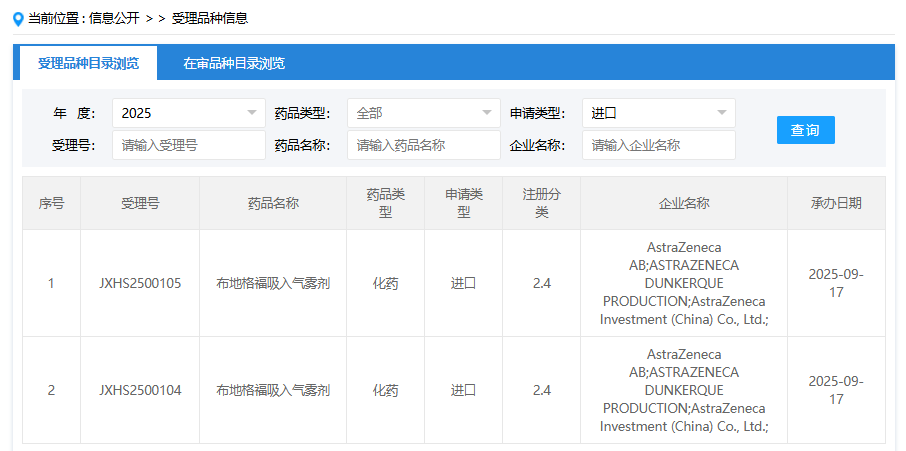
阿斯利康(AZN.US)哮喘三联疗法“布地格福吸入气雾剂”在华申报上市
智通财经网· 2025-09-17 13:02
Core Viewpoint - AstraZeneca's Breztri inhalation aerosol has been submitted for a new indication in China, likely for asthma treatment, following positive results from two Phase III trials [1][3]. Group 1: Product Information - Breztri inhalation aerosol is a fixed-dose combination therapy that includes budesonide (an inhaled corticosteroid), glycopyrrolate (a long-acting muscarinic antagonist), and formoterol (a long-acting beta-2 adrenergic agonist) [2]. - The product is classified as a chemical drug and is imported, with the application date recorded as September 17, 2025 [2]. Group 2: Clinical Trial Results - Two Phase III studies (KALOS and LOGOS) involving 4,461 poorly controlled asthma patients demonstrated that Breztri significantly improved forced expiratory volume in one second (FEV1) compared to the Symbicort group [3]. - The studies also indicated a significant reduction in the rate of severe asthma exacerbations for patients using Breztri [3]. Group 3: Market Context - Asthma affects up to 262 million people globally, with nearly half of those on dual therapy still experiencing poor control, which limits lung function and quality of life [3].
SAPHNELO self-administration TULIP-SC Phase III trial meets primary endpoint in patients with systemic lupus erythematosus based on an interim analysis
Businesswire· 2025-09-17 11:05
Core Insights - Positive high-level results from the interim analysis of the Phase III TULIP-SC trial indicate that AstraZeneca's SAPHNELO® (anifrolumab) significantly reduces disease activity in patients with systemic lupus erythematosus (SLE) compared to placebo [1] - The safety profile observed in the interim analysis aligns with the known clinical profile of SAPHNELO® [1]
阿斯利康(AZN.US)明星哮喘药物Fasenra治疗COPD晚期研究未达主要终点
智通财经网· 2025-09-17 08:58
Core Insights - AstraZeneca's asthma drug Fasenra failed to control acute exacerbations in a late-stage study for chronic obstructive pulmonary disease (COPD) patients, marking a setback for the company's efforts in addressing this serious lung condition [1] - Fasenra is AstraZeneca's second-best-selling respiratory and immunology drug, with sales reaching $920 million in the first half of 2025, an 18% year-over-year increase [1] - The study participants were current or former smokers with a history of at least two acute exacerbations in the past year, and Fasenra did not meet the primary endpoint compared to placebo [1] - AstraZeneca plans to analyze the complete study data to better understand the results [1] Additional Developments - AstraZeneca's executive Sharon Barr emphasized the complexity and heterogeneity of COPD, stating the company will continue to advance other promising solutions in its pipeline to meet unmet patient needs [2] - The company has other COPD treatments, including the three-in-one inhaler Breztri Aerosphere and the investigational drug tozorakimab [2] - AstraZeneca announced that its rare disease drug Saphnelo successfully met its primary endpoint in a late-stage clinical trial, significantly reducing the activity of systemic lupus erythematosus, a chronic autoimmune disease [2]
关税威胁下药企在美投资承诺激增,专家:药企生产回流美国或难实现
Di Yi Cai Jing· 2025-09-17 08:05
Group 1 - Multinational pharmaceutical companies are increasingly investing in the U.S., with GlaxoSmithKline (GSK) committing to invest $30 billion over the next five years, viewing the U.S. as its top priority market [3][4] - Other pharmaceutical companies have also announced significant investments in the U.S., including Eli Lilly's $27 billion, Johnson & Johnson's $55 billion, and Merck's $9 billion plans [3][4][5] - The U.S. pharmaceutical industry heavily relies on overseas supply chains for active pharmaceutical ingredients (APIs) and generic drugs, raising concerns about the feasibility of reshoring production [4][6] Group 2 - The U.K. pharmaceutical industry faces significant investment loss risks due to ongoing disputes over drug pricing controls, with the new VPAG scheme requiring companies to return 23.5% to 35.6% of brand drug revenues to the NHS [7][8] - The British pharmaceutical industry association has warned that maintaining high rebate rates could lead to a loss of approximately £11 billion in R&D investment by 2033 [7][8] - Recent actions by multinational companies, such as Merck canceling a £1 billion research hub in London and AstraZeneca pausing expansion plans, highlight the impact of the U.K. government's slow progress on life sciences investment [8]


X @Bloomberg
Bloomberg· 2025-09-17 06:44
AstraZeneca's Fasenra failed to meet its goal in a late-stage trial of patients with chronic obstructive pulmonary disease for a second time https://t.co/0b9fyPrl9u ...
AstraZeneca's asthma drug fails main goal of COPD study
Reuters· 2025-09-17 06:13
Core Viewpoint - AstraZeneca's asthma drug Fasenra did not meet the primary endpoint in a late-stage study for patients with chronic obstructive pulmonary disease (COPD) [1] Company Summary - AstraZeneca announced the failure of Fasenra in a late-stage clinical trial [1] Industry Summary - The outcome of the study may impact the competitive landscape for asthma and COPD treatments [1]