
Lilly(LLY)

Search documents
Eli Lilly is better at executing now than Novo Nordisk, says BMO's Evan Seigerman
Youtube· 2025-11-24 19:12
Core Insights - The competitive dynamic between Eli Lilly and Novo Nordisk is highlighted, with Lilly currently outperforming Novo in execution and earnings expectations [2][3]. - There is a significant valuation gap between the two companies, attributed to Lilly's strong performance and Novo's internal challenges, including a new CEO and a failed acquisition attempt [3][4]. - Analysts suggest that Novo could become a value trap, while Lilly is expected to continue its outperformance in the coming years [5]. Company Performance - Eli Lilly is successfully beating earnings expectations and maintaining strong guidance, while Novo Nordisk has missed expectations and had to lower its forecasts [2]. - Internal issues at Novo, including leadership changes and strategic missteps, are contributing to its struggles in the market [3]. Valuation Perspectives - The valuation disconnect between Lilly and Novo is seen as justified due to Lilly's superior execution [4]. - Analysts recommend looking at other healthcare companies like Pfizer and Merck for value investments, rather than focusing solely on Lilly [4][5]. Investment Opportunities - Beyond the GLP-1 market, analysts identify Disc Medicine, a small-cap biotech in rare hematology, and Gilead Sciences, a leader in HIV treatment, as promising investment opportunities [6][7]. - Gilead's long-acting pre-exposure prophylaxis (PrEP) business and its leadership in cell therapy are noted as key strengths [7].


This Healthcare Company Just Touched $1 Trillion in Market Cap. Should You Invest $1,000?
Yahoo Finance· 2025-11-24 17:35
Core Insights - Eli Lilly has joined the exclusive trillionaire club, becoming the first healthcare company to reach a market capitalization of $1 trillion, driven by the success of its GLP-1 drug, tirzepatide [1][2] Company Performance - Eli Lilly's share price increased by 1.7% on November 21, briefly reaching a market cap of $1 trillion, before settling around $950 billion later that day. The company regained the $1 trillion cap in intra-day trading on the following Monday [2] - The company's shares have risen 38% in 2025 and 645% over the past five years, indicating strong growth potential [3] Market Dynamics - Tirzepatide, marketed as Mounjaro for type 2 diabetes and Zepbound for weight loss, has become the best-selling drug globally, surpassing Merck's Keytruda [5] - The GLP-1 medication market, valued at approximately $52 billion in 2024, is projected to grow to $187 billion by 2032, reflecting a compound annual growth rate of nearly 17% [6] Competitive Position - Eli Lilly holds a dominant 58% share of the GLP-1 drug market as of the third quarter [6] - The company is set to release a pill form of its best-selling drug, further enhancing its market position [9] Regulatory Developments - In early November, Eli Lilly and competitor Novo Nordisk reached an agreement with the Trump administration to significantly reduce prices for their anti-obesity drugs for Medicare and Medicaid patients, in exchange for a three-year grace period from tariffs [10] - The price of Zepbound for Medicare and Medicaid patients will decrease from $1,000 to $299 for a month's supply, providing greater access to a large patient base [11]
Citi's Geoff Meacham: Novo misses on Alzheimer’s trial, but ‘winners keep winning’ in obesity drugs
CNBC Television· 2025-11-24 17:31
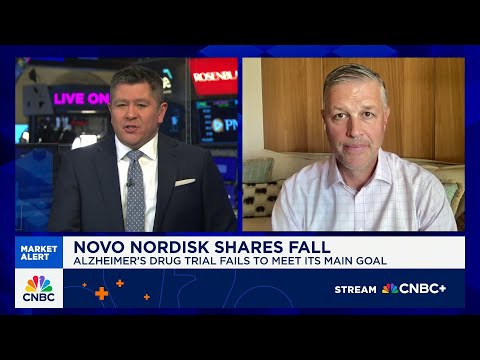
Clinical Trial & Drug Performance - Novo's Alzheimer's drug trial (using weight loss drug MGovi) failed to meet its primary goal, showing no statistically significant slowing of Alzheimer's progression [1][2][3] - The trial results suggest that GLP-1s, while a new mechanism, may require combination with other drugs to be effective in treating Alzheimer's [8] - Biogen and Lily are considered the main players in the Alzheimer's space, with many other companies in earlier phases of development [8][9] Competitive Landscape & Market Share - Lily is perceived as consistently delivering best-in-class GLP-1 growth in obesity and diabetes, with a next product in orphagon [4] - Lily's Mjaro and Zetbound are growing significantly, taking market share from Novo [6] - Lily's market share has increased from 50% to approximately 75%, while Novo's has decreased to around 25% [11] Financial Analysis & Future Outlook - Analyst has a street-high target of $1500 for Lily, driven by the company's core business in the US [5] - Lily is expected to benefit significantly from locking in Medicare and Medicaid payer segments in the next 2-3 years, offsetting lower prices with higher volumes [10] - The Total Addressable Market (TAM) for obesity and diabetes drugs is expected to grow dramatically with expanded access to Medicare and Medicaid [12][14] - Analyst suggests that Lily is a better investment than Novo due to its pipeline, growth in the US and internationally, and overall investment in the space [13]
Citi's Geoff Meacham: Novo misses on Alzheimer's trial, but ‘winners keep winning' in obesity drugs
Youtube· 2025-11-24 17:31
Company Overview - Novo's shares have fallen to a four-year low following the failure of its Alzheimer's drug trial, which did not meet its primary goal of slowing disease progression [1] - The trial results for Novo's weight loss drug MGovi were disappointing, leading to a significant drop in investor confidence [2] Market Comparison - There is a notable disparity in share prices between Novo and its competitor Lilly, with Lilly continuing to perform well in the GLP-1 market for obesity and diabetes [3][4] - Lilly's products, such as Mjaro and Zetbound, are experiencing significant growth and taking market share from Novo [6][11] Future Outlook - Despite the setback for Novo, there is still potential for GLP-1 drugs to be effective in treating Alzheimer's when combined with other therapies, indicating ongoing research opportunities in this area [8][9] - The total addressable market (TAM) for obesity drugs is expected to grow significantly, particularly with expanded access to Medicare and Medicaid [12] Investment Perspective - Analysts suggest that investing in Lilly may be more favorable than Novo, given Lilly's strong pipeline and growth trajectory in the obesity and diabetes sectors [13]

Jim Cramer: This stock will skyrocket if its chips are approved for China sales
CNBC· 2025-11-24 17:21
Group 1 - The S&P 500 and Nasdaq surged due to Alphabet's gains and expectations for a Fed interest rate cut in 2025, with a 77% probability of a 25 basis-point reduction [1] - Alphabet's stock rose over 4% following excitement about the launch of Gemini 3, sparking comparisons to OpenAI's ChatGPT [1] - Nvidia's stock increased nearly 2% after the Commerce Secretary indicated potential approval for Nvidia to sell H200 chips in China, with significant implications for the stock price [1] Group 2 - Novo Nordisk shares fell more than 6% after its trial for semaglutide in Alzheimer's treatment did not meet expectations [1] - Eli Lilly, a competitor in the GLP-1 market, saw its stock rise modestly and became the first healthcare company to reach a $1 trillion market cap, with Bernstein raising its price target to $1,300 [1] - Analysts expect Eli Lilly's new oral GLP-1 to exceed revenue expectations of $550 million next year, with Morgan Stanley also increasing its price target for the company [1] Group 3 - Stocks mentioned in the rapid-fire segment included Merck, Carvana, Booking Holdings, and Cummins [1]

Lilly to present data from two positive Phase 3 studies of Jaypirca (pirtobrutinib) in chronic lymphocytic leukemia at the 2025 American Society of Hematology (ASH) Annual Meeting
Prnewswire· 2025-11-24 17:00
Core Insights - Eli Lilly and Company will present data from the BRUIN CLL-314 and BRUIN CLL-313 studies of Jaypirca (pirtobrutinib) at the 67th American Society of Hematology (ASH) Annual Meeting, highlighting its unique clinical profile and potential role in treating B-cell malignancies [1][2][3] Study Results - The BRUIN CLL-314 study is the first head-to-head Phase 3 trial comparing pirtobrutinib to Imbruvica (ibrutinib) in treatment-naïve CLL/SLL patients, showing non-inferiority in response rates with a nominal P-value for superiority < 0.05 [3] - The BRUIN CLL-313 study demonstrated a statistically significant improvement in progression-free survival for pirtobrutinib compared to chemoimmunotherapy in treatment-naïve CLL/SLL patients without del(17p) [3] Presentation Details - Key presentations include long-term data from the Phase 1/2 BRUIN study in relapsed or refractory CLL, mantle cell lymphoma (MCL), and Waldenström macroglobulinemia (WM), with approximately five years of follow-up [2][3] - Additional presentations will cover real-world treatment patterns and outcomes of patients receiving covalent BTK inhibitors in China, as well as the efficacy of pirtobrutinib in various treatment settings [4][5] Drug Profile - Jaypirca is a non-covalent BTK inhibitor, highly selective for BTK, and is FDA-approved for treating CLL/SLL and MCL [5][6] - The drug is administered as a 200 mg oral dose once daily, with ongoing treatment until disease progression or unacceptable toxicity [5] Safety and Efficacy - Common adverse reactions in patients treated with Jaypirca include decreased neutrophil count (46%), decreased hemoglobin (39%), and fatigue (32%) [9][10] - Serious adverse reactions occurred in 56% of CLL/SLL patients, with pneumonia and COVID-19 being the most common [10]


Eli Lilly flies the pharma flag in tech-heavy $1tn market cap club
Yahoo Finance· 2025-11-24 16:59
Core Insights - Eli Lilly has achieved a market capitalisation of $1 trillion, becoming the first healthcare company to reach this milestone, previously dominated by technology firms [1][2] - The surge in Eli Lilly's market value is primarily driven by the unprecedented demand for its weight loss drugs, particularly tirzepatide [1][4] Financial Performance - Eli Lilly's share price closed at $1,059.70 on November 21, reflecting a 27% increase since January 2025, although it slightly retreated to $1,056.77 by November 24 [2] - The S&P 500 pharmaceutical index has risen by 19% since the beginning of September, indicating a growing investor interest in pharmaceutical stocks [3] Product Success - Tirzepatide, marketed as Zepbound and Mounjaro, has significantly contributed to Eli Lilly's success, with Mounjaro generating $6.5 billion in Q3 2025, a 109% increase from Q3 2024, and Zepbound achieving $3.6 billion, up 185% from the same period [4][5] - GlobalData forecasts that the combined sales of Zepbound and Mounjaro will reach $64 billion by 2031 [5] Competitive Landscape - Tirzepatide's growth has positioned Eli Lilly ahead of its main competitor, Novo Nordisk, which has seen a decline in share prices despite being first to market with semaglutide [6] - Tirzepatide's dual-action mechanism offers better efficacy compared to semaglutide, contributing to its market success [6] - The sales performance of tirzepatide has surpassed that of MSD's Keytruda, which has been the top-selling drug globally in recent years [7]
Eli Lilly Stock Joins $1 Trillion Club: What Is Happening?
Forbes· 2025-11-24 16:50
Core Insights - Eli Lilly's stock surged nearly 50% over the past six months, driven by strong earnings, margin increases, and excitement around GLP-1 and oral drug potentials [2][3][8] Financial Performance - Revenue increased by 8.7%, net margin grew by 14%, and P/E multiples rose by 20% in the last six months [3] - Q3 2025 revenue reached $17.6 billion with non-GAAP EPS of $7.02, exceeding projections and leading to an upgraded 2025 guidance [8] - Q2 2025 revenue was $15.56 billion with adjusted EPS of $6.31, also surpassing predictions and prompting a raised full-year outlook [8] Market Capitalization - Eli Lilly achieved a $1 trillion market cap on November 21, becoming the first pharmaceutical company to reach this milestone, largely due to the success of GLP-1 drugs [8] Product Success - High demand for GLP-1 drugs, specifically Mounjaro and Zepbound, significantly contributed to revenue growth and market share [8] - Anticipation for the oral obesity drug Orforglipron's early 2026 approval is expected to boost future growth prospects [8]

Spotlight on Eli Lilly: Analyzing the Surge in Options Activity - Eli Lilly (NYSE:LLY)
Benzinga· 2025-11-24 15:02
Core Insights - Financial institutions are showing a bullish sentiment towards Eli Lilly, with 41% of traders being bullish and 32% bearish, indicating a strong interest in the stock [1] - The predicted price range for Eli Lilly over the last three months is between $730.0 and $1200.0, suggesting significant market expectations [2] - Analysts have set an average target price of $1174.2 for Eli Lilly, with various firms maintaining or upgrading their ratings [9][10] Options Activity - A total of 46 unusual trades were identified for Eli Lilly, with 41 being calls valued at $2,414,792 and 5 puts valued at $616,686, reflecting a preference for bullish positions [1] - The mean open interest for Eli Lilly options trades is 648.68, with a total volume of 1,068.00, indicating active trading [3] - Noteworthy options activity includes a mix of bullish and bearish trades, with significant volumes and varying strike prices [7] Company Overview - Eli Lilly focuses on neuroscience, cardiometabolic diseases, cancer, and immunology, with key products including Verzenio, Mounjaro, and Taltz [8] - The stock is currently trading at $1059.99, reflecting a slight increase of 0.03%, with an anticipated earnings release in 73 days [12]

诺和诺德阿尔茨海默症试验失败
Xin Lang Cai Jing· 2025-11-24 15:00
Core Viewpoint - Novo Nordisk's semaglutide failed to delay the progression of Alzheimer's disease, leading to a decline in its stock price, while Eli Lilly and Biogen saw their stock prices rise due to improved relative expectations [1] Company Summary - Novo Nordisk's stock price is under pressure following the announcement regarding semaglutide's ineffectiveness in Alzheimer's treatment [1] - Eli Lilly's stock price increased as market expectations improved in light of the news [1] - Biogen also experienced a rise in stock price, benefiting from the relative positive outlook compared to Novo Nordisk [1]
