
Lilly(LLY)

Search documents
Tuesday's Morning Movers: DAL Lifts Guidance, LLY & DKNG Downgrades
Youtube· 2026-03-17 14:02
Delta Airlines - Delta Airlines has updated its first quarter sales outlook, now expecting high single-digit growth due to an acceleration in both corporate and leisure travel [2][6] - The airline reported logging eight of its ten highest sales days ever this month, which is helping to offset a significant rise in fuel costs, with a noted increase of approximately $400 million in fuel expenses as oil prices spiked above $100 per barrel [3][5] - Delta's revenue for Q1 is now projected to be between $15 billion and $15.3 billion, an increase from just above $14 billion last year and above consensus estimates [6] Eli Lilly - Eli Lilly received a downgrade from HSBC, reducing its rating from hold to reduce and slashing its price target from $1,070 to $850, citing that the stock is priced to perfection after a significant run [7][8] - Concerns have been raised regarding the obesity drug market being overhyped, with expectations of pricing pressure and potential competition affecting Eli Lilly's market position [8][9] - The anticipated launch of Eli Lilly's obesity pill is projected to generate $1.1 billion to $1.3 billion, but there are concerns about higher dropout rates and shorter treatment durations than previously modeled [11][12] DraftKings - DraftKings has been downgraded by Argus from buy to hold, facing challenges in prediction markets and high customer acquisition costs, which are seen as headwinds for the company [12][14] - Increased state taxes and a loss of market share in internet gaming in the US are additional concerns contributing to the downgrade [14]



10000亿减肥药生意背后,谁在闷声发大财?
GLP1减重宝典· 2026-03-17 10:49
Core Viewpoint - The article discusses the significant price drop in the domestic weight loss drug market, driven by major pharmaceutical companies like Eli Lilly and Novo Nordisk, which are adopting a "price for volume" strategy to capture market share and establish long-term user habits [3][5]. Market Dynamics - The weight loss drug market is projected to become increasingly competitive, with a potential market size of approximately $150 billion (10465 billion RMB) over the next decade, as major players and over 80 domestic GLP-1 drug development pipelines are actively pursuing opportunities [8][10]. - The introduction of GLP-1 drugs, such as tirzepatide and semaglutide, is reshaping the pharmaceutical landscape, previously dominated by cancer drugs, highlighting the growing concern over obesity [6][8]. Financial Performance - Eli Lilly reported a revenue of $45.887 billion in the first three quarters of 2025, with tirzepatide sales reaching $24.837 billion, accounting for 54.1% of total revenue [8]. - Novo Nordisk's semaglutide generated $25.4 billion in sales during the same period, representing 73.6% of its total revenue [8]. Injection Pen Market - The injection pen market, essential for administering GLP-1 drugs, is expected to see a demand exceeding 200 million units annually, with the production cost of the active drug being significantly lower than that of the injection pen itself [10][11]. - The global injection pen market is projected to reach $74.126 billion by 2030, with a compound annual growth rate of 7.9% from 2024 to 2030 [13]. Competitive Landscape - The expiration of core patents for semaglutide in March 2026 has prompted numerous companies, including Jiuyuan Gene and East China Pharmaceutical, to submit applications for generic versions, indicating a race to capture market share in the lucrative weight loss drug sector [9][10]. - Domestic companies are focusing on vertical integration and cost-effective manufacturing to compete with established international players, while also navigating the challenges posed by high patent barriers [19][21]. Technological and Manufacturing Challenges - The injection pen industry faces significant technological barriers, with complex manufacturing processes and stringent patent protections making entry difficult for new players [14][16]. - Companies like Ypsomed have established strong patent portfolios and are capitalizing on the growing demand for self-administration devices, particularly in the GLP-1 market [16][17]. Future Outlook - The domestic injection pen market is poised for growth as the expiration of key drug patents opens opportunities for local manufacturers to innovate and compete on a global scale [17][21]. - The focus on high-quality manufacturing and compliance with international standards will be crucial for domestic companies aiming to penetrate the global market [21].


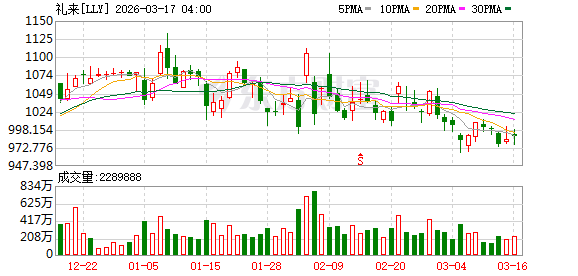
礼来公司股价在盘前交易中下跌1.5%
Mei Ri Jing Ji Xin Wen· 2026-03-17 10:06
Group 1 - The core point of the article is that Eli Lilly's stock price fell by 1.5% in pre-market trading on March 17 [2]
制药巨头开始疯抢芯片
第一财经· 2026-03-17 07:24
Core Insights - Roche has deployed 2,176 NVIDIA AI computing chips across multiple locations in the US and Europe, surpassing the computing power of Eli Lilly's AI factory announced earlier this month [3][4] - Eli Lilly's AI drug factory, LillyPod, is the world's first fully autonomous AI drug factory operated by a pharmaceutical company, completed in just four months with over 1,000 NVIDIA Blackwell Ultra GPUs [3][4] - Major pharmaceutical companies are increasingly investing in AI to shorten product development cycles and reduce costs, with Roche, Eli Lilly, AstraZeneca, and Pfizer acquiring promising AI tools through partnerships [3][4] Investment and Market Trends - Eli Lilly and NVIDIA announced a $1 billion investment over five years to establish a joint research lab in the San Francisco Bay Area to accelerate AI drug development [4] - AstraZeneca has also acquired an AI company, Modella, to integrate AI models into oncology research and development processes [4] - The competitive landscape in AI drug development is shifting from models and algorithms to data quality and production capacity, with the ability to generate large-scale high-quality data becoming crucial for building powerful AI models [4] Market Size and Efficiency Gains - The global AI pharmaceutical market exceeded $1 billion in 2022 and is expected to approach $3 billion by 2026 according to Research & Markets [4] - Investments in new modeling tools and automated laboratories are expected to significantly enhance the efficiency of the biopharmaceutical pipeline in the coming years [4] - McKinsey predicts that fully automated AI agents with minimal human intervention could improve clinical development efficiency by approximately 35% to 45% over the next five years, although companies will need to continue investing in computing power [4]


罗氏AI算力规模超越礼来!制药巨头开始疯抢芯片
Di Yi Cai Jing· 2026-03-17 05:47
Core Insights - Roche has deployed 2,176 NVIDIA AI computing chips to enhance its AI capabilities for drug development and diagnostics [1][3] - The deployment surpasses the computational capacity of Eli Lilly's recently launched AI drug factory, LillyPod, which utilizes over 1,000 NVIDIA Blackwell Ultra GPUs [1][3] Group 1: AI Deployment and Impact - Roche's AI project aims to accelerate research and development processes, including modeling, data analysis, and clinical trials [3] - Major pharmaceutical companies are increasingly investing in AI to shorten product development cycles and reduce costs, with Roche, Eli Lilly, AstraZeneca, and Pfizer leading the way [3] Group 2: Market Trends and Projections - The global AI pharmaceutical market exceeded $1 billion in 2022 and is projected to approach $3 billion by 2026 [4] - The shift towards new modeling tools and automated laboratories is expected to significantly enhance the efficiency of biopharmaceutical research and development pipelines in the coming years [4] - McKinsey predicts that fully automated AI agents could improve clinical development efficiency by approximately 35% to 45% over the next five years, although companies will need to continue investing in computational power [4]

Wall Street Firms Turn Bullish on Eli Lilly and Company (LLY) Buoyed by GLP-1 Medication Expansion Plans
Insider Monkey· 2026-03-16 21:11
Core Insights - Generative AI is viewed as a transformative technology by Amazon's CEO Andy Jassy, indicating its potential to significantly enhance customer experiences across the company [1] - Elon Musk predicts that by 2040, humanoid robots could create a market worth $250 trillion, representing a major shift in the global economy driven by AI innovation [2][3] - Major firms like PwC and McKinsey acknowledge the multi-trillion-dollar potential of AI, suggesting a broad consensus on its economic impact [3] Company and Industry Analysis - A breakthrough in AI technology is redefining work, learning, and creativity, leading to increased interest from hedge funds and top investors [4] - There is speculation about an under-owned company that may play a crucial role in the AI revolution, with its technology posing a threat to competitors [4][6] - Prominent figures in technology and investment, including Bill Gates and Warren Buffett, recognize AI as a significant advancement with the potential for substantial social benefits [8] Market Dynamics - The AI ecosystem is expected to reshape operations for businesses, governments, and consumers globally, indicating a shift in market dynamics [2] - The enthusiasm for AI is reflected in the investments and partnerships being formed by major companies, such as Oracle's collaboration with Nvidia [8]

Is There Too Much Bullishness Priced Into Eli Lilly's Stock Price?
Yahoo Finance· 2026-03-16 16:20
Eli Lilly (NYSE: LLY) has been an exceptional growth stock to own in recent years. Its popular GLP-1 treatments, Zepbound and Mounjaro, have been in high demand, and they are amassing billions in revenue for the business. Investors and analysts continue to expect much more growth from them in the future. However, with Eli Lilly's valuation at around $900 billion today, expectations are also sky-high. That can make it difficult for the stock to impress investors and generate strong returns in the future. I ...
3 Stocks That Could Be Next to Announce a Stock Split
Investing· 2026-03-16 15:52
Core Insights - The article discusses three companies that may announce stock splits in 2026, highlighting the psychological appeal of stock splits to retail investors and the potential for increased accessibility to shares [2][5]. Company Summaries - **KLA Corporation**: KLA's stock has surged over 375% in the last five years and over 100% in 2025, currently trading at approximately $1,400 per share. The company recently announced a $7 billion share repurchase program and a 21% dividend increase, which may delay a stock split announcement [6][8][9]. - **Eli Lilly & Co.**: Eli Lilly's stock has increased by over 350% in the last five years, trading just under $1,000. Analysts project a 25% growth potential, supported by expected earnings growth of around 35% in the next year. The company leads the GLP-1 weight loss market and may consider a stock split depending on FDA approvals and recent dividend increases [10][11][12]. - **McKesson Corporation**: McKesson's stock has risen more than 400% in the last five years and 47% in the last 12 months, currently priced over $900. The company raised its FY2026 guidance, expecting 12% to 16% revenue growth and 17% to 19% growth in adjusted earnings per share, with analyst targets suggesting a price over $1,000 [13][14][15].


Eli Lilly Just Opened the Door to Even Greater GLP-1 Growth
247Wallst· 2026-03-16 15:19
Eli Lilly Just Opened the Door to Even Greater GLP-1 Growth - 24/7 Wall St. S&P 5006,709.70 +1.30% Dow Jones47,015.60 +1.14% Nasdaq 10024,702.20 +1.54% Russell 20002,516.79 +1.73% FTSE 10010,361.60 +1.20% Nikkei 22554,589.50 +2.38% Live Nasdaq Composite: Tech Leads, Oil Eases With AI's Next Chapter in Focus Investing Follow 24/7 Wall St. on Google This post may contain links from our sponsors and affiliates, and Flywheel Publishing may receive compensation for actions taken through them. How to Add Us to Go ...

3 Companies at the Forefront of the GLP-1 Pill Wars
Yahoo Finance· 2026-03-16 11:44
Industry Overview - The GLP-1 agonist market is projected to reach nearly $63 billion by early 2026, with forecasts indicating it could triple over the next decade [2] - The biopharma industry is rapidly developing new GLP-1 receptor agonist medications, with numerous firms involved in this growth [3] Company Focus: Eli Lilly - Eli Lilly and Company is a major player in the pharmaceutical industry, with a market capitalization nearing $1 trillion and shares increasing by almost 20% in the past year [4] - The company plans to invest $3 billion in China over the next decade to enhance its supply chain and local manufacturing capacity for GLP-1 medications, aiming to tap into the growing weight-loss market [5] - Eli Lilly has filed for approval of a new GLP-1 treatment, orforglipron, for obesity in the U.S. and over three dozen other countries, with a domestic launch expected by mid-2026 [6] Competitive Landscape - Eli Lilly's size and market position enable it to develop multiple GLP-1 medicines and expand globally [7] - Other companies to watch in the GLP-1 space include Viking Therapeutics and Structure Therapeutics, which are smaller but have promising GLP-1 candidates in clinical trials [7]