lululemon(LULU)

Search documents
Cramer's Stop Trading: Lululemon
CNBC Television· 2025-09-25 14:56
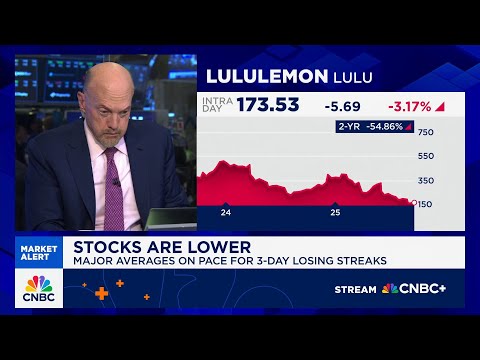
Let's get to Jim and stop training. You know, Carl, just when you thought that Lulu couldn't go any lower and there was nobody left to downgrade, Edm comes on by to hold. I didn't know anyone was left.It's competitive environment. And the top of Lulu, I've always felt, was when Costco came in against them. Uh, so what can I say.I mean, this company now sells at 11 times earnings. This was the premium. Calvin McDonald, we're still waiting for him to come up with something that makes you feel like you should ...


Cramer's Stop Trading: Lululemon
Youtube· 2025-09-25 14:56
Let's get to Jim and stop training. You know, >> Carl, just when you thought that Lulu couldn't go any lower and there was nobody left to downgrade, Edm comes on by to hold. I didn't know anyone was left.It's competitive environment. And the top of Lulu, I've always felt, was when Costco came in against them. Uh, so what can I say.I mean, this company now sells at 11 times earnings. This was the premium. Calvin McDonald, we're still waiting for him to come up with something that makes you feel like you shou ...

Lululemon Shares Dip As Needham Downgrades Stock To Hold
Financial Modeling Prep· 2025-09-25 14:19
Group 1 - Needham downgraded Lululemon Athletica Inc. from Buy to Hold, with shares falling more than 1% in pre-market trading [1] - The last 18 months have been disappointing for Lululemon, and while new product launches are expected to lift U.S. sales in 2025, the competitive environment has proven too challenging [1] - Street estimates for FY26 are considered too high, forecasting a mid-single-digit EPS decline compared to consensus expectations for flat performance [2] Group 2 - Analysts noted that while the company has not harmed its brand, the U.S. market remains difficult, making it prudent to wait for signs of stabilization before turning more positive [2]
LULU Downgrade, KMX Earnings Slide, SBUX Layoffs
Youtube· 2025-09-25 14:01
CarMax - CarMax's stock has dropped approximately 20% following disappointing earnings results, missing both revenue and earnings expectations [2][3] - The company reported earnings of 64 cents per share, significantly below the expected $1.09, with revenue falling short at $6.6 billion compared to the anticipated over $7 billion [3][4] - Same-store sales declined by 6.3%, while analysts were expecting at least 1% growth, indicating a challenging market environment for the used car retailer [4][5] - The CEO described the second quarter as "challenging" and announced plans to cut costs by $150 million over the next 18 months [5] Starbucks - Starbucks is undergoing a billion-dollar restructuring plan, which includes cutting hundreds of non-retail jobs and closing underperforming stores [6][7] - The company aims to improve sales through various initiatives, including the closure of stores focused solely on mobile ordering and pickup, which were deemed overly transactional [8][10] - Workers affected by the job cuts will be notified soon, following a previous decision to eliminate over a thousand jobs earlier this year [9] Lululemon - Lululemon has faced multiple downgrades, with analysts expressing concerns over a challenging competitive environment and tariff risks, particularly related to their exposure in Vietnam [11][13] - The stock has fallen more than 50% year-to-date, with recent downgrades indicating a lack of confidence in the company's performance [12][14] - Despite the challenges, there is a potential opportunity with the Amex Platinum card offering a $300 credit for Lululemon, which may attract affluent customers [15]


道指开盘跌0.3% 标普500跌0.6%,纳指跌0.9%
Xin Lang Cai Jing· 2025-09-25 13:35
Core Viewpoint - Oracle's stock dropped by 4.2% following a "sell" rating from Rothschild & Co Redburn [1] - Transocean's shares plummeted by 16.5% after announcing a plan to issue 125 million shares at $3.05 each, significantly below the previous closing price of $3.64 [1] - Lululemon's stock fell by 2% after Needham downgraded its rating from "buy" to "hold" [1] - Intel's stock rose over 5% as the company plans to increase prices for its "Raptor Lake" processors by more than 10% in Q4 [1] Company Summaries - **Oracle**: Experienced a 4.2% decline in stock price due to a negative rating from Rothschild & Co Redburn [1] - **Transocean**: Stock fell 16.5% after announcing a share issuance plan at a price lower than the recent closing price [1] - **Lululemon**: Saw a 2% decrease in stock value following a downgrade from Needham [1] - **Intel**: Stock increased by over 5% with plans to raise prices for its processors in the upcoming quarter [1]



Lululemon股价盘前下跌2%
Mei Ri Jing Ji Xin Wen· 2025-09-25 10:08
每经AI快讯,9月25日,Lululemon股价盘前下跌2%,此前Needham将其评级从"买入"下调至"持有"。 ...
Lululemon盘前跌2%
Ge Long Hui A P P· 2025-09-25 10:02
格隆汇9月25日|Lululemon股价盘前下跌2%,此前Needham将其评级从"买入"下调至"持有"。 ...
HSBC Downgrades lululemon athletica (LULU) Stock to Hold
Yahoo Finance· 2025-09-24 13:54
Core Viewpoint - Lululemon athletica inc. is facing challenges in its U.S. business, leading to a downgrade by HSBC from "Buy" to "Hold" with a reduced price target of $175 from $275 [1][2] Financial Performance - In Q2 2025, Lululemon exceeded EPS expectations but fell short on revenue guidance primarily due to its U.S. operations [2] - For Q3 2025, the company anticipates net revenue between $2.470 billion and $2.500 billion, indicating a growth of 3% to 4% [2] - The expected diluted EPS for Q3 2025 is projected to be between $2.18 and $2.23 [2] Market Position and Competition - Despite increased competition from brands like Vuori, Alo, and Fabletics, Lululemon continues to maintain its relevance and strong performance [3] - The competitive landscape has seen these upstart brands gaining market share primarily from Nike, which is experiencing negative topline growth [3] - Lululemon's proprietary fabrics provide a quality advantage, keeping it core to the wardrobes of many consumers, even amidst rising competition [3]
Lululemon Is Down 57% in 2025. Is This a Once-in-a-Lifetime Buying Opportunity Before the Stock Goes Parabolic?
The Motley Fool· 2025-09-24 08:05
Core Viewpoint - Lululemon has faced significant macroeconomic and competitive challenges, leading to a substantial decline in its stock price from record highs, raising questions about its future growth potential and investment attractiveness [1][2]. Company Overview - Lululemon, founded in 1998, initially gained a strong foothold in the premium yoga and athleisure market through brand loyalty initiatives like free yoga classes and an expansion of its online and physical store presence [4]. - The company experienced setbacks, including a recall of see-through yoga pants in 2013 and leadership changes that impacted its stability [5][6]. Growth Strategy - In 2019, Lululemon launched the "Power of Three" plan aimed at doubling digital and men's revenue and quadrupling international revenue over five years, which it achieved ahead of schedule despite pandemic-related store closures [6][7]. - A subsequent "Power of Three x2" plan was introduced in 2022, targeting similar growth goals, including increasing total revenue from $6.3 billion to $12.5 billion by fiscal 2026 [9]. Financial Performance - Lululemon's revenue growth has slowed, with year-over-year growth rates dropping from 30% in FY 2022 to an expected 4% to 6% in FY 2024, while comparable sales growth has also decreased significantly [11][12]. - The company's gross margin peaked at 59.2% in FY 2024 but has faced pressure due to increased markdowns and inflation-related costs [11][12]. Market Position and Challenges - Lululemon's largest market, North America, has seen a slowdown in women's apparel sales amid tough macroeconomic conditions and increased competition from brands like Nike and Under Armour [11]. - The abrupt resignation of the chief product officer in May 2025 raised concerns about the company's ability to maintain its competitive edge [11]. Stock Valuation - At a stock price of $166, Lululemon is considered undervalued at 12 times next year's earnings, but this discount reflects a significant gap between its near-term outlook and Wall Street expectations [13]. - Analysts project modest revenue growth of 5% to $11.5 billion, with earnings per share expected to increase by 4%, indicating cautious sentiment regarding the company's recovery [12][13].
Baird下调Lululemon(LULU.US.US)评级,耐克携手SKIMS搅局高端运动服饰
智通财经网· 2025-09-24 07:35
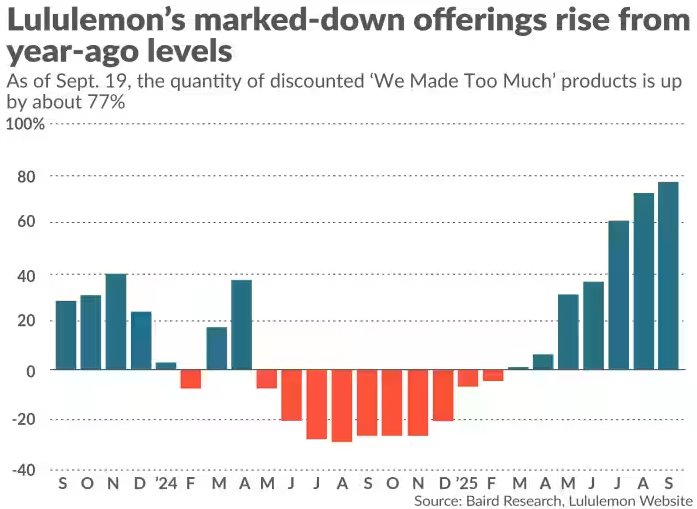
Core Viewpoint - Lululemon's Q2 earnings report was disappointing, leading Baird to downgrade its rating from "Buy" to "Neutral" and reduce the target price by 13% to $195, citing increased short-term earnings uncertainty overshadowing attractive valuation levels [1][4] Group 1: Financial Performance and Analyst Ratings - Baird analyst Mark Altschwager noted that Lululemon's recent product launches may struggle to attract high-value core customers, compounded by signs of consumer weakness in the Canadian market [1] - As of September 19, the discount items in Lululemon's "We Did Too Much" section increased by 77% compared to a year ago, marking the highest level in at least two years [1] - Following the downgrade, only 8 out of 34 analysts tracked by FactSet maintained a "Buy" rating, a reduction of 50% since the end of August; the average target price dropped by 31% to $187.65 over three weeks, indicating a significant shift in market sentiment [4] Group 2: Competitive Landscape - Nike's recent collaboration with SKIMS is expected to pose a direct competitive threat to Lululemon, as the new sportswear line targets the same consumer demographic [5][6] - The partnership leverages Kim Kardashian's influence and SKIMS' digital community, potentially disrupting the high-end sportswear market and creating significant pricing competition for Lululemon [6] - Despite the potential for Nike to capture market share, it remains to be seen if the collaboration can convert brand influence into sustained credibility in the sportswear sector, particularly among Nike's traditional loyal customers [7]