
MTR CORPORATION(MTCPY)

Search documents
港铁公司(00066) - 致新登记股东之函件(2025中期报告及发送公司通讯的安排)及回条
2025-09-11 08:36
各位股東: 香港鐵路有限公司 MTR CORPORATION LIMITED (「本公司」) (於香港成立之有限公司) (股份代號:66) 發送公司通訊的安排 閣下如對本函有任何疑問,請於辦公時間內(星期一至五上午9時至下午6時,香港公眾假期除外)致電股份 過戶登記處的熱線(852)2862 8688。 根據《香港聯合交易所有限公司證券上市規則》(「上市規則」)、本公司的組織章程細則及香港法例第622章 《公司條例》,本公司已採用通過刊載於網站發布公司通訊(附註1) (可供採取行動的公司通訊(附註2)除外)。公司 通訊的英文和中文版本將以電子方式上載於本公司網站www.mtr.com.hk 及香港聯合交易所有限公司(「聯 交所」)網站www.hkexnews.hk。 閣下如欲查閱公司通訊,可以在本公司網站主頁「關於港鐵」項下點擊 「投資資料」,然後選擇「財務及報告」以閱覽年報及中期報告以及選擇「公告及通函」以閱覽其他的公司通 訊;或可以瀏覽聯交所網站。倘 閣下欲收到本公司在聯交所網站刊載公司通訊的通知,可在現時於聯交所 網站(www.hkex.com.hk)的「市場數據」項下登記使用「訊息提示」服務。 202 ...
港铁公司(00066) - 2025 - 中期财报
2025-09-11 08:34
連繫社區 共建未來 2025中期報告 股份代號:66 2025年中期業績 財務摘要 | 總收入 | 274 億港元 6.5% | | --- | --- | | 經常性業務利潤 | 34 億港元 | | | 15.7% | | 物業發展利潤 | 55 億港元 218.5% | | 投資物業公允價值 | 12 億港元 | | 計量虧損 | (與截至2024年6月30日止六個月的 公允價值計量收益3億港元相比) | | 本公司股東 應佔淨利潤 | 77 億港元 27.5% | | 中期普通股息 | 0.42 每股 港元 | | | (與2024年中期相同) | | 總資產 | 4,026 億港元 | | | 9.6%(與2024年12月31日相比) | | 淨資產 | 2,112 億港元 | | | 13.5%(與2024年12月31日相比) | | 淨負債權益比率 | 18.8% | | | 12.8個百分點(與2024年12月31日相比) | 目錄 MTR SHOP 我們的長遠目標 我們用關懷備至、創新及 可持續的服務,連繫及建 設社區,以成為廣受國際 認可的企業。 我們的使命 推動城市前行 我們的信念 我們 ...
港铁公司(00066) - 截至2025年8月31日止月份之股份发行人的证券变动月报表
2025-09-03 08:32
股份發行人及根據《上市規則》第十九B章上市的香港預託證券發行人的證券變動月報表 | 截至月份: | 2025年8月31日 | 狀態: 新提交 | | --- | --- | --- | | 致:香港交易及結算所有限公司 | | | | 公司名稱: | 香港鐵路有限公司 | | | 呈交日期: | 2025年9月3日 | | | I. 法定/註冊股本變動 | 不適用 | | FF301 第 1 頁 共 10 頁 v 1.1.1 FF301 II. 已發行股份及/或庫存股份變動 (B). 承諾發行發行人股份的權證 不適用 | 1. 股份分類 | 普通股 | 股份類別 | 不適用 | | 於香港聯交所上市 (註1) | 是 | | | --- | --- | --- | --- | --- | --- | --- | --- | | 證券代號 (如上市) | 00066 | 說明 | 不適用 | | | | | | | | 已發行股份(不包括庫存股份)數目 | | 庫存股份數目 | | 已發行股份總數 | | | 上月底結存 | | | 6,224,823,171 | | 0 | | 6,224,823,171 | ...
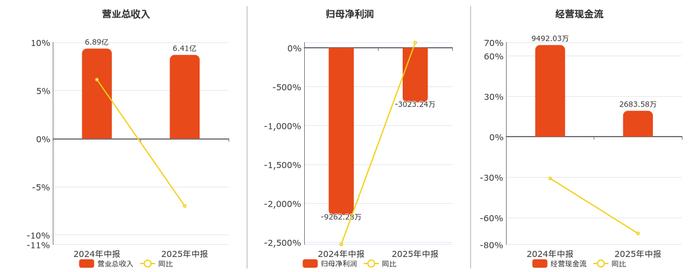
ST金鸿(000669.SZ):2025年中报净利润为-3023.24万元
Xin Lang Cai Jing· 2025-08-29 01:16
Core Insights - ST Jin Hong (000669.SZ) reported a total operating revenue of 641 million yuan for the first half of 2025, ranking 23rd among disclosed peers, which represents a decrease of 48.15 million yuan or 6.99% year-on-year [1] - The company recorded a net profit attributable to shareholders of -30.23 million yuan, ranking 26th among peers [1] - Operating cash flow showed a net inflow of 26.84 million yuan, ranking 20th among peers, down 68.08 million yuan or 71.73% year-on-year [1] Financial Ratios - The latest debt-to-asset ratio stands at 95.85%, ranking 28th among disclosed peers, an increase of 0.74 percentage points from the previous quarter and 6.74 percentage points year-on-year [3] - The latest gross profit margin is 7.17%, ranking 26th among peers, down 8.00 percentage points from the same period last year [3] - The latest return on equity (ROE) is -693.70%, ranking 28th among peers, a decrease of 636.56 percentage points year-on-year [3] - The diluted earnings per share is -0.04 yuan, ranking 26th among peers [3] - The latest total asset turnover ratio is 0.26 times, ranking 19th among peers [3] - The latest inventory turnover ratio is 37.79 times, down 0.33 times or 0.86% year-on-year [3]

*ST荣控(000668)2025年中报简析:增收不增利
Zheng Quan Zhi Xing· 2025-08-27 11:53
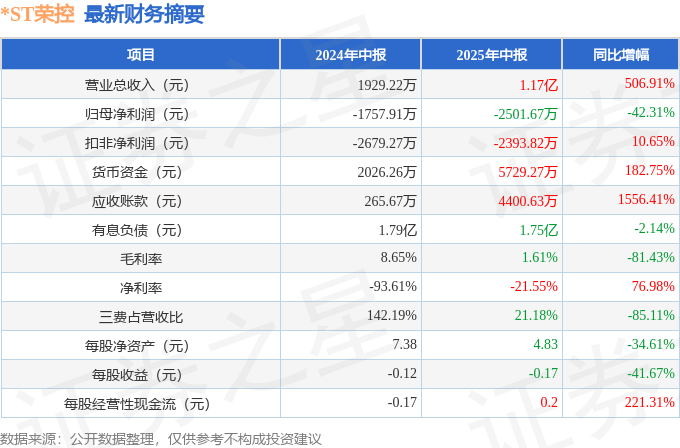
Core Viewpoint - *ST Rong Control reported significant revenue growth but continued to face net losses, indicating challenges in profitability despite increased sales [1][3]. Financial Performance - The total operating revenue for the first half of 2025 reached 117 million yuan, a year-on-year increase of 506.91% [1]. - The net profit attributable to shareholders was -25.02 million yuan, a decrease of 42.31% compared to the previous year [1]. - In Q2 2025, the operating revenue was 36.35 million yuan, up 266.57% year-on-year, while the net profit attributable to shareholders was -10.42 million yuan, an increase of 12.73% year-on-year [1]. Profitability Metrics - The gross profit margin was 1.61%, down 81.43% year-on-year [1]. - The net profit margin was -21.55%, an improvement of 76.98% year-on-year [1]. - Total selling, administrative, and financial expenses amounted to 24.80 million yuan, accounting for 21.18% of revenue, a decrease of 85.11% year-on-year [1]. Cash Flow and Assets - Cash and cash equivalents increased to 57.29 million yuan, a rise of 182.75% year-on-year [1]. - Accounts receivable surged to 44.01 million yuan, up 1556.41% year-on-year [1]. - The operating cash flow per share was 0.20 yuan, a significant increase of 221.31% year-on-year [1]. Historical Performance and Investment Return - The company's historical return on invested capital (ROIC) has been weak, with a median of 0.85% over the past decade and a particularly poor ROIC of -31.95% in 2024 [3]. - The company has reported losses in 6 out of 36 annual reports since its listing, indicating a challenging financial history [3]. Financial Health Indicators - The cash flow situation is concerning, with cash and cash equivalents covering only 24.77% of current liabilities [3]. - The average net cash flow from operating activities over the past three years has been negative [3]. - The inventory to revenue ratio has reached 374.11%, suggesting potential issues with inventory management [3].
里昂:降港铁公司评级至“持有” 目标价降至27港元
Zhi Tong Cai Jing· 2025-08-21 07:12
Core Viewpoint - The report from Credit Lyonnais indicates that MTR Corporation's recurring profit growth remains weak due to rising expenses potentially dragging down profits, while revenues also remain weak [1] Financial Performance - Credit Lyonnais has lowered the target price for MTR Corporation from HKD 30 to HKD 27 and downgraded the rating from outperform to hold [1] - The firm has reduced its recurring profit forecasts for 2025 and 2026 by 28% and 33% respectively [1] Capital Expenditure and Debt Ratios - Increased capital expenditures may lead to MTR's adjusted net debt-to-equity ratios rising to 46% and 55% for 2026 and 2027 respectively [1] - The forecast for MTR's working capital to net debt ratio for 2027 has been lowered to 14% [1] Dividend and Risk Assessment - With a dividend yield of 4.8% per year, Credit Lyonnais considers MTR's risk-return profile unattractive and does not rule out the possibility of issuing convertible bonds or even equity [1]
里昂:降港铁公司(00066)评级至“持有” 目标价降至27港元
智通财经网· 2025-08-21 07:08
Core Viewpoint - The report from Credit Lyonnais indicates that MTR Corporation's recurring profit growth remains weak due to rising expenses potentially dragging down profits, while revenues are also weak [1] Financial Performance - Credit Lyonnais has lowered the target price for MTR Corporation from HKD 30 to HKD 27 and downgraded the rating from "Outperform" to "Hold" [1] - The firm has reduced its recurring profit forecasts for 2025 and 2026 by 28% and 33% respectively [1] Capital Expenditure and Debt - Increased capital expenditures may lead to MTR's adjusted net debt-to-equity ratios rising to 46% and 55% for 2026 and 2027 respectively [1] - The forecast for MTR's working capital to net debt ratio for 2027 has been lowered to 14% [1] Dividend and Risk Assessment - With a dividend yield of 4.8% per year, Credit Lyonnais considers MTR's risk-reward profile unattractive and does not rule out the possibility of issuing convertible bonds or even equity [1]
港铁(00066):旗下所有商场出租率均达100% 未来先推屯门A16地段项目
智通财经网· 2025-08-21 06:30
Core Viewpoint - The company is adapting to the new consumer behavior in Hong Kong's retail market, focusing on strengthening its dining segment while maintaining a 100% occupancy rate across all its malls [1][2] Group 1: Retail Market Impact - The overall retail sales in Hong Kong have been declining, leading to a decrease in rental income for the company, which has recorded a single-digit percentage drop [1] - The new consumer behavior is affecting entertainment, general retail, and local attractions, indicating a potential long-term trend that tenants must adapt to [1] Group 2: Strategic Adjustments - The company is actively adjusting its strategy by regularly phasing out unpopular tenants and introducing new brands to enhance customer choices and meet changing consumer demands [1] - The dining segment is a crucial pillar for the company, with its share in malls increasing from approximately 20% to 30%, and it is expected to rise further [1] Group 3: Real Estate Development - The company plans to prioritize the Tuen Mun A16 project, covering an area of 4 million square feet, with the first phase of land tendering involving several hundred thousand square feet and over a thousand residential units [2] - A second project in Tung Chung is also in the pipeline, but the company acknowledges that market conditions are constantly changing, which may affect future plans [2]
星展:升港铁公司目标价至31.15港元 维持“买入”评级
Zhi Tong Cai Jing· 2025-08-18 06:34
Core Viewpoint - DBS has released a report indicating that MTR Corporation (00066) experienced a 55% increase in basic business profit to HKD 8.93 billion in the first half of the year, exceeding the bank's expectations [1] Group 1: Financial Performance - MTR's basic business profit rose to HKD 8.93 billion, reflecting a significant growth of 55% [1] - The increase in residential project completions is expected to lead to a substantial rise in property development profits, projected to reach HKD 12.8 billion and HKD 10.7 billion in 2025 and 2026, respectively [1] Group 2: Future Outlook - The continuous growth in MTR's residential business is anticipated to positively impact its future profitability and stock performance [1] - DBS has raised the target price for MTR from HKD 30.3 to HKD 31.15, maintaining a "buy" rating [1]
星展:升港铁公司(00066)目标价至31.15港元 维持“买入”评级
智通财经网· 2025-08-18 06:33
智通财经APP获悉,星展发布研报称,港铁公司(00066) 上半年基本业务利润增长55%至89.3亿港元,超 出该行预期。由于住宅项目落成量上升,物业发展利润将于2025至26年大幅上升。该行预计将分别达 128亿及107亿港元,该行表示,由于港铁的住宅业务不断增长,这将有利于其未来盈利前景及股价表 现。该行将公司目标价由30.3港元上调至31.15港元,续予"买入"评级。 ...