Rivian Automotive(RIVN)

Search documents
Rivian expects tariffs to increase car production costs by 'a couple thousand dollars per unit'
Business Insider· 2025-08-06 01:38
Core Insights - Rivian is facing challenges due to evolving policies affecting EV production in the US, which are expected to impact results and cash flow [1][2] - The company has revised its anticipated EBITDA losses for the 2025 fiscal year to a range of $2 billion to $2.5 billion, up from a previous estimate of $1.7 billion to $1.9 billion [1] - Rivian's CFO indicated that total sales in regulatory credits are expected to be around $160 million, nearly half of the prior outlook of $300 million [2] Financial Performance - Rivian reported second-quarter revenue of $1.3 billion, slightly exceeding Wall Street estimates of $1.28 billion, but operating losses were higher than anticipated with total operating expenses of $908 million [12] - The stock fell about 5% after trading hours following the earnings report [13] Production and Cost Outlook - Production costs are expected to increase due to recent policy changes, with tariffs anticipated to have a net impact of a couple thousand dollars per unit for the remainder of 2025 [3] - Rivian is on track to deliver its R2 model, a midsize SUV priced between $45,000 and $50,000, expected next year [10] - The company has secured contracts with suppliers to ensure that the cost of making the R2 will be about half that of the R1 model [11]


Rivian:Q2营收13亿美元,高于预期
Ge Long Hui A P P· 2025-08-06 01:01
格隆汇8月6日|Rivian(RIVN.US):2025年Q2营收13亿美元,市场预期12.84亿美元,上年同期11.58亿美 元。2025年交付量预计为40,000-46,000辆。预计第三季度将是公司今年在消费和商用汽车领域交付量最 高的季度。 ...
Rivian第二季度交付量10661辆 同比下降22%
Zheng Quan Shi Bao Wang· 2025-08-06 00:42
Rivian第二季度每股亏损0.80美元,高于分析师预期的0.65美元,但营收13亿美元略高于预期的12.8亿美 元。 第二季度交付量为10661辆,同比下降22%。公司已将2025年交付量预测下调至4万至4.6万辆,原因是 美国关税影响了消费者需求。 Rivian预计全年亏损在20亿至22.5亿美元之间,高于此前预期的17亿至19亿美元,主要原因是美国监管 积分价值下降。 ...
Rivian Automotive (RIVN) Reports Q2 Loss, Beats Revenue Estimates
ZACKS· 2025-08-05 23:26
Company Performance - Rivian Automotive reported a quarterly loss of $0.8 per share, which was worse than the Zacks Consensus Estimate of a loss of $0.65, but an improvement from a loss of $1.21 per share a year ago, indicating a year-over-year improvement in loss figures [1] - The company posted revenues of $1.3 billion for the quarter ended June 2025, surpassing the Zacks Consensus Estimate by 3.19% and showing an increase from $1.16 billion in the same quarter last year [2] - Over the last four quarters, Rivian has surpassed consensus EPS estimates two times and topped consensus revenue estimates three times [2] Stock Performance - Rivian shares have declined approximately 6.7% since the beginning of the year, contrasting with the S&P 500's gain of 7.6% [3] - The current consensus EPS estimate for the upcoming quarter is -$0.71 on projected revenues of $1.39 billion, and for the current fiscal year, it is -$2.45 on revenues of $5.23 billion [7] Industry Outlook - The Automotive - Domestic industry, to which Rivian belongs, is currently ranked in the bottom 29% of over 250 Zacks industries, suggesting a challenging environment for stocks in this sector [8] - Empirical research indicates a strong correlation between near-term stock movements and trends in earnings estimate revisions, which could impact Rivian's stock performance [5]
Rivian Automotive(RIVN) - 2025 Q2 - Earnings Call Transcript
2025-08-05 22:02
Financial Data and Key Metrics Changes - In Q2, the company produced 5,979 vehicles and delivered 10,661 vehicles, generating $927 million in automotive revenue [14] - Consolidated revenue for the quarter was $1.3 billion, with gross profit losses of $206 million, including $185 million in depreciation and $37 million in stock-based compensation [16] - Adjusted EBITDA losses for the quarter were $667 million, with an increase in overall operating expenses compared to Q1 due to ongoing investments in key technologies and sales infrastructure [16][18] Business Line Data and Key Metrics Changes - Automotive gross profit losses were $335 million, negatively impacted by lower production volumes and approximately $137 million of fixed costs included in cost of revenues [15] - The Software and Services segment reported $376 million in revenue and $129 million in gross profit, with significant contributions from a joint venture with Volkswagen Group [15] Market Data and Key Metrics Changes - The company expects total regulatory credit sales for 2025 to be approximately $160 million, down from a prior outlook of $300 million due to changes in regulatory credit programs [18] - Increased tariffs are expected to have a net impact of a couple thousand dollars per unit for the remainder of 2025 [18] Company Strategy and Development Direction - The company is focused on developing world-class technology and efficiently scaling manufacturing capacity in the U.S. in light of evolving policy changes [7] - R2 is a core focus, with the company aiming to deliver millions of vehicles per year, supported by a new 1.1 million square foot facility in Houma, Illinois [9][10] - The company is also investing heavily in its autonomy platform, believing that advanced levels of autonomy will be essential for future vehicle success [10][11] Management's Comments on Operating Environment and Future Outlook - Management acknowledges the complex and rapidly evolving policy environment affecting the business, including changes to EV tax credits and tariffs [7] - Despite recent headwinds, management remains confident in achieving positive EBITDA by 2027, driven by R2 production and strong software and services performance [28][66] Other Important Information - The company received a $1 billion equity investment from Volkswagen Group at a 33% premium to the trading day volume weighted average stock price [16] - The company plans to shut down its normal facility for approximately three weeks starting in September to prepare for the planned launch of R2 in 2026 [17] Q&A Session Summary Question: Transition from R1 to R2 and cost reduction - Management confirmed that the bill of material cost for R2 is about half that of R1, supported by negotiated contracts with suppliers [24][27] Question: Path to EBITDA breakeven in 2027 - Management is working on cost efficiency initiatives and believes that R2's cost structure will support achieving positive EBITDA by 2027 despite recent headwinds [28][66] Question: Impact of Department of Energy loan - The company intends to draw on the $6.6 billion loan from the Department of Energy for the Georgia facility once construction begins [39] Question: COGS per vehicle increase - The increase in COGS per vehicle was primarily due to lower production volume and higher warranty costs, with expectations for improved cost structure with R2 [48][50] Question: ASP trends and pricing strategy - Management believes that R2 will maintain a healthy positive gross margin and is closely monitoring market conditions to adjust pricing strategies as needed [67]
Rivian Automotive(RIVN) - 2025 Q2 - Earnings Call Transcript
2025-08-05 22:00
Financial Data and Key Metrics Changes - In Q2 2025, the company produced 5,979 vehicles and delivered 10,661 vehicles, generating $927 million in automotive revenue [14] - Consolidated revenue for the quarter was $1.3 billion, with gross profit losses of $206 million, impacted by $185 million in depreciation and $37 million in stock-based compensation [16] - Adjusted EBITDA losses for the quarter were $667 million, with an increase in operating expenses due to ongoing investments in technology and sales infrastructure [16][19] Business Line Data and Key Metrics Changes - The Automotive segment faced a significant decrease in production volume compared to Q1, leading to automotive gross profit losses of $335 million due to fixed costs [15] - The Software and Services segment reported $376 million in revenue and $129 million in gross profit, with half of the revenue coming from a joint venture with Volkswagen Group [15] Market Data and Key Metrics Changes - The company anticipates total regulatory credit sales for 2025 to be approximately $160 million, down from a prior outlook of $300 million due to changes in regulatory credit programs [19] - The company expects the third quarter to be the peak delivery quarter of the year across both consumer and commercial vehicles [18] Company Strategy and Development Direction - The company is focused on developing the R2 vehicle and its autonomy platform, aiming to scale production and establish market leadership [5][6] - The company plans to shut down its normal facility for approximately three weeks in September to prepare for the R2 launch in 2026 [17] - The company is actively studying tariff mitigation strategies and believes that R2 and technology development will be transformative for growth and profitability [20] Management's Comments on Operating Environment and Future Outlook - Management acknowledged changes in the external operating environment, including complex policy changes affecting EV tax credits and tariffs, which are expected to impact results and cash flow [6][19] - Despite headwinds, management remains confident in achieving positive EBITDA by 2027, driven by R2 production and strong software and services performance [30][64] Other Important Information - The company received a $1 billion equity investment from Volkswagen Group at a 33% premium to the trading price [16] - The company refinanced its senior secured notes by issuing $1.25 billion of green secured notes at a 10% rate maturing in January 2031 [17] Q&A Session Summary Question: Transitioning from R1 to R2 and cost reduction - Management confirmed that the bill of material cost for R2 is about half that of R1, supported by negotiated contracts with suppliers [24][28] Question: Path to EBITDA breakeven in 2027 - Management emphasized that the R2 cost structure is designed to achieve positive gross margins, despite recent headwinds [66] Question: Impact of the Department of Energy loan - Management confirmed that the loan has not yet been drawn as construction has not started, but they intend to utilize it for expanding manufacturing in Georgia [39] Question: COGS per vehicle increase - The increase in COGS per vehicle was primarily due to lower production volumes and fixed cost absorption issues [48] Question: ASP trends and pricing strategy - Management indicated that Rivian remains a market share leader in its segments and expects strong ASPs despite potential headwinds from the loss of IRA credits [54][56]
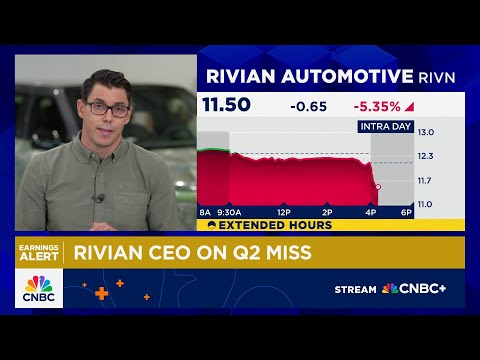
Rivian CEO: Trade policy on heavy earth metals had a significant impact on production volume
CNBC Television· 2025-08-05 21:15
Financial Performance - Rivian's Q2 loss was wider than expected at $080 per share, compared to the expected loss of $065 per share [1] - Q2 revenue was roughly in line with expectations at $13 billion [1] - The company swung to a gross loss of $26 million in Q2 after two straight quarters of gross profit [1] - Rivian is widening its full-year loss expectation to a range of $2 billion to $225 billion, previously expecting a loss of $17 billion to $19 billion [2] Production and Supply Chain - Lower Q2 production was driven by changes in trade policy, specifically the control of heavy rare earth metal exports from China [3] - Supply chain uncertainty and constrained suppliers led to a significant drop in production from over 14000 units in Q1 to around 6000 units in Q2 [4] - Rivian developed solutions during Q2 to address the heavy rare earth metal shortage, aiming for higher production levels in Q3 and Q4 [6][7] - The company expects to deliver between 40000 and 46000 vehicles for the full year [2] Future Outlook - Rivian is confident that Q3 and Q4 production will return to much higher levels, allowing for more vehicles to be produced in the second half of 2025 relative to the first half [7] - The company is excited about the R2 next-generation model, with a target starting price of $45000 [7][8] - Rivian has thoughtfully sourced materials for R2, including heavy earth metals, to protect against potential export challenges [9]
Rivian Automotive(RIVN) - 2025 Q2 - Quarterly Report
2025-08-05 21:00
[Part I. Financial Information](index=6&type=section&id=Part%20I.%20Financial%20Information) This section presents Rivian's unaudited financial statements, including balance sheets, statements of operations, cash flows, and detailed notes for the reporting period [Item 1. Financial Statements (unaudited)](index=6&type=section&id=Item%201.%20Financial%20Statements%20(unaudited)) Rivian reported **$2.54 billion** in revenue and a reduced net loss of **$1.66 billion** for H1 2025, with total assets of **$15.6 billion** and liabilities of **$9.5 billion**, and significantly improved operating cash flow [Condensed Consolidated Balance Sheets](index=6&type=section&id=Condensed%20Consolidated%20Balance%20Sheets) The balance sheet shows total assets of **$15.597 billion** and total liabilities of **$9.518 billion** as of June 30, 2025 Condensed Consolidated Balance Sheet Highlights (in millions) | Balance Sheet Item | Dec 31, 2024 (USD) | June 30, 2025 (USD) | | :--- | :--- | :--- | | **Assets** | | | | Cash and cash equivalents | $5,294 | $4,812 | | Total current assets | $10,583 | $10,120 | | Property, plant, and equipment, net | $3,965 | $4,421 | | **Total assets** | **$15,410** | **$15,597** | | **Liabilities & Equity** | | | | Total current liabilities | $2,251 | $2,943 | | Long-term debt | $4,441 | $4,436 | | **Total liabilities** | **$8,848** | **$9,518** | | **Total stockholders' equity** | **$6,562** | **$6,079** | [Condensed Consolidated Statements of Operations](index=7&type=section&id=Condensed%20Consolidated%20Statements%20of%20Operations) The statements of operations show total revenues of **$2.543 billion** and a net loss of **$1.656 billion** for H1 2025 Condensed Consolidated Statements of Operations Highlights (in millions, except per share data) | Metric | Q2 2024 (USD) | Q2 2025 (USD) | H1 2024 (USD) | H1 2025 (USD) | | :--- | :--- | :--- | :--- | :--- | | **Total revenues** | **$1,158** | **$1,303** | **$2,362** | **$2,543** | | Automotive Revenues | $1,074 | $927 | $2,190 | $1,849 | | Software and services Revenues | $84 | $376 | $172 | $694 | | Gross profit | ($451) | ($206) | ($978) | $0 | | Loss from operations | ($1,375) | ($1,114) | ($2,859) | ($1,769) | | **Net loss** | **($1,457)** | **($1,115)** | **($2,903)** | **($1,656)** | | Net loss per share | ($1.46) | ($0.97) | ($2.93) | ($1.45) | [Condensed Consolidated Statements of Cash Flows](index=10&type=section&id=Condensed%20Consolidated%20Statements%20of%20Cash%20Flows) Cash flow statements indicate a significant reduction in net cash used in operating activities to **$124 million** for H1 2025 Condensed Consolidated Statements of Cash Flows Highlights (in millions) | Cash Flow Activity | Six Months Ended June 30, 2024 (USD) | Six Months Ended June 30, 2025 (USD) | | :--- | :--- | :--- | | Net cash used in operating activities | ($2,023) | ($124) | | Net cash used in investing activities | ($1,095) | ($1,114) | | Net cash provided by financing activities | $1,028 | $750 | | **Net change in cash** | **($2,094)** | **($482)** | [Notes to Condensed Consolidated Financial Statements](index=11&type=section&id=Notes%20to%20Condensed%20Consolidated%20Financial%20Statements) Notes detail the Volkswagen Group investment, revenue by source, outstanding debt, and segment gross profit - On June 30, 2025, Rivian received **$1.0 billion** from Volkswagen Group after achieving a financial milestone, exchanging **$750 million** for Class A common stock and recording the **$250 million** premium as deferred revenue[35](index=35&type=chunk) Revenue by Major Source (in millions) | Revenue Source | Q2 2024 (USD) | Q2 2025 (USD) | H1 2024 (USD) | H1 2025 (USD) | | :--- | :--- | :--- | :--- | :--- | | New electric vehicles | $1,057 | $924 | $2,172 | $1,688 | | Regulatory credits | $17 | $7 | $18 | $166 | | Software and services | $84 | $372 | $172 | $689 | | **Total revenues** | **$1,158** | **$1,303** | **$2,362** | **$2,543** | - Revenue from the Volkswagen Group joint venture for the combined performance obligation was **$182 million** for Q2 2025 and **$349 million** for H1 2025, with the majority of the transaction price expected to be recognized over approximately three years[70](index=70&type=chunk) Outstanding Debt (in millions) | Debt Instrument | Maturity | Dec 31, 2024 (USD) | June 30, 2025 (USD) | | :--- | :--- | :--- | :--- | | 2026 Notes | 2026 | $1,250 | $0 | | 2029 Green Convertible Notes | 2029 | $1,500 | $1,500 | | 2030 Green Convertible Notes | 2030 | $1,725 | $1,725 | | 2031 Green Secured Notes | 2031 | $0 | $1,250 | | **Total long-term debt** | | **$4,475** | **$4,475** | - In June 2025, the company issued **$1.25 billion** of 10% 2031 Green Secured Notes and used the proceeds to pay off the outstanding **$1.25 billion** 2026 Notes[81](index=81&type=chunk)[88](index=88&type=chunk) Segment Gross Profit (in millions) | Segment | Q2 2024 (USD) | Q2 2025 (USD) | H1 2024 (USD) | H1 2025 (USD) | | :--- | :--- | :--- | :--- | :--- | | Automotive | ($441) | ($335) | ($938) | ($243) | | Software and Services | ($10) | $129 | ($40) | $243 | | **Consolidated** | **($451)** | **($206)** | **($978)** | **$0** | [Item 2. Management's Discussion and Analysis of Financial Condition and Results of Operations](index=35&type=section&id=Item%202.%20Management's%20Discussion%20and%20Analysis%20of%20Financial%20Condition%20and%20Results%20of%20Operations) Management discusses decreased automotive revenue, improved gross loss, significant growth in software and services, R2 platform focus, and strong liquidity of **$8.5 billion** [Overview](index=35&type=section&id=Overview) The overview details Rivian's segment structure, R2 production plans, and H1 2025 production and delivery volumes - Rivian's business is structured into two reportable segments: Automotive (consumer and commercial vehicles) and Software and Services (including the VW joint venture, remarketing, charging, and subscriptions)[132](index=132&type=chunk) - The company plans to start production of its new midsize SUV, the R2, in the first half of 2026, which is considered foundational to its long-term growth and profitability[137](index=137&type=chunk) Production and Delivery Volumes | Metric | H1 2025 | | :--- | :--- | | Vehicles Produced | 20,590 units | | Vehicles Delivered | 19,301 units | [Results of Operations](index=45&type=section&id=Results%20of%20Operations) Results show a **16% decrease** in automotive revenue, a **74% improvement** in automotive gross loss, and a **303% increase** in software and services revenue for H1 2025 - Automotive revenue for H1 2025 decreased by **16% YoY** to **$1.85 billion**, primarily due to a **30% decrease** in delivery volume, partially offset by increased average selling prices[159](index=159&type=chunk)[161](index=161&type=chunk) - Automotive gross profit loss improved by **74% YoY** for H1 2025, from a loss of **$938 million** to **$243 million**, driven by higher average selling prices, increased sales of regulatory credits, and reductions in material and overhead costs[162](index=162&type=chunk)[165](index=165&type=chunk) - Software and Services revenue for H1 2025 increased by **303% YoY** to **$694 million**, and gross profit turned positive to **$243 million** from a **$40 million** loss, primarily due to services provided by the Volkswagen joint venture[168](index=168&type=chunk)[170](index=170&type=chunk) - The company plans a three-week shutdown of its Normal Factory in late Q3 2025 to prepare for R2 production, which is expected to negatively impact near-term production and costs[167](index=167&type=chunk) [Liquidity and Capital Resources](index=50&type=section&id=Liquidity%20and%20Capital%20Resources) Liquidity and capital resources highlight **$8.519 billion** in total liquidity, Volkswagen Group investments, and a potential DOE loan facility Total Liquidity (in millions) | Component | Dec 31, 2024 (USD) | June 30, 2025 (USD) | | :--- | :--- | :--- | | Cash and cash equivalents | $5,294 | $4,812 | | Short-term investments | $2,406 | $2,696 | | Availability under ABL Facility | $1,363 | $1,011 | | **Total liquidity** | **$9,063** | **$8,519** | - Rivian received a **$1.0 billion** equity investment from Volkswagen Group on June 30, 2025, and expects up to an additional **$2.5 billion** in future investments and loans from VW, subject to milestones[187](index=187&type=chunk) - The company has a loan arrangement with the U.S. Department of Energy (DOE) for a multi-draw term loan facility of up to approximately **$6.0 billion** to support the development of its Stanton Springs North Facility, subject to conditions[189](index=189&type=chunk) - Management believes that the existing balance of cash, cash equivalents, short-term investments, and available credit will be sufficient to meet operating, working capital, and capital expenditure needs for at least the next 12 months[192](index=192&type=chunk) [Item 3. Quantitative and Qualitative Disclosures about Market Risk](index=56&type=section&id=Item%203.%20Quantitative%20and%20Qualitative%20Disclosures%20about%20Market%20Risk) The company reports no material changes in market risk exposure, having repaid floating-rate debt in June 2025 to reduce interest rate risk - In June 2025, the company paid off its outstanding floating-rate debt, reducing its exposure to interest rate risk[199](index=199&type=chunk) [Item 4. Controls and Procedures](index=56&type=section&id=Item%204.%20Controls%20and%20Procedures) Management concluded that disclosure controls and procedures were effective as of June 30, 2025, with no material changes to internal control over financial reporting - The CEO and CFO concluded that the company's disclosure controls and procedures were effective at a reasonable assurance level as of June 30, 2025[201](index=201&type=chunk) [Part II. Other Information](index=57&type=section&id=Part%20II.%20Other%20Information) This section covers legal proceedings, various risk factors, and other pertinent information [Item 1. Legal Proceedings](index=57&type=section&id=Item%201.%20Legal%20Proceedings) Rivian is actively defending against multiple stockholder class action and derivative lawsuits related to its IPO and alleged securities violations - The company is defending against multiple stockholder lawsuits, including class actions and derivative suits, alleging violations of securities laws and breaches of fiduciary duties[206](index=206&type=chunk) [Item 1A. Risk Factors](index=58&type=section&id=Item%201A.%20Risk%20Factors) The company faces extensive risks including ongoing losses, financing needs, intense competition, R2 launch dependence, supply chain issues, and reliance on key partners [Risks Related to Our Business](index=58&type=section&id=Risks%20Related%20to%20Our%20Business) Business risks include a history of losses, future financing needs, and significant reliance on Amazon and the Volkswagen Group joint venture - Rivian is a growth-stage company with a history of losses, including a net loss of **$1.656 billion** for the first six months of 2025, and expects to incur significant expenses and losses for the foreseeable future[208](index=208&type=chunk) - The company will require additional financing to support its business, which may not be available on acceptable terms, if at all, and the ability to draw on its DOE loan is subject to meeting certain milestones[211](index=211&type=chunk) - A significant portion of automotive revenues has been from Amazon, and any reduction in orders or termination of the relationship would materially and adversely affect the business[258](index=258&type=chunk)[260](index=260&type=chunk) - The business is subject to risks associated with the joint venture with Volkswagen Group, including reliance on it for a significant portion of software and services revenue and for future software development[224](index=224&type=chunk) [Risks Related to Information Technology, Data Security, Privacy, and Intellectual Property](index=104&type=section&id=Risks%20Related%20to%20Information%20Technology%2C%20Data%20Security%2C%20Privacy%2C%20and%20Intellectual%20Property) Risks involve cybersecurity threats, compliance with evolving data privacy laws, and regulatory scrutiny of AI technologies - The company faces numerous cybersecurity risks, including ransomware and phishing attacks, which could lead to data breaches, compromise vehicle safety, and result in significant liability and reputational harm[346](index=346&type=chunk)[348](index=348&type=chunk) - Compliance with complex and evolving federal, state, and foreign data privacy laws (e.g., CCPA, GDPR) is critical, and failure to comply could result in significant fines and legal action[351](index=351&type=chunk)[352](index=352&type=chunk) - The use of AI technologies is subject to increasing regulatory scrutiny, such as the EU AI Act, which could require significant resources to ensure compliance and may expose the company to new liabilities[362](index=362&type=chunk)[366](index=366&type=chunk) [Risks Related to Other Legal, Regulatory, and Tax Matters](index=116&type=section&id=Risks%20Related%20to%20Other%20Legal%2C%20Regulatory%2C%20and%20Tax%20Matters) Legal and regulatory risks include trade tariffs, potential loss of government incentives, and compliance with environmental, health, and safety regulations - The business is adversely affected by trade tariffs and other barriers, which increase the cost of imported components and may disrupt the supply chain[381](index=381&type=chunk) - The unavailability, reduction, or elimination of government incentives, such as the 30D and 45W tax credits removed by the OBBBA, could diminish the competitiveness of EVs and harm the business[308](index=308&type=chunk)[309](index=309&type=chunk) - The company is subject to substantial and evolving environmental, health, and safety regulations, and compliance could impose significant costs and cause delays in manufacturing operations[396](index=396&type=chunk) [Risks Related to the Ownership of Our Class A Common Stock](index=128&type=section&id=Risks%20Related%20to%20the%20Ownership%20of%20Our%20Class%20A%20Common%20Stock) Risks for stockholders include stock price volatility and concentrated voting control by executive officers, directors, and principal stockholders - The market price of the company's Class A common stock has been and may continue to be volatile due to a variety of factors, including operating performance, analyst ratings, and overall market conditions[412](index=412&type=chunk) - Executive officers, directors, and principal stockholders collectively hold approximately **31.7%** of the voting power, allowing them to significantly influence corporate matters[415](index=415&type=chunk) - The company has a dual-class stock structure where Class B common stock, held by an affiliate of the Founder and CEO, has ten votes per share, concentrating voting control[416](index=416&type=chunk) [Item 5. Other Information](index=140&type=section&id=Item%205.%20Other%20Information) CEO Robert J. Scaringe amended his Rule 10b5-1 trading plan on June 11, 2025, for the sale of up to **894,195** Class A common shares - On June 11, 2025, CEO Robert J. Scaringe amended his Rule 10b5-1 trading arrangement to cover the sale of up to **894,195** shares of Class A common stock[453](index=453&type=chunk)
Rivian Automotive(RIVN) - 2025 Q2 - Quarterly Results
2025-08-05 20:01
Production and Delivery - In Q2 2025, Rivian produced 5,979 vehicles and delivered 10,661 vehicles, with production limited due to supply chain complexities[43]. - The company anticipates a peak delivery quarter in Q3 2025, maintaining delivery guidance of 40,000 - 46,000 vehicles for the year[53]. - Rivian's new Quad-Motor R1 variant offers an EPA-estimated range of up to 374 miles, featuring advanced performance capabilities[40][38]. - The company expects to expand its manufacturing capacity and production ramp, with a focus on new product launches such as R2 and R3[91]. Financial Performance - Total automotive revenues for Q2 2025 were $927 million, down from $1,074 million in Q2 2024, primarily due to higher sales of first generation R1 vehicles in the prior period[57]. - Total consolidated revenues increased to $1,303 million in Q2 2025, compared to $1,158 million in the same quarter of 2024[60]. - Net loss for Q2 2025 was $(1,115) million, an improvement from $(1,457) million in Q2 2024[62]. - The company is increasing its guidance for adjusted EBITDA losses to between ($2,000) million and ($2,250) million[53]. - The adjusted net loss attributable to common stockholders for Q2 2024 was $1,112 million, compared to $920 million for Q2 2025, reflecting a decrease of 18% year-over-year[84]. - The net loss per share attributable to common stockholders for Q2 2024 was $(1.12), while for Q2 2025 it was $(0.80), indicating a 29% improvement[88]. - Free cash flow for Q2 2025 was negative $(398) million, an improvement from negative $(1,037) million in Q2 2024[64]. - The company reported net cash used in operating activities of $(754) million for Q2 2024, which improved to $64 million in Q2 2025, indicating a positive shift in operational cash flow[89]. Investments and Capital Expenditures - Rivian received a $1 billion equity investment from Volkswagen Group, part of a larger $5.8 billion agreement for a technology joint venture[48]. - Capital expenditures rose to $462 million in Q2 2025, compared to $283 million in the same period last year, driven by production capacity expansion[64]. - Capital expenditures for the first half of 2025 were $800 million, an increase from $537 million in the first half of 2024[74]. Research and Development - Rivian's gross margin from software and services reached 34%[17]. - Research and development expenses for Q2 2025 were $410 million, a slight decrease of 4.2% from $428 million in Q2 2024[79]. - The company is investing in research and development to improve vehicle performance and safety features[91]. Operational Efficiency - The company expanded its charging network to over 780 chargers across 123 sites, achieving a 98% uptime in Q2 2025[17][36]. - The company has completed the first phase of its paint shop upgrade, expected to reduce downtime by approximately one week starting in September[17]. - Total operating expenses decreased to $908 million in Q2 2025 from $924 million in the same period last year[62]. - Total operating expenses for Q2 2025 were $908 million, down from $924 million in Q2 2024, reflecting a decrease of 1.7%[80]. Market Strategy and Risks - The company is focusing on future operations and business strategy, including anticipated production levels and vehicle profitability[91]. - The company is exploring revenue opportunities in the emerging autonomous driving market and has a joint venture with Volkswagen Group[91]. - The company is managing risks related to supply chain disruptions and the competitive automotive market, which may impact future performance[91]. - The company acknowledges the potential impact of government incentives and economic conditions on its market opportunities[91]. Liquidity and Financial Position - Rivian's cash, cash equivalents, and short-term investments totaled $7,508 million as of June 30, 2025[47]. - Cash and cash equivalents at the end of Q2 2025 totaled $7,508 million, with total liquidity reaching $8,519 million[64]. - Total liabilities decreased to $8,848 million in Q2 2025 from $9,518 million in Q2 2024, reflecting a reduction of 7.0%[71]. - Total stockholders' equity decreased to $6,079 million in Q2 2025 from $6,562 million in Q2 2024, a decline of 7.4%[71]. - Cash, cash equivalents, and restricted cash at the end of Q2 2025 were $4,812 million, down from $5,763 million at the end of Q2 2024[74].
Rivian Vs. Lucid: EVs Forge Partnerships To Tackle Tesla
Benzinga· 2025-08-05 15:32
Group 1: Lucid Group Inc - Lucid Group has partnered with Uber and Nuro to deploy 20,000 autonomous SUVs by 2026, indicating strong ambition despite the long delivery timeline [2] - The partnership includes a $300 million investment from Uber, highlighting the potential for future growth, although current profits remain elusive [2] - Lucid is enhancing its luxury brand image by featuring Timothée Chalamet and supplying technology to Aston Martin [2] Group 2: Rivian Automotive Inc - Rivian is actively supplying thousands of electric delivery vans to Amazon, with the exclusivity clause now lapsed, allowing for new revenue opportunities [3] - The company has formed a $5.8 billion software joint venture with Volkswagen and a battery deal with LG, aiming for mass-market scale and technological strength [4] - Despite these strategic moves, Rivian is still experiencing significant cash burn [4] Group 3: Tesla Inc - Tesla delivered over 400,000 vehicles in the last quarter and is expanding its Supercharger network, maintaining a competitive edge [5] - The company's vertical integration and scale allow it to keep prices low and margins high, even as competition increases [5] - While competitors like Rivian and Lucid seek partnerships for survival, Tesla continues to operate independently and profitably [5]