
Banco Santander(SAN)

Search documents
业绩新高之际的豪赌:桑坦德银行(SAN.US)斥资120亿美元收购韦伯斯特(WBS.US),剑指美国前十
智通财经网· 2026-02-04 09:45
Core Insights - Santander Bank reported a record net profit of €14.101 billion for the fiscal year 2025, a 12% increase from the previous year, driven by an improved interest rate environment and global business transformation [1] - The bank announced a strategic acquisition plan to purchase Webster Financial Corporation for approximately $12 billion and approved a new €5 billion share buyback program [1][4] Financial Performance - In Q4, Santander's net profit reached €3.764 billion, a 15% year-on-year increase, significantly exceeding market analysts' expectations of €3.48 billion [2] - The bank's return on tangible equity (RoTE) rose to 16.3%, and earnings per share (EPS) increased by 17% to €0.91 [2] - The bank's non-performing loan (NPL) ratio improved to 2.91%, and the common equity tier 1 (CET1) capital ratio reached a historical high of 13.5% [3] Strategic Initiatives - The acquisition of Webster Financial aims to enhance Santander's presence in the U.S. market, targeting a RoTE of over 20% by 2028 [4] - The deal will create a financial entity with total assets of $327 billion, positioning it among the top ten retail and commercial banks in the U.S. [4] - Santander's strategy includes expanding its footprint in growth markets while reducing operations in certain European countries [5][7] Market Position and Future Outlook - Santander plans to achieve mid-single-digit revenue growth and aims to lower costs in constant euros [3] - The bank is actively pursuing the acquisition of TSB in the UK, with funding partially sourced from the sale of its stake in the Polish subsidiary [6] - Analysts suggest that the combination of Santander's consumer finance business with Webster's commercial banking operations will significantly enhance its scale in the region [10]


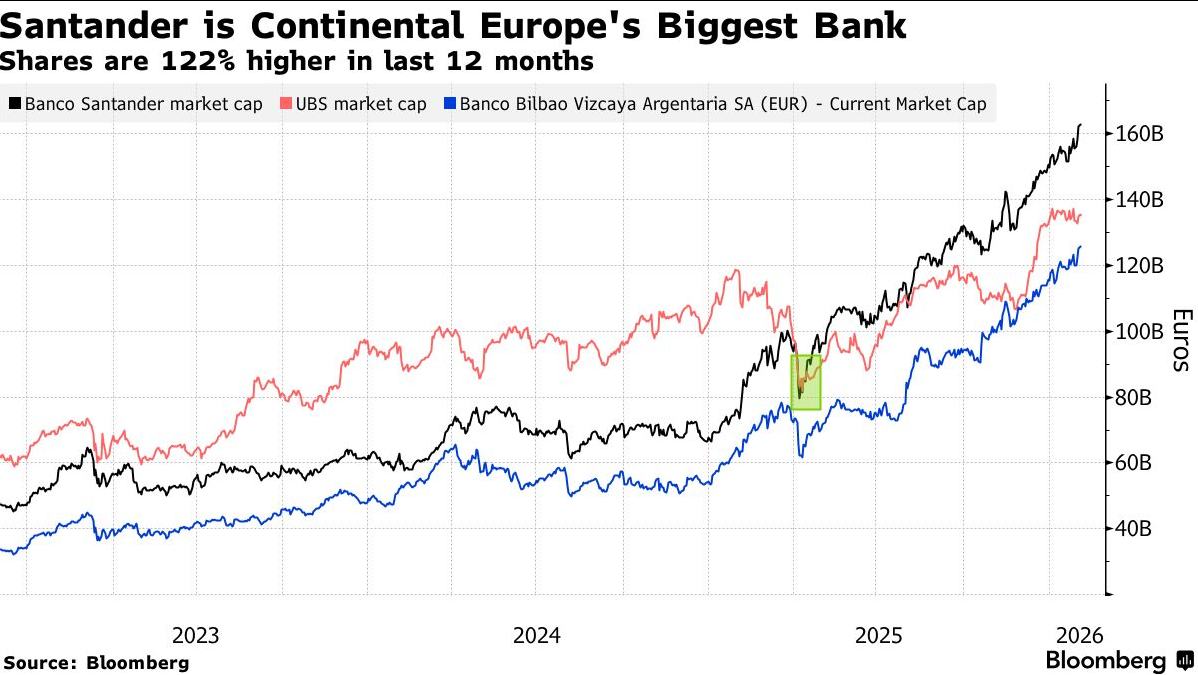
美股异动丨桑坦德银行盘前涨近3%,Q4业绩超预期+拟回购50亿欧元股票
Ge Long Hui· 2026-02-04 09:36
桑坦德银行(SAN.US)盘前涨近3%,报12.59美元。消息面上,桑坦德银行去年第四季度收入同比小幅增 长1%至161.1亿欧元,净利润同比增长15%至37.6亿欧元,均超过分析师的预期。公司董事会批准了一 项50亿欧元的股票回购计划。此外,桑坦德银行意外地宣布将以123亿美元收购美国韦伯斯特金融公 司,以扩大其在美国的影响力。(格隆汇) ...
Santander UK reports 14% jump in annual pretax profit
Reuters· 2026-02-04 07:30
Core Insights - Santander UK reported a 14% increase in annual pretax profit, driven by higher net interest income, lower costs, and reduced provision charges [1] Financial Performance - The annual pretax profit rose by 14%, indicating strong financial performance [1] - The increase in net interest income contributed significantly to the profit growth [1] - Lower operational costs and reduced provision charges also played a crucial role in enhancing profitability [1]

Spain's Santander Launches Buyback Alongside Earnings Beat
WSJ· 2026-02-04 07:07
Core Insights - The lender reported a 15% rise in net profit for the last quarter of 2025 [1] - The company approved a €5 billion share-buyback program [1] Financial Performance - The net profit increase of 15% indicates strong financial performance in the last quarter of 2025 [1] Shareholder Returns - The approval of a €5 billion share-buyback program reflects the company's commitment to returning value to shareholders [1]

Santander to Acquire Connecticut-Based Webster Bank
PYMNTS.com· 2026-02-03 23:13
Core Viewpoint - Banco Santander is set to enhance its presence in the U.S. by acquiring Webster Bank's holding company for $12.2 billion, aiming to create a top 10 retail and commercial bank in the U.S. by assets [1][2]. Group 1: Acquisition Details - The acquisition will result in a combined business with total assets of $327 billion, loans amounting to $185 billion, and deposits of $172 billion [2]. - The transaction is expected to close in the second half of the year, pending customary closing conditions [3]. Group 2: Strategic Implications - The acquisition will strengthen Santander's commercial banking presence and expand its retail branch footprint, particularly in Connecticut [4]. - The combined entity will offer customers enhanced digital and mobile banking capabilities, a broader service footprint, and a more diverse product offering [3]. Group 3: Leadership Perspectives - Christiana Riley, CEO of Santander US, emphasized that the acquisition will lead to a more balanced business mix and sustainable long-term growth [4]. - John R. Ciulla, CEO of Webster Financial Corporation, stated that the transaction will create a stronger partnership for Webster Bank's clients and unlock greater scale and capabilities [5][6]. Group 4: Recent Developments - Santander's digital banking platform, Openbank, gained over 100,000 customers in the U.S. within its first six months, exceeding growth expectations [6]. - In May, Santander sold a majority of its Polish business to Erste Group for $7.9 billion, indicating a strategic shift in its international operations [7].
Santander to Expand in US by Acquiring Connecticut-Based Webster Bank
PYMNTS.com· 2026-02-03 23:13
Core Viewpoint - Banco Santander is set to enhance its presence in the U.S. by acquiring Webster Bank's holding company for $12.2 billion, aiming to create a top 10 retail and commercial bank in the U.S. by assets [1][2]. Group 1: Acquisition Details - The acquisition will result in a combined business with total assets of $327 billion, loans amounting to $185 billion, and deposits of $172 billion [2]. - The transaction is expected to close in the second half of the year, pending customary closing conditions [3]. Group 2: Strategic Implications - The acquisition will strengthen Santander's commercial banking presence and expand its retail branch footprint, particularly in Connecticut [4]. - The combined entity will offer customers enhanced digital and mobile banking capabilities, a broader service footprint, and a wider range of products [3]. Group 3: Leadership Perspectives - Christiana Riley, CEO of Santander US, emphasized that the acquisition will lead to a more balanced business mix and sustainable long-term growth [4]. - John R. Ciulla, CEO of Webster Financial Corporation, stated that the transaction will create a stronger partnership for Webster Bank's clients, unlocking greater scale and capabilities [5][6]. Group 4: Recent Developments - Santander's digital banking platform, Openbank, gained over 100,000 customers in the U.S. within its first six months, exceeding growth expectations [6]. - In May, Santander sold a majority of its Polish business to Erste Group for $7.9 billion, indicating a strategic shift in its international operations [7].
Banco Santander(SAN) - 2025 Q4 - Earnings Call Transcript
2026-02-03 20:02
Financial Data and Key Metrics Changes - Santander reported a record annual profit of EUR 14.1 billion for 2025, marking a 12% year-over-year increase, and 15% excluding Argentina [3][4] - The annual dividend per share grew by 14%, reflecting strong shareholder value creation [4] - The CET1 ratio reached an all-time high of 13.5%, up 70 basis points from the previous year, indicating strong capital generation [13][30] Business Line Data and Key Metrics Changes - Retail profit increased by 9% year-on-year, with a cost-to-income ratio of 39% [8][9] - Consumer business net interest income (NII) grew by 5% year-on-year, while group NII, excluding Argentina, increased by 3% [5][6] - Wealth profit surged by 27% in 2025, driven by strong commercial activity and double-digit fee growth [11] - Payments volume rose by 9%, with PagoNxt EBITDA margin exceeding 34% [11] Market Data and Key Metrics Changes - The customer base expanded by 8 million to 180 million, showcasing strong market penetration [3] - The U.S. market is highlighted as a key growth area, with profits growing over 30% from 2023 to 2025 [15][16] Company Strategy and Development Direction - The acquisition of Webster Financial Corporation is a strategic move to enhance Santander's U.S. operations, aiming for a return on tangible equity (ROTE) of 18% by 2028 [17][22] - The focus remains on improving efficiency and profitability through the "One Transformation" initiative, which emphasizes simplification and automation [7][8] - The company aims to maintain a disciplined approach to capital allocation while pursuing growth opportunities in key markets [12][31] Management's Comments on Operating Environment and Future Outlook - Management expressed confidence in achieving a ROTE exceeding 20% by 2028, driven by the integration of Webster and ongoing transformation efforts [34] - The U.S. market is viewed as attractive due to its growth potential and favorable regulatory environment, with expectations for continued value creation [33][34] - The company anticipates mid-single-digit revenue growth in 2026, with double-digit growth including M&A impacts [35] Other Important Information - A new share buyback program of up to EUR 5 billion was approved, with 65% of the acquisition price for Webster to be paid in cash [13][19] - The integration of Webster is expected to yield approximately $800 million in cost synergies, with a focus on operational efficiencies [27][40] Q&A Session Summary Question: Can you provide more details on the EUR 800 million cost synergies? - Management highlighted that the synergies will come from significant overhead reductions and technology integrations, with a focus on eliminating duplicative structures [37][39][40] Question: Why is the expected ROTE for the U.S. set at 15%? - Management explained that the 15% ROTE aligns with their capital hierarchy and reflects the strong performance of the U.S. operations over the past five years [38][44] Question: What has changed regarding the West Coast market? - The acquisition of Webster allows Santander to operate as a full-service retail commercial bank in the Northeast, which was not feasible previously [49][50] Question: What are the implications of the 140 basis points impact on capital? - The capital impact from the acquisition will primarily come from cash payments, with additional adjustments for deferred tax assets and risk-weighted assets [52] Question: Will new shares be issued for the Webster acquisition? - Yes, 35% of the acquisition consideration will be paid in new shares, while a EUR 5 billion share buyback program will also be initiated [62][63]
Banco Santander(SAN) - 2025 Q4 - Earnings Call Transcript
2026-02-03 20:02
Financial Data and Key Metrics Changes - The company reported a record quarterly profit of EUR 14.1 billion for 2025, marking a 12% year-over-year increase, and 15% excluding Argentina [2][4] - The efficiency ratio improved to almost 41%, with Return on Tangible Equity (RoTE) increasing from 8.1% to 16.3% [3][18] - The Common Equity Tier 1 (CET1) ratio reached an all-time high of 13.5%, reflecting strong organic capital generation [3][21] Business Line Data and Key Metrics Changes - The Corporate and Investment Banking (CIB), Wealth, and Payments segments experienced strong revenue growth, with double-digit fee increases driven by network effects [6][15] - Retail profits grew by 9% year-on-year, supported by a 5% increase in Net Interest Income (NII) [12][6] - Wealth profits surged by 27% in 2025, driven by strong commercial activity and fee growth [16] Market Data and Key Metrics Changes - The customer base expanded by 8 million to 180 million, indicating robust customer activity across all business lines [2] - The company reported a 9% increase in payment volumes, with PagoNXT EBITDA margin closing above 34% [17] Company Strategy and Development Direction - The company is focused on "One Transformation," aiming to simplify products and enhance operational efficiency through a common operating model [9][11] - The acquisition of Webster is expected to enhance the U.S. operations, aiming for a RoTE of 18% by 2028, positioning the company among the top banks in profitability [28][49] - The strategy includes maintaining a commitment to at least EUR 10 billion in share buybacks for 2025 and 2026 [19][51] Management's Comments on Operating Environment and Future Outlook - Management expressed confidence in the U.S. market, highlighting its attractiveness and potential for growth, particularly in the Northeast region [53][70] - The company anticipates mid-single-digit revenue growth in 2026, with double-digit growth including M&A activities [56][84] - The outlook for 2027 includes expectations for revenue growth in the double digits and net profit growth in the mid-teens [56] Other Important Information - The company completed the disposal of Santander Polska, generating around 95 basis points of capital, which will be used for share buybacks and acquisitions [22][50] - The integration of Santander Consumer Finance and Openbank into a single entity is expected to simplify operations and enhance customer experience [14] Q&A Session Summary Question: Can you provide more details on the $800 million cost synergies? - Management explained that the $800 million in synergies includes $480 million from headquarters and overheads, and $300 million from technology integrations, emphasizing the significant duplication in operations [59][62] Question: What has changed regarding the West Coast market? - Management clarified that the acquisition of Webster allows Santander to operate as a full-service retail commercial bank in the Northeast, which was not feasible previously [70] Question: What is the expected capital impact from the Webster acquisition? - The capital impact is estimated at 140 basis points, with 110 basis points attributed to the cash portion of the acquisition [68][73] Question: How will the transaction affect funding costs? - The average cost of deposits for the combined bank is expected to decrease by about 40 basis points, improving overall funding costs [78] Question: Will there be new shares issued for the Webster acquisition? - Yes, 35% of the acquisition will be paid in new shares, with the exchange ratio set at 2.0548 Santander shares per Webster share [85][86]
Banco Santander(SAN) - 2025 Q4 - Earnings Call Transcript
2026-02-03 20:02
Financial Data and Key Metrics Changes - Santander reported a record annual profit of EUR 14.1 billion for 2025, marking a 12% year-over-year increase, and 15% excluding Argentina [4][5] - The return on tangible equity (ROTE) post-AT1 reached 16.3%, up nearly one percentage point year-over-year [13] - The fully loaded CET1 ratio increased by 70 basis points to 13.5%, exceeding the target range of 12-13% [15][32] - The annual dividend per share grew by 14% [5] Business Line Data and Key Metrics Changes - Retail profit grew by 9% year-on-year, with a cost-to-income ratio of 39% [9][10] - Consumer business net interest income (NII) increased by 5% year-on-year, while group NII, excluding Argentina, grew by 3% [7][10] - Wealth profit surged by 27% in 2025, driven by strong commercial activity and double-digit fee growth [12] - Corporate and Investment Banking (CIB) and Payments also saw strong revenue growth, with payments volume up 9% [12][13] Market Data and Key Metrics Changes - The customer base expanded by 8 million to 180 million [4] - The U.S. market has shown significant growth, with profits increasing by over 30% from 2023 to 2025 [17][18] - The acquisition of Webster Financial Corporation is expected to enhance Santander's position in the U.S. market, making it the tenth largest retail and commercial bank by assets [19][22] Company Strategy and Development Direction - The acquisition of Webster is a strategic move to enhance profitability and efficiency in the U.S. market, aiming for an ROTE of 18% by 2028 [19][23] - The company is focused on a "One Transformation" strategy to simplify operations and improve efficiency, which has already resulted in significant cost savings [8][10] - Santander aims to maintain a disciplined approach to capital allocation while pursuing growth opportunities in core markets [13][32] Management's Comments on Operating Environment and Future Outlook - Management expressed confidence in achieving a ROTE in excess of 20% by 2028, supported by the integration of Webster and ongoing transformation efforts [35] - The U.S. market is viewed as attractive due to its growth potential and favorable regulatory environment [34] - The company anticipates mid-single-digit revenue growth in 2026, with double-digit growth including M&A [37][38] Other Important Information - A new share buyback program of up to EUR 5 billion was approved, with 35% of the acquisition cost for Webster to be paid in shares [15][65] - The integration of Webster is expected to yield approximately $800 million in cost synergies, fully phased in by the end of 2028 [27][43] Q&A Session Questions and Answers Question: Can you provide more details on the EUR 800 million cost synergies? - Management highlighted that the synergies will come from headquarters and overhead reductions, technology integrations, and operational efficiencies [40][42][43] Question: Why is the expected ROIC set at 15% for the U.S. market? - Management explained that the 15% ROIC aligns with their capital hierarchy and reflects the expected returns from the acquisition [41][47] Question: What has changed regarding the attractiveness of the West Coast market? - The acquisition of Webster allows Santander to operate as a full-service retail commercial bank in the Northeast, which was not feasible previously [51][52] Question: Will new shares be issued for the Webster acquisition? - Yes, 35% of the acquisition consideration will be paid in new shares, while a share buyback program will also be initiated [65][66]
Banco Santander(SAN) - 2025 Q4 - Earnings Call Transcript
2026-02-03 20:02
Financial Data and Key Metrics Changes - The company reported a record quarterly profit, achieving EUR 14.1 billion in 2025, with a year-over-year profit increase of 12%, and 15% excluding Argentina [1][2] - Revenue grew by 4% in constant euros, with fee income up 9% in constant euros, while expenses decreased by 1% in absolute terms [2] - The cost of risk ended the year at 1.15%, aligning with guidance for 2025, and the return on tangible equity (ROTE) increased from 8.1% to 16.3% [1][2][9] Business Line Data and Key Metrics Changes - The Corporate and Investment Banking (CIB), Wealth, and Payments segments experienced strong revenue growth, driven by fee increases and network effects [3][8] - The consumer business saw net interest income (NII) rise by 5% year-on-year, while group NII, excluding Argentina, grew by 3% [3][6] - Wealth profit increased by 27% in 2025, supported by strong commercial activity and double-digit fee growth [8] Market Data and Key Metrics Changes - The customer base grew by 8 million to 180 million, indicating strong customer activity across all business lines [1] - The company maintained a fully loaded CET1 ratio of 13.5%, well above the target range of 12-13% [10][28] Company Strategy and Development Direction - The company is focused on "One Transformation," aiming to simplify products and improve efficiency, which has resulted in a cost-to-income ratio of 39% [5][6] - The acquisition of Webster is expected to enhance the U.S. operations, aiming for an ROTCE of 18% by 2028, and is seen as a strategic move to strengthen the retail and commercial banking presence in the U.S. [14][18][29] - The company plans to maintain a commitment to at least EUR 10 billion in share buybacks for 2025 and 2026, while also pursuing bolt-on acquisitions [9][28] Management Comments on Operating Environment and Future Outlook - Management expressed confidence in the U.S. market, highlighting its attractiveness and potential for growth, with expectations of achieving a ROTE in excess of 20% by 2028 [30][31] - The integration of TSB and Webster is expected to provide significant operational synergies and enhance profitability [31][32] - The company anticipates mid-single-digit revenue growth in 2026, with double-digit growth including M&A, and profits expected to rise in constant euros [32][60] Other Important Information - The company completed the disposal of Santander Polska, generating around 95 basis points of capital, which will be used for share buybacks and acquisitions [10][11] - The integration of Webster is projected to yield approximately $800 million in cost synergies, with a focus on operational efficiencies and technology integration [23][39] Q&A Session Summary Question: Can you provide more details on the $800 million cost synergies? - Management explained that the synergies are derived from significant overhead reductions and technology integrations, with a focus on eliminating duplicative structures [35][38] Question: What is the rationale behind the 15% ROIC target? - Management stated that the target aligns with the company's capital hierarchy and reflects a consistent approach to shareholder value creation [41][42] Question: How does the acquisition of Webster change the strategy in the U.S. market? - The acquisition allows the company to operate as a full-service retail commercial bank in the Northeast, enhancing its competitive position and profitability [46][48] Question: What are the expected impacts from the Polish sale and TSB integration? - Management indicated that the sale of Poland and the integration of TSB will lead to improved profitability and operational leverage in 2027 [60][61] Question: Are new shares being issued for the Webster acquisition? - Yes, 35% of the acquisition consideration will be paid in new shares, while a share buyback program is also being initiated [61][62]