
Under Armour(UA)

Search documents
安德玛推进业务重组,计划分离旗下库里品牌
Ge Long Hui A P P· 2025-11-14 07:19
Core Viewpoint - Under Armour plans to separate its Curry brand, ending a partnership with NBA star Stephen Curry that has lasted over a decade. The Curry brand will operate independently from Under Armour, which will focus on its core brand. The company expects that this separation will not have a significant impact on its consolidated financial performance or profitability [1]. Group 1 - Under Armour is ending its long-term collaboration with Stephen Curry [1] - The Curry brand will operate independently from Under Armour [1] - Under Armour will concentrate on its core brand following the separation [1] Group 2 - The company anticipates that the separation will not materially affect its financial results or profitability [1]
安德玛与库里达成Curry品牌战略拆分协议,Curry将品牌独立运营
Cai Jing Wang· 2025-11-14 03:07
Core Insights - Under Armour announces the independent operation of the Curry brand, ending a decade-long partnership that redefined functional products and athlete-led narratives [1] - The company will focus on developing new basketball products while continuing to support athletes and basketball programs at all levels [1] Summary by Sections - **Strategic Split**: The Curry brand will operate independently from Under Armour, allowing both entities to leverage their strengths [1] - **Product Launch Plans**: Under Armour plans to release the final signature shoe, Curry 13, in February 2026, along with additional colorways and related apparel before October 2026 [1] - **Leadership Statement**: Under Armour's CEO Kevin Plank emphasizes that this decision is beneficial for both parties, enabling Under Armour to enhance its innovation for athletes while allowing the Curry brand to pursue its own direction [1]
Stephen Curry and Under Armour end their 13-year partnership as the sportswear company restructures to revive sales
Business Insider· 2025-11-14 01:54
Core Insights - Under Armour and Stephen Curry have mutually agreed to end their 13-year partnership as the company undergoes a broader restructuring [1][2] - The Curry 13 shoes will still be released in February, marking the final sneaker produced under their collaboration [1] - Under Armour's CEO emphasized the need for discipline and focus on the core brand during a critical turnaround stage [2] Company Performance - Under Armour has been struggling with declining sales for the past eight quarters, alongside executive turnover and a restructuring plan estimated to cost $255 million, which now includes costs related to the separation from the Curry brand [3] - The collaboration with Curry is expected to generate at least $100 million in revenue for the current fiscal year, but the company stated that the separation will not significantly affect profitability [4] - Under Armour's stock fell by 2% on the day of the announcement and has decreased nearly 50% over the past year [5] Historical Context - Curry joined Under Armour in 2013, choosing the smaller brand over Nike, and the Curry Brand debuted in 2020 [6] - In 2023, Curry signed a long-term extension that made him president of the Curry Brand, receiving 8.8 million Under Armour shares valued at approximately $75 million at that time [6]

Under Armour and Steph Curry are breaking up. The move is partly about ‘discipline,' CEO says.
MarketWatch· 2025-11-14 00:16
Core Insights - Under Armour Inc. and NBA star Stephen Curry are ending their partnership after more than a decade, as the company focuses on a turnaround strategy and a renewed emphasis on its core products [1] Company Strategy - Under Armour is moving ahead with a turnaround effort, indicating a strategic shift in its business approach [1] - The decision to part ways with Stephen Curry suggests a potential reallocation of resources towards core product lines [1]
Under Armour, Stephen Curry to end partnership
CNBC Television· 2025-11-13 23:36
Partnership Dissolution - Under Armour and Curry brand are officially splitting ways, ending a 13-year partnership [1] - Under Armour wants to focus on its core UA brand, while Curry brand will be free to find another partner [2] - UA will maintain contracts with athletes currently under Curry Brand, but Curry brand will have the right of first refusal [3] Under Armour's Performance - Under Armour is down 40% this year, struggling from both a revenue and branding standpoint [2] - Under Armour's stock is down by about 76% [4] Steph Curry's Future - Steph Curry maintains sole ownership of Curry Brand [2] - Curry is still one of the top NBA stars and will likely play for several more years, making him a hot commodity [6] - Curry may potentially move into golf and join the senior tour when he turns 50 [5] Branding and Market Positioning - The Curry brand represents being the underdog [6] - Curry turned down Nike back in 2013 to join Under Armour [6]
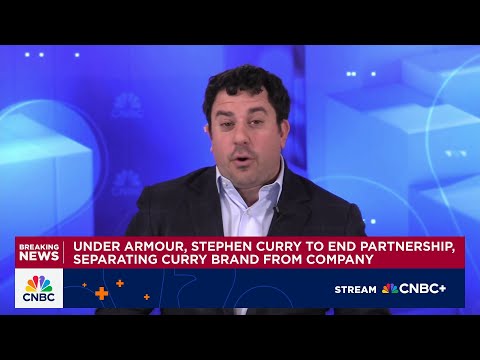
Under Armour, Stephen Curry to end partnership
Youtube· 2025-11-13 23:36
Core Insights - Under Armour and Curry Brand have officially ended their 13-year partnership, which significantly elevated Under Armour's profile in athletic sponsorships [1][2] - Under Armour has faced substantial challenges, with its stock down 40% this year and a total decline of 76%, prompting the company to refocus on its core UA brand [2][4] - Steph Curry retains sole ownership of the Curry Brand and is free to seek new partnerships, while Under Armour will maintain contracts with athletes under the Curry Brand but with the right of first refusal for Curry [2][3] Company Performance - Under Armour's recent struggles are evident in its revenue and branding, leading to a strategic decision to concentrate on its primary brand [2] - The decline in Under Armour's stock price reflects broader issues within the company, necessitating a reevaluation of its partnerships and branding strategies [4] Future Prospects - Steph Curry is expected to remain a prominent figure in the NBA for several more years, making him a valuable asset for potential new partnerships [6] - Curry's brand is characterized by an underdog image, raising questions about how this identity will be maintained with future collaborations, especially considering his previous rejection of Nike in favor of Under Armour [6][7] - There is speculation about Curry's potential transition into golf, which could open new partnership opportunities as he considers future endeavors [5]
Under Armour Expands Restructuring Plan, Ditches Curry Brand
WSJ· 2025-11-13 23:09
Core Insights - The athleticwear retailer's board has approved an additional $95 million in restructuring actions, increasing the total estimated restructuring and related charges to up to $255 million [1] Company Actions - The company is undertaking significant restructuring efforts, with the latest approval indicating a proactive approach to address operational challenges [1] - The total restructuring charges reflect the company's commitment to improving its financial health and operational efficiency [1] Financial Implications - The increase in restructuring charges suggests potential short-term financial strain but may lead to long-term benefits if the restructuring is successful [1] - The total estimated charges of $255 million highlight the scale of the company's restructuring efforts and the financial resources being allocated to this initiative [1]
Under Armour parts ways with Steph Curry as restructuring gathers pace
Reuters· 2025-11-13 22:50
Under Armour and Stephen Curry have parted ways, ending over a decade-long partnership between the NBA star and the sportswear company. ...
Under Armour splits with Steph Curry as it focuses on strengthening core brand
CNBC· 2025-11-13 22:32
Core Insights - Under Armour and Stephen Curry have mutually agreed to end their 13-year partnership, effective immediately [1][2] - Curry Brand will now operate independently, with Curry maintaining sole ownership and the freedom to seek new retail partnerships [2] - Under Armour will release the Curry 13, marking the final shoe collaboration with Curry [2] Company Strategy - Under Armour's CEO emphasized the need for discipline and focus on the core brand during a critical turnaround phase [3] - The breakup is seen as an opportunity for both parties to evolve; Curry aims for aggressive growth while Under Armour seeks to redefine its brand [3] - Under Armour has faced significant challenges, including leadership turnover and declining sales for eight consecutive quarters [3][4] Market Context - The competitive landscape has shifted, with established brands like Nike struggling against emerging competitors such as On and Hoka [4] - Under Armour's strategy includes fixing its product assortment and redefining its brand identity, with changes expected to appear in stores and social media this fall and winter [4] - Under Armour's stock has declined approximately 40% this year, reflecting ongoing challenges in the market [5]
Jim Cramer Discusses Under Armour (UA) & Turnarounds
Yahoo Finance· 2025-11-13 16:31
Core Viewpoint - Under Armour, Inc. (NYSE:UA) is undergoing a turnaround, but recent earnings and guidance indicate challenges ahead, leading to mixed sentiments among analysts and investors [2][3]. Financial Performance - For the fiscal second quarter, Under Armour reported revenue of $1.33 billion and earnings per share of $0.04, both slightly exceeding analyst expectations [2]. - The company's full-year revenue guidance indicates a drop of 4.5%, which is steeper than the analyst estimate of 4% [2]. - The third quarter revenue guidance suggests a decline of 6.5%, significantly worse than the analyst estimate of 4.1%, and the profit per share guidance of $0.04 falls short of the $0.06 estimate [2]. Market Sentiment - Jim Cramer noted that Under Armour's stock struggles are partly due to money managers focusing on short-term cycles, typically 90 days [2]. - Cramer expressed belief in a potential turnaround for Under Armour, suggesting that significant improvements could be seen in three quarters [3].