Axis Bank

Search documents
Sensex surges on firm global trends, fresh foreign fund
Rediff· 2025-11-20 11:15
Market Performance - The BSE Sensex increased by 446.21 points or 0.52% to close at 85,632.68, reaching a 52-week high of 85,801.70 during the day [3][4] - The NSE Nifty also achieved a 52-week high of 26,246.65 before closing at 26,192.15, reflecting a gain of 139.50 points or 0.54% [3][4] Influencing Factors - The rally in global markets contributed to the rise in Indian indices, with optimism surrounding India's trade talks and progress on phase-1 agreements enhancing market sentiment [4] - Strong performance in sectors such as Auto, Financials, and IT, along with fresh foreign institutional investor (FII) inflows, supported the positive trend [5] Institutional Activity - Foreign institutional investors purchased equities worth ₹1,580.72 crore in the previous trading session [6] - Domestic institutional investors also bought stocks valued at ₹1,360.27 crore [7] Sector Performance - Major gainers among Sensex firms included Bajaj Finance, Bajaj Finserv, Reliance Industries, HDFC Bank, Tech Mahindra, and Axis Bank [4] - Conversely, Asian Paints, HCL Tech, Titan, and Hindustan Unilever were among the laggards [4] Commodity Prices - Brent crude oil prices rose by 0.83% to $64.03 per barrel [7]

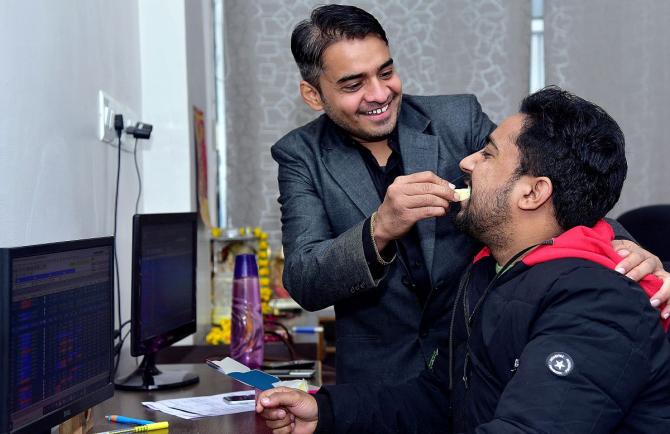
NHAI launches Raajmarg Infra Investment Managers for highway monetization
The Economic Times· 2025-11-20 11:11
Core Viewpoint - The National Highways Authority of India (NHAI) is establishing the Raajmarg Infra Investment Trust (RIIT) as a Public InvIT to monetize National Highway assets, targeting retail and domestic investors [7]. Group 1: Investment Structure - Public InvITs allow retail investors to invest in operational infrastructure projects, with units traded on stock exchanges like NSE and BSE [1][7]. - Raajmarg Infra Investment Managers Pvt Ltd (RIIMPL) has been incorporated as the Investment Manager for the proposed InvIT, with equity participation from major banks and financial institutions [2][7]. Group 2: Financial Performance - NHAI has successfully monetized assets worth Rs 48,995 crore through the Toll-Operate-Transfer (TOT) model and raised approximately Rs 43,638 crore across four rounds of Private InvITs [5][7]. - The introduction of around 1,500 km of completed and operational National Highways into the Public InvIT is expected over the next 3-5 years, creating significant investment opportunities [6][7]. Group 3: Governance and Compliance - RIIMPL will focus on establishing strong governance standards aligned with SEBI's InvIT regulations, ensuring transparency and investor protection [6][7]. - The first issuance of InvIT units for retail and public investors is anticipated to launch in February 2026 [7].

Stock markets rally in early trade tracking firm global peers, fresh foreign fund inflows
The Hindu· 2025-11-20 05:10
Market Performance - Equity benchmark indices Sensex and Nifty were trading higher, with Sensex reaching a 52-week high of 85,470.96 and Nifty hitting 26,136, also a 52-week peak [1] - The Sensex increased by 513.45 points or 0.61% to settle at 85,186.47, while Nifty climbed 142.60 points or 0.55% to 26,052.65 [5] Sector and Stock Movement - Gainers among Sensex firms included Adani Ports, Reliance Industries, Tata Motors Passenger Vehicles, Axis Bank, Mahindra & Mahindra, and Power Grid [2] - Lagging stocks included HCL Tech, Tech Mahindra, ICICI Bank, and Maruti [2] Global Market Influence - U.S. markets ended positively, with significant gains in technology shares following Nvidia's strong earnings guidance, which boosted optimism in AI and semiconductor sectors [4] - Asian markets also showed positive trends, with South Korea's Kospi and Japan's Nikkei 225 index trading over 3% higher [2] Foreign Investment Activity - Foreign institutional investors (FIIs) purchased equities worth ₹1,580.72 crore, while domestic institutional investors (DIIs) bought stocks worth ₹1,360.27 crore [5]

Sensex down 278 points; Nifty ends below 26,000
Rediff· 2025-11-18 11:40
Market Performance - The benchmark Sensex dropped by nearly 278 points, ending a six-day winning streak, while the Nifty closed below the 26,000-mark due to profit-taking in IT, metal, and capital goods shares amid weak global market trends [1][3] - The 30-share BSE Sensex declined by 277.93 points or 0.33% to settle at 84,673.02, with an intraday low of 84,558.36, a drop of 392.59 points or 0.46% [3] - The 50-share NSE Nifty dipped 103.40 points or 0.40% to close at 25,910.05 [3] Sector Performance - Major laggards among Sensex firms included Tech Mahindra, Infosys, Bajaj Finance, Bajaj Finserv, Eternal, Adani Ports, Hindustan Unilever, and Bharat Electronics [4] - Gainers included Bharti Airtel, Axis Bank, Asian Paints, and Titan [4] Investor Sentiment - The domestic equity market declined as investors booked profits following a recent rebound, reflecting weak global sentiment and diminished expectations of a US Fed rate cut in December [5] - The stronger dollar contributed to declines in IT, metal, and realty stocks [5] Global Market Trends - Asian markets, including South Korea's Kospi, Japan's Nikkei 225, Shanghai's SSE Composite, and Hong Kong's Hang Seng, settled sharply lower [5] - European markets were also trading in the red, and US markets ended in negative territory [6] Institutional Investments - Foreign Institutional Investors (FIIs) purchased equities worth Rs 442.17 crore, while Domestic Institutional Investors (DIIs) bought stocks worth Rs 1,465.86 crore in the previous trade [7] Commodity Prices - Brent crude, the global oil benchmark, decreased by 0.40% to $63.94 per barrel [7]
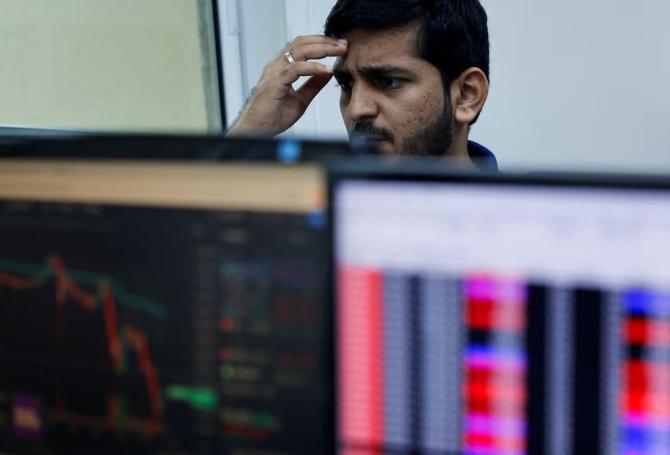
Data-centre boom exciting but risky; focus on green energy and select banks, says Sameer Dalal
The Economic Times· 2025-11-18 06:42
Group 1: Data Centres and AI Boom - Data centres are considered the back office of the AI boom, but the sector involves heavy upfront capital expenditure (capex) and uncertain initial utilization, which can negatively impact profitability [1] - Replacing storage hardware is costly and frequent, leading to significant depreciation as a cash cost, distinguishing it from other infrastructure investments [1] Group 2: Market Valuation and Stock Picking - Indian markets have become complacent regarding high valuations, making selective stock picking crucial [2] - There is no sector-wide valuation comfort, but individual stocks within sectors may still present attractive opportunities [2] - The market is expected to remain range-bound with a mild negative bias due to foreign institutional investor (FII) selling, fresh equity supply, and modest earnings growth [2] Group 3: Investment Themes - A blend of growth and value investment strategies is recommended, indicating that this is not a market for index buying [5][7] - Strong opportunities are identified in green energy, particularly in local solar cell manufacturing, which is seen as a significant structural shift [6][9] - In the banking sector, select banks like Axis Bank, IndusInd Bank, and IDFC First Bank are highlighted for their growth visibility and reasonable valuations, with improved liquidity and managed deposit repricing [6][9]

How Indian Banks Are Betting Big on AI 🤖🏦
Medium· 2025-11-16 04:32
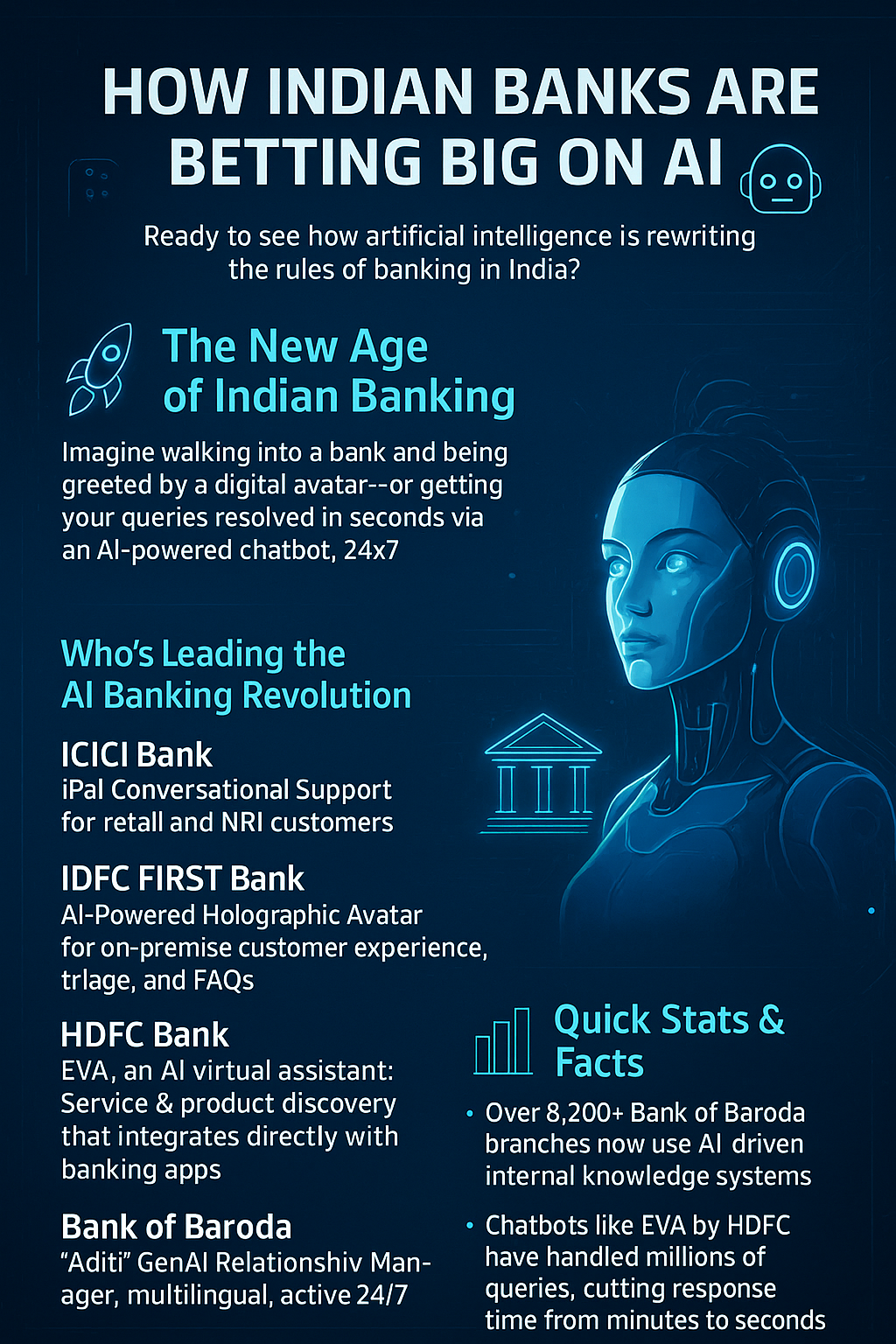
Core Insights - Indian banks are leveraging artificial intelligence (AI) to enhance customer experience, operational efficiency, and service scalability in the financial sector [1][3]. AI Implementation by Leading Banks - ICICI Bank utilizes iPal for conversational support aimed at retail and NRI customers [4]. - IDFC FIRST Bank has introduced an AI-powered holographic avatar to improve on-premise customer interactions [5]. - HDFC Bank employs EVA, an AI virtual assistant, for service and product discovery integrated with banking applications [6]. - Bank of Baroda features "Aditi," a GenAI relationship manager, providing multilingual support and operating 24/7 [7]. - SBI (State Bank of India) has revamped its YONO platform to incorporate a broader AI strategy and features [8]. - Axis Bank and IndusInd Bank offer IndusAssist, providing seamless AI service across various channels [9]. Market Context - India's banking sector serves over 1.4 billion people, managing crores of accounts and billions in daily transactions [11]. - AI technologies are essential for addressing the scale of operations, personalizing services, and ensuring 24/7 availability [11]. Performance Metrics - Over 8,200 branches of Bank of Baroda utilize AI-driven internal knowledge systems [12]. - HDFC's chatbot EVA has managed millions of queries, significantly reducing response times from minutes to seconds [12]. - The introduction of holographic avatars and multilingual support is enhancing accessibility and personalization in banking services [12].
Post Office schemes beating FD returns: These small savings schemes offer 7% and higher interest rates on deposits
The Economic Times· 2025-11-15 07:20
SBI to discontinue mCASH service after November 30, 2025: Here’s how customers can send money to third-party beneficiaries after thatWhich Post Office small savings schemes offer higher interest rates than FDs of many leading banks?Post Office small savings schemes are offering better returns than many leading banks’ fixed deposit schemes. Post office scheme interest rates are revised every quarter by the government. At present, below-mentioned post office schemes are offering 7% and above interest rates.In ...

Sensex, Nifty settle with modest gains
Rediff· 2025-11-14 11:32
Equity benchmark indices Sensex and Nifty reversed early losses to end modestly higher on Friday as investors turned to buying blue-chip stocks at beaten down prices.Illustration: Uttam GhoshThe 30-share BSE Sensex benchmark began the trade on a negative note by declining 449.35 points, or 0.53 per cent to 84,029.32.The NSE Nifty started the day off lower by 138.35 points or 0.53 per cent to 25,740.80.However, both the benchmark indices showed some recovery at the fag end before closing the session with gai ...

The Bright Spots in India's Stock Market Right Now
Bloomberg Television· 2025-11-14 08:55
Indian Economic Outlook - India could benefit from a potential burst in the "air bubble" due to its limited exposure to hyperscaler stocks and data center capacity stocks [2][3] - Axis Bank's chief economist anticipates a cyclical recovery in the Indian economy driven by the reversal of monetary tightening and the end of hard fiscal tightening [5] - The market expects 12-month forward earnings to rise as the economic recovery comes in [6] - Mishra anticipates more than 7% growth in the Indian economy [9] Financial Services Industry Trends - Fundamentals, such as economic growth, credit build-out, and market structure, are more significant than volatility in driving the financial services industry [11] - Lending in India has grown at a nominal rate of 15% to 15.5% annualized over a 50-year period, but has come down to about 11% in the last ten years [13][14] - Government spending slowed down, impacting the economy, but is now recovering [16][17] - Credit growth in India is currently running at about 10%, with a credit growth to GDP growth ratio of 1:1, lower than the historical average of 1.25% to 1.3% [22] - India has a capital deficit, particularly in long-duration capital, and the government is working to attract long-term capital into the financial services sector [24][26] - The number of banks in India has decreased over the last ten years due to the government's merging of public sector banks, reducing competitive intensity [28][29]

The Bright Spots in India's Stock Market Right Now
Youtube· 2025-11-14 08:55
Group 1: Market Overview - Air-related stocks are experiencing a significant downturn across global markets, raising questions about India's potential to benefit if the bubble bursts [1] - India currently lacks significant air play and hyperscaler stocks, positioning it as a potential growth opportunity if investors seek alternatives [2][3] Group 2: Economic Recovery - The reversal of monetary tightening and the end of hard fiscal tightening are driving a cyclical recovery in the Indian economy, with expectations of over 7% growth [5][9] - In the past year, India faced a 12% cut in earnings revisions, making it one of the worst-performing markets, but this trend is expected to change as economic recovery takes hold [7][8] Group 3: Financial Services Sector - The financial services industry is poised to benefit significantly from the anticipated economic growth and revival in credit growth, alongside increased foreign investment and potential mergers of small public sector banks [10][9] - Lending in India has historically grown at a nominal rate of 15% annually, but this has decreased to about 11% in recent years, indicating a need for renewed growth [13][14] Group 4: Government Spending and Consumption - Government spending and personal consumption expenditure have been the main drivers of the Indian economy, with recent slowdowns in government spending impacting overall growth [15][16] - Mid-market India is performing well, with signs of recovery in consumption, particularly in urban areas, despite some softness in rural regions [17][18] Group 5: Credit Growth and Risk - Current credit growth in India is around 10%, matching nominal GDP growth, which is lower than historical ratios, indicating a conservative lending environment [22] - Lenders have become overly cautious following a credit risk jolt, leading to a stark decline in growth in unsecured credit and personal loans [20][21] Group 6: Foreign Investment and Competitive Landscape - Large foreign banks are increasingly interested in the Indian financial services sector, which is seen as a source of long-term capital needed for economic growth [23][24] - The consolidation of public sector banks has reduced the number of banks in India, leading to decreased competitive intensity in the financial services industry [29][30]