
Vanguard

Search documents
VGUS: Parking Spot For Cash
Seeking Alpha· 2025-10-18 07:37
Group 1 - The Vanguard Ultra-Short Treasury ETF (NASDAQ: VGUS) offers a higher yield than traditional checking accounts, making it an attractive option for parking excess liquidity [1] - The ETF is designed for investors seeking a low-risk investment vehicle with better returns compared to standard cash management options [1]


Fixed Income ETFs Set New $325 Billion Record
Etftrends· 2025-10-17 22:38
Core Insights - ETFs are projected to surpass the 2024 record of $1.1 trillion in net inflows, with $1.01 trillion already recorded for the year, likely achieving this milestone in November [1] - Fixed income ETFs have reached a new milestone with $325 billion in new money as of October 15, contributing to a total of $303 billion for the year [1] Fixed Income ETFs Performance - The iShares 0-3 Month Treasury Bond ETF (SGOV) is the most popular ETF, adding $29 billion, with a low risk profile and a 30-day SEC yield of 4.1% [2] - Vanguard Total Bond Market ETF (BND) and iShares Core US Aggregate Bond ETF (AGG) are also popular, adding $15 billion and $8.9 billion respectively, both offering low-cost exposure to investment-grade U.S. bonds [3][4] - Vanguard Total International Bond ETF (BNDX) saw $9.2 billion in net inflows, with a yield of 3.0% and an average duration of seven years, although its performance has lagged behind BND [5][6] Actively Managed Fixed Income ETFs - The Janus Henderson AAA CLO ETF (JAAA) led actively managed ETFs with $9.3 billion in inflows, achieving a yield of 5.4% and a total return of 3.8% for the year [7] - iShares Flexible Income Active ETF (BINC) and JPMorgan Ultra-Short Income ETF (JPST) also performed well, with inflows of $6.2 billion and $6.1 billion respectively, offering yields of 5.1% and 4.2% [8][9] Future Outlook for Fixed Income ETFs - There is optimism for innovation in the fixed income ETF market, particularly in actively managed ETFs, as well as potential developments in fixed income index strategies [11][12]
Treasury Yields Snapshot: October 17, 2025
Etftrends· 2025-10-17 21:37
Group 1: Treasury Yields and Economic Indicators - The 10-year Treasury note yield fell below 4.00% for the first time in over a year, ending at 4.02%, while the 2-year note reached its lowest level since September 2022 at 3.46% [1] - An inverted yield curve, where longer-term Treasury yields are lower than shorter-term yields, is considered a reliable leading indicator for recessions, with the 10-2 spread turning negative before recessions [3][4] - The average lead time to a recession based on the first negative spread date is approximately 48 weeks, while using the last positive spread date yields an average lead time of 18.5 weeks [5][7] Group 2: Mortgage Rates and Federal Funds Rate - The Federal Funds Rate (FFR) influences borrowing costs for banks, which typically leads to higher mortgage rates when the FFR increases; however, recent trends show mortgage rates declining despite the Fed holding rates steady [8] - The latest Freddie Mac Weekly Primary Mortgage Market Survey reported the 30-year fixed mortgage rate at 6.27% [8] Group 3: Market Behavior and Federal Reserve Influence - Federal Reserve policy has significantly influenced market behavior, particularly in relation to Treasury yields and the S&P 500 [9]
Worldwide Exchange: ETF Flows Week of October 13
CNBC Television· 2025-10-17 11:23
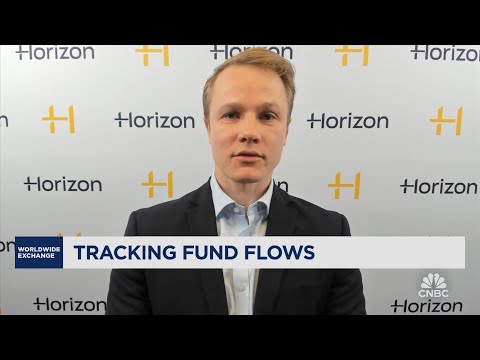
ETF Market Trends & Inflows - ETF net inflows have topped $1 trillion for the second consecutive year and are on pace for a new record year [1][2] - The growth is attributed to transparency, liquidity, tax efficiency, and innovation within the ETF wrapper, including options-based strategies [3][6] - Demand for growth-type exposure, particularly in AI and innovation, is driving inflows [5] - Actively managed ETFs are attracting more investors, accounting for approximately 37% of inflows compared to 26% in 2024, due to the accessibility of sophisticated strategies [13] Top ETF Inflows & Market Sentiment - Top inflows this week were into BBEU (a large-cap European stock ETF), GLD (gold ETF), and BNDX (Vanguard Total Bond ETF) [7] - The shift towards European equities and bonds may be due to tariff concerns and government shutdown fears, prompting investors to seek safer, more stable markets and fixed income exposure [8][9] ETF Innovation & Investment Strategies - Sophisticated options-based approaches within ETFs are giving investors access to solutions they haven't had historically [4][6] - Horizon's "Why Not" digital frontier ETF offers a one-stop-shop solution for exposure to growth, AI, crypto, and quantum, with dynamic weightings [10][11] - Actively managed ETFs allow for layering crypto exposure on top of stock baskets using options and other approaches [15]
Which Index Funds Are Best for Beginners
Medium· 2025-10-17 10:33
Core Insights - Index funds are an effective investment option for beginners, providing a simple way to build long-term wealth without needing extensive expertise or large amounts of capital [1][2] Group 1: Benefits of Index Funds - Index funds track specific market indices, such as the S&P 500, offering diversification by allowing investors to own shares in hundreds of top companies simultaneously [2] - They are characterized by low costs and reduced risk compared to individual stock picking, leading to steady growth and less anxiety for investors [2] Group 2: Recommended Index Funds - Vanguard S&P 500 ETF (VOO) is highlighted as a great option for long-term, low-cost investing [3] - Schwab Total Stock Market Index Fund (SWTSX) is recommended for broad market exposure [5] - Fidelity ZERO Large Cap Index Fund (FNILX) is noted for having no expense ratio, making it suitable for small budgets [5] Group 3: Getting Started with Investing - Beginners can start investing with as little as $50 or $100 by opening accounts with platforms like Fidelity, Schwab, or Vanguard [6] - Setting up automatic monthly contributions is advised to take advantage of compound growth over time [6] - The principle of "time in the market beats timing the market" is emphasized, encouraging early investment [6]

2 Vanguard ETFs That Can Be Cash-Generating Machines for Your Portfolio for Years to Come
The Motley Fool· 2025-10-17 09:30
Core Insights - The article emphasizes the attractiveness of exchange-traded funds (ETFs) for long-term investors seeking quality investments that generate recurring income through dividends [1] Group 1: Vanguard Dividend Appreciation ETF - The Vanguard Dividend Appreciation ETF offers a dividend yield of 1.6%, slightly above the S&P 500 average of 1.2%, with a focus on dividend growth, making it appealing for long-term investors [3] - The fund has a low expense ratio of 0.05%, which is significant for long-term investing as lower fees can lead to higher returns over time [4] - The ETF holds over 330 quality dividend stocks, with Broadcom, Microsoft, and JPMorgan Chase as the top three holdings, where Broadcom constitutes about 6% of the portfolio, providing good diversification [5] - In 2025, the fund has generated total returns of 11%, which is close to the S&P 500's 14%, indicating potential resilience in down years due to its dividend growth [6] Group 2: Vanguard High Dividend Yield ETF - The Vanguard High Dividend Yield ETF offers a higher yield of around 2.5%, more than double the S&P 500 average, focusing on high-yielding stocks with 579 holdings as of August 31 [7] - The fund has a low expense ratio of 0.06%, making it a cost-effective option for investors [7] - There is some overlap with the Dividend Appreciation ETF, as Broadcom and JPMorgan Chase are also top holdings, while ExxonMobil, with a 3.5% yield, is among the top three in this fund [8] - Despite the higher risk associated with high-yielding stocks, the ETF's diversification mitigates this risk, as no single stock, apart from Broadcom and JPMorgan Chase, accounts for more than 3% of the portfolio [9] - This year, the ETF's returns have been consistent with the Dividend Appreciation ETF, both achieving over 11% returns including payouts, making them strong long-term investment options [10]
A Once-in-a-Decade Investment Opportunity: 1 Vanguard Index Fund to Buy for the AI Boom
The Motley Fool· 2025-10-17 07:45
Core Insights - U.S. electricity demand is projected to increase significantly, driven by artificial intelligence and other trends, marking the fastest growth since the 1990s [2][6] - The utilities sector has outperformed the S&P 500 year to date, with a 23% increase, suggesting a potential investment opportunity [3][4] Electricity Demand Trends - Goldman Sachs estimates a 2.4% annual increase in U.S. electricity consumption through 2030, influenced by electrification, industrial reshoring, and AI [2][6] - The utilities sector's performance is expected to continue improving as electricity demand rises [3] Vanguard Utilities ETF - The Vanguard Utilities ETF tracks 69 U.S. utility companies, primarily electric utilities, and has an expense ratio of 0.09% [4][5] - The ETF has achieved a total return of 186% over the last decade, averaging 11% annually, compared to the S&P 500's 300% return [8] Major Utility Companies - Key holdings in the Vanguard Utilities ETF include NextEra Energy (10.3%), Constellation Energy (6.8%), and Southern Company (6.6%), with Constellation Energy showing an 81% stock increase year to date [7] - The majority of the top 10 holdings have outperformed the S&P 500 this year, indicating strong market performance [4][7] Investment Strategy - The Vanguard Utilities ETF is recommended to be held alongside AI stocks and S&P 500 index funds for diversified exposure [8][9] - The S&P 500 has a significant number of companies mentioning AI in earnings calls, highlighting its relevance in the current market [10]
Cango to Terminate ADR Program, Expanding Access to U.S. Institutional Investors
Ge Long Hui· 2025-10-17 03:44
Core Insights - Cango's termination of its ADR program and transition to a direct listing on the NYSE represents a significant shift in its capital-market strategy, reflecting its evolution from auto finance to cryptocurrency mining [1][2] Group 1: Strategic Shift - The termination of the ADR program and the direct listing are part of a broader strategic evolution following the divestment of Cango's auto-finance business for US$351.9 million, marking a decisive shift to compute-power operations [1] - The direct listing simplifies Cango's market structure, enhancing its correlation with U.S. mining indices and potentially increasing its inclusion in specialized mining ETFs [2] Group 2: Institutional Participation - The move to a direct listing removes barriers for institutional investors, as approximately 62% of U.S. long-only funds restrict holdings of non-directly-listed securities, thus broadening Cango's investor base [3] - The potential increase in institutional ownership is illustrated by BitDeer's experience, where ownership rose from 12% to 27% after migrating to a U.S. board [3] Group 3: Operational Performance - In September, Cango demonstrated operational resilience with a production decline of only 7.1% despite an 8.3% increase in Bitcoin's network hash rate and a 7.1% rise in mining difficulty, outperforming the industry average decline of ~12% [4] - Cango's operational capacity of 44.85 EH/s resulted in an 89.7% utilization rate, nearly matching that of industry leader Marathon Digital [4] Group 4: Valuation Metrics - Cango's shares are currently trading at approximately US$4.37 per ADS, with a market capitalization of US$796 million, while projected revenues for 2025 and 2026 are US$609 million and US$850 million, respectively [5] - The company's P/S multiples of 1.6× for 2025E and 1.2× for 2026E are significantly lower than peer averages, indicating potential for a structural re-rating following the direct listing [5]
X @Investopedia
Investopedia· 2025-10-16 21:00
The majority of workers don’t contribute the annual maximum amount to their retirement savings plans, a Vanguard study shows. Learn how contributing the maximum can provide significant benefits for savings. https://t.co/U3eQ80dkJh ...
2 Simple ETFs to Buy With $1,000 and Hold for a Lifetime
Yahoo Finance· 2025-10-16 19:05
Core Insights - Investing is perceived as complicated, but exchange-traded funds (ETFs) simplify the process by allowing ownership of multiple companies through a single investment [1] Group 1: ETF Overview - ETFs provide a straightforward way to invest, making it easier for individuals to build a diversified portfolio [1] - A $1,000 investment can be effectively allocated among a few ETFs to create a well-rounded investment strategy [2] Group 2: Vanguard S&P 500 ETF (VOO) - The Vanguard S&P 500 ETF (VOO) tracks the S&P 500 index, which includes 500 of the largest and most influential U.S. companies [4] - VOO offers diversification, access to blue-chip stocks, and low costs, although it has become less diversified due to rising tech valuations [5] - S&P 500 companies are generally industry leaders with proven business models and strong track records [6] - Since its inception in 2010, VOO has averaged over 12% annual returns, with over 14% when dividends are reinvested, indicating potential for stable long-term returns [7] - VOO has one of the lowest expense ratios in the market, making it an attractive option for investors [8]