Apple

Search documents
全球半导体_高位建仓,更高位卖出;先进封装成核心,助力 AI 性能指数级提升-Global Semiconductor_ Stack ‘Em High, Sell ‘Em Higher; Advanced packaging takes center stage to deliver exponential AI performance gains
2026-03-22 14:35
Summary of Key Points from the Conference Call Industry Overview - The semiconductor industry is facing challenges due to explosive performance requirements for AI infrastructure, marking the end of Moore's Law. Chips are becoming more expensive to manufacture with diminishing returns [1][5]. Core Insights - **Advanced Packaging Growth**: Advanced packaging is becoming the primary driver of semiconductor performance as traditional scaling slows. The industry expects 2.5D and 3D advanced packaging to grow approximately 7x by 2030, with wafer consumption projected to reach around 3.5 million wafers per month (wpm) by 2030 [2][6]. - **Stacking Technologies**: Stacking technologies, including CoWoS, SoIC, and HBM, are crucial for enhancing chip performance by increasing bandwidth and are essential for AI chips. These technologies are also being extended to frontend processes to facilitate upcoming node migrations [3][5]. - **Testing Market Growth**: The testing market is expected to grow at an 8% compound annual growth rate (CAGR) through 2029, driven by increased complexity in packaging and higher yield requirements per layer [11]. Specific Technologies and Projections - **High-Bandwidth Memory (HBM)**: HBM capacity is anticipated to expand to approximately 758k wpm by 2027, with a shift from flux-based TCB to fluxless processes and hybrid bonding to achieve better performance metrics [7][27]. - **Chip on Wafer on Substrate (CoWoS)**: CoWoS capacity is projected to reach around 140k wpm by 2027, with increasing complexity in GPU and ASIC designs pushing packaging limits [8][35]. - **3D IC Adoption**: The adoption of 3D ICs is accelerating, with hybrid bonding providing significant improvements in I/O density and energy efficiency. Companies like AMD and Intel are leading this trend [9][32]. - **NAND and DRAM Innovations**: NAND manufacturers are expected to adopt CMOS bonded to array (CBA) stacking, which could enhance performance metrics significantly. The NAND bonding capacity is projected to reach 1,057k wpm by 2030 [54][57]. DRAM is also expected to transition to CBA architecture, enhancing performance and efficiency [66]. Key Beneficiaries - Companies such as DISCO, Advantest, Besi, and Ibiden are identified as key beneficiaries of the advanced packaging and testing market growth due to their roles in equipment and technology supply [11][12]. Additional Insights - **Yield Challenges**: The yield for stacked dies can degrade significantly, with complex packaging leading to lower overall yields compared to single die packages. Testing is critical to maintaining higher yield rates [76][78]. - **Longer Testing Times**: As chip complexity increases, testing times are expected to grow exponentially, with projections indicating a 50x increase in testing time for SoCs by 2031 compared to 2017 [79][80]. This summary encapsulates the critical insights and projections from the conference call, highlighting the evolving landscape of the semiconductor industry and the implications for various stakeholders.


Apple CEO praises China partners as Beijing applies pressure
The Economic Times· 2026-03-22 13:38
Core Insights - Apple has lowered fees for app developers in China, a significant move in response to potential antitrust scrutiny from local regulators [1][4] - The People's Daily has called for further easing of App Store restrictions and highlighted concerns over Apple's monopolistic practices, indicating ongoing pressure from the Chinese government [1][4] Group 1: Financial Performance - Apple's revenue from China surged by 38% to $25.5 billion in the holiday quarter ending in December, driven by demand for the latest iPhone and consumers switching from competitors [3][4] Group 2: Strategic Initiatives - Tim Cook emphasized the interconnectedness of innovation, green development, and education, showcasing Apple's commitment to collaborating with partners in China to achieve shared goals [2][4] - Apple has diversified its manufacturing beyond China to include regions like Vietnam and India, reflecting a strategic shift in its supply chain management [2][4] Group 3: Government Relations - Chinese Premier Li Qiang cited Apple as an example of a company with a diversified supply chain and warned against politicizing industrial issues, which could harm global supply chain stability [4]



Is Apple Stock Going to $500? Here's What Has to Happen.
The Motley Fool· 2026-03-21 23:00
Core Viewpoint - Apple's stock has seen a remarkable increase of 953% over the past decade, and investors are now looking for the next milestone, specifically whether the stock can reach $500 in the next five years [1] Financial Performance - Between fiscal 2022 and fiscal 2025, Apple's diluted earnings per share (EPS) is projected to grow at a compound annual rate of 6.9%, with analysts expecting this to increase to 11.4% annually over the next three fiscal years [2] - In the first quarter of fiscal 2026, Apple's revenue increased by 15.7% year over year, with a significant 23.4% growth in iPhone sales, leading to an 18.3% rise in diluted EPS [4] Growth Challenges - Despite recent strong financial results, there is skepticism about whether this growth can be sustained, as larger companies typically experience slower growth rates [3][5] - The annualized revenue for Q1 reached $575 billion, making it increasingly challenging for the company to achieve significant growth at this scale [5] Market Sentiment and Valuation - Currently, Apple shares are trading 11% below their record high from December, with a price-to-earnings (P/E) ratio of 32.2, indicating that the stock is not seen as a bargain [7] - For the stock to reach $500 by 2031, an expansion of the P/E multiple may be necessary, but if growth slows, a lower P/E ratio could be justified, adding risk to the investment thesis [8] Long-term Outlook - Given the expected high-single-digit or low-double-digit growth in diluted EPS and the potential contraction of Apple's valuation ratio, confidence in reaching $500 in five years is low, but the possibility seems more plausible over a longer time horizon [9]

3 themes that gripped Wall Street as stocks dropped for a 4th straight week
CNBC· 2026-03-21 19:13
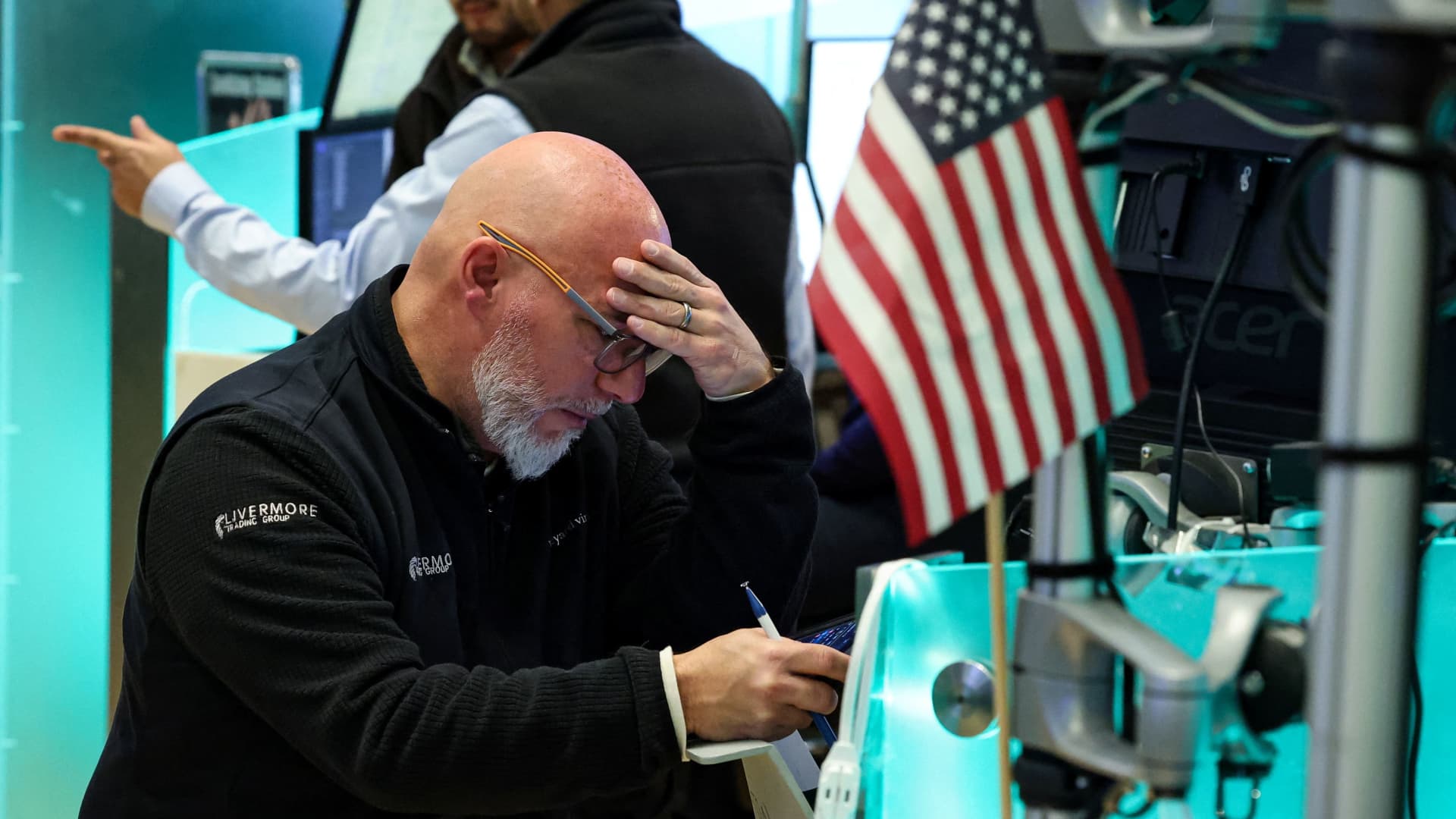
Market Overview - The S&P 500, Nasdaq, and Dow experienced their fourth consecutive week of losses due to the Iran war and rising wholesale inflation, with the S&P 500 falling 1.5% over the past week and both the Nasdaq and Dow dropping approximately 2% [1][1][1] - The rise in oil prices has negatively impacted stock performance since the U.S. and Israel's attacks on Iran, leading to a market that has been in oversold territory for nine straight sessions [1][1][1] Inflation Concerns - Inflation concerns were heightened as wholesale prices for February increased by a seasonally adjusted 0.7%, significantly above Dow Jones estimates of a 0.3% increase [1][1] - Fed Chair Jerome Powell indicated that inflation is not decreasing as quickly as anticipated and that the war-induced spike in oil prices will further elevate inflation in the near term [1][1] Memory Crunch - Micron reported a significant increase in revenue, nearly tripling, but attributed this to "structural supply constraints" and increased memory demand driven by AI [1][1] - The CEO of Micron stated that the company can only meet 50% to two-thirds of major customers' memory requirements due to tightening supply, indicating a severe memory shortage impacting hardware companies [1][1] - HP's stock hit a 52-week low due to projected annual profits at the low end of guidance, while Apple managed to perform better, with its stock down less than 9% year to date, gaining market share in China [1][1][1] Nvidia's GTC Event - Nvidia's GTC event featured bullish announcements, with CEO Jensen Huang projecting that orders for their Blackwell and Vera Rubin generation chips could reach $1 trillion by 2027 [1][1] - Despite positive news from the event, Nvidia's stock fell 4% for the week, reflecting ongoing frustrations for investors [1][1]


X @Elon Musk
Elon Musk· 2026-03-21 06:45
RT Wall Street Apes (@WallStreetApes)Absolutely insaneThis is why the Democrat Party still has supportersMedia Research Investigation finds “Only 2% of Google's top morning articles — were from a right-leaning news site. The vast majority of the rest, all from left-wing outlets”“Do you remember when I told you that Apple News had gone 3 straight months without featuring a single article from a conservative news outlet in its top stories? Well, now they can hold Google's beer.Only 2% of Google's top morning ...
The Two Forces Reshaping Your Portfolio - February Dividend Income Report
Seeking Alpha· 2026-03-21 03:45
Core Insights - The author transitioned from a traditional financial career to focus on personal finance education through online platforms [1] Group 1: Background and Experience - The author has a background in finance-marketing, holds a CFP title, and has an MBA in financial services [1] - The author began a career in the financial industry in 2003 and has received several promotions and diplomas [1] - The author worked in private banking for five years before deciding to pursue a different path [1] Group 2: Personal Journey - In 2016, the author traveled across North America and Central America with family, visiting nine countries and spending three months in Costa Rica [1] - This travel experience was described as eye-opening and led to a career change in 2017 [1] - The author aims to help others with personal finance through investing websites after leaving the traditional financial industry [1]

Market Volatility Surges as Quadruple Witching and Geopolitical Tensions Pressure Major Indexes
Stock Market News· 2026-03-20 16:07
Market Performance - U.S. equity markets are experiencing volatility, with major indexes largely in the red, indicating a potential fourth consecutive losing week, the longest streak in over a year [1] - The S&P 500 is down approximately 0.45%, the Nasdaq Composite has fallen 0.77%, and the Dow Jones Industrial Average is down 0.26% [2] - Market breadth is weak, with a majority of issues on the New York Stock Exchange declining, while the CBOE Volatility Index remains elevated near 24 [2] Federal Reserve Policy - The Federal Reserve maintained the federal funds rate in the 3.5% to 3.75% range, indicating a "hawkish hold" [3] - The updated "dot plot" projections suggest only one potential rate cut for the remainder of 2026, contrasting with earlier expectations of multiple cuts [3] Inflation and Economic Indicators - Inflationary concerns are heightened due to ongoing Middle East conflicts, pushing Brent Crude oil prices toward $110 per barrel [4] - The Philadelphia Fed Index reported at 18.1 for March, significantly above the consensus estimate of 8.4, indicating robust manufacturing activity but persistent cost pressures [4] Corporate Developments - FedEx reported an EPS of $5.25, exceeding estimates by over a dollar, and raised its full-year guidance due to improved profitability and strong free cash flow [5] - Micron Technology's disappointing guidance for Q3 fiscal 2026 led to a nearly 4% drop in its shares, impacting other semiconductor stocks like Nvidia, which is down 0.9% [6] - Nexstar Media Group completed its $6.2 billion acquisition of Tegna, creating a large broadcast entity, though gains are tempered by federal antitrust challenges [7] - Alibaba fell 5% following weak quarterly results, while XPeng slipped 2.5% after its earnings release [7] Mega-Cap Tech Performance - Mega-cap tech stocks are mixed; Microsoft and Google are seeing modest declines, while Tesla is down over 3% as investors rotate out of high-multiple discretionary stocks [8] - Apple is also trading slightly lower as the broader market remains defensive [8]

Tim Cook’s China visit reinforces country’s importance to Apple as global frictions rise
CNBC· 2026-03-20 15:12
Core Insights - Tim Cook's visit to Chengdu, China, coincides with Apple's 50th anniversary and highlights the company's complex relationship with the Chinese smartphone market [1] - Despite geopolitical tensions and antitrust pressures, China remains a vital market for Apple [3] Group 1: Market Dynamics - The U.S.-China tensions have escalated, influenced by the Iran war and a new U.S. investigation into Chinese trade practices following the Supreme Court's decision to strike down significant tariffs on Chinese imports [2] - Apple has reduced its App Store commission in mainland China from 30% to 25% for in-app purchases, effective March 15, and lowered fees for smaller developers from 15% to 12% [3] Group 2: Regulatory Environment - The People's Daily, the official newspaper of the Chinese Communist Party, has called for Apple to make further concessions, emphasizing the need for access to third-party payment systems and alternative app distribution for Chinese users and developers [4] - China's State Administration for Market Regulation is investigating Apple's app fee policies and its prohibition on external payment services [5]

AI sets Apple stock price for Q2 2026
Finbold· 2026-03-20 13:49
Core Viewpoint - Despite a partnership with Alphabet aimed at enhancing AI integration, Apple is expected to face challenges in Q2 2026, with its stock performance aligning closely with the S&P 500 since late 2022 [1] Group 1: Stock Performance - Apple shares have not fully capitalized on recent market booms, resulting in a year-to-date decline of 8.74% as of March 20, with a price of $248.09 [2] - The stock is projected to start Q2 at $205 and end at $212, indicating a potential volatility range with a low of $188 and a high of $224 during the quarter [6] Group 2: Factors Influencing Performance - Key factors affecting Apple's stock include a mature hardware cycle, service expansion, equity buybacks, and perceptions of lagging in AI technology [5] - ChatGPT describes Apple as a 'premium defensive tech compounder,' reflecting its stable yet cautious outlook in the current market environment [5] Group 3: Market Sentiment - The analysis indicates a bearish sentiment for Apple in early 2026, with expectations of deeper downside risks based on recent performance trends [7] - Despite the bearish outlook, there is an anticipated consolidation with an upward bias, as indicated by the slight increase from the forecasted start to end prices in Q2 [7]
Fidelity's Active Large Cap Growth ETF Continues to Quietly Outpace Passive Rivals from Vanguard and iShares
247Wallst· 2026-03-20 13:35
Core Viewpoint - Fidelity's Enhanced Large Cap Growth ETF (FELG) has outperformed passive competitors from Vanguard and iShares, delivering a 21% return over the past 12 months with a low expense ratio of 0.18% [2][7]. Performance Summary - FELG achieved a 21% return over the last year, slightly ahead of iShares Russell 1000 Growth ETF (20%) and Vanguard Growth ETF (21%) [7]. - The fund has total net assets of $4.7 billion and benchmarks against the Russell 1000 Growth Index [8]. Investment Strategy - The ETF employs a quantitative investment process that focuses on companies with improving fundamentals and reasonable valuations, aiming to beat its benchmark rather than merely tracking it [5][13]. - The fund's top holdings include Nvidia (12.6%), Apple (11.5%), and Microsoft (10.1%), reflecting a strong conviction in the semiconductor and device ecosystems driving AI capital spending [2][9]. Market Dependency - The performance of FELG is closely tied to AI capital expenditure trends from hyperscalers and enterprise customers, which directly impacts revenue for its holdings in chipmakers and cloud platforms [3][10]. - A significant portion of the portfolio (over 50%) is allocated to Information Technology, making it sensitive to the health of large-cap technology earnings [10]. Future Outlook - Continued expansion in AI capital expenditure is crucial for the fund's performance, with upcoming quarterly earnings reports expected to provide insights into spending trends [15]. - The fund's quantitative model will be monitored for adjustments in positioning among its top holdings, which could indicate shifts in market dynamics [14].