HDFC Bank

Search documents
2 Vanguard Index Funds to Buy Now -- They Can Beat the S&P 500 Over the Next Decade, According to Wall Street Analysts
The Motley Fool· 2025-11-29 09:30
Core Insights - Goldman Sachs has updated its 10-year forecast for global equities, projecting the S&P 500 to return 6.5% annually, which is below the global average of 7.7% annually [1][2] - Asian and emerging-market stocks are expected to outperform, with projected annual returns of 10.3% and 10.9% respectively in local currency, and 12.6% and 12.8% when measured in U.S. dollars [2] Vanguard FTSE Pacific ETF - The Vanguard FTSE Pacific ETF tracks 2,300 companies in Asia, primarily in Japan, Australia, and Korea, with significant exposure to financial, industrial, and consumer discretionary sectors [4] - Over the past decade, the S&P 500 returned 288%, while the Vanguard FTSE Pacific ETF returned only 105% [4][5] - The ETF has a low expense ratio of 0.07%, making it a cost-effective option for gaining exposure to Asian equities [5] Vanguard FTSE Emerging Markets ETF - The Vanguard FTSE Emerging Markets ETF measures around 6,000 companies in emerging markets, focusing on China, Taiwan, and India, with heavy investments in technology, financial, and consumer discretionary sectors [8] - Similar to the Pacific ETF, the S&P 500 outperformed the Vanguard FTSE Emerging Markets ETF over the last decade, achieving a total return of 288% compared to the ETF's 106% [8][9] - This ETF also has a modest expense ratio of 0.07%, providing an affordable way to invest in emerging markets [9] Investment Strategy Considerations - Despite the potential for Asian and emerging-market stocks to outperform, there is a strong recommendation to maintain a larger portion of investment in U.S. stocks, particularly the S&P 500 index fund, due to its historical performance [10][12] - Past forecasts by Goldman Sachs have been overly conservative, as seen in their 2015 prediction for the S&P 500, which underestimated actual returns [11][12]



Active banking funds fail to capitalise on PSU rally: Value Research data
Rediff· 2025-11-29 09:22
Core Insights - Sectoral funds focused on public sector banks (PSBs) have outperformed other domestic mutual fund categories, achieving nearly a 28% rise in the Nifty PSU Bank index over the past six months [1][3] - Active banking and financial services funds have lagged behind, with median returns of only 9.2% during the same period, primarily due to their heavy investment in private sector lenders [3][4] Investment Composition - Most active banking and financial services (BFSI) funds allocate over 50% of their investments to the top 4-5 private sector banks, which dominate the banking sector's profit pool [4][6] - HDFC Bank, ICICI Bank, Axis Bank, and Kotak Mahindra Bank collectively account for 66% of the Nifty Financial Services index, while State Bank of India (SBI) is the only PSB with over 5% weight in the index [4][5] Performance Analysis - Despite the flexibility of active funds to build independent portfolios, their performance is still benchmarked against indices, leading to a performance gap with PSB indices [5][6] - Direct plans of BFSI schemes have generally outperformed the Nifty Financial Services total return index, which increased by 7.17% in the last six months [5] Market Outlook - Experts suggest that the performance gap between PSU and private sector banks may narrow in the near term, with private banks expected to outperform in the medium term due to their superior deposit franchises and operational efficiencies [7][8] - The rally in PSU banks may have peaked, with a potential sector rotation anticipated in 2026, as the Nifty PSU Bank index appears overextended after a multi-year rally [9]

These 7 top banks offer interest up to 7.2% on fixed deposits for senior citizens
MINT· 2025-11-29 08:50
Core Insights - The article emphasizes the importance of comparing fixed deposit (FD) interest rates across different banks, particularly for senior citizens who receive an additional 50 basis points on their deposits [1] Bank Interest Rates Summary - **HDFC Bank**: Offers the highest interest rate of 7.1% for senior citizens on a tenor of 18-21 months, with rates ranging from 6.75% to 6.9% for tenors between 1-5 years [2] - **ICICI Bank**: Provides an interest rate of 7.2% for tenors of 2 to 5 years, starting from 6.75% for a 1-year tenor for senior citizens [2] - **Kotak Mahindra Bank**: Offers 7.2% interest on FDs with tenors between 391 days to less than 2 years, and 6.75% for a 1-year deposit [3] - **Federal Bank**: Provides a competitive interest rate of 7.2% on a 36-month FD for senior citizens, with a 1-year tenor offering 6.75% [4] - **State Bank of India (SBI)**: The largest bank in India offers 7.05% interest for tenors between 5 to 10 years, including a 50 basis points premium under the SBI We Care program [5] - **Canara Bank**: Offers 7% interest on a 444-day FD for senior citizens, with a 1-year tenor also providing 6.75% [5] - **Union Bank of India**: Provides 7.1% interest on a 3-year FD for senior citizens, with a 1-year tenor offering 6.9% [6]

Q2 GDP: Sizzling, six-quarter high growth lights up India economic scene
The Economic Times· 2025-11-29 01:42
Economic Growth Overview - India's economy experienced a significant growth of 8.2% in the July-September period, marking a six-quarter high, driven by a surge in consumer demand and a reduction in goods and services tax (GST) [12][5][6] - The expansion was primarily led by a 9.2% growth in services and a 9.1% rebound in manufacturing [12][1] Consumer and Investment Trends - Private consumption, which constitutes nearly 60% of GDP, rose to a three-quarter high of 7.9% in the July-September period, up from 7% in the previous quarter [2][12] - Gross fixed capital formation, an investment measure, increased by 7.3%, slightly lower than the 7.8% growth in the prior quarter [2][12] - Agriculture growth was recorded at 3.5% in Q2, a slight decrease from 3.7% in Q1 [2][12] Future Growth Projections - The strong economic performance is expected to lead to upward revisions in growth estimates for FY26, with rating agency Crisil raising its forecast from 6.5% to 7% [7][12] - First-half FY26 growth was reported at 8%, an increase from 6.1% a year earlier, with gross value added (GVA) rising by 7.9% compared to 6.2% in the same period [7][12] Rural Consumption and Inflation - Strong agricultural performance and easing inflation are contributing to improved rural consumption growth, which is anticipated to continue into the first half of FY27 [8][12] - Retail inflation slowed to a record low of 0.25% in October, which, combined with strong growth, has complicated the outlook for potential rate cuts [10][12] Trade and Policy Considerations - The imposition of a 50% tariff by the US on India, including a 25% penalty for importing Russian oil, is a significant factor affecting future growth, with ongoing negotiations for a trade deal [8][12] - The GST Council's approval of a two-slab tax structure is expected to positively impact consumption by lowering taxes on various household goods [8][12]


Sensex, Nifty scale record highs on rate cut hopes
Rediff· 2025-11-27 10:50
Market Performance - Benchmark stock indices Sensex and Nifty reached new lifetime highs during intra-day trade, closing slightly higher due to positive global trends and expectations of a US Fed rate cut [1][6] - The BSE Sensex increased by 110.87 points or 0.13% to close at 85,720.38, hitting a record high of 86,055.86 during the day, which is a rise of 446.35 points or 0.52% [2] - The NSE Nifty ended up by 10.25 points or 0.04% at 26,215.55, with an intra-day peak of 26,310.45, reflecting a gain of 105.15 points or 0.40% [3] Sector Performance - Major gainers among Sensex firms included Bajaj Finance, ICICI Bank, Hindustan Unilever, Bajaj Finserv, HCL Tech, and HDFC Bank [3] - Conversely, Maruti, Eternal, UltraTech Cement, and State Bank of India were identified as laggards [4] Foreign and Domestic Investment - Foreign Institutional Investors (FIIs) purchased equities worth ₹4,778.03 crore on Wednesday, while Domestic Institutional Investors (DIIs) bought stocks worth ₹6,247.93 crore in the previous trade [4] Global Market Influence - The Indian markets were buoyed by improved global risk appetite, driven by rising expectations of an interest-rate cut by the US Federal Reserve, which provided a strong tailwind for domestic markets [6] - Brent crude oil prices slightly decreased by 0.05% to $63.10 per barrel [6]

Lumina Datamatics Honored with Dual Recognition at The Asian Brand & Leadership Awards 2025
BusinessLine· 2025-11-26 12:45
Core Insights - Lumina Datamatics achieved recognition at The Asian Brand & Leadership Awards 2025, winning in two categories, highlighting its commitment to innovation and excellence in the IT/ITeS industry [1][3][4] Awards and Recognition - Lumina Datamatics was named Asia's Most Admirable Brand in the IT/ITeS industry, reflecting its exceptional performance and innovative solutions [3] - Sameer Kanodia, Managing Director & CEO of Lumina Datamatics, received the Asia's Leader of the Year award for his exemplary leadership and strategic vision [4] Leadership Statements - Sameer Kanodia expressed gratitude for the recognition, attributing the success to the dedication and innovative spirit of the teams at Lumina Datamatics and TNQTech [5] Event Highlights - The awards event focused on the theme 'Innovating Tomorrow: Leading with Vision and Impact', featuring discussions and dialogues among industry leaders [6] Company Overview - Lumina Datamatics is a major provider of digital content services, retail support services, and technology solutions, serving top academic publishers and large retailers globally [7]
Sensex, Nifty jump 1% on global optimism, banks and metals lead broad market rally
BusinessLine· 2025-11-26 07:03
Market Overview - Domestic benchmark indices experienced a rally driven by strong global cues and improved investor sentiment, primarily due to rising expectations of a US Federal Reserve rate cut, which has enhanced risk appetite globally [1] - The Sensex rose by 850.49 points (1.01%) to 85,437.50, while the Nifty 50 increased by 272.40 points (1.05%) to 26,157.20, reflecting a mix of short-covering, sector rotation, and supportive technicals [2] Sector Performance - All sectoral indices showed positive movement, with banking and metal stocks leading the gains, while IT, realty, media, and oil & gas sectors also posted increases of over 1% [3][4] - The Nifty Bank index reached a record high of 59,515.30 during the session [3] Stock Performance - Top gainers in the Nifty 50 included JSW Steel, Adani Ports, HDFC Life, Bajaj Finance, Trent, and Bajaj Finserv, while Bharti Airtel was the only stock in negative territory [5] - Heavyweight stocks such as Reliance, MCX, Axis Bank, Canara Bank, and SBI reached their 52-week highs, indicating strong bullish activity [6] Midcap and Smallcap Indices - The midcap index saw gains led by HUDCO, SAIL, Paytm, Dixon Tech, and Suzlon, which rose by 3-4%, while some stocks like M&M Financial and Coromandel International faced declines [7] - In the smallcap segment, Natco Pharma and Reliance Power surged by 6-7%, while other stocks like MRPL and CreditAccess experienced declines of 1-3% [7]

M&A financing the new frontier for banks, but RBI's watching
Rediff· 2025-11-26 06:39
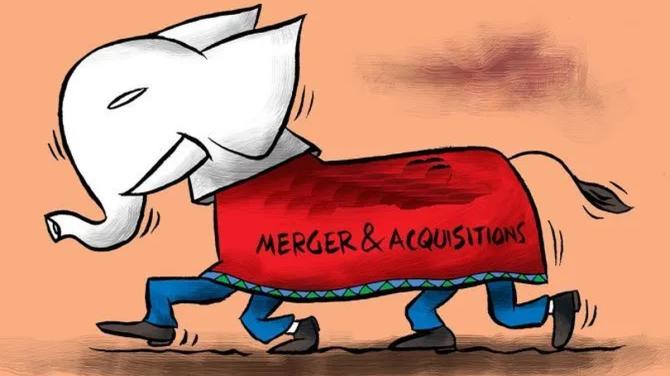
Core Viewpoint - The Reserve Bank of India's cautious proposals on M&A funding for banks aim to balance risk management with the growing opportunities in the M&A space, which is expected to exceed $100 billion annually in India [4][5][16]. Group 1: M&A Market Dynamics - Domestic banks are now entering the M&A advisory space, traditionally dominated by foreign banks and shadow banks, indicating a shift in the competitive landscape [4][5]. - The aggregate acquisition finance exposure for banks is capped at 10% of their Tier-I capital, and financing can only cover up to 70% of the acquisition value [5][6][14]. - The net worth of the banking sector was over ₹27 trillion, allowing for available funds exceeding $30 billion for M&A financing under the proposed regulations [16]. Group 2: Regulatory Framework - The draft regulations propose a fixed debt-to-equity (D/E) ratio of 3:1, which some industry experts argue may not adequately reflect sector-specific nuances [8][13]. - There is a call for more flexibility in underwriting judgments based on individual deal characteristics rather than strict regulatory limits [9][12]. - The proposed regulations signal a cautious approach from the RBI, reflecting concerns about market risks and the need for robust governance in M&A transactions [12][22]. Group 3: Industry Perspectives - Industry leaders express a desire for more liberal financing norms to facilitate M&A activities, while also acknowledging the need for improved governance and oversight within banks [22][23]. - The potential for partnerships between state-run banks and established financial institutions is highlighted as a way to enhance M&A capabilities [19][21]. - Compensation structures for M&A professionals are expected to be significant, reflecting the specialized nature of the business and the competitive landscape for talent [18][20].
A Marriott executive says the hotel chain is betting big on this market
Business Insider· 2025-11-26 00:08
Core Insights - Marriott International is planning to significantly expand its presence in India, aiming to double its footprint from 48 to 90 cities, reflecting the country's booming economy and tourism potential [1][3][11] Expansion Plans - The company has over 150 hotels in the pipeline in India, in addition to the 160 hotels currently in operation [2] - Marriott is focusing on both major metropolitan areas and tier two and three cities, with initiatives like "Series by Marriott" to add 115 properties [4] - The expansion is driven by improvements in India's infrastructure, including an increase in the number of airports from 50 to 150, with plans to add another 200 [5] Market Potential - India has a large, young, and affluent population, which is expected to drive domestic and international tourism [3] - The Indian travel market is projected to grow significantly, with McKinsey estimating that Indian tourists could make 80 million to 90 million trips annually by 2040, up from 13 million trips in 2022 [7] - Morgan Stanley forecasts that India's consumption of goods and services, including leisure and recreation, will double to $4.9 trillion by the end of the decade [8] Strategic Partnerships - Marriott is enhancing its partnerships with local entities, including launching a co-branded hotel credit card with HDFC Bank and a joint loyalty program with Flipkart [12] Comparative Market Insights - Marriott's strategy in India is informed by its experiences in China, with the company viewing India as being in a similar position to China 10 to 15 years ago [11] - Despite the focus on India, Marriott maintains its commitment to other Asian markets, including China, which remains a significant source market for travelers [10]


Attention pensioners! Submit life certificate by November 30 or miss pension payments
MINT· 2025-11-25 14:50
All pensioners in India need to annually submit their Life Certificate (LC) or Jeevan Pramaan Patra to pension disbursing agencies on or before the November 30 deadline in order to keep receiving their pension payments.Pension receiving central and state government employees can submit the document either in person at the relevant authorities or now have the option to submit a Digital LC within the deadline.With the deadline fast approaching and as the government has not announced an extension on the same, ...