Jones Lang LaSalle

Search documents
From software to real estate, US sectors gripped by AI scare trade
BusinessLine· 2026-02-13 18:10
Market Overview - Wall Street is experiencing significant disruption concerns due to AI, leading to a sell-off in various sectors, particularly software companies, which has resulted in sharp losses in U.S. stocks this week [1][2]. Software Sector - The S&P 500 Software & Services index has lost approximately $2 trillion in value since its peak in October, with half of this loss occurring in the past two weeks due to fears that AI could disrupt traditional subscription and enterprise tools [2]. - Notable declines in the Nasdaq 100 include Atlassian down 47%, Intuit down 40%, and Workday down 33% [4]. - The U.S. software sector is facing its worst drawdown in over three years, impacting alternative asset managers with exposure to software-related loans, with firms like Ares, Blackstone, and KKR seeing declines between 13% and 24% this year [5]. Financial Brokerage, Data Analytics & Legal Services - The financial industry, especially brokerages and data analytics firms, has been negatively affected after Altruist introduced AI-enabled tax planning features, raising fears about the viability of their business models [6]. - Shares of brokers such as LPL Financial and Charles Schwab fell over 7%, while S&P Global's shares dropped more than 25% in February, marking its worst month since 2009 [7]. Real Estate Services - Commercial real estate and investment managers have suffered as investors shift away from high-fee, labor-intensive business models perceived as vulnerable to AI disruption, with CBRE Group and Jones Lang LaSalle each dropping about 12% [8]. Insurance Sector - Insurance stocks have experienced a significant decline, with the S&P 500 insurance index falling 3.9% on a single day, its largest drop since mid-October, following the release of an AI-powered comparison tool by Insurify [10]. - Shares of Willis Towers Watson have decreased by 15% this week, while Aon and Arthur J. Gallagher fell by 9% and 15%, respectively [11]. Trucking & Logistics - The trucking and logistics sector saw unexpected declines, with stocks like Landstar System and C.H. Robinson dropping sharply after Algorhythm Holdings reported a significant increase in freight volumes without a corresponding rise in operational headcount [13].



Trucking and real estate stocks struggle to gain momentum in premarket after becoming latest victims of AI fears
CNBC· 2026-02-13 12:37
Logistics Sector - Logistics stocks experienced significant declines due to AI-related fears, particularly after the introduction of a new tool called SemiCab from Algorhythm Holdings, which is marketed as a leading transportation platform [2][3] - C.H. Robinson and RXO saw their stock prices drop by as much as 20% on Thursday, with C.H. Robinson rebounding slightly by 0.7% in premarket trading, while RXO continued to decline by 1.5% [2] - Expeditors International of Washington fell over 16% on Thursday but was trading flat in premarket, while J.B. Hunt Transportation Services lost an additional 0.6% after a 9% drop the previous day [3] Real Estate Sector - The commercial real estate sector faced a continued sell-off, with CBRE among the hardest hit, extending its losses with a 0.6% decline in premarket trading [4] - Jones Lang LaSalle and Hudson Pacific Properties also saw marginal declines, while SL Green Realty rebounded slightly by 0.4% after a 5% drop on Thursday [4] Software Sector - Software stocks were affected by the broader market sell-off, with Palantir Technologies down 1.5% and Autodesk and Salesforce both down 0.1% in premarket trading [5] - The iShares Expanded Tech-Software Sector ETF (IGV) lost around 3% on Thursday and is down approximately 23% year-to-date, indicating a bear market [6] - Notably, all "Magnificent Seven" tech stocks ended Thursday in negative territory, with Tesla leading the losses at 0.8% [6] Analyst Insights - UBS strategists noted that the recent developments validate AI's monetization potential and emphasize its transformative nature, suggesting that investors should diversify across sectors and geographies rather than focusing solely on the U.S. information technology sector [7] - Dan Ives from Wedbush Securities acknowledged that while some software companies may struggle due to AI advancements, the entire sector should not be discounted, highlighting that companies like Salesforce and ServiceNow will remain integral to the AI revolution [9][10]

AI担忧蔓延,商业地产股继续下挫,两天暴跌20%
Hua Er Jie Jian Wen· 2026-02-12 23:24
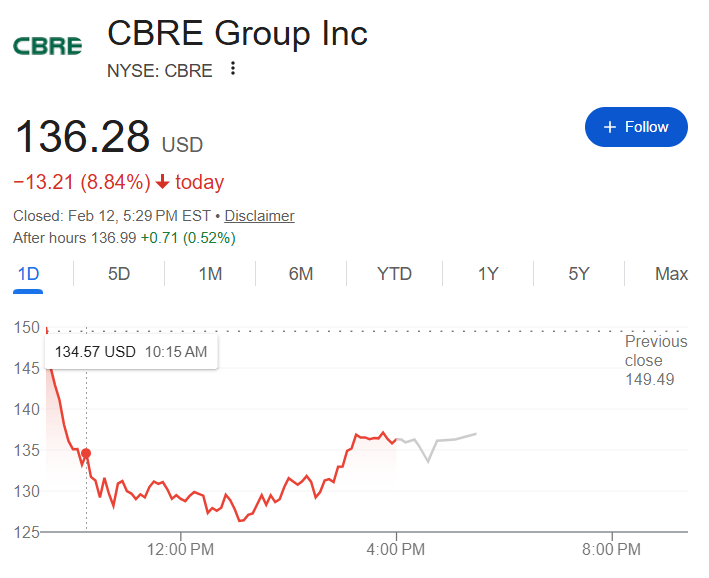
Group 1 - The commercial real estate sector experienced a significant decline, with investors concerned that the widespread application of artificial intelligence tools will reduce demand for office space [1][3] - CBRE Group fell by 8.8% on Thursday, marking a total decline of 20% over two days, the worst performance since 2020. Other major commercial real estate companies also suffered, with Jones Lang LaSalle down 7.6% and Cushman & Wakefield plummeting 12% [1] - The index tracking office real estate companies dropped by 4.2% on Thursday, with significant declines in stocks such as SL Green Realty, Cousins Properties, Kilroy Realty, and BXP [3] Group 2 - Investor fears regarding AI's disruption of business models intensified after the launch of new tools by startup Anthropic, leading to significant sell-offs across various sectors, including software manufacturers, private credit firms, insurance companies, wealth management institutions, real estate service companies, and logistics firms [4] - Analysts noted that the recent sell-offs reflect traders' knee-jerk reactions, potentially overestimating actual risks, indicating that the market is still in a phase of digesting the impact of AI [5] - The financial services sector is currently in a state of confusion, with investors reacting sharply to even minor earnings misses due to widespread concerns about AI's disruptive potential [4]
AI引发的资本市场大溃逃 美股商业地产遭遇“黑色星期四”
Di Yi Cai Jing· 2026-02-12 23:13
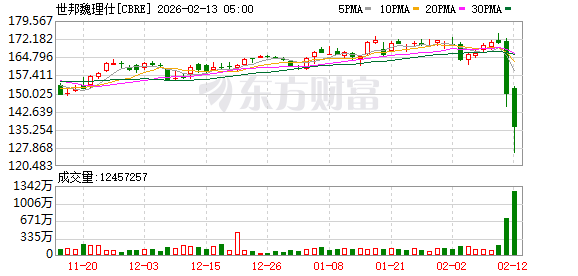
Core Viewpoint - The rise in the use of artificial intelligence tools is raising concerns about a potential decrease in demand for office space, leading to significant declines in commercial real estate stocks [2] Group 1: Stock Performance - Commercial real estate stocks experienced a sharp decline, with CBRE Group's stock plummeting by 15% at one point and a total drop of 26% over two days, marking the worst decline since the 2008 financial crisis [2] - Jones Lang LaSalle saw a decline of 14%, Cushman & Wakefield dropped by 13%, and Newmark Group fell by 11% [2] Group 2: Analyst Insights - Analyst Jeffrey Langbaum noted that concerns about AI applications reducing office space demand have been present for some time, but the recent sell-off has spread to actual office space providers [2] - Morningstar analyst Sean Dunlop commented on the financial services sector's current state, describing it as "shoot first, aim later," where investors react strongly to even minor performance declines due to fears of disruption from AI [2]
美股商业地产周四再次大跌
Jin Rong Jie· 2026-02-12 20:13
Group 1 - The commercial real estate stocks in the US experienced a significant decline on Thursday, with a sell-off that expanded from Wednesday [1] - CBRE Group's stock price plummeted by 15% at one point, with a cumulative drop of 26% over two days, marking the worst decline since the 2008 financial crisis [1] - Other major commercial real estate service companies also faced substantial losses, including Jones Lang LaSalle, which fell by 14%, Cushman & Wakefield by 13%, and Newmark Group by 11% [1]
JLL arranges $596M refinancing for The Crescent in Uptown Dallas
Prnewswire· 2026-02-12 18:00
Core Insights - JLL arranged a $596 million refinancing for The Crescent, a mixed-use property in Uptown Dallas, Texas [1] - The property spans 1.3 million square feet and includes trophy office space and luxury retail [1] - The refinancing was secured through a three-year, floating-rate CMBS loan from Goldman Sachs and J.P. Morgan [1] Property Overview - The Crescent consists of three office towers and an atrium building, totaling 1,206,239 square feet of office space and 167,510 square feet of retail [1] - The property has undergone significant renovations in the last five years and is surrounded by high-quality amenities [1] - It is 90% leased to prominent tenants including Jeffries, BankUnited, and Wells Fargo [1] Market Context - Uptown Dallas has become the highest performing submarket in the city, with a 57.1% rent growth since 2014 [1] - The area is characterized by its affluent neighborhoods and has seen a scarcity of Tier 1 office products [1] Company Background - Crescent Real Estate LLC manages over $10 billion in assets and operates across various real estate asset classes [1] - JLL is a leading global commercial real estate and investment management company with annual revenue of $23.4 billion [1]


“下一个AI受害者”出现了,房地产服务股遭抛售,创疫情以来最大单日跌幅
Hua Er Jie Jian Wen· 2026-02-11 23:06
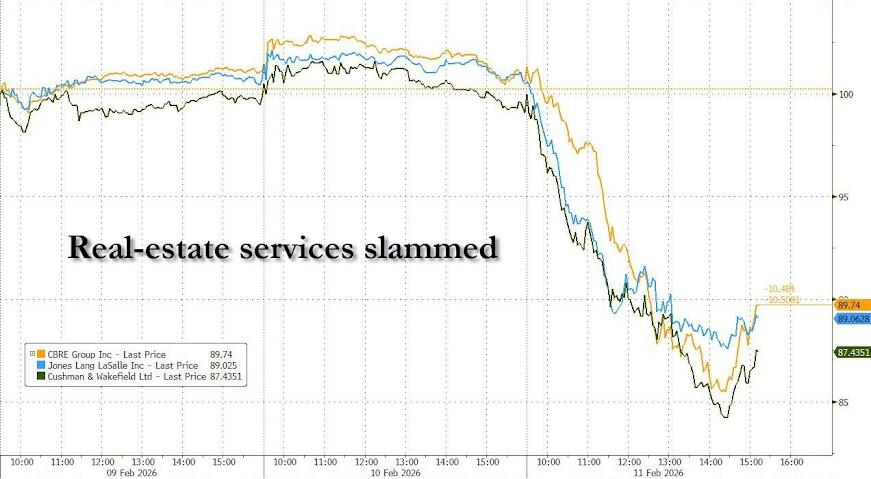
Core Viewpoint - The stock prices of real estate service companies have significantly declined as investors reassess the vulnerability of these firms to artificial intelligence applications and tools [1][3]. Group 1: Market Reaction - On Wednesday, CBRE Group and Jones Lang LaSalle saw their stock prices plummet by 12%, while Cushman & Wakefield dropped by 14%, marking the largest single-day declines since the market sell-off in 2020 [1]. - Analysts from Keefe, Bruyette & Woods noted that investors are withdrawing from high-fee, labor-intensive business models perceived as susceptible to AI-driven disruption [3]. - Barclays analyst Brendan Lynch described the stock price drop as "excessive," attributing part of the selling pressure to concerns over AI's potential disruption to the job market and commercial real estate demand [5]. Group 2: Industry Impact - The commercial real estate sector is facing additional challenges, having struggled to recover since the pandemic, with changes in office demand and high interest rates severely limiting transaction volumes [4]. - Despite the AI boom providing growth opportunities in certain segments, such as data centers and high-end office leasing, investors are weighing whether advancements in AI will ultimately pressure some business operations through automation and streamlined processes [4]. - CBRE and Jones Lang LaSalle have been attempting to mitigate the impact of market downturns by expanding their services into property management, valuation, and investment sales across various sectors, including hotels, warehousing, apartments, and life sciences laboratories [4]. Group 3: Long-term Perspectives - Analysts believe that the immediate concerns regarding AI's threat to leasing and capital markets are limited, as CBRE and its peers benefit from significant scale advantages, including data and industry relationships [6]. - While there is a consensus that the market's fears regarding immediate AI risks may be overstated, there remains a cautious outlook on the long-term implications of AI [6].
JLL appoints Mencía Barreiros as Head of Communications
Prnewswire· 2026-02-05 18:00
Core Insights - JLL has appointed MencÃa Barreiros as Head of Communications to lead its global communications strategy, effective immediately [1] - Barreiros will oversee the alignment of communications and marketing strategies across all markets to enhance JLL's global leadership position [1] Group 1: Appointment and Responsibilities - MencÃa Barreiros brings a decade of institutional knowledge at JLL and has held senior roles including Head of Marketing for EMEA and Spain [2] - Her strategic vision is expected to drive key marketing initiatives across JLL's diverse portfolio [2] Group 2: Strategic Vision and Goals - Barreiros aims to strengthen JLL's reputation worldwide and showcase the value created for clients through effective communication [3] - The company emphasizes its deep market expertise and global reach as key factors in supporting continued growth [3] Group 3: Company Overview - JLL is a leading global commercial real estate and investment management company with annual revenue of $23.4 billion and operations in over 80 countries [4] - The firm has over 113,000 employees and focuses on shaping the future of real estate for a better world [4]

JLL Income Property Trust Sells Washington DC Area Apartment Community
Prnewswire· 2026-02-04 17:00
Core Insights - JLL Income Property Trust has announced the sale of Kingston at McClean Crossing, a 319-unit apartment community in McClean, VA, for an undisclosed amount, aligning with its strategy of capital recycling and reinvestment into higher-performing properties [1][2]. Group 1: Company Strategy and Performance - The sale supports JLL Income Property Trust's long-term strategy of harvesting gains and reinvesting in property sectors that are better positioned for future returns [2]. - Over its 13-year history, the company has sold more than 50 properties totaling over $1.3 billion, maintaining a trading value within 1% of the most recent independent appraised value [3]. - The company aims to increase its capital available for new investments and redeploy into more core, stabilized assets during a new market cycle for real estate [3]. Group 2: Portfolio Composition - After the sale, JLL Income Property Trust's allocation to residential investments remains significant, with $2.5 billion in residential sector investments, which constitutes 38% of its total $6.9 billion diversified portfolio [4]. - The portfolio includes high-quality, income-producing residential, industrial, grocery-anchored retail, healthcare, and office properties located in the United States [5]. Group 3: Company Background - JLL Income Property Trust is an institutionally managed, daily NAV REIT with a growing portfolio of real estate investments, sponsored by a leading real estate services firm [5]. - LaSalle Investment Management, a subsidiary of JLL, manages $86.4 billion in assets globally, indicating the scale and reach of the investment management capabilities [6].

JLL Income Property Trust Announces Tax Treatment of 2025 Distributions
Prnewswire· 2026-01-29 17:00
Core Viewpoint - JLL Income Property Trust announced the income tax treatment of its distributions for the year 2025, highlighting that approximately 18% of distributions will be classified as non-dividend distributions or return of capital, while about 82% will qualify as tax-advantaged long-term capital gains [1][2]. Distribution Summary - The company has provided nine distribution increases over its 13-year history, maintaining a focus on maximizing tax efficiency for investors [2]. - For the year ended December 31, 2025, the total net distribution per share for Class A stockholders was $0.53147, with 81.8% classified as capital gain income and 18.2% as return of capital [2]. - Class M stockholders received a total net distribution per share of $0.59543, with similar classifications of 81.8% capital gain income and 18.2% return of capital [3]. - Class A-I stockholders had a total net distribution per share of $0.59525, maintaining the same distribution classification percentages [4]. - Class M-I stockholders received a total net distribution per share of $0.63000, with 81.8% as capital gain income and 18.2% as return of capital [6]. - Class I stockholders had a net distribution per share of $0.15750, with 81.8% classified as capital gain income [7]. - Class N stockholders received a total net distribution per share of $0.63000, with the same classification percentages [8]. - Class S stockholders had a net distribution per share of $0.14651, with 81.8% as capital gain income [10]. Company Overview - JLL Income Property Trust is an institutionally managed, daily NAV REIT with approximately $7 billion in portfolio equity and debt investments, focusing on a diversified portfolio of income-producing properties across various sectors [1][14].