
商业房地产

Search documents
施罗德:对内地和香港股市看法正面,看好医疗护理及贵金属板块
Xin Lang Cai Jing· 2026-02-26 13:33
Group 1 - The investment outlook for the mainland and Hong Kong stock markets is positive, supported by factors such as a weakening US dollar, declining interest rates in the mainland, and reasonable valuation levels [1] - The focus will be on companies with strong earnings performance, particularly in the healthcare and precious metals sectors [1] - Healthcare stocks are expected to benefit from ample liquidity and government support for innovative drugs, with a preference for industry leaders and companies with late-stage drug pipelines [1] Group 2 - Schroders has recently re-engaged in commercial property loans in Hong Kong, indicating that the commercial real estate market is in a bottoming process, dependent on the overall performance of the Hong Kong economy [1]
美股商业地产周四再次大跌
Jin Rong Jie· 2026-02-12 20:13
Group 1 - The commercial real estate stocks in the US experienced a significant decline on Thursday, with a sell-off that expanded from Wednesday [1] - CBRE Group's stock price plummeted by 15% at one point, with a cumulative drop of 26% over two days, marking the worst decline since the 2008 financial crisis [1] - Other major commercial real estate service companies also faced substantial losses, including Jones Lang LaSalle, which fell by 14%, Cushman & Wakefield by 13%, and Newmark Group by 11% [1]
华润置地20260210
2026-02-11 05:58
Summary of China Resources Land Conference Call Company Overview - **Company**: China Resources Land - **Industry**: Commercial Real Estate Key Points Industry and Company Insights - **Valuation Reassessment**: China Resources Land is experiencing a valuation reassessment in commercial real estate, driven by internal growth and external expansion, particularly in high-end luxury brands [2][4] - **Rental Growth Performance**: Historical data indicates that the same-store rental growth of China Resources Land has significantly outperformed the growth of social retail sales by 4.3% to 8% from 2017 to 2022 [2][4][6] - **Interest Rate Impact**: The decline in interest rates is expected to lower capitalization rates, enhancing the overall valuation of China Resources Land's real estate assets [2][4] Financial Performance and Valuation - **Market Capitalization**: The current market capitalization of China Resources Land is approximately RMB 200 billion, which is considered undervalued. The reasonable market cap range is estimated to be between RMB 230 billion and RMB 250 billion, with potential to exceed RMB 300 billion in three to five years [4][5][9] - **Development Business Potential**: If the real estate market rebounds, the development business could provide additional valuation growth, supporting the overall market cap increase [2][4] Operational Advantages - **Shopping Center Operations**: China Resources Land has demonstrated exceptional operational capabilities in shopping center management through strategic site selection, flexible adjustment strategies, and an efficient management team [2][6][7] - **Site Selection Advantage**: Early entry into core urban areas has allowed China Resources Land to secure prime locations, contributing to long-term stable development [6] - **High Adjustment Rates**: The company has achieved a high adjustment rate of over 30% in its Shenzhen shopping center, compared to the typical 10% to 15% in the industry, indicating strong adaptability to consumer trends [6][7] Valuation Multiples - **Undervalued Valuation Multiples**: The commercial real estate valuation multiples of China Resources Land are significantly lower compared to REITs and Hong Kong-listed Swire Properties, suggesting a substantial revaluation opportunity [2][8] - **EBITDA Valuation Comparison**: The EBITDA valuation for China Resources Land is estimated at 10-13 times, while comparable REITs have valuations around 25 times, indicating a clear undervaluation [8][9] Market Trends - **Real Estate Stock Performance**: Since January, the real estate sector has seen stock price increases due to liquidity easing and inflation expectations, with actual interest rates declining, which may stabilize and rebound housing prices [3][10] - **Future Monitoring**: Attention should be paid to policy implementations and asset price stability post the Chinese New Year, which could influence the direction of real estate stock performance [10][11]

每经热评丨商业用房首付比例降至30% 释放结构性去库存新信号
Xin Lang Cai Jing· 2026-01-18 13:19
Core Viewpoint - The People's Bank of China and the National Financial Regulatory Administration have announced a reduction in the minimum down payment ratio for commercial property loans to 30%, aiming to stimulate demand and alleviate inventory issues in the commercial real estate market [1][2]. Group 1: Policy Changes - The minimum down payment for commercial property loans has been adjusted from a previous range of 50% to 60% to a new minimum of 30%, which is expected to enhance liquidity in the commercial real estate sector [1][2]. - This policy extension to commercial properties follows a trend of focusing primarily on residential real estate in past regulatory measures, marking a significant shift in support for the commercial sector [1][2]. Group 2: Market Impact - The high down payment requirements had previously restricted market circulation, with some areas experiencing transaction volume declines of up to 90% due to stringent regulations [2]. - The reduction in down payment will lower the investment threshold, allowing for greater participation from small investors and startups, thereby injecting new vitality into the commercial market [3]. Group 3: Broader Economic Context - The down payment adjustment is part of a broader set of policies aimed at stabilizing the real estate market, including tax reductions on property sales and continued implementation of accommodative monetary policies [3][4]. - The current policy shift is not merely a relaxation of previous restrictions but is strategically focused on structural inventory reduction, signaling a new phase for the commercial real estate market [4].
房地产去库存再加速!买商业用房最低首付降至30%
Di Yi Cai Jing· 2026-01-17 10:53
Core Viewpoint - The People's Bank of China and the National Financial Regulatory Administration have announced a policy to lower the minimum down payment ratio for commercial property loans to no less than 30%, aiming to adapt to changes in the real estate market and support a new development model [1][5] Group 1: Policy Implementation - The policy allows provincial branches of the People's Bank of China and local regulatory agencies to set their own minimum down payment ratios based on local government requirements, following the principle of "differentiated measures" [1] - Prior to this policy, most cities had a minimum down payment requirement of around 50%, with some banks setting it as high as 60% or more [1][2] Group 2: Market Conditions - The commercial property market is facing high inventory levels and slow absorption rates, with office buildings and commercial properties accounting for 25.7% of the total unsold residential properties in China as of November 2025 [2] - The average absorption period for commercial properties is reported to be around 30 months, with some areas experiencing periods of 50 to 70 months [2] Group 3: Demand Dynamics - There is a rising interest from institutional and individual investors in commercial properties, particularly in long-term rental products such as serviced apartments [3] - In Shenzhen, the proportion of non-residential new home transactions reached 31.4% in 2025, indicating a growing preference for rental-oriented products [3] Group 4: Local Measures - Various cities have implemented localized measures to stimulate the commercial property market, including allowing the conversion of commercial properties to rental housing and providing purchase subsidies [4] - For example, Shanghai permits business buildings to be used for various functions, while Wuhan offers a 50% subsidy on deed tax for new commercial property purchases [4] Group 5: Strategic Shift - The shift in policy reflects a broader trend of extending support from residential to commercial and industrial real estate, embodying a "precise drip irrigation" approach to regulation [5] - Lowering financial barriers for commercial real estate is seen as a targeted easing measure to invigorate the market and support a stable transition to a new development model in the real estate sector [5]
商业用房首付比例降至30%,释放去库存新信号
Mei Ri Jing Ji Xin Wen· 2026-01-16 13:58
Core Viewpoint - The People's Bank of China announced a reduction in the minimum down payment ratio for commercial property loans to 30%, aiming to stimulate market demand and inject new liquidity into the commercial real estate sector [1][2]. Group 1: Policy Changes - The minimum down payment ratio for commercial properties, including shops, office buildings, hotels, and commercial complexes, has been unified and lowered from 50% to 30% [1]. - This policy shift is seen as a significant move to support the commercial real estate market, which has seen limited targeted support in recent years compared to residential properties [1][2]. Group 2: Market Impact - The reduction in down payment requirements is expected to release liquidity, making it easier for small investors and startups to enter the market. For instance, a commercial property priced at 2 million yuan will see the down payment drop from 1 million yuan to 600,000 yuan [2]. - The high inventory of commercial real estate projects has created pressure on the regional real estate market, and the new policy aims to address this issue by facilitating inventory reduction [2]. Group 3: Future Outlook - The current policy is part of a broader set of measures aimed at stabilizing the real estate market, including tax reductions for property sales and continued implementation of a moderately loose monetary policy [2]. - Investors are encouraged to view this policy not merely as a return to past conditions but as an opportunity to explore new avenues for investment and asset diversification in the commercial real estate sector [3].


首付比例下调至30%,商业用房拉开去库存大幕
21世纪经济报道· 2026-01-15 14:36
Core Viewpoint - The People's Bank of China has announced a significant policy change by lowering the minimum down payment ratio for commercial property loans to 30%, aimed at stimulating the commercial real estate market and reducing inventory levels [1]. Group 1: Policy Impact - The previous minimum down payment for commercial property loans was 50%, with some banks setting it as high as 60%, making this reduction a substantial easing of transaction barriers [1]. - The policy is expected to positively impact the inventory reduction of commercial properties, which include office buildings and retail spaces, as the current inventory is notably high [1]. Group 2: Market Conditions - As of November 2025, there is a total of approximately 200 million square meters of unsold commercial properties in China, comprising 52.34 million square meters of office space and 14 million square meters of commercial space [1]. - The high inventory levels are attributed to various factors, including prolonged sales cycles and declining property prices, which negatively affect overall property values and corporate cash flows [1]. Group 3: Future Expectations - The reduction in the down payment ratio is anticipated to invigorate the existing commercial property market and promote the development of affordable rental housing and long-term rental apartments [2]. - Financially, this move may also support the growth of Real Estate Investment Trusts (REITs) [2]. - More cities are expected to implement policies aimed at reducing commercial property inventory, with a focus on optimizing purchase restrictions to enhance transaction activity [3].

2026年香港核心街铺租金或涨5%至7%
Xin Lang Cai Jing· 2026-01-06 13:19
Group 1 - The core rental prices for Hong Kong's prime street shops are expected to increase by 5% to 7% in 2026, driven by improved retail leasing momentum and strong demand from tourism and dining sectors [1][2] - The vacancy rate in core retail areas has decreased by 2 percentage points to 5.8%, the lowest level since Q4 2019, contributing to a quarterly rental increase of 0.6% and an annual increase of 2.9% [1] - The total investment amount in Hong Kong's commercial real estate reached HKD 20.3 billion in Q4 2025, marking a 130% quarter-on-quarter increase and a total annual amount of HKD 44.5 billion, reflecting a slight annual increase of 3% [1] Group 2 - The commercial real estate investment market in Hong Kong is showing cautious optimism for 2025, with gradual improvement in market activity despite limited interest rate cuts and ongoing funding gaps [2] - Accommodation assets and corporate headquarters are expected to become focal points in 2026, with a moderate growth forecast of about 5% in investment amounts [2]

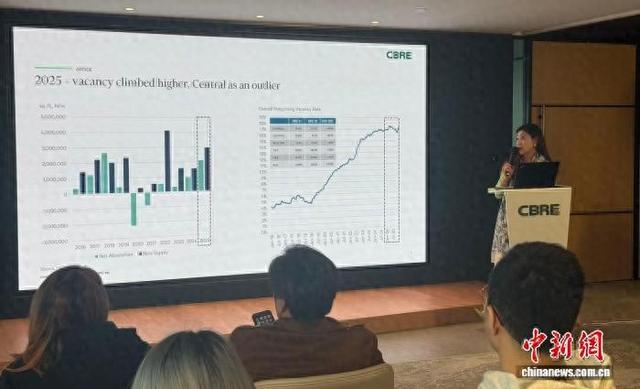
世邦魏理仕料今年香港办公室空置率续升至近18%
Xin Lang Cai Jing· 2026-01-06 08:06
Group 1: Office Market Outlook - The report by CBRE anticipates an improvement in market sentiment for Hong Kong's commercial real estate by 2026, with growth expected in core retail and office sectors as financing costs decrease, enhancing investor interest [1] - Office leasing momentum is expected to strengthen, driven by the continuation of Hong Kong's financial market dynamics into the new year, leading tenants to pursue "quality" relocation strategies [1] - Despite facing significant supply pressure in recent years, the office market has shown resilience, with leasing activity stabilizing since mid-last year, particularly due to strong demand from non-bank financial institutions and global investment firms [1] Group 2: Retail Market Outlook - The retail leasing market in Hong Kong remained active last year, primarily driven by a rebound in tourism and strong demand in the dining sector [2] - Core street shops and major shopping malls experienced active leasing, while neighborhood retail faced challenges from e-commerce and consumer downgrading [2] - For 2026, an increase in leasing speed is expected due to numerous leases signed in 2023 nearing expiration, with experiential concepts and collaboration between landlords and tenants being key to attracting local and tourist spending [2]
美联储威廉姆斯:未发现商业房地产领域存在“压力”环境。
Sou Hu Cai Jing· 2025-12-15 16:18
Core Viewpoint - The Federal Reserve's Williams stated that no "stress" environment has been identified in the commercial real estate sector [1] Group 1 - The Federal Reserve is monitoring the commercial real estate market closely [1] - Williams emphasized the resilience of the commercial real estate sector despite broader economic challenges [1] - There are no immediate concerns regarding defaults or significant downturns in commercial real estate [1]