
UBTECH

Search documents
中国电机供应商_宏观驱动的回调带来机遇;结构性催化因素依然存在China Electric Motor Suppliers_ Macro-driven pullback presents opportunity; structural catalysts remain intact
2025-10-23 13:28
Summary of Conference Call Notes Industry and Companies Involved - **Industry**: Electric Motor Suppliers in China - **Companies**: Johnson Electric and Wolong Electric Core Insights and Arguments - **Valuation-Driven Correction**: The recent share price correction for Johnson Electric and Wolong Electric is viewed as valuation-driven rather than based on the underlying investment thesis [2][8] - **Muted Earnings Expectations**: Anticipated muted earnings for 3Q25 for both companies, but the long-term structural drivers remain intact [2][8] - **Core Structural Drivers**: The three main structural drivers identified are: - AI Data Centers (AIDC) - Humanoid/Industrial Robotics - eVTOL (Electric Vertical Takeoff and Landing) and low-altitude economy [2][4] Key Developments - **AIDC Developments**: - Nvidia's Blackwell Ultra platform deployment is ramping up in October, with the first US-made Blackwell wafer unveiled on October 17 [4] - Alibaba announced a new green AI data center in Dubai expected to be operational by 2026, indicating global AI compute expansion [4] - **Robotics Sector Growth**: - Zhiyuan launched its Elf G2 and expects robotics revenue to grow more than tenfold YoY in 2025 [4] - Shanghai's AI terminal action plan prioritizes humanoid robots, benefiting companies like Shanghai Electric, a partner of Johnson [4] - UBTECH secured additional orders for its Walker S-series, reinforcing the acceleration of humanoid adoption [4] Policy and Market Indicators - **20th CCP Fourth Plenary Session**: Expected to reaffirm national strategic technologies, including AI industrialization and low-altitude economy ecosystems [2][8] - **eVTOL as a Strategic Priority**: The low-altitude economy and eVTOL are anticipated to be elevated as strategic national development priorities during the Fourth Plenary [8] Investment Outlook - **Investment Ratings**: - Johnson Electric is rated as Overweight (OW) due to its superior operating leverage in AIDC and humanoid robotics [8] - Wolong Electric is rated Neutral (N) as its structural story remains compelling, but near-term valuation is less favorable [8] - **Catalysts to Monitor**: Key catalysts include order wins, production ramp updates, and policy support that could influence the investment case for both companies [6][7] Additional Important Points - **Market Dynamics**: The report emphasizes that the recent pullback in stock prices is driven by macroeconomic factors rather than the companies' fundamental performance [8] - **Potential Risks**: Risks include faster-than-expected adoption of next-gen cooling technologies that could impact demand for existing products [7] This summary encapsulates the key points from the conference call, focusing on the industry context, company-specific developments, and investment outlook.
Meet the New "New Trio” ,China’s Answer to Tech Revolution丨CBN Perspective
2 1 Shi Ji Jing Ji Bao Dao· 2025-09-26 10:34
Core Insights - China's economy is transitioning to a new focus on artificial intelligence, robotics, and innovative pharmaceuticals, marking a significant shift in its industrial landscape [1][2][4] Industry Dynamics - Technology companies now represent over 25% of China's A-share market, with their market capitalization surpassing that of banking, non-bank financial, and real estate sectors, indicating a paradigm shift towards tech-driven growth [3] - The robotics sector is highlighted as a key area, with companies like Inovance Technology exceeding a market cap of 200 billion yuan and Sanxie Motor experiencing a 785% surge on its debut trading day [6] - In the AI sector, firms such as Cambricon and Foxconn Industrial Internet have market caps over 100 billion yuan, with record-high order books and profit margins in H1 2024 [7] - Innovative pharmaceuticals are also gaining traction, with Hengrui Pharmaceuticals nearing a 500 billion yuan market cap, while other companies like WuXi AppTec and Hansoh Pharma exceed 100 billion yuan [8] Global Positioning - China's robotics sector is moving from a "catch-up" phase to a leadership role globally, characterized by a complete industrial chain and the largest market, although it still relies on imports for high-end servo motors [9] - AI is in a catch-up phase overall but shows leadership in specific applications like computer vision and speech recognition, facing challenges in core chip production where NVIDIA holds 80% of the market [9] - The innovative pharmaceuticals sector is transitioning from following to catching up, with increased international recognition for R&D capabilities despite challenges in target discovery [9] Strategic Recommendations - To address existing bottlenecks, it is suggested to unlock cross-sector data, expedite approvals for life-saving technologies, and enhance computing infrastructure and talent training [10] - Implementing regulatory sandboxes is recommended to foster innovation while avoiding restrictive policies [10] - Engaging in global tech standard-setting is crucial for ensuring China's influence in the international arena [10] Investment Outlook - The shift to the new "new trio" reflects China's industrial upgrading logic, with leading enterprises and supportive policies indicating a strong investment climate [11] - For international investors, this represents a strategic opportunity for tech-driven expansion in China, leveraging its market size and robust industrial ecosystems [12]
人形机器人考察要点_市场展望、组件与具身人工智能-Humanoid Robot tour takeaways_ market outlook, components and embodied AI
2025-09-18 13:09
Summary of Conference Call Notes on Greater China Industrials (Humanoid Robots and Autonomous Driving) Industry Overview - The humanoid robot and autonomous driving (AD) sectors in China are expected to experience rapid expansion over the next decade, with significant growth anticipated in factory settings within 2-3 years and further opportunities in commercial and household applications in the long term [1][1] - The current bill of materials (BOM) cost for a fully-functional humanoid robot is approximately US$50-60k, with expectations for rapid cost reductions in the next five years due to improved product design and economies of scale [1][1] - Stricter regulations in the AD sector are anticipated to create more opportunities for AD components, particularly for LiDAR technology, which will benefit from new long-distance object detection requirements [1][1] Key Players and Developments Dobot - Dobot is a leading global collaborative robot (COBOT) brand, achieving a 47% year-over-year growth in 6-axis COBOT sales in the first half of 2025, indicating market share gains [8][8] - The company has entered the humanoid robot market, launching its first prototype in early 2025 and planning deployment in manufacturing and business scenarios [9][9] RoboSense - RoboSense is focusing on its new EMX LiDAR products, which offer superior precision and detection distance compared to competitors, with expectations to ship 600-700k units in 2025 and 1.5 million units in 2026 [10][10] - The company is also exploring opportunities in the lawn mower, unmanned delivery, and robotaxi industries, with significant partnerships established [11][11] Zhaowei Machinery & Electronics - Zhaowei has launched new dexterous hand models for humanoid robots and aims for a 10-15% global market share in this segment [12][12][13][13] - The BOM cost of the dexterous hand is estimated to account for 20-30% of the total BOM cost of a humanoid robot [13][13] Googol Technology - Googol Technology specializes in high-end control systems for advanced manufacturing and sees strong growth potential in humanoid robots due to its expertise in multi-degree-of-freedom (DoF) controlling [14][15] Minieye - Minieye is making progress with its smart driving solutions, including iPilot and iRobo, and anticipates significant growth in the penetration of front-view camera modules and driver monitoring systems due to new safety regulations [16][17] Leju Robotics - Leju targets to deliver over 1,000 units of robotics in 2025, focusing on stability and durability for large-scale applications [18][18] Orbbec - Orbbec is a leading player in robot vision systems, holding over 70% market share in 3D vision systems for service robots in China [21][21][22][22] UBTECH - UBTECH aims to ship 500 humanoid robots in 2025 and 2,000-3,000 units in 2026, with expectations for BOM cost reductions in the coming years [23][23][24][24] LK Tech - LK Tech is focusing on magnesium alloy technology for humanoid robots, which offers lightweighting and other advantages, and has signed cooperation agreements for R&D projects [25][26][26] Technology Insights - The competition between VLA (Vision-Language-Action) and world model technologies for embodied AI is highlighted, with data availability being a key bottleneck [3][3] - The vision system of humanoid robots is evolving, with depth cameras becoming the mainstream choice for enhancing sensing and navigation capabilities [22][22] Market Outlook - The humanoid robot market is expected to grow significantly, with projections of 3 million units shipped by 2030, leading to substantial opportunities for component suppliers [13][13] - The average selling price (ASP) of humanoid robots is expected to decline to approximately RMB150k (~US$20k) by 2026-2028 due to scale effects [20][20] Conclusion - The humanoid robot and AD sectors in Greater China are poised for significant growth, driven by technological advancements, regulatory changes, and increasing market demand. Key players are actively innovating and expanding their product offerings to capture market share in this rapidly evolving landscape.

Tesla Optimus rival Unitree shines at the 'World Humanoid Robot Games' in China
CNBC· 2025-08-18 19:16
Group 1 - The first "World Humanoid Robot Games" took place in Beijing, featuring 280 teams from 16 countries, including the U.S. [1] - The competition included various events such as dance battles, martial arts, track and field events (400-meter and 1500-meter races, long jump), and a soccer tournament [1] - Robots used in the competition were manufactured by Chinese companies like Unitree and Booster [1] Group 2 - Guo Tong, a programmer, expressed that robots have stronger joints and core strength, predicting they could replace human soccer stars by 2050 [2] - Unitree, based in Hangzhou, won multiple medals and is seen as a competitor to Tesla's Optimus [2] - Other notable companies included Beijing-based X-Humanoid and Hong Kong-listed Shenzhen firm UBTECH, which also performed impressively in the competition [2]



人形机器人-2025 年世界机器人大会收获:拥抱未来-Humanoids_ WRC 2025 Takeaways_ Embracing the Future
2025-08-14 02:44
Summary of the Conference Call on Humanoids Industry Industry Overview - The conference focused on the humanoid robotics industry, particularly highlighted at the World Robot Conference (WRC) 2025, showcasing rapid expansion and public interest in intelligent robots [1][4]. Key Insights - **Increased Public Engagement**: WRC 2025 saw significantly higher attendance compared to WRC 2024, with a notable presence of families, indicating a growing public interest in humanoid robots [4]. - **China's Leadership**: China's enthusiasm for humanoid robots is not limited to government officials but is widespread among the general public, which is crucial for the country's leadership in the humanoid ecosystem [4][9]. - **Market Sentiment**: The market sentiment for humanoid stocks is expected to remain strong, with potential increases of 2-5% by the end of WRC 2025, contingent on any major orders announced during the event [5]. Company Developments - **UBTECH**: Increased its 2025 delivery target to over 500 units from a previous range of 300-500 units, with a goal of 2,000-3,000 units in 2026 due to surging order volumes [10]. - **Galbot and Robotera**: Galbot targets 300-500 units, while Robotera aims for 100 robot units and 500-600 hands [10]. - **Linkerbot and OY Motion**: Linkerbot expects 5,000-10,000 shipments of dexterous hands this year, with a ten-fold increase projected for 2026; OY Motion anticipates 2,000-3,000 units in the second half of 2025 [10]. Technological Advancements - **Integration of Hardware and Software**: Companies are focusing on optimizing both hardware and software to enhance the intelligence level of humanoid robots, with full-stack players achieving better results through integrated systems [11]. - **Data Utilization**: The industry faces challenges in achieving generalization due to a lack of robot data, raising debates on the effectiveness of simulation versus real-world data [12][15]. - **Efficiency Improvements**: Observations at WRC indicated that humanoids still require significant time to perform tasks compared to humans, highlighting the need for efficiency enhancements [13]. Market Trends - **Adoption of Wheel-based Humanoids**: Wheel-based humanoids are expected to see earlier adoption in commercial services due to their simpler algorithms and better efficiency compared to bipedal robots [17]. - **Dexterous Hands**: The industry is shifting towards 5-finger dexterous hands, which are essential for humanoid capabilities, with expectations for increased adoption in the second half of 2025 [21][22]. - **Tactile Sensors**: Tactile sensors are becoming a standard feature in dexterous hands, accounting for 15-20% of their value, and are expected to see accelerated adoption [23]. Global Expansion - **Chinese Companies Going Global**: Several Chinese humanoid robot companies are strategically expanding into international markets, focusing on commercial services like retail, which offer easier scaling opportunities [26]. Conclusion - The humanoid robotics industry is experiencing significant growth, driven by public interest, technological advancements, and strategic company developments. China's position as a leader in this field is reinforced by widespread adoption and global expansion efforts by its companies.
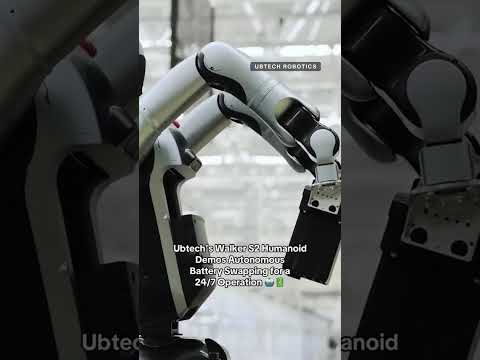
UBTECH's Humanoid Robot Can Swap Its Own Battery
CNET· 2025-07-28 13:22
Robotics Technology - UBtech's Walker S2 is claimed to be the first autonomous humanoid robot capable of changing its own battery [1] - Walker S2's hot-swap capabilities potentially allow for 24/7 operation without powering down [1] Company Focus - UBtech is a Chinese robotics manufacturer [1] Media & Engagement - CNET promotes its YouTube channel, browser extension, Amazon storefront, and various social media platforms [1]
人形机器人的前景:一场应用竞赛0Humanoids-Humanoid Horizons An Adoption Race
2025-07-25 07:15
Summary of Humanoid Industry Conference Call Industry Overview - The humanoid robotics industry is experiencing rapid development, particularly in China, which is heavily investing in humanoid technology through adoption, financing, and government support [2][7][46]. - Tesla's Optimus aims to ramp up production to 1 million units annually within five years, although scaled production may be delayed until next year [2][7]. Key Developments Adoption and Market Sentiment - China has made significant progress in humanoid orders, with notable contracts from Agibot (~US$11 million), Unitree (~US$6 million), and UBTech (~US$13 million), boosting market sentiment [7]. - The focus has shifted from expectations to actual adoption progress, with adoption expected to drive the market in the second half of 2025 [7]. Investment Trends - Major humanoid manufacturers in China have completed financing rounds recently, with Unitree starting its IPO process at a valuation of approximately US$1.7 billion [7]. - JD.com is actively investing in humanoid startups, indicating a trend of major tech firms entering the humanoid space [7]. Technological Advancements - Continuous updates in robot technology, including new features like autonomous battery swapping in UBTech's Walker S2, are expected to enhance capabilities [7][29]. - Tesla's Optimus Gen 3 is anticipated to achieve human-level agility, which could broaden task applications in both China and the US [7][29]. Performance Metrics - The Humanoid 100 index has increased by 11.1% since its inception, outperforming major indices like the S&P 500 and MSCI Europe, but underperforming MSCI China and Korea [7][58]. - Notable top performers in the Humanoid 100 include MP Materials (+149%) and JL Mag (+92%) [9][62]. Upcoming Events - Key events to watch include the World Robots Conference (August 8-12) and the World Humanoid Robot Games (August 15-17), which may drive positive sentiment in the humanoid market [8][12]. Government Support and Policy - The Chinese government is actively supporting the humanoid industry, with plans to deploy 10,000 to 20,000 humanoids by 2027 and various subsidies for R&D and adoption [46][49]. - Local governments are providing significant financial support, including dual-side subsidies for application providers and humanoid product providers [49]. Conclusion - The humanoid robotics industry is poised for growth driven by technological advancements, increased adoption, and substantial government support, particularly in China. The upcoming events and continued investment in the sector are expected to further enhance market dynamics and opportunities.
人形机器人 -2025 年下半年将由哪些因素驱动人形机器人行业发展?Humanoids-What Will Drive the Humanoid Sector in 2H25
2025-07-22 01:59
Summary of Humanoid Sector Conference Call Industry Overview - **Industry**: Humanoid Robotics Sector in Asia Pacific, particularly focusing on China - **Key Players**: Tesla, Figure, Unitree, Agibot, UBTECH, and various component suppliers Core Insights 1. **Market Dynamics Shift**: The humanoid sector experienced a strong stock rally from January to March 2025 (+37% in China's humanoid value chain) due to ambitious targets and government support, followed by a pullback (-6%) as integrators lowered their 2025 targets and no significant breakthroughs occurred [3][18][19] 2. **Adoption and Orders**: Initial adoption and orders are expected in 2H25, with integrators targeting hundreds to thousands of units. This is crucial for sector performance as robots are anticipated to expand their task applications in industrial and commercial services [4][22] 3. **Technological Innovations**: Continuous model launches and hardware/software innovations are expected to support sector performance. Key updates from integrators like Tesla and Figure could signal progress [5][8] 4. **Government Support**: The Chinese government is playing a critical role in promoting the humanoid sector, with policies aimed at deploying 10-20k units by 2027 and providing R&D subsidies [33][34][35] Important Developments 1. **Key Events to Watch**: Upcoming events include Tesla's 2Q earnings call (July 23), World AI Conference (July 26-28), and World Robots Conference (August 8-12) [8][14] 2. **New Integrator Models**: The humanoid value chain list has been updated to include 45 stocks, reflecting the latest progress in the industry. Six new companies have been added due to their cooperation with key humanoid firms or high-potential products [9][11] 3. **Commercial Orders**: Significant commercial orders have been announced, including a Rmb91 million order from UBTECH for automotive technology tasks and a Rmb124 million contract from China Mobile for Agibot and Unitree [27][28] Potential Risks 1. **Concerns Over Delays**: Delays in adoption could hamper stock performance, as the market has already priced in various catalysts. The humanoid value chain has underperformed compared to MSCI China [18][21] 2. **Data Bottlenecks**: Companies are still seeking innovations to improve the effectiveness of humanoid robots, as data remains a bottleneck for broader task applications [21][22] Future Outlook 1. **Focus on Adoption**: The focus in 2H25 will be on downstream adoption, with expectations for broader use cases in industrial and commercial services. The ability of integrators to meet market expectations will be closely monitored [22][23] 2. **Continuous Improvements**: The sector is expected to see continuous hardware breakthroughs and software innovations, which will be critical for enhancing humanoid capabilities [41][42] Conclusion The humanoid robotics sector is at a pivotal point, with significant potential for growth driven by technological advancements and government support. However, the realization of commercial value and successful adoption will be key to sustaining market momentum.
【Tesla每日快訊】 Optimus充電有多智能?與Figure、UBTECH的電池技術大對決!🔥Robotaxi/Cybercab(2025/7/18-2)
大鱼聊电动· 2025-07-18 10:09
Robot Battery Technology - Figure AI's F03 robot battery achieves a 78% cost reduction and a 94% increase in energy density, reaching 2300Wh, with 2kW fast charging and robust safety features [1] - UBTECH's Walker S2 robot features a 3-minute battery swap capability, enabling 24/7 operation with dual-battery balancing and standardized battery modules, suitable for continuous factory operations [1] - Tesla's Optimus robot uses a 2300Wh battery and autonomous navigation to charging stations, leveraging Tesla's AI and self-driving expertise, though specific charging details are not yet public [1] Tesla Production and Operations - Tesla is contacting US users who registered interest in Robotaxi to discuss vehicle upgrades, suggesting a private initiative to prepare for Robotaxi services, with newer vehicles like those equipped with AI 4 being more suitable [1] - Tesla patented a paint-free body panel manufacturing process (WO 2025/151308) using a special mold surface and high-gloss layer, reducing costs and VOC emissions, aligning with Tesla's unbox manufacturing process [1][2] - Tesla is collaborating with Australian and New Zealand authorities to launch FSD, starting with Hardware 4 (HW4) vehicles like some Model Y and Model S models, aiming for a full rollout by the end of 2025 [2] Vehicle Safety - Tesla vehicles have a fire incident rate of one per 130 million miles, which is eight times lower than the US average of one per 18 million miles, attributed to lithium-ion battery safety, advanced Battery Management System (BMS), and rigorous testing [2]

摩根士丹利:人形机器人-订单已公布;预计 2025 年下半年将有更多订单
摩根· 2025-07-15 01:58
Investment Rating - The industry investment rating is "In-Line" [6] Core Insights - The humanoid robot market is experiencing strong demand, with companies like UBTECH, Agibot, and Unitree announcing significant orders and contracts [2][3][8] - There is an expectation for more adoption announcements in the second half of 2025, driven by advancements in technology and a push from both companies and government for humanoid adoption [8] Summary by Relevant Sections - **UBTECH's Tiangong Walker**: Received orders for approximately 100 units and expects to deliver over 300 units in 2025, with over 60% of orders for premium versions [2] - **Agibot and Unitree Contract**: Awarded a Rmb124 million humanoid robot contract from China Mobile, with Agibot receiving Rmb78 million for full-size robots and Unitree Rmb46 million for smaller robots and accessories [3] - **Market Trends**: The focus is shifting from new model announcements to tracking adoption progress, indicating a maturation of the market and a potential for a virtuous cycle in humanoid technology [8]