上海交通大学医学院附属瑞金医院

Search documents
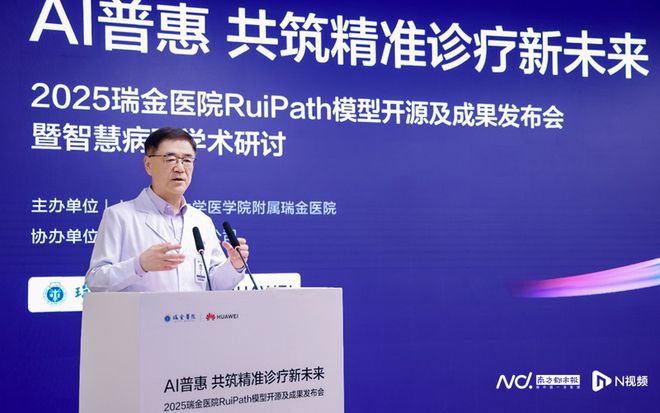
加速医疗AI普惠落地,瑞金医院联合华为开源病理大模型
Nan Fang Du Shi Bao· 2025-07-02 06:25
Core Insights - The RuiPath pathology model, co-developed by Ruijin Hospital and Huawei, aims to enhance the application of artificial intelligence (AI) in the medical field by providing an open-source core "visual foundation model" [1][2][4] - The model supports clinical applications across 19 common cancer types, covering approximately 90% of annual incidence rates in China, and facilitates hundreds of auxiliary diagnostic tasks [1][2] - The open-source initiative is expected to lower the deployment barriers for pathology AI, allowing grassroots hospitals to access clinical-grade model capabilities without extensive initial investments [2][5] Group 1: Model Development and Capabilities - The RuiPath model incorporates advanced features such as multi-modal pathology modeling, visual feature extraction, and deep sequence modeling, which are essential for comprehensive pathology diagnosis [1][4] - The model has achieved state-of-the-art (SOTA) performance in 7 out of 14 diagnostic tasks tested across 12 mainstream public datasets, demonstrating its clinical validation capabilities [1][5] Group 2: Collaboration and Implementation - The collaboration between Ruijin Hospital and Huawei has been ongoing for three years, focusing on end-to-end processes from data engineering to application engineering [5] - The use of Huawei's ModelEngine platform has streamlined the data annotation process, reducing the AI diagnostic application launch time from 10 days to 2 days [5] Group 3: Future Directions and Goals - The initiative aims to democratize AI capabilities in healthcare, with a focus on sharing high-quality medical resources and accelerating the clinical application of the RuiPath model [4][5] - Huawei plans to enhance the industry adoption of medical AI by standardizing data management, building shared data platforms, and exploring viable business models for AI in healthcare [4][5]

半年发5个大模型,大三甲医院有多怕被淘汰?
Hu Xiu· 2025-06-12 10:52
Core Viewpoint - The rapid adoption of artificial intelligence (AI) in China's top hospitals reflects a broader trend in the healthcare industry, driven by the need to enhance efficiency and maintain competitiveness in the face of technological advancements [2][3][4]. Group 1: AI Adoption in Hospitals - Beijing Union Medical College Hospital has launched multiple AI products, including the first rare disease model "Xiehe·Taichu" and various decision support systems for surgeries and critical care [2][3]. - Since the beginning of 2024, at least 60 vertical large models have been released by the top 100 hospitals in China, covering various medical fields and achieving several "national firsts" [3]. - Shanghai Ruijin Hospital has developed over 30 AI applications, completing 1.33 million AI-assisted diagnoses in the past year [3]. Group 2: Competitive Landscape - The competition among major hospitals is intensifying, particularly in specialized fields, as they seek to leverage AI for better patient outcomes and operational efficiency [4][5]. - Hospitals are increasingly forming collaborations with grassroots medical institutions to enhance early screening for diseases like Alzheimer's, indicating a shift towards integrated healthcare models [6][8]. Group 3: Challenges for Regional Hospitals - The rise of AI and advanced technologies is creating pressure on regional hospitals, which are facing consolidation and competition from both grassroots facilities and top-tier hospitals [10][13]. - There have been multiple mergers among regional hospitals in 2023, highlighting the ongoing challenges and the need for these institutions to adapt to the changing healthcare landscape [10]. - The increasing number of tertiary hospitals in China, which has grown by nearly 1.8 times since 2011, is contributing to the survival crisis for many regional hospitals [13][14]. Group 4: Future of Healthcare - The integration of IoT, sensing technologies, and AI is being referred to as the "third medical revolution," which is expected to redefine healthcare delivery and operational standards [11]. - A potential future model of healthcare may involve "distributed examination and centralized diagnosis," which could further impact the roles of various hospitals [13][14].
细菌巧造人工耳!马竞/张天宇团队突破耳廓畸形修复难题,利用细菌编织人工耳廓支架
生物世界· 2025-05-27 03:57
Core Viewpoint - The article discusses a breakthrough in reconstructive surgery for ear deformities, utilizing bacteria as a "biological 3D printer" to create customizable artificial ear scaffolds, potentially transforming clinical practices in auricular reconstruction [2][4]. Group 1: Challenges in Traditional Methods - Traditional ear reconstruction methods involve harvesting rib cartilage, which presents three main challenges: insufficient rib cartilage in children requiring multiple surgeries, the complexity of sculpting and stitching that relies heavily on the surgeon's skill, and the risk of postoperative complications such as infections and scaffold exposure [4][5]. - Existing artificial materials used as cartilage substitutes also face issues, including manual shaping and stitching, along with the risk of rejection [4]. Group 2: Innovative Approach - The research team focused on the bacterium Komagataeibacter xylinus, which can synthesize bacterial cellulose known for its high purity, nanoscale network structure, excellent biocompatibility, and functionalization properties [4][5]. - The bacteria exhibit an "oxygen navigation" feature, allowing them to gather in oxygen-rich areas and secrete nanofibers, which are utilized to create the ear scaffold [5]. Group 3: Key Innovations in Scaffold Production - The team designed a high-oxygen-permeable silicone mold to achieve three critical controls: precise molds created from 3D-printed ear models, dynamic oxygen supply to guide bacteria evenly throughout the scaffold, and nanometer-level precision in the cellulose fibers produced [5][7]. - The cellulose fibers have a diameter of 20-100 nanometers and form a cartilage-like network structure with mechanical strength comparable to real ear cartilage, with an elastic modulus ranging from 3.89 to 9.56 MPa [5][8]. Group 4: Performance and Clinical Implications - After 21 days of bacterial "biomanufacturing" and purification, the artificial ear scaffolds demonstrated remarkable characteristics: precise replication of ear structures, high tensile strength with no deformation after 50 days of immersion, long-term stability in the body, and extremely low endotoxin levels [8][9]. - The scaffolds show over 95% survival rates for cartilage and skin cells, allowing for rapid integration with surrounding tissues, indicating significant clinical application potential for personalized ear reconstruction [9]. Group 5: Broader Impact - This research marks the first application of microbial manufacturing technology in organ reconstruction, offering hope for patients with ear deformities and paving the way for future developments in complex tissue engineering, potentially extending to heart valves and vascular networks [9].

2025人工智能系列活动全景透视,慕尼黑上海电子展邀您共探未来!
半导体芯闻· 2025-03-27 10:11
Core Viewpoint - The recent launch of AI Agent product Manus has generated significant excitement in the tech industry, highlighting the potential for disruptive innovation across various sectors driven by AI technology [1] PART.01: AI Joint Exhibition Area - The 2025 Munich Shanghai Electronics Show will feature an AI Joint Exhibition Area, focusing on four key applications: smart driving, cloud computing and data centers, consumer electronics, and medical industry [2] PART.02: AI Technology Innovation Forum - An AI Technology Innovation Forum will be held during the exhibition, bringing together experts and industry representatives to discuss challenges and trends in next-generation AI chip architecture, data security, and the integration of AI with storage [4] Human-shaped Robot Exhibition Area - The exhibition will introduce a Human-shaped Robot Exhibition Area, showcasing the latest technologies and applications in humanoid robotics, providing a platform for industry innovation and commercialization [7] Human-shaped Robot Innovation Forum - A Human-shaped Robot Innovation Forum will take place, focusing on the latest humanoid robot technologies and their applications across various fields [12] Medical Electronics Innovation Forum - The International Medical Electronics Innovation Forum will explore breakthroughs and transformations in the medical electronics field, with discussions on AI applications in healthcare [24] Embedded Systems Innovation Forum - The International Embedded Systems Innovation Forum will feature discussions on new product designs and research achievements, emphasizing the role of AI in embedded systems [29] Event Schedule and Participation - The exhibition will host various thematic forums and activities, covering hot application markets such as electric vehicles, automotive electronics, humanoid robots, and AI technology [38]