
HDFC Bank

Search documents
Infosys, Paytm and BSE among key stocks bought and sold by mutual funds in August. Check full list
The Economic Times· 2025-09-15 06:22
Core Insights - Mutual funds have shown significant activity in various segments, with notable additions and reductions across large-cap, mid-cap, and small-cap stocks. Large-Cap Segment - Key additions by mutual funds included Eternal (Rs 7,200 crore), Infosys (Rs 5,000 crore), and HDFC Bank (Rs 3,100 crore) [6] - Major reductions were observed in Maruti Suzuki (Rs 3,100 crore), Avenue Super (Rs 2,900 crore), and NTPC (Rs 2,700 crore) [6] - Consistent additions over three months included State Bank of India, Bajaj Finance, Kotak Mahindra Bank, Axis Bank, and Titan Company, while reductions were seen in Coal India, Grasim Industries, TVS Motor Co, LTIMindtree, and Solar Industries [6] Mid-Cap Segment - Significant additions included Bank Of Maharashtra, Escorts Kubota, Blue Star, Gujarat Fluorochem, and Global Health, while key reductions were in ACC, Exide Industries, KPIT Tech, Metro Brands, and Gland Pharma [4][6] - Notable buying was seen in One 97, L&T Finance, Thermax, Tata Communications, and Coforge, with selling occurring in Exide Industries, Muthoot Finance, HDFC AMC, JK Cements, and LIC Housing Finance [6] Small-Cap Segment - Important additions by mutual funds included Bluestone Jewellery (Rs 4,000 crore), Medi Assist Health (Rs 3,000 crore), and Thirumalai Chem (Rs 2,000 crore) [5] - Key reductions were in Aditya Birla Fashion (Rs 4,000 crore), JK Tyre & Industries (Rs 1,000 crore), and Senco Gold (Rs 1,000 crore) [5] - New entries in the small-cap segment included Thirumalai Chemicals, Suven Life Sciences, PSP Projects, Foseco India, and Epack Durable, while exits included Thomas Cook, Sarda Energy, Faze Three, and Hindware Home Interiors [5] Overall Trends - The total cash and equivalents held by mutual funds decreased from Rs 1.85 lakh crore (5.46%) in July to Rs 1.76 lakh crore (5.23%) in August [6] - Significant buying was noted in Clean Science, Home First Finance, Syrma SGS Tech, Krishna Institute, and KFin Technologies, while the highest selling was in Hitachi Energy, BSE, PNB Housing, and Aditya Birla Fashion [5][6]



GST reforms set to reignite consumption growth, spur corporate profitability
The Economic Times· 2025-09-15 01:00
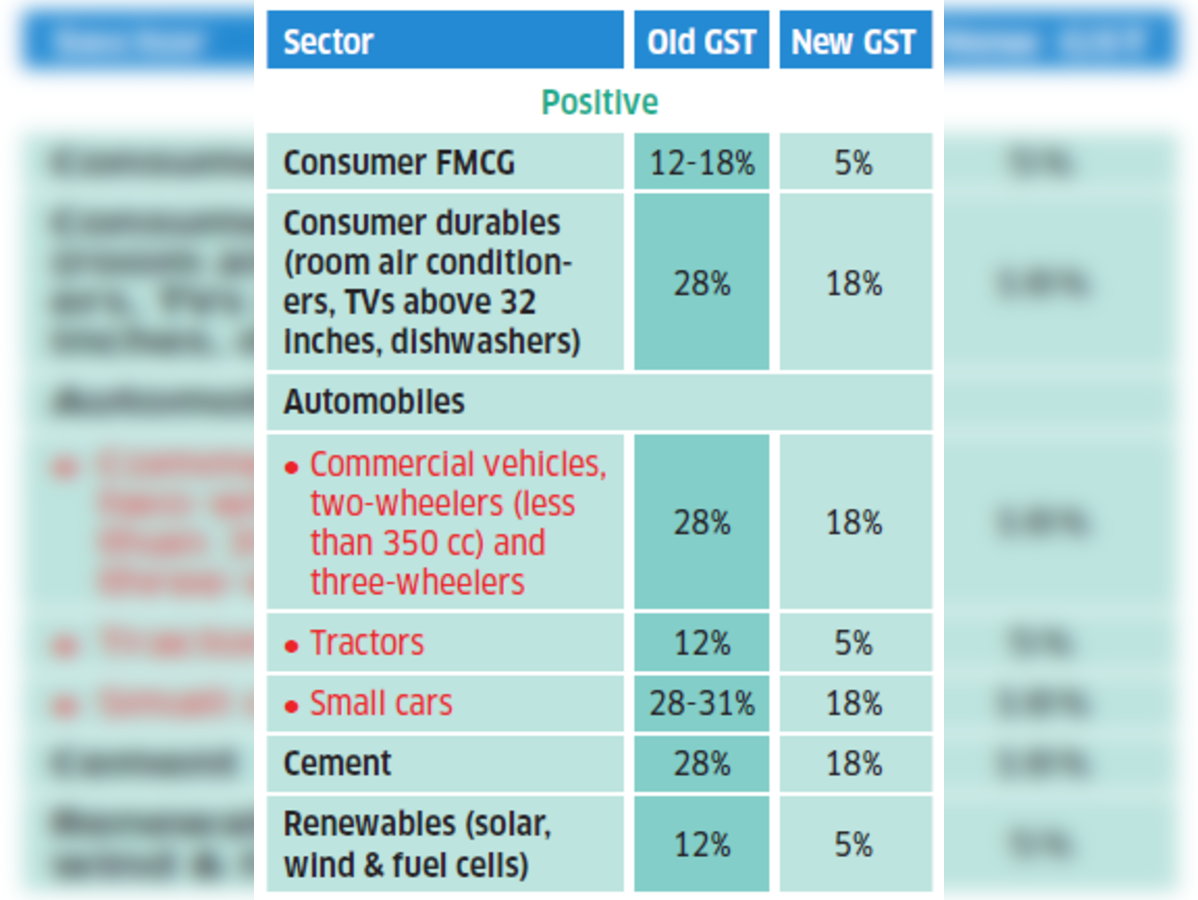
Consumption Sector - The recent GST reforms are expected to boost affordability and consumption across rural and urban markets, with around 90% of items moved from higher to lower tax slabs [1][38] - Experts anticipate a premiumisation effect among low- and middle-income households, as savings on essential goods will redirect purchasing power towards high-value consumption [2][38] - The consumption sector is projected to recover over the next 12-15 months, with private consumption growth expected to rise by 40-50 basis points in the second half of the current financial year [4][41] Corporate Profitability - Lower prices from GST reforms will create volume acceleration for producers, supporting profit margins and leading to an anticipated overall profitability increase of 1-1.5% relative to 2024-25 earnings [5][41] - The reforms are expected to stimulate demand for first-time buyers and replacement purchases, particularly during the festive season, with an industry expectation of a 10-15% improvement in demand for room air conditioners [22][41] Sector-Specific Impacts - Key beneficiaries in the consumer FMCG sector include Britannia Industries, Colgate Palmolive (India), Nestle India, and Emami due to reduced GST on essentials from 12-18% to 5% [11][15][41] - In the consumer durables sector, companies like LG, Daikin, Blue Star, and Dixon Technologies will benefit from reduced GST on room air conditioners and dishwashers from 28% to 18% [18][41] - The automobile sector, including Maruti Suzuki, TVS Motor, Hero MotoCorp, and Bajaj Auto, will see positive impacts from reduced GST rates on commercial vehicles and small cars [23][41] Infrastructure and Housing - The cement industry is expected to benefit from a reduction in GST from 28% to 9%, potentially lowering cement prices by Rs.25-30 per bag, which will support infrastructure and housing sectors [24][41] - Cost-efficient firms like Prism Johnson and Heidelberg Cement are positioned to enhance net realizations and margins over the medium to long term due to these reforms [25][41] Renewable Energy - The renewable energy sector will benefit from a reduction in GST on equipment from 12% to 5%, with key beneficiaries including Tata Power, JSW Energy, and Vikram Solar [26][41] - This reduction is expected to lower capital costs for solar and wind power projects, improving the internal rate of return and supporting government initiatives around renewable energy transition [31][41] Banking and Financial Services - Banks such as HDFC Bank, ICICI Bank, and IDFC First Bank are expected to benefit from increased demand for credit due to a pick-up in consumption and economic activities [32][41] - Non-Banking Financial Companies (NBFCs) focused on retail loans will also benefit from rising demand for consumer durables and vehicles [32][41] Insurance and Textiles - The insurance sector will face mixed impacts, with a reduction in GST on life and health insurance to nil, improving affordability but potentially diluting margins due to loss of input tax credit [33][41] - The textile industry will see a reduction in GST on fabrics and home textiles from 12% to 5%, benefiting companies like Sanathan Textiles and Grasim Industries [30][36][41] Oil and Gas - The oil exploration sector will be adversely impacted by an increase in GST from 12% to 18%, affecting companies like ONGC and Oil India [37][41] - The increase in costs for exploration and production is expected to dent cash flows significantly, with estimates of Rs.2,500-3,000 crore in losses for ONGC [40][41]

Inflation's ways give room for a rate cut, but RBI may not do it
The Economic Times· 2025-09-14 19:20
Group 1 - The Reserve Bank of India (RBI) has room to cut rates by 25-50 basis points due to a comfortable inflation trajectory, but is not expected to do so in the current cycle given strong Q1 GDP numbers and recent consumption boosts from GST cuts [1][6] - CPI-based inflation rose to 2.07% in August from July's eight-year-low of 1.61%, entering the RBI's medium-term target of 2-6% [1][6] - Economists expect inflation to ease further due to GST rate cuts effective from September 22, with CPI for FY26 likely lower than the RBI's estimate of 3.1% [6] Group 2 - Retail inflation for September is currently tracking at approximately 1.75%, with October potentially going below 1% due to GST cuts and base effects [6] - Growth momentum is expected to slow in H2 FY26 as support from transient factors wanes and the impact of tariffs becomes more visible [6] - There are downside risks to inflation that may leave scope for another repo rate cut in the October-December period, although this was priced out by the market after a strong GDP print [6]
Festive offers, tax cuts to fuel retail lending by banks
The Economic Times· 2025-09-14 19:15
Core Insights - The festive season in India is expected to drive consumer spending, with banks like Axis Bank and HDFC Bank launching special offers to capitalize on this trend [1][5][6] - The Reserve Bank of India (RBI) reported that overall bank credit growth is at 10%, down from 14% a year earlier, indicating a slowdown in major loan components [2][8] - Retail loans, which typically offer higher margins, are being targeted by banks to boost their asset base and mitigate earnings pressure during periods of reduced policy rates [8] Bank Initiatives - Axis Bank has partnered with leading brands to provide curated deals and discounts on credit cards, along with easy EMIs for large purchases [1][8] - HDFC Bank has introduced its annual 'Festive Treats' offers, collaborating with various brands across multiple sectors including apparel and travel [5][8] - ICICI Bank is set to launch its 'Festive Bonanza' offers, while Axis Bank will introduce special discounts and cashback offers aligned with GST cuts effective September 22 [6][8] Credit Growth Trends - Loan growth in agriculture and allied activities has decreased to 7% year-on-year, down from 17% a year ago, while industrial credit growth has fallen to 6% from 8% [7][8] - Mortgage growth has slowed to around 10% year-on-year in 2025, down from 18% previously, indicating a need for improvement in this segment to boost overall loan growth [9]
Yes Bank stake sale: SBI, private banks set to reap a big tax bonanza
The Economic Times· 2025-09-14 18:37
With all regulatory approvals in place, SMBC will conclude the deal to buy 20% stake through a secondary market transaction in this quarter. The selling banks will book proceeds as "other income". The Yes Bank Reconstruction Scheme, 2020 has a specific clause exempting banks that invested in the reconstruction from paying capital gains tax on profits from the sale of shares.Yes Bank and SMBC did not respond to ET's queries in this regard.The ₹13,483-crore ($1.6 billion) deal for 20% stake in the private ba ...
White-label ATM firm India1 Payments’ CEO steps away amid banktech foray
MINT· 2025-09-14 12:36
Core Insights - India1 Payments is transitioning leadership and pivoting towards digital services by launching a banking technology arm to counter sluggish ATM growth in India [1][12] - K. Srinivas, the long-time CEO, is stepping back from daily operations but will remain as executive vice-chairman to guide strategy [2][15] - The company operates over 15,000 ATMs, holding a 40% market share among white-label operators and 53% in transactions [4][5] Company Overview - India1 Payments is the largest white-label ATM operator in India, with a significant presence in semi-urban and rural areas [5][10] - The company was established through a partnership with ICICI Venture and has grown significantly since the Reserve Bank of India opened the white-label ATM space in 2013 [6][7] - In FY25, India1 reported revenues of ₹670 crore and profits of ₹35 crore, benefiting from recent policy changes regarding interchange fees [7][8] Market Dynamics - India has approximately 250,000 ATMs, with around 36,000 being white-label machines [5] - The company faces challenges as banks are reducing ATM deployments due to a shift towards digital payments, despite high cash circulation [11] - India1 aims to expand its ATM network to 20,000–25,000 ATMs in the next five years [9] New Initiatives - India1 is launching a fintech arm named Paysis, targeting smaller banks that lack the infrastructure for transaction processing [12][13] - Paysis is already servicing rural co-operative and small finance banks, managing switching and transaction services [14] - The company plans to sign up 200 co-operative banks in the next two years, capitalizing on the vast market of over 90,000 rural banks and co-operative credit institutions [15]
M-cap weekly gains: Eight of top-10 firms add Rs 1.69 lakh cr; Bajaj Finance leads rally as LIC, HUL lose value
The Times Of India· 2025-09-14 09:26
Group 1 - The BSE benchmark surged by 1,193.94 points or 1.47%, boosting the wealth of blue-chip companies [4][6] - The combined market valuation of eight of the ten most valued domestic firms increased by Rs 1,69,506.83 crore last week [6] - Bajaj Finance was the standout performer, with its valuation climbing by Rs 40,788.38 crore to Rs 6,24,239.65 crore [4][6] Group 2 - Infosys gained Rs 33,736.83 crore, bringing its market capitalization to Rs 6,33,773.30 crore [4][6] - Tata Consultancy Services added Rs 30,970.83 crore, pushing its valuation to Rs 11,33,926.72 crore [4][6] - Reliance Industries' market capitalization advanced by Rs 27,741.57 crore to Rs 18,87,509.28 crore, maintaining its position as the most valued firm [5][6] Group 3 - State Bank of India gained Rs 15,092.06 crore, reaching Rs 7,59,956.75 crore [4][6] - ICICI Bank rose by Rs 10,644.91 crore to Rs 10,12,362.33 crore [4][6] - HDFC Bank added Rs 6,141.63 crore to reach Rs 14,84,585.95 crore [4][6] Group 4 - Bharti Airtel's market capitalization rose by Rs 4,390.62 crore to Rs 10,85,737.87 crore [4][6] - Hindustan Unilever's valuation fell by Rs 12,429.34 crore to Rs 6,06,265.03 crore, making it one of the laggards [5][6] - LIC's valuation decreased by Rs 1,454.75 crore, slipping to Rs 5,53,152.67 crore [5][6]
Mcap of eight of top-10 most valued firms jumps by Rs 1.69 lakh cr; Bajaj Finance biggest gainer
BusinessLine· 2025-09-14 05:12
Group 1 - The combined market valuation of eight of the top-10 most valued firms increased by ₹169,506.83 million last week, driven by a positive trend at the Dalal Street, with Bajaj Finance being the largest gainer [1] - The BSE benchmark rose by 1,193.94 points or 1.47 percent during the same period [1] Group 2 - Bajaj Finance's market valuation increased by ₹40,788.38 million, reaching ₹624,239.65 million [2] - Infosys added ₹33,736.83 million to its valuation, totaling ₹633,773.30 million [2] - Tata Consultancy Services (TCS) saw a surge of ₹30,970.83 million, bringing its market capitalization to ₹1,133,926.72 million [2] - Reliance Industries' valuation rose by ₹27,741.57 million, reaching ₹1,887,509.28 million [2] - State Bank of India's market capitalization climbed by ₹15,092.06 million to ₹759,956.75 million [2] - ICICI Bank's valuation increased by ₹10,644.91 million, totaling ₹1,012,362.33 million [2] Group 3 - HDFC Bank's market capitalization edged higher by ₹6,141.63 million, reaching ₹1,484,585.95 million [3] - Bharti Airtel's valuation increased by ₹4,390.62 million, totaling ₹1,085,737.87 million [3] - Hindustan Unilever's valuation decreased by ₹12,429.34 million, bringing it down to ₹606,265.03 million [3] - Life Insurance Corporation of India's (LIC) market capitalization declined by ₹1,454.75 million, totaling ₹553,152.67 million [3] Group 4 - Reliance Industries remains the most valued firm, followed by HDFC Bank, TCS, Bharti Airtel, ICICI Bank, State Bank of India, Infosys, Bajaj Finance, Hindustan Unilever, and LIC [4]

Global ambition: India aims to place two PSBs among top 20 banks; ‘Viksit Bharat 2047’ drives long-term vision
The Times Of India· 2025-09-13 10:18
Group 1 - The Indian government aims to develop at least two public sector banks (PSBs) that rank among the top 20 global lenders by assets as part of its 'Viksit Bharat 2047' vision [4] - Currently, only State Bank of India (SBI) and HDFC Bank are in the top 100 global banks, ranked 43rd and 73rd respectively [4] - The financial performance of the 12 PSBs has improved significantly, with a cumulative net profit of Rs 1.78 lakh crore in FY25, a 26% increase from the previous year, and SBI contributing over 40% of this profit [4] Group 2 - Key discussions at the PSB conclave included strengthening corporate governance, enhancing customer experience, improving risk management, and utilizing artificial intelligence for modernization [4] - Gross non-performing assets (NPAs) have decreased to 2.58% as of March 2025, down from 9.11% in 2021 [4] - The conclave also focused on priority sector lending, particularly to agriculture and MSMEs, with non-food credit growth easing to 9.9% year-on-year in July 2025 [4] Group 3 - Discussions emphasized improving the CASA ratio, diversifying operations, and strengthening risk management to better absorb economic shocks [3] - Participants included key figures from the Department of Financial Services, SBI, Punjab National Bank, and the Reserve Bank of India [3] - The government underscored the importance of organic growth and operational autonomy for banks to achieve global scale, aiming for a significant international role by 2047 [3]
India aims for two PSBs on world top 20 list by 2047
The Economic Times· 2025-09-13 00:00
Group 1 - The PSB Manthan conclave focuses on strengthening corporate governance, enhancing customer experience, and modernizing public sector banks (PSBs) to improve global competitiveness, including the use of artificial intelligence [1][10] - The agenda includes preparing PSBs for future challenges, scaling them organically, and increasing resilience amid global uncertainties [2][10] - Key discussions involve improving the current account-savings account (CASA) ratio and boosting credit growth in priority sectors like agriculture and MSMEs [5][11] Group 2 - Credit growth has moderated, with non-food credit growth at 9.9% year-on-year in July 2025, down from 13.7%, and lending to large industries growing by less than 1% [6][11] - State-run lenders have improved financial performance, with gross NPAs reduced to 2.58% as of March 2025 from 9.11% in March 2021, and net profit increased to Rs 1.78 lakh crore from Rs 1.04 lakh crore during the same period [8][11] - The last PSB Manthan in 2022 led to a government directive for banks to create a three-year business strategy roadmap and enhance collaboration among banks [9][11] Group 3 - Under the EASErise reform agenda for FY26, PSBs will focus on strengthening risk-management systems, enhancing capacity to absorb economic shocks, and maintaining financial stability [10][11]