Oracle

Search documents
Doug Casey On The Death Of Privacy... And What Comes Next
ZeroHedge· 2026-01-09 00:45
Core Viewpoint - The article discusses the increasing limitations on cash transactions and the implications of Central Bank Digital Currencies (CBDCs) on personal freedom and privacy, suggesting that these developments represent a coordinated effort by governments to exert control over individuals [1][5][9]. Group 1: Cash and Personal Freedom - Cash is portrayed as a symbol of freedom, and its limitation by the state compromises personal freedom and privacy [4][17]. - The reduction of cash withdrawal limits and rampant currency debasement are highlighted as tactics to phase out cash [1]. Group 2: Central Bank Digital Currencies (CBDCs) - CBDCs are presented as a proposed solution to financial crises, but they are argued to be a significant problem that undermines privacy [5][9]. - The implementation of CBDCs would allow authorities to monitor all transactions, effectively eliminating privacy and enabling control over assets [6][7]. Group 3: Surveillance and Privacy - The article emphasizes the pervasive surveillance enabled by modern technology, likening it to the dystopian themes in George Orwell's "1984" [13][14]. - The loss of privacy is framed as a regression towards barbarism, with transparency being a euphemism for increased state control [17][21]. Group 4: Recommendations for Privacy Protection - To protect privacy, individuals are advised to limit their presence on social media platforms, as these make it easier for the state to exert control [22]. - The article suggests considering living in a country where one is not a citizen to enhance personal freedom, as citizens are viewed as subjects by their governments [24].



Britain’s biggest weapons maker surges after Trump military pledge
Yahoo Finance· 2026-01-08 17:12
Oil Market - Brent crude increased by 2% to $61.16 per barrel, while West Texas Intermediate (WTI) rose by 1.8% to $57.01 per barrel, following a decline in US crude oil stockpiles by 3.8 million barrels to 419.1 million barrels, contrary to analysts' expectations of a rise [1][7]. Retail Sector - Tesco's shares fell by 6.5% despite achieving a 10-year high in market share in the UK, while Associated British Foods, owner of Primark, saw a 13% decline in shares due to weaker-than-expected sales [2][3]. Defence Sector - BAE Systems' shares surged by up to 7% after President Trump announced plans to increase the US defence budget from $1 trillion to $1.5 trillion, adding over £4 billion to its market value [6][40]. - UK defence stocks, including Babcock and Rolls Royce, saw significant gains, with nearly £7 billion invested in early trading following Trump's military spending pledge [53][41]. - European defence stocks also rose, with notable increases in companies like Rheinmetall and Airbus, reflecting investor confidence in increased government spending on defence [40][55]. Economic Indicators - A major credit rating agency predicts the US Federal Reserve will lower interest rates two more times this year due to a slowdown in the jobs market, with expectations of a decrease from the current range of 3.75% to 3% [19]. - The US trade deficit fell to its lowest level since 2009, dropping 39% to $29.4 billion in October, attributed to a $11 billion decrease in imports [24][25].
Should You Hold Oracle Stock Despite Debt-Fueled AI Data Center Bet?
ZACKS· 2026-01-08 15:56
Core Insights - Oracle is pursuing an aggressive infrastructure expansion strategy to position itself at the forefront of the artificial intelligence revolution, which has raised concerns among investors regarding the timing of their investments [1] Financial Performance - Oracle reported fiscal second-quarter revenues of $16.1 billion, reflecting a 14% year-over-year growth, with cloud infrastructure revenues increasing by 68% to $4.1 billion [2] - Remaining performance obligations surged to $523 billion, with $68 billion in new commitments from major clients like Meta and NVIDIA, indicating strong enterprise demand for Oracle's cloud infrastructure [2] Capital Expenditure and Cash Flow - The company raised its fiscal 2026 capital expenditure guidance to approximately $50 billion, a $15 billion increase from previous expectations, more than double the $21.2 billion spent in fiscal 2025 [3] - Free cash flow turned negative at $10 billion in the fiscal second quarter due to accelerated data center capacity buildout [3] Strategic Developments - Oracle announced the availability of Oracle AI Database 26ai for on-premises Linux x86-64 platforms, expanding its AI-native database capabilities beyond cloud services [4] - A partnership with the U.S. Department of Energy was revealed, focusing on advancing AI and computing initiatives, including the Genesis Mission [5] - At the AWS re:Invent conference, Oracle announced native integration with AWS Key Management Service, enhancing security for its database services [6] Multicloud Strategy - Oracle's multicloud strategy is gaining traction, with 147 live customer-facing regions and plans for 64 additional regions, alongside the construction of 72 multicloud data centers within major cloud environments [7] - The multicloud database business grew by 817% in the fiscal second quarter, marking it as the fastest-growing segment of Oracle's portfolio [7] Future Guidance - For the fiscal third quarter, Oracle projects total revenue growth of 19% to 21% and non-GAAP earnings per share between $1.70 and $1.74, maintaining its full-year fiscal 2026 revenue expectation of $67 billion [10] - Management emphasized a commitment to maintaining an investment-grade debt rating and highlighted alternative financing options to reduce borrowing requirements [11] Valuation and Competitive Landscape - Oracle trades at a trailing 12-month Price-to-earnings ratio of 33.95, slightly above the industry average of 33.5, indicating relatively expensive valuation metrics [13] - Over the past six months, Oracle shares have declined by 18.2%, underperforming the broader Computer and Technology sector [16] - The competitive environment remains intense, with Oracle competing against major players like Microsoft, Google, and Amazon, each focusing on different aspects of cloud infrastructure and AI capabilities [17]

AMD's "AI Everywhere, for Everyone" Push: Is the Stock Ready to Rally?
ZACKS· 2026-01-07 17:26
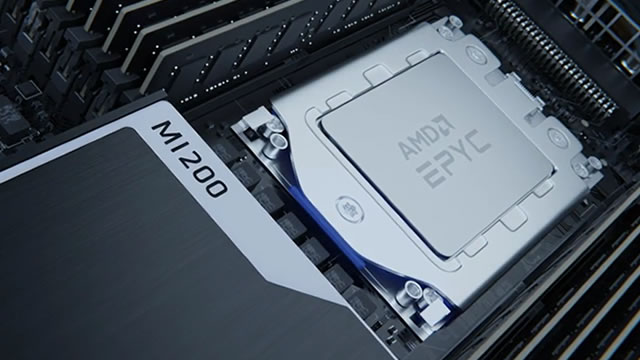
Core Insights - Advanced Micro Devices (AMD) has introduced its "AI Everywhere, for Everyone" strategy at CES 2026, featuring the Helios rack-scale platform, Instinct MI400 series, and Ryzen AI 400 and AI PRO 400 Series processors aimed at enhancing its presence in AI-powered data centers, high-performance computing, and AI PCs amid competition from NVIDIA, Broadcom, and Intel [1][6][10] AMD's Stock Performance - AMD shares have increased by 75.8% over the past year, outperforming the Zacks Computer and Technology sector's 25.3% return, while also surpassing Broadcom and NVIDIA, which returned 50.2% and 34% respectively; however, Intel outperformed AMD with a 101.1% increase [2] Expanding AI Portfolio - CEO Lisa Su emphasized the rapid shift towards "yotta-scale computing," with global compute capacity expected to grow from approximately 100 zettaflops to over 10 yottaflops within five years [6][8] - The Helios platform can deliver up to 3 AI exaflops per rack, optimized for training trillion-parameter models, and includes Instinct MI455X accelerators and EPYC "Venice" CPUs [7][8] - The MI440X and MI430X GPUs are designed for enterprise AI and supercomputers, respectively, with the next-gen Instinct MI500 GPUs set to launch in 2027, promising a performance increase of up to 1,000 times compared to the MI300X [9] Data Center Market Potential - AMD anticipates the data center total addressable market to reach $1 trillion by 2030, indicating a compound annual growth rate (CAGR) of over 40% from an estimated $200 billion in 2025; data center AI revenues are expected to grow at a CAGR of over 80% in the next 3-5 years [11] - The company expects overall data center business revenues and total revenues to see CAGRs of more than 60% and greater than 35%, respectively, over the same period [11] Strategic Partnerships and Adoption - Oracle Cloud Infrastructure plans to launch the first publicly available AI supercluster using AMD's Helios design, with the MI350 series gaining traction among neocloud providers [12] - New partners like Character.AI and Luma AI are utilizing the MI300 Series for production workloads, and OpenAI has selected AMD to build 6 gigawatts of next-generation AI computing capacity [12] Earnings Estimates - The Zacks Consensus Estimate for AMD's 2026 revenues is $43.05 billion, reflecting a 26.9% growth from the 2025 estimate of $33.94 billion [13] - The consensus estimate for 2026 earnings is $6.26 per share, indicating a 58% growth from the 2025 estimate of $3.96 per share [14] Valuation Concerns - AMD's stock is currently considered overvalued, with a Value Score of F, and is trading at a forward 12-month price/sales ratio of 8.05X compared to the sector's 7.42X [15] Conclusion - AMD's expanding AI portfolio and data center footprint are expected to enhance top-line growth, but near-term prospects are modest due to strong competition from NVIDIA in the cloud data center and AI chip markets, along with concerns regarding stretched valuation [18]

Oracle Stock Just Made A Death Cross — Should Ken Fisher Be Worried?
Benzinga· 2026-01-07 17:19
Core Viewpoint - Oracle Corp's stock has recently printed a death cross, indicating a potential decline in momentum, with shares currently trading around $193, down significantly from a 52-week high of $345 [1][6]. Technical Analysis - The stock is trading below its eight-day and 20-day simple moving averages (SMAs), with the 50-day and 200-day SMAs positioned at $215.84 and $216.02 respectively, indicating overhead resistance [2]. - The MACD indicator shows a negative value of -6.03, suggesting increasing downside pressure, while the RSI is near 42, indicating that the stock has not yet reached oversold conditions [3]. Hedge Fund Activity - Ken Fisher's Fisher Asset Management holds approximately 9 million shares of Oracle, with an average buy price around $56, resulting in substantial gains despite the recent stock decline [4]. - Other hedge funds, such as AQR and Coatue, have increased their positions in Oracle during the third quarter at prices closer to current levels, which may be testing their patience as the stock trades below key trend lines [5]. Market Sentiment - Despite Oracle's strong position in the enterprise software sector, the current technical indicators are raising caution for short-term investors, suggesting that the timing is unfavorable for bullish positions [6][7].

Oracle's Secret Weapon Against AI Customer Risk Has a Fatal Flaw
The Motley Fool· 2026-01-07 10:15
Core Viewpoint - Oracle is rapidly expanding its AI infrastructure capabilities through significant contracts, particularly with OpenAI, which has led to a substantial increase in its remaining performance obligations (RPO) to $523 billion [1][2]. Group 1: AI Infrastructure and Customer Contracts - Oracle has over 700 AI customers, with OpenAI being a major contributor to its RPO growth, attributed to a $300 billion cloud infrastructure deal [2]. - The company can quickly reallocate AI computing capacity between customers, taking only a few hours to do so, which minimizes customer concentration risk [5][7]. - Oracle's ability to shift capacity allows it to maintain high utilization rates, crucial for its gross margin, as downtime would negatively impact profitability [8]. Group 2: Market Risks and Future Outlook - While current demand for AI infrastructure exceeds supply, there is a potential risk of oversupply in the future, which could pose significant challenges for Oracle if a major customer fails to pay [9][10]. - Major tech companies are independently building substantial AI capacity based on optimistic demand forecasts, leading to concerns about future market saturation [11]. - Oracle's reliance on OpenAI for fulfilling its commitments raises concerns about financial stability in an oversupply scenario, which could become a significant risk in the coming years [12][13].
Oracle's AI Hangover Highlights the Risk of Chasing Late Cycle Tech Winners
247Wallst· 2026-01-06 11:20
Core Insights - Oracle has experienced a significant decline in market perception, shifting from a favored stock to one that is viewed with disappointment within a few months [1] Financial Performance - The company's recent earnings report showed a revenue increase of 18% year-over-year, reaching $12.5 billion, but this was below market expectations [1] - Oracle's cloud services revenue grew by 30%, totaling $3.5 billion, indicating strong demand in this segment [1] Market Reaction - Following the earnings report, Oracle's stock price dropped by 10%, reflecting investor concerns over growth sustainability and competitive pressures [1] - Analysts have expressed mixed sentiments, with some highlighting the potential for recovery while others remain cautious about future performance [1] Competitive Landscape - Oracle faces increasing competition from other cloud service providers, which has raised questions about its market share and growth trajectory [1] - The company is investing heavily in artificial intelligence and cloud infrastructure to maintain its competitive edge [1]

Oracle shares suffer on OpenAI concerns, But UBS sees 2026 upside
Proactiveinvestors NA· 2026-01-05 18:34
Company Overview - Proactive is a financial news publisher that provides fast, accessible, informative, and actionable business and finance news content to a global investment audience [2] - The company has a team of experienced and qualified news journalists who produce independent content [2] Market Focus - Proactive specializes in medium and small-cap markets while also covering blue-chip companies, commodities, and broader investment stories [3] - The news team delivers insights across various sectors including biotech and pharma, mining and natural resources, battery metals, oil and gas, crypto, and emerging digital and EV technologies [3] Technology Adoption - Proactive is recognized for its forward-looking approach and enthusiastic adoption of technology to enhance workflows [4] - The company utilizes automation and software tools, including generative AI, while ensuring that all content is edited and authored by humans [5]

Oracle vs. Palantir: Wall Street Is Neutral on One of These AI Stocks but Expects the Other to Surge
The Motley Fool· 2026-01-05 00:40
Core Insights - The artificial intelligence sector is currently the hottest market segment, with Oracle and Palantir being closely monitored stocks within this space [2][3] Palantir - Palantir has seen remarkable stock performance, with a 147% increase over the past year and a staggering 1,920% rise since its IPO in October 2020 [5] - The company utilizes AI to analyze data from various sources, identifying trends and recommending actions, making it appealing to both government and business sectors [6] - Despite strong fundamentals, Palantir's stock trades at 256 times forward earnings, leading to concerns about overvaluation among analysts; currently, 3 analysts recommend buying, 11 suggest holding, and 2 recommend selling [8][9] Oracle - Oracle reported $455 billion in remaining performance obligations (RPOs) due to AI data center demand, which initially led to a nearly 40% stock price surge [10] - However, concerns arose regarding the debt required for data center expansion and the thin margins in this business, leading to a decline in investor confidence [11][12] - Despite these challenges, Oracle's stock is up approximately 18% over the past year, and analysts remain optimistic, with 24 out of 34 recommending a buy and an average 12-month price target suggesting a 60% upside [15][16]


Is Oracle Stock Really Capable of Surging to $400? Or is That a Pipe Dream?
247Wallst· 2026-01-03 16:21
Core Viewpoint - Oracle shares finished 2025 with respectable, market-beating gains, up around 17%, outperforming the S&P 500 by close to a full percentage point [1] Summary by Relevant Categories - **Company Performance** - Oracle's stock increased by approximately 17% in 2025 [1] - The performance surpassed the S&P 500 index by nearly one percentage point [1]