ITC

Search documents
Stock markets bounce back on buying in metal, bank stocks; optimism over India-EU FTA
The Hindu· 2026-01-27 11:18
Equity benchmark indices Sensex and Nifty ended higher in highly volatile trade on Tuesday (January 27, 2026), buoyed by heavy buying in bank and metal stocks, a firm trend in global markets and optimism over India-EU FTA.The 30-share BSE Sensex climbed 319.78 points, or 0.39%, to settle at 81,857.48. During the day, it hit a high of 82,084.92 and a low of 81,088.59.The 50-share NSE Nifty surged 126.75 points or 0.51% to end at 25,175.40.From the 30-Sensex firms, Adani Ports, Axis Bank, Tata Steel, Tech Ma ...


Stock markets fall for second day as selling in Reliance Industries, HDFC Bank dents sentiment
The Hindu· 2026-01-06 12:04
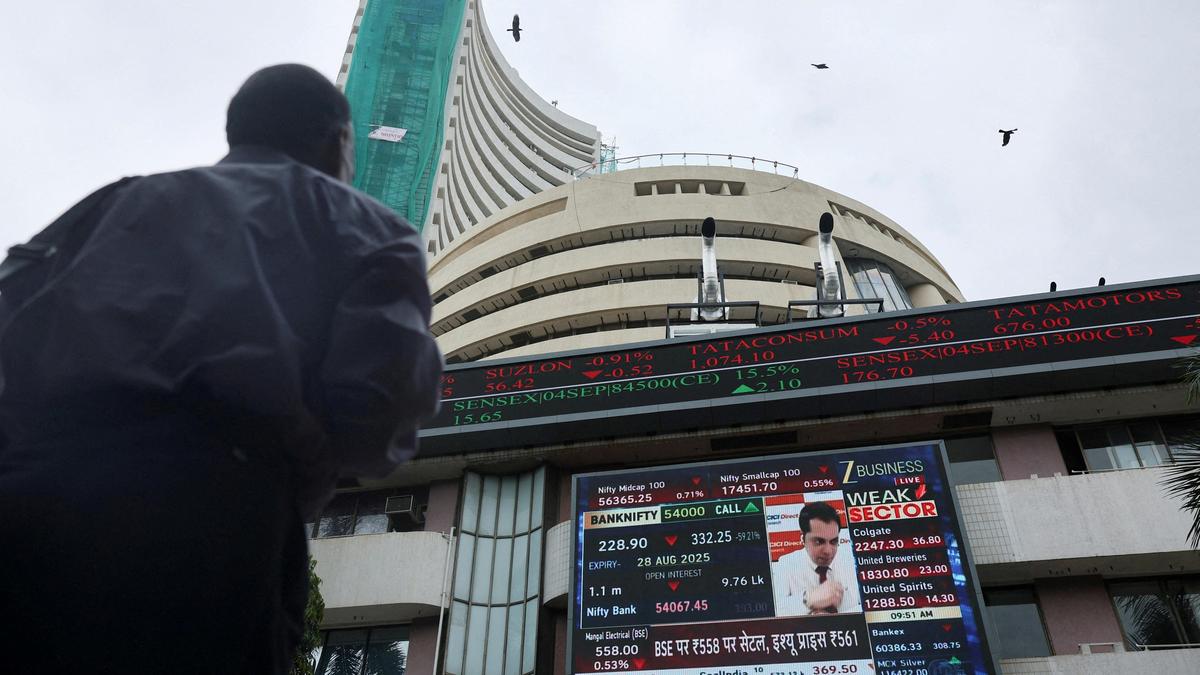
Market Performance - Benchmark indices Sensex and Nifty ended lower for the second consecutive day, with Sensex dropping 376.28 points (0.445%) to settle at 85,063.34 and Nifty declining 71.60 points (0.275%) to end at 26,178.70 [1][2] - Heavy selling was observed in blue-chip stocks such as Reliance Industries, which fell 4.42%, and HDFC Bank, contributing to the overall market decline [1][2] Sector Performance - The services sector growth in India moderated in December, with the HSBC India Services PMI Business Activity Index falling from 59.8 in November to 58.0 in December, indicating the slowest rate of expansion since January [4][5] - Despite the slowdown, firms remained optimistic about growth prospects, although overall sentiment reached its lowest level in nearly three-and-a-half years [5] Institutional Activity - Foreign institutional investors sold equities worth ₹36.25 crore on January 5, 2026, while domestic institutional investors purchased stocks worth ₹1,764.07 crore [3] Global Context - U.S. President Donald Trump indicated potential tariff increases on India due to dissatisfaction with India's purchases of Russian oil, which may impact market sentiment [3][4] - In contrast, Asian markets showed positive performance, with indices such as South Korea's Kospi and Japan's Nikkei 225 ending significantly higher [6]
Sensex down 376 points on selling in RIL, HDFC Bank
Rediff· 2026-01-06 10:56
Market Performance - Benchmark indices Sensex and Nifty ended lower for the second consecutive day, influenced by heavy selling in blue-chip stocks such as Reliance Industries and HDFC Bank, alongside concerns over potential tariff increases from the US against India [1][4] - The 30-share BSE Sensex dropped by 376.28 points, or 0.44%, closing at 85,063.34, with an intraday low of 84,900.10, down 539.52 points or 0.63% [3] - The 50-share NSE Nifty declined by 71.60 points, or 0.27%, ending at 26,178.70 [3] Company-Specific Movements - Trent's shares fell by 8.62% after disappointing revenue growth in the December quarter [3] - Reliance Industries saw a decline of 4.42%, with other laggards including ITC, Kotak Mahindra Bank, InterGlobe Aviation, and HDFC Bank [4] - In contrast, ICICI Bank, Sun Pharma, Hindustan Unilever, and State Bank of India were among the gainers [4] Institutional Investment Trends - Foreign institutional investors sold equities worth ₹36.25 crore on Monday, following a brief pause in selling [4] - Domestic institutional investors, however, purchased stocks worth ₹1,764.07 crore [4] Economic Indicators - India's services sector growth moderated in December, with the HSBC India Services PMI Business Activity Index falling from 59.8 in November to 58.0 in December, marking the slowest expansion rate in 11 months [6] - Despite the slowdown, firms remained optimistic about growth prospects, although overall sentiment reached its lowest level in nearly three-and-a-half years [7]
Q3 credit growth signals economic pickup, still prefer larger banks like Axis, Kotak, ICICI, SBI: Sandip Sabharwal
The Economic Times· 2026-01-06 08:32
Economic Outlook - Double-digit loan growth across most large banks indicates rising economic activity after a prolonged phase of single-digit growth, suggesting an economic pickup [1][13] - System-wide gross NPAs have fallen to multi-year lows, strengthening the investment case for large banks [5][13] Banking Sector - Axis Bank and Kotak Mahindra Bank reported strong Q3 updates, while HDFC Bank showed stable but unspectacular growth; Axis is considered attractive from a valuation standpoint [2][13] - Preference remains with large banks over smaller lenders due to historical asset-quality risks associated with aggressive lending by smaller institutions [6][13] - Preferred banking holdings include ICICI Bank, Axis Bank, State Bank of India, and IDFC First Bank, which may benefit from lower interest rates [13] Consumption and Retail - Caution is advised on high-valuation retail stocks, with expectations for Trent being high, making sustained 20%+ growth difficult [7][13] - FMCG companies like Marico and Britannia have performed well during the consumption slowdown, while stocks such as Dabur and Godrej Consumer Products could emerge as strong performers in the next one to two years [8][13] FMCG Sector - ITC faces challenges due to a sharp excise duty hike on cigarettes, which could hurt volumes and presents risks from illicit cigarette inflows; its non-tobacco FMCG business has yet to achieve meaningful profitability [9][13] Power Sector - Preference is for transmission, transformer, and power equipment companies over pure financiers or generators due to long-term risks in solar project financing [10][11][13] Automotive Sector - Market leaders in the automotive sector continue to outperform, making turnaround bets less attractive; Mahindra & Mahindra is highlighted as a strong position [12][14] - Commercial vehicles are seen as having better prospects than passenger vehicles within Tata Motors [14] Staples Sector - A gradual recovery in staples is expected after two to three years of weak demand, with potential for double-digit returns if consumer demand picks up and inflation eases [12][14]

“最受伤”的行业?印度香烟加税,烟草巨头一天暴跌近10%!
Sou Hu Cai Jing· 2026-01-04 07:13
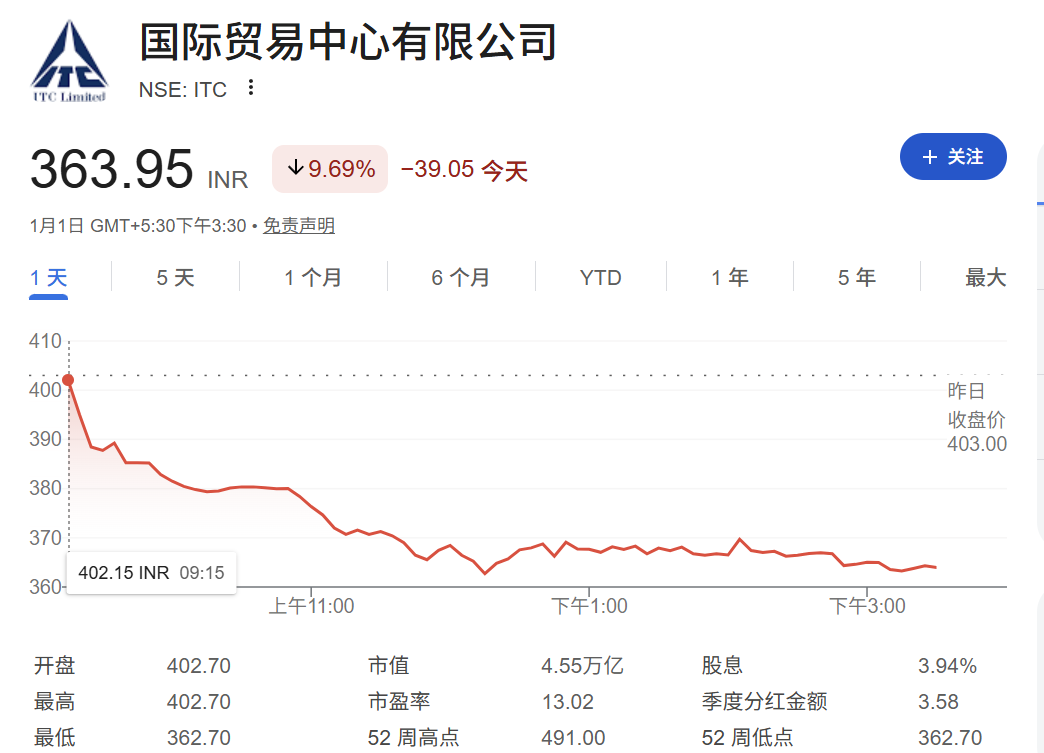
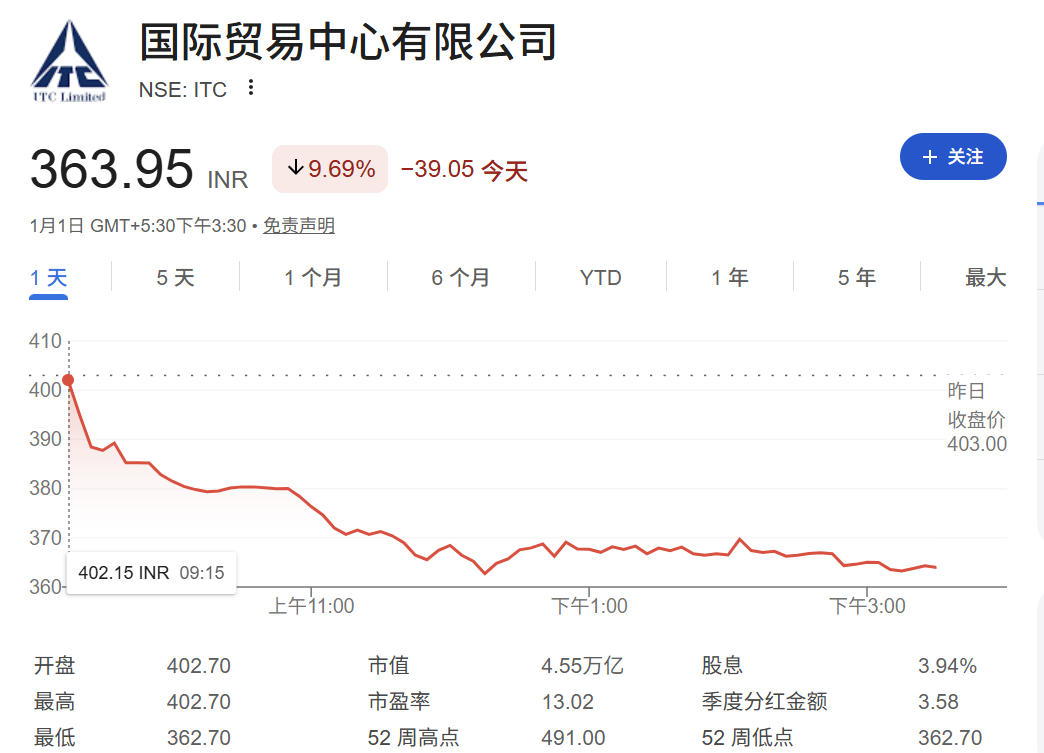
Core Viewpoint - The Indian government's decision to impose a new consumption tax on cigarettes has led to significant market reactions, particularly affecting major tobacco companies' stock prices [1][3]. Group 1: Market Reaction - On January 4, 2026, stocks of major tobacco companies in India experienced massive sell-offs, with ITC's stock price plummeting by 9.2% to 365.50 rupees, marking its lowest level since April 2023 and the worst single-day performance in nearly six years [1]. - The stock of Godfrey Phillips, the distributor of Marlboro in India, fell by 14.1%, representing the largest decline since November 2016 [1]. - ITC emerged as the biggest drag on the benchmark Nifty 50 index [1]. Group 2: Tax Details and Implications - The Indian Ministry of Finance announced on December 31 that a new consumption tax on cigarettes will take effect on February 1, 2026, with rates ranging from 2,050 to 8,500 rupees per 1,000 cigarettes, depending on the length of the cigarettes [3]. - This new tax is an addition to the existing 40% Goods and Services Tax [3]. - Analysts predict that manufacturers may pass on some of the costs to consumers, estimating that the overall cost of cigarettes measuring 75 to 85 millimeters could increase by 22% to 28%, with prices potentially rising by 2 to 3 rupees per cigarette [3]. Group 3: Industry Concerns - Analysts from firms like Jefferies view the tax as having a "clearly negative impact," warning that price increases may affect cigarette sales and raise concerns about the growth of the illegal cigarette market [3]. - The Indian government has been consistently increasing taxes and implementing graphic health warnings to curb tobacco consumption and alleviate public health burdens [3]. - The recent tax hike has severely impacted tobacco stocks and reflects deep market concerns regarding future industry demand and profitability [3].

Nifty hits record intra-day high; Sensex jumps 573 points
Rediff· 2026-01-02 11:14
Market Performance - The Nifty equity benchmark index reached its all-time high before closing 182 points higher, while the BSE Sensex increased by 573 points, driven by strong buying in power, banking, and metal stocks [1][3] - The BSE Sensex climbed 573.41 points or 0.67% to settle at 85,762.01, with an intraday high of 85,812.27, marking a jump of 623.67 points or 0.73% [3][4] - The NSE Nifty rose by 182 points or 0.70% to 26,328.55, with a peak of 26,340 during the day, reflecting a surge of 193.45 points or 0.73% [4] Sector Performance - Major gainers among the 30-Sensex firms included NTPC, Trent, Bajaj Finance, Power Grid, Maruti, State Bank of India, ICICI Bank, and Bharat Electronics [4] - Conversely, laggards in the market included ITC, Kotak Mahindra Bank, Titan Company, Axis Bank, and Bharti Airtel [4] Investor Activity - Domestic Institutional Investors (DIIs) purchased stocks worth ₹1,525.89 crore, while Foreign Institutional Investors (FIIs) sold equities worth ₹3,268.60 crore [5] - The strong capital infusion by domestic institutional investors contributed to the positive trend in the domestic stock market [3] Global Market Influence - Asian markets showed a positive trend, with South Korea's Kospi index and Hong Kong's Hang Seng index ending significantly higher, while China's Shanghai index and Japan's Nikkei were closed for a holiday [5] - Brent crude oil prices decreased by 0.36% to $60.63 per barrel, which may influence market sentiment [5]
Sensex jumps over 350 pts, Nifty above 26,250 as earnings buzz builds
The Economic Times· 2026-01-02 04:03
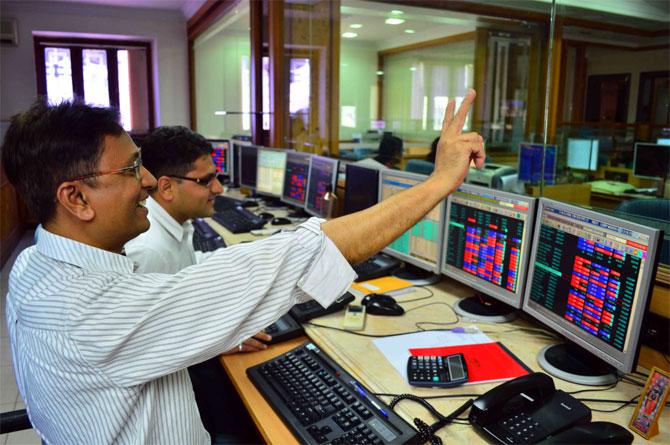
Market Overview - The BSE Sensex rose over 400 points, trading above 85,600, while the NSE Nifty50 added 100 points, trading above 26,250, nearing its previous all-time high of 26,325 [12] - Broader market sentiment was mildly positive, with small-cap stocks up 0.2% and mid-cap shares advancing 0.4% [3][12] Auto Industry - The auto sector index rose 0.8%, driven by gains of about 2% in Hero MotoCorp and TVS Motor, following a 25.8% year-on-year increase in passenger vehicle sales in December [4][12] - Dr. VK Vijayakumar, Chief Investment Strategist at Geojit Investments, emphasized the importance of sustaining growth momentum in the economy for earnings growth [4] Consumer Goods - ITC shares slid 5%, extending a selloff after a 10% drop in the previous session due to brokerage downgrades and pressure from the government's cigarette tax increase, impacting the fast-moving consumer goods index, which fell 1.4% [12] Institutional Investment - Foreign Institutional Investors (FIIs) sold equities worth nearly Rs 3,269 crore on January 1, while Domestic Institutional Investors (DIIs) were net buyers of Rs 1,526 crore [5][12] Global Market Trends - Stocks opened 2026 on a firmer footing, with MSCI's Asia-Pacific index excluding Japan rising 0.66% and Hong Kong's Hang Seng Index climbing 1.24% [8] - Precious metals continued their strong performance, with spot gold rising 0.9% to $4,351.70 an ounce and silver jumping 2% to $72.63 [7][8] Oil Market - Oil prices inched higher, with Brent crude futures rising 14 cents to $60.99 a barrel and U.S. West Texas Intermediate crude gaining 14 cents to $57.56 a barrel, following geopolitical risks resurfacing [9][12] Currency Movements - The Indian rupee edged up 6 paise to 89.92 against the U.S. dollar, reflecting a cautious investor stance at the start of the New Year [10][12]
印度政府对香烟征收新税,相关个股暴跌
Zhong Guo Ji Jin Bao· 2026-01-01 23:17
Group 1 - The Indian tobacco stocks experienced a sudden drop due to the government's announcement of a new tax on cigarettes, which is expected to increase the cost of smoking for approximately 100 million smokers in the country [1][4] - ITC, a leading player in the industry, saw its stock price decline by 9.7%, while Godfrey Phillips India, responsible for distributing "Marlboro," plummeted by 17% [1][4] - The new excise duty will be imposed based on cigarette length, with tax rates ranging from 2,050 to 8,500 rupees (approximately 22.82 to 94.60 USD) per 1,000 cigarettes, effective from February 1 [4][5] Group 2 - Analysts view the tax increase as "clearly negative," predicting it will impact sales and raise concerns about market share shifting to illegal channels [4][5] - The tax burden is expected to raise overall costs by 22% to 28% for cigarettes longer than 75mm, which account for about 16% of ITC's sales, potentially leading to a price increase of 2 to 3 rupees per cigarette [4][5] - The new tax will be added on top of the existing 40% Goods and Services Tax (GST), which is also set to take effect on February 1 [5][6] Group 3 - The increase in tax burden is higher than previously anticipated by analysts and investors, leading to increased uncertainty and pressure on stock prices [5] - ITC's cigarette business contributes over 40% of its revenue, and the company may need to raise prices by at least 15% to offset the impact of the new tax [5] - The Indian government aims to keep cigarettes "sufficiently expensive" as a means to curb usage and alleviate pressure on the public health system [6]
印度烟草新政打击市场 行业巨头股价遭重创
Xin Lang Cai Jing· 2026-01-01 16:39
Core Viewpoint - The Indian tobacco stocks experienced a sudden decline due to the government's announcement of new taxes on cigarettes, which is expected to significantly increase the consumption costs for approximately 100 million smokers nationwide [1] Group 1: Market Impact - Industry giant ITC's stock price fell by 9.7% following the tax announcement [1] - Godfrey Phillips India, responsible for distributing "Marlboro" in India, saw a dramatic drop of 17% in its stock price [1] Group 2: Tax Details - The Indian Ministry of Finance announced that starting February 1, a differentiated consumption tax will be imposed based on cigarette length, with tax amounts set between 2,050 to 8,500 rupees per thousand cigarettes [1] Group 3: Analyst Sentiment - Analysts generally view this tax increase as bearish for the industry, as it may directly suppress cigarette sales and raise concerns about a shift from legal to illegal consumption channels [1] - The tax burden is perceived to be higher than previously anticipated by analysts and investors, leading to increased uncertainty and pressure on related stocks [1]
突发黑天鹅,闪崩暴跌!
Zhong Guo Ji Jin Bao· 2026-01-01 16:14
Core Viewpoint - The Indian government has announced a new tax on cigarettes, leading to a significant drop in tobacco stocks, with major companies like ITC and Godfrey Phillips India experiencing sharp declines in their stock prices due to increased costs for consumers [1][4]. Group 1: Tax Impact - The new excise duty on cigarettes will be imposed based on the length of the cigarettes, ranging from 2050 to 8500 rupees (approximately 22.82 to 94.60 USD) per 1000 cigarettes, effective from February 1 [4]. - Analysts predict that this tax increase could lead to a 22% to 28% rise in overall costs for cigarettes measuring 75 to 85 millimeters, potentially resulting in a price increase of 2 to 3 rupees per cigarette [4][5]. - The new tax will be added on top of the existing 40% Goods and Services Tax (GST), further increasing the financial burden on consumers [5]. Group 2: Market Reaction - ITC's stock was the largest decliner in the Nifty 50 index, contributing to a 3.2% drop in the fast-moving consumer goods index [4]. - The uncertainty surrounding the tax's impact has led to increased pressure on stock prices, with analysts noting that ITC may need to raise prices by at least 15% to offset the tax burden [5]. - The tobacco industry in India, which has over 253 million users, is facing challenges as the government aims to curb tobacco consumption through higher taxes and other regulatory measures [5][6]. Group 3: Government's Rationale - The Indian Finance Ministry stated that maintaining a high tax framework on cigarettes is one of the most effective ways to reduce usage and alleviate pressure on the public health system [6]. - The government believes that increasing taxes on such products will not promote smuggling or the expansion of the gray market [6].