PTC Inc.

Search documents
Cadence Expands Digital Twin Platform With NVIDIA DGX SuperPOD Model
ZACKS· 2025-09-10 16:06
Core Insights - Cadence Design Systems, Inc. (CDNS) has expanded its Cadence Reality Digital Twin Platform by adding a digital twin of NVIDIA DGX SuperPOD with DGX GB200 systems, enhancing capabilities for AI factory development [1][4][5] Group 1: Digital Twin Platform Features - The Digital Twin platform allows designers to create high-fidelity digital twins by dragging and dropping vendor-provided models, enabling precise design of data centers [2][3] - The platform includes over 14,000 items from more than 750 vendors, ensuring comprehensive coverage of data center components [3] Group 2: Collaboration and Market Demand - The expansion signifies ongoing collaboration between Cadence and NVIDIA, aimed at improving AI factory design and operations [4] - Cadence is experiencing rising demand for its AI-driven solutions, with new product launches expected to sustain momentum in the market [6] Group 3: Strategic Acquisition - Cadence has signed a definitive agreement to acquire the Design & Engineering division of Hexagon AB for €2.7 billion, which will enhance its Intelligent System Design strategy [7] Group 4: Stock Performance - CDNS shares have increased by 28.3% over the past year, outperforming the Zacks Computer-Software industry's growth of 17.3% [8]


Descartes Q2 Earnings Lag, Top Line Up Y/Y Despite Global Trade Woes
ZACKS· 2025-09-04 15:16
Core Insights - Descartes Systems (DSGX) reported second-quarter fiscal 2026 non-GAAP EPS of 43 cents, missing the Zacks Consensus Estimate by 12.2%, but showing a year-over-year growth of 7.5% and a sequential increase of 4.9% [1] - Total revenues for the quarter reached $179.8 million, reflecting a 10% year-over-year increase and a 7% sequential rise, driven by synergies from recent acquisitions and growth from both new and existing customers [2] - The company’s acquisition strategy, including the purchase of PackageRoute Holdco, Inc. and Finale, Inc., is expected to enhance its logistics and e-commerce solutions, positioning it well in high-growth verticals [3][4][5] Financial Performance - Services revenues, which accounted for 93% of total revenues, amounted to $166.8 million, up 14% year over year, while license revenues were minimal at $0.2 million [8] - Operating cash flow surged 82% year over year to $63.3 million, with cash reserves increasing to $240.6 million, indicating strong operational performance [10][14] - The gross margin improved to 77%, up from 75% year over year, and adjusted EBITDA grew by 14% to a record $80.2 million, with an adjusted EBITDA margin of 44.6% [12] Strategic Developments - The acquisition of PackageRoute for approximately $1.9 million and Finale for $40 million is part of Descartes' strategy to expand its logistics and e-commerce capabilities [3][4] - Finale's solutions are aimed at helping small and medium-sized e-commerce companies scale operations, aligning with global consumption trends [5] - Despite challenges in global supply chains due to trade dynamics and transportation costs, Descartes' Global Logistics Network continues to drive recurring revenues [6] Market Context - Over the past year, Descartes' shares have increased by 4.3%, while the Zacks Computer - Software industry has seen a growth of 21.6%, indicating a relative underperformance [7]



展望十五五:医疗器械设备迎黄金机遇,在高监管环境中加速创新
Sou Hu Cai Jing· 2025-09-02 08:11
Industry Overview - In 2024, China's medical device industry market size is projected to reach 1.2 trillion yuan, with medical equipment accounting for 55% of the market [2] - The first half of 2025 saw the approval of 45 innovative medical devices by the National Medical Products Administration, representing a year-on-year growth of 87% [2] Market Dynamics - The demand for innovative medical devices is driven by clinical needs, influenced by factors such as an aging population, the decentralization of medical resources, and large-scale updates of medical equipment [3] - National policies are promoting the development of high-end medical devices, accelerating innovation in domestic medical equipment [3] Technological Advancements - The integration of AI and digital technologies is transforming the medical device sector, leading to trends such as agile development and software-defined medical devices [3][4] - The release of the announcement by the National Medical Products Administration on July 3 supports the innovation of high-end medical devices through optimized approval processes and standard systems [3] Regulatory Environment - The medical device industry is characterized by strong regulatory oversight, necessitating rapid product development and innovation to meet market demands [4] - The concept of Regulated Software Lifecycle Management (RSLM) is gaining traction, emphasizing the management of software products embedded in critical medical devices [4] Company Spotlight: PTC Codebeamer - PTC Codebeamer is recognized as a leader in the ALM software space, facilitating compliance with stringent regulations while accelerating innovation in medical devices [4][6] - The platform supports agile software development and integrates with top DevOps and source code management tools, enhancing collaboration and efficiency [5][7] - PTC Codebeamer 3.0, released in April 2025, ensures comprehensive traceability across product development, helping companies mitigate compliance risks [6]


Nokia Chosen by Vortex to Upgrade IP Edge & Transport for Broadband
ZACKS· 2025-09-01 14:26
Core Insights - Nokia has been selected by Vortex Group to upgrade its IP edge and transport network in Maharashtra, Goa, and Gujarat, aiming to enhance broadband speeds and extend connectivity to underserved areas [1][10] - The upgrade will allow over 150 smaller ISPs connected to Vortex's backbone to access high-speed, reliable services, improving internet experiences for customers [1] Group 1: Network Transformation - The transformation will utilize Nokia's advanced Broadband Network Gateway (BNG) solution, consolidating multiple smaller BNGs into a single scalable platform that supports over 200,000 subscribers [2][10] - Vortex's network will shift from Layer 2 (L2) to Layer 3 (L3) IP/MPLS architecture, significantly enhancing capacity and operational efficiency [4][10] - Nokia will provide its 7250 IXR series routers and 7750 SR-1 BNG, replacing legacy equipment with high-capacity, future-ready solutions [4][10] Group 2: Strategic Investment and Growth - This strategic investment enables the launch of faster broadband plans and supports rapid expansion and stronger backbone for future growth and wholesale partnerships [3] - The upgrade will help Vortex reduce capital and operational costs while improving performance and reliability [2][5] - Nokia's IP edge and transport platforms, powered by proprietary silicon, offer the necessary flexibility and scalability for sustainable service delivery [3] Group 3: Market Position and Future Outlook - Nokia is experiencing solid momentum in software and enterprise sectors, which is beneficial for its licensing business [7] - The company is well-positioned to capitalize on copper and fiber rollouts in passive optical networking and is the only global supplier offering O-RAN with commercial 5G Cloud-RAN networks [7] - Nokia's expansion into the data center market and partnerships with major companies like Apple indicate a strong growth trajectory [8]


SoundHound's AI Voice Assistant Rolls Into Jeep Vehicles Across Europe
ZACKS· 2025-08-27 14:11
Core Insights - SoundHound AI, Inc. has launched a generative AI-powered voice assistant in select Jeep vehicles in Europe, marking a significant advancement in automotive AI and enhancing its presence in the competitive connected mobility sector [1][8] Strategic Partnership - The collaboration with Stellantis, Jeep's parent company, highlights the automotive industry's growing demand for intelligent voice assistants, allowing for natural conversations beyond basic commands [2][3] Market Positioning - The deployment in Jeep vehicles provides SoundHound visibility in Europe, a major auto market, and establishes credibility with a leading automaker, potentially leading to broader adoption across Stellantis and other manufacturers [3][8] Monetization Opportunities - The launch opens avenues for monetization in the emerging in-car voice commerce market, with SoundHound's hands-free commerce agent integrating ordering, payments, and loyalty into infotainment systems [4][5] Industry Potential - Research indicates that the in-car voice commerce segment could generate up to $35 billion annually for automakers, positioning SoundHound to unlock high-margin recurring revenue streams by integrating its technology into infotainment and commerce [5][6] Stock Performance - SoundHound's stock has surged 147.8% over the past year, outperforming various indices, and the partnership with Jeep solidifies its role in the future of connected mobility [7][8]


AI Exposure Without the Hype: 3 ETFs That Offer Smarter AI Bets
MarketBeat· 2025-08-25 12:10
Core Viewpoint - Many ETFs focused on artificial intelligence (AI) heavily rely on a few major companies, particularly NVIDIA, which constitutes significant portions of their portfolios [1][2]. Group 1: ETF Overview - The First Trust Nasdaq Artificial Intelligence and Robotics ETF (ROBT) targets companies involved in AI, robotics, and automation, with a diversified portfolio of over 100 holdings [3][4]. - ROBT has returned 9.7% year-to-date (YTD), slightly outperforming the S&P 500 and the Magnificent Seven [5]. - The iShares Future AI & Tech ETF (ARTY) tracks the Morningstar Global Artificial Intelligence Select Index, focusing on firms critical to generative AI and related technologies, with around 50 holdings [7][8]. - ARTY has a YTD return of 11.4%, indicating stronger performance compared to ROBT [9]. - The ROBO Global Artificial Intelligence ETF (THNQ) includes a mix of well-known and lesser-known AI companies, with a strong international focus and a YTD performance of 14.5% [11][12]. Group 2: Fund Characteristics - ROBT has an expense ratio of 0.65%, while ARTY's is 0.47%, and THNQ's is 0.68%, reflecting varying cost structures among these ETFs [5][9][12]. - The largest holding in ROBT is Symbotic Inc., representing only 2.4% of the portfolio, showcasing its diversification [4]. - THNQ's largest holding occupies about 3.3% of its portfolio, indicating a balanced approach to investment [11][12].

Intuit Q4 Earnings Surpass Estimates, Revenues Increase Y/Y
ZACKS· 2025-08-22 17:01
Core Insights - Intuit (INTU) reported Q4 fiscal 2025 non-GAAP EPS of $2.75, exceeding the Zacks Consensus Estimate of $2.65, with a year-over-year increase of 38.2% [1] - Total revenues reached $3.83 billion, surpassing the consensus mark of $3.74 billion, and reflecting a 20.3% year-over-year growth [1] Revenue Breakdown - Global Business Solutions Group revenues, accounting for 78.6% of total revenues, grew 17.8% year over year to $3.01 billion [2] - Online Ecosystem revenues within this segment increased by 21.1% year over year to $2.2 billion [2] - QuickBooks Online Accounting revenues rose 23.2% year over year to $1.10 billion, driven by higher effective prices and customer growth [2] - Online Services revenues, including payroll and payments, jumped 19% year over year to $1.11 billion [3] - Consumer Group revenues increased by 21.2% to $137 million [3] - ProTax Group's professional tax revenues rose 10.3% year over year to $32 million [3] - Credit Karma contributed $649 million to total revenues, marking a 33.8% year-over-year increase [4] Profitability Metrics - Non-GAAP operating income climbed 39.2% to $1.02 billion, with a non-GAAP operating margin increase of 360 basis points to 26.5% [4] Balance Sheet and Cash Flow - As of July 31, 2025, Intuit's cash and investments totaled $4.6 billion, down from $6.2 billion as of April 30, 2025 [5] - The company had long-term debt of $6 billion and repurchased $2.8 billion of stock during fiscal 2025 [5] - A quarterly dividend of $1.20 per share was approved, representing a 14% year-over-year increase [5] Future Outlook - For Q1 fiscal 2026, Intuit expects revenues to grow between 14% and 15% year-over-year, with non-GAAP EPS estimated between $3.05 and $3.12 [6] - Fiscal 2026 revenue projections are between $20.997 billion and $21.186 billion, indicating approximately 12-13% growth [6] - Non-GAAP operating income for fiscal 2026 is anticipated to be between $8.611 billion and $8.688 billion [7] - Revenue growth expectations for business segments include Global Business Solutions (14-15%), Consumer Group (8-9%), Credit Karma (10-13%), and ProTax (2.3%) [7]


Top 3D Printing Stocks for Higher Returns and Portfolio Growth
ZACKS· 2025-08-19 17:31
Industry Overview - 3D Printing, or additive manufacturing, is a transformative technology that creates physical objects from digital designs by layering materials with high precision, significantly changing product design and manufacturing since the 1980s [1] - The technology is gaining traction across various sectors, including healthcare, aerospace, automotive, and consumer goods, due to its ability to produce complex shapes and reduce supply chain costs [3][4] Market Growth - The global 3D Printing market is projected to grow from $24.61 billion in 2024 to $29.29 billion in 2025, and is expected to reach $134.6 billion by 2034, with a CAGR of 18.52% [6] - The healthcare 3D Printing market is anticipated to increase from $1.66 billion in 2024 to $1.96 billion by the end of the year, with projections to exceed $8.71 billion by 2034, reflecting a CAGR of 18% [5] Regional Insights - North America currently leads the 3D Printing market with over 35% share, followed closely by Asia Pacific at 30%, with strong growth expected in the U.S. market at a CAGR of 19.18% from 2025 to 2034 [7] Key Players - Xometry, Proto Labs Inc., and Stratasys, Ltd. are recognized as leaders in the 3D Printing space, capitalizing on the technology's advantages in cost, customization, precision, and sustainability [2] - GE Aerospace has made significant investments in additive manufacturing, enhancing fuel efficiency in its engines by 10% to 15% through 3D-printed components [11][12][13] - PTC's Creo software is designed to optimize product development in 3D printing, offering advanced capabilities for manufacturers [15][16] - Carpenter Technology has developed its additive manufacturing capabilities through strategic acquisitions and is recognized for its versatile metal powder production [17][18][19] - Proto Labs is noted for its rapid prototyping and on-demand production capabilities, generating approximately $84 million in revenue from its 3D Printing services in 2024 [22] - 3D Systems provides a wide range of 3D printing solutions and has made strides in digital dentistry and bioprinting, collaborating on projects with NASA [23][24][25][26]





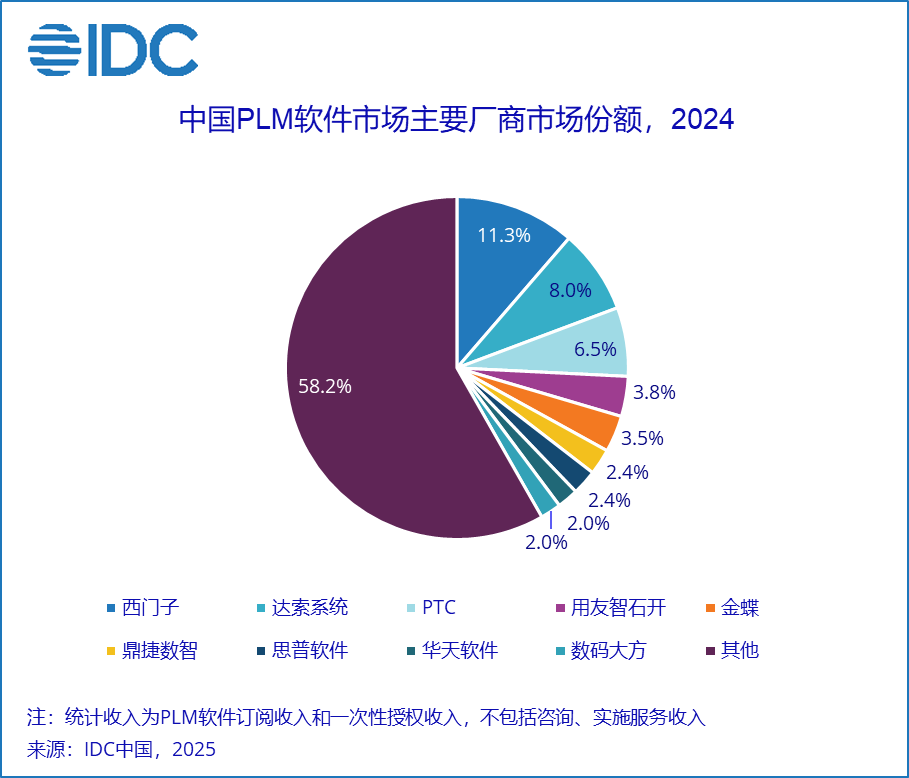
IDC:2024年中国PLM软件总市场规模为35.1亿元 年增长率为21.6%
智通财经网· 2025-08-19 06:01
Market Overview - The total market size for PLM software in China is projected to reach 3.51 billion RMB in 2024, with a year-on-year growth rate of 21.6%, an increase of 5.6 percentage points from the previous year [1] - The market is experiencing intensified competition, leading to a decline in average transaction prices and longer decision-making cycles [1] Competitive Landscape - Siemens, Dassault Systèmes, and PTC remain the top three players in the market, although their growth rates are slowing. Siemens' market share decreased from 14.3% in 2023 to 11.3%, while Dassault Systèmes' share fell from 10.2% to 8.0% [1] - Other notable companies include Yonyou, Kingdee, Dingjie Zhizhi, Supcon Software, Huaten Software, and Digital Dafa, which rank from fourth to ninth in market share [1] SaaS PLM Market - The SaaS PLM software sub-market in China is expected to reach 181 million RMB in 2024, with a growth rate of 21.9%, slightly higher than the overall PLM market growth rate, but it only accounts for 5.25% of the total PLM market [3] - There is a growing trend of manufacturers launching cloud-native PLM products, with an increasing adoption rate among end-users despite concerns about storing design and R&D data on public clouds [3] Industry Segmentation - The PLM market is segmented into eight major industries: high-tech electronics and computers, equipment manufacturing, automotive, aerospace and shipbuilding, consumer goods, raw materials, home appliances, and new energy [5] - The total market size for PLM solutions (including software and services) is projected to reach 5.32 billion RMB in 2024, with the top three industries being high-tech electronics, equipment manufacturing, and automotive [5] Market Share by Industry - In the high-tech electronics and computer communication PLM solutions market, Dingjie Zhizhi holds a market share of 12.2%, followed by Yonyou and Supcon Software [6] - In the equipment manufacturing PLM solutions market, Dingjie Zhizhi leads with a 6.2% market share, followed by Digital Dafa and Supcon Software [7] - In the automotive PLM solutions market, Huaten Software has a dominant share of 77.2%, with other players like Supcon Software and Kingdee following [8] - In the new energy PLM solutions market, Kingdee leads with an 11.3% market share, followed by Meiyun Zhishu and Huaten Software [9] Key Market Trends - Major market changes for 2024 include AI reshaping industrial software, the globalization of Chinese manufacturing, large-scale equipment updates, and the integration of industrial software with the industrial internet [11] - The research indicates that the intensity of R&D investment by Chinese enterprises is increasing, with a long-term trend of moving from price competition to innovation [11]

CDNS, NVDA Team Up to Advance Billion-Gate AI Design Power Analysis
ZACKS· 2025-08-14 15:15
Group 1: Breakthrough in Power Analysis - Cadence Design Systems and NVIDIA Corporation have achieved hardware-accelerated dynamic power analysis for billion-gate AI designs, completing the process in just a few hours with up to 97% accuracy [1][4] - The new Cadence Dynamic Power Analysis App, integrated with the Palladium Z3 Enterprise Emulation Platform, allows for accurate power consumption estimates in real-world workloads, enhancing energy efficiency and preventing delays in chip design [4][5] - Traditional power analysis tools are limited to processing a few hundred thousand cycles, but the collaboration between Cadence and NVIDIA has enabled unprecedented accuracy across billions of cycles [3][4] Group 2: Market Opportunities and Growth - There is broad-based demand for Cadence's solutions, particularly in AI-driven portfolios, driven by trends such as 5G, hyperscale computing, and autonomous driving [5][7] - Cadence is collaborating with major tech companies like Qualcomm and NVIDIA on next-generation AI designs, and is targeting new markets such as Life Sciences with its OpenEye drug discovery software [6][7] - The company is expanding partnerships with foundry partners like Taiwan Semiconductor Manufacturing, Intel, and Arm Holdings, positioning itself to benefit from increased R&D spending on AI-driven automation [7] Group 3: Competitive Landscape - Cadence faces intensifying competition and challenges related to international exposure and a high level of goodwill and intangible assets [8] - In the broader software space, competitors like PTC Inc. and Adobe Inc. are also leveraging AI technologies, indicating a competitive environment for Cadence [9][13]