
沪农商行

Search documents
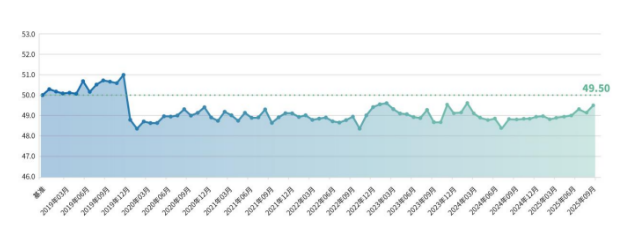
9月普惠金融-景气指数整体向好,经营融资同步改善
Jing Ji Wang· 2025-10-30 02:12
Core Insights - The Inclusive Finance Prosperity Index reached 49.50 points in September, an increase of 0.32 points from August, indicating simultaneous improvement in both operational and financing dimensions [1] Financing Dimension - The financing prosperity index rose to 54.93 points in September, up 0.71 points from August, reflecting effective release of corporate financing demand and a stable decrease in financing costs [2] - The average interest rate for newly issued corporate loans in September was approximately 3.1%, down about 40 basis points year-on-year, demonstrating the continued effectiveness of monetary policies such as reserve requirement ratio cuts and interest rate reductions [2] Operational Dimension - The operational prosperity index increased to 48.44 points in September, up 0.24 points from August, driven by a sustained recovery in consumer demand and improved order volumes for small and micro enterprises [3] - The operational vitality index rose by 0.29 points in September, indicating that enterprises are accelerating production and optimizing service processes in response to market changes [3] Industry Performance - Among nine major industries, six showed an increase in operational prosperity, particularly in wholesale and retail, accommodation and catering, and transportation, while three industries, including real estate and construction, experienced declines [4] Regional Performance - In terms of regional performance, five out of seven regions showed an increase in operational prosperity, with East China and South China leading the way, while Northeast and North China saw declines [5] Index Overview - The Inclusive Finance Prosperity Index is jointly launched by several financial institutions and reflects the development status of inclusive finance services for small and micro enterprises, based on both objective data from financial institutions and subjective data from surveys of over 5,000 small and micro enterprises [5][7]

农商行板块10月29日跌1.59%,江阴银行领跌,主力资金净流入7863.93万元
Zheng Xing Xing Ye Ri Bao· 2025-10-29 08:41
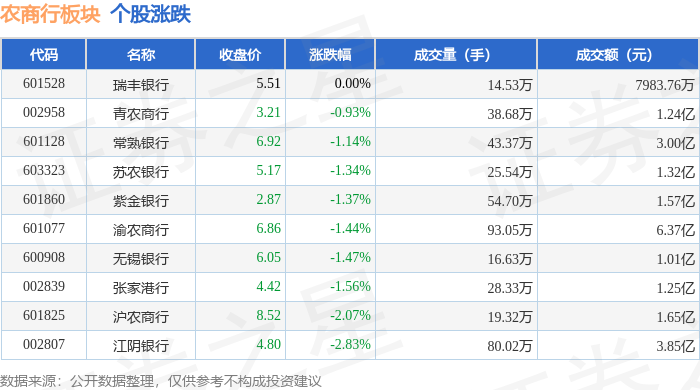
Core Points - The rural commercial bank sector experienced a decline of 1.59% on October 29, with Jiangyin Bank leading the drop [1] - The Shanghai Composite Index closed at 4016.33, up 0.7%, while the Shenzhen Component Index closed at 13691.38, up 1.95% [1] Group 1: Stock Performance - Ruifeng Bank (601528) closed at 5.51 with no change in price [1] - Qingnong Commercial Bank (002958) closed at 3.21, down 0.93% [1] - Changshu Bank (601128) closed at 6.92, down 1.14% [1] - Sunong Bank (603323) closed at 5.17, down 1.34% [1] - Zijin Bank (601860) closed at 2.87, down 1.37% [1] - Yunnan Agricultural Commercial Bank (601077) closed at 6.86, down 1.44% [1] - Wuxi Bank (600908) closed at 6.05, down 1.47% [1] - Zhangjiagang Bank (002839) closed at 4.42, down 1.56% [1] - Shanghai Agricultural Commercial Bank (601825) closed at 8.52, down 2.07% [1] - Jiangyin Bank (002807) closed at 4.80, down 2.83% [1] Group 2: Capital Flow - The rural commercial bank sector saw a net inflow of 78.64 million yuan from main funds, while retail funds experienced a net outflow of 10.52 million yuan [2] - Speculative funds had a net outflow of 68.12 million yuan [2]



刚刚!暴力拉升!
Zhong Guo Ji Jin Bao· 2025-10-29 07:57
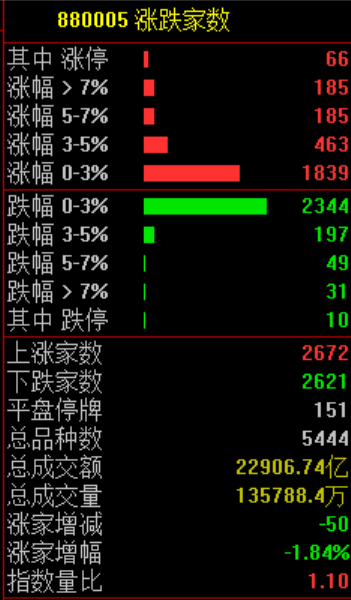
Market Overview - The A-share market experienced a significant rally on October 29, with the Shanghai Composite Index surpassing 4000 points and the North Exchange 50 Index soaring over 8% [1][2] - The closing figures showed the Shanghai Composite Index up by 0.7%, the Shenzhen Component Index up by 1.95%, and the ChiNext Index up by 2.93% [2] Stock Performance - A total of 2672 stocks rose, with 66 hitting the daily limit up, while 2621 stocks declined [3] - The photovoltaic and energy storage sectors saw notable gains, with stocks like Longi Green Energy and Tongwei Co. hitting the daily limit up, and Sungrow Power Supply reaching a new high [5] - Lithium mining stocks also performed well, with companies like Dazhong Mining seeing significant increases [6] Sector Highlights - The non-ferrous metals sector rallied, with stocks such as Chang Aluminum and Jiangxi Copper showing strong performance [7][8] - Hainan Free Trade Zone concept stocks surged, with Haiqi Group experiencing a significant increase [9] Banking Sector - The banking sector faced declines, with Chengdu Bank dropping over 5% [10] Positive Developments - The chairman of the Beijing Stock Exchange announced plans to accelerate the launch of the North Exchange 50 ETF and explore after-hours fixed-price trading [11] - The Ministry of Commerce and other departments released the "Urban Commercial Quality Improvement Action Plan," aiming to enhance urban commercial systems and promote a fair business environment [12][13][14] - Additional supportive measures for commercial real estate projects and new service consumption scenarios were introduced [15][16] - The Beijing Municipal Financial Committee announced opinions to promote high-quality development in venture capital and equity investment [17] - The State Administration of Foreign Exchange released policies to facilitate cross-border trade and support foreign trade development [17] - A significant meeting between Chinese and U.S. leaders is scheduled, which may impact market sentiment [18]
A股银行股集体下跌:成都银行跌5%,浦发银行跌超3%
Ge Long Hui A P P· 2025-10-29 04:03
Group 1 - The A-share market saw a collective decline in bank stocks, with Chengdu Bank dropping by 5% and several others, including Xiamen Bank, Shanghai Pudong Development Bank, and Qingdao Bank, falling over 3% [1] - Specific declines included Jiangyin Bank, Qilu Bank, Hangzhou Bank, Shanghai Bank, and Hu Nong Commercial Bank, all experiencing drops exceeding 2% [1] Group 2 - Chengdu Bank's market capitalization is reported at 72.9 billion, with a year-to-date increase of 5.28% despite the recent decline of 5.08% [2] - Xiamen Bank has a market capitalization of 18.1 billion, with a year-to-date increase of 24.69%, but it fell by 3.92% today [2] - Shanghai Pudong Development Bank's market capitalization stands at 396.7 billion, with a year-to-date increase of 19.25%, experiencing a decline of 3.87% [2] - Qingdao Bank's market capitalization is 29.2 billion, with a year-to-date increase of 33.50%, and it dropped by 3.28% [2] - Jiangsu Bank has a market capitalization of 194.5 billion, with a year-to-date increase of 13.38%, and it fell by 3.11% [2] - Other banks like Jiangyin Bank, Qilu Bank, Hangzhou Bank, Shanghai Bank, and Hu Nong Commercial Bank also reported declines, with respective market capitalizations of 11.8 billion, 36.4 billion, 114.4 billion, 133.3 billion, and 82.1 billion [2]


晨会纪要:对近期重要经济金融新闻、行业事件、公司公告等进行点评-20251029
Xiangcai Securities· 2025-10-28 23:33
Group 1: Industry Overview - The report highlights that the financial sector will focus on serving the real economy, emphasizing the importance of supporting key areas such as technology, green initiatives, and digital transformation during the 14th Five-Year Plan period [3][4] - The People's Bank of China (PBOC) has established a policy framework to enhance financial support for technological innovation, indicating a sustained increase in loans to technology-oriented small and medium-sized enterprises, with a growth rate of 22.3% in Q3 2025 [4][5] - The report notes that the monetary policy will maintain its current stance, with an emphasis on macroeconomic policies to support high-quality development and mitigate local government debt risks [5][6] Group 2: Regional Banking Dynamics - The report discusses the potential for regional banks to expand their assets, driven by the economic growth in major provinces, which are expected to play a pivotal role in regional economic development [6][7] - It emphasizes the collaboration between regional banks and local fiscal policies, which is anticipated to enhance their capacity to serve the real economy and promote industrial upgrades [6][7] Group 3: Investment Recommendations - The report suggests that regional banks are likely to benefit from the demonstration effect of economic powerhouses, with asset expansion expected to remain resilient [7][8] - It recommends focusing on state-owned banks for their stable high dividend yields and suggests potential valuation recovery opportunities for joint-stock and regional banks, specifically naming banks such as CITIC Bank, Jiangsu Bank, Chengdu Bank, and others [8]
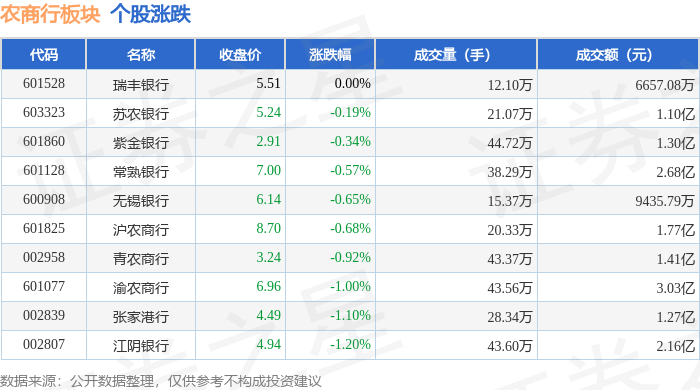
农商行板块10月28日跌0.75%,江阴银行领跌,主力资金净流入1650.52万元
Zheng Xing Xing Ye Ri Bao· 2025-10-28 08:40
Market Overview - The rural commercial bank sector experienced a decline of 0.75% on October 28, with Jiangyin Bank leading the drop [1] - The Shanghai Composite Index closed at 3988.22, down 0.22%, while the Shenzhen Component Index closed at 13430.1, down 0.44% [1] Individual Stock Performance - Key stock performances in the rural commercial bank sector included: - Ruifeng Bank: Closed at 5.51, unchanged - Sunong Bank: Closed at 5.24, down 0.19% - Zijin Bank: Closed at 2.91, down 0.34% - Changshu Bank: Closed at 7.00, down 0.57% - Yuanxi Bank: Closed at 6.14, down 0.65% - Hunan Rural Commercial Bank: Closed at 8.70, down 0.68% - Qingnong Bank: Closed at 3.24, down 0.92% - Yunnan Rural Commercial Bank: Closed at 6.96, down 1.00% - Zhangjiagang Bank: Closed at 4.49, down 1.10% - Jiangyin Bank: Closed at 4.94, down 1.20% [1] Capital Flow Analysis - The rural commercial bank sector saw a net inflow of 16.51 million yuan from institutional investors, while retail investors experienced a net outflow of 25.96 million yuan [1] - Detailed capital flow for selected banks included: - Sunong Bank: Net inflow of 13.07 million yuan from institutional investors, with a net outflow of 9.25 million yuan from retail investors [2] - Hunan Rural Commercial Bank: Net inflow of 13.06 million yuan from institutional investors, with a net outflow of 16.03 million yuan from retail investors [2] - Qingnong Bank: Net inflow of 7.95 million yuan from institutional investors, with a net outflow of 7.73 million yuan from retail investors [2] - Jiangyin Bank: Net outflow of 5.93 million yuan from institutional investors, with a net inflow of 8.14 million yuan from retail investors [2]

晨会纪要:对近期重要经济金融新闻、行业事件、公司公告等进行点评-20251028
Xiangcai Securities· 2025-10-28 00:32
Macroeconomic Information and Commentary - Recent US-China trade negotiations in Kuala Lumpur focused on key economic issues, including maritime logistics and shipbuilding industry measures, resulting in a basic consensus on addressing mutual concerns [2] - The State Council's financial work report emphasizes high-quality financial services for the real economy, with a focus on technology innovation, consumption, small and micro enterprises, and stabilizing foreign trade [2] Company and Industry Analysis Electronics Industry - The electronics sector saw an 8.49% increase last week, with semiconductor and consumer electronics indices rising by 8.01% and 9.38% respectively [5] - Notable companies in the electronics sector include Yunhan Chip City and Yuanjie Technology, while companies like Abison and Huatian Technology lagged behind [5] - The electronics sector's PE ratio (TTM) is 66.18X, up 5.10X week-on-week, indicating a high valuation relative to historical levels [5] - Storage prices have surged, with DRAM and NAND Flash prices increasing by 15%-20%, driven by AI demand, suggesting a sustained positive outlook for the storage market [6] - Investment opportunities are identified in AI infrastructure, edge SOC, foldable smartphone supply chains, and the storage industry, maintaining an "overweight" rating for the electronics sector [6] Medical Services Industry - WuXi AppTec reported a revenue increase of 18.61% year-on-year for the first three quarters of 2025, with a significant rise in net profit [8] - The company's gross margin improved to 46.62%, driven by operational efficiency and the sale of shares in a joint venture [9] - The chemical business segment showed robust growth, particularly in TIDES (oligonucleotide and peptide drugs), which saw a revenue increase of 121.1% [10] - The company expects a return to double-digit growth in its ongoing business, raising revenue forecasts for 2025-2027 [11] Banking Industry - Policy banks have deployed over 330 billion yuan in new financial tools to stimulate credit demand, with a focus on infrastructure and emerging sectors like AI [12] - The introduction of these financial tools is expected to support medium to long-term corporate loans and improve the loan structure [12] - The banking sector is anticipated to benefit from the increased investment demand, particularly in regional banks, with a recommendation to focus on state-owned banks and select regional banks for their stable dividend yields [13]

SunCar Announces First Half 2025 Financial Results
Globenewswire· 2025-10-27 20:05
Core Insights - SunCar Technology Group Inc. reported a 9% increase in total revenue to $222.3 million for the first half of 2025, compared to $203.1 million in the same period of 2024 [5][8] - The company achieved a significant increase in EV insurance premiums, which rose by 111.3% to $697.6 million, up from $330.2 million year-over-year [5][8] - SunCar's net loss decreased to $5.5 million in the first half of 2025, a substantial improvement from a net loss of $60.1 million in the prior year [5][8] Financial Performance - Total revenue for the first half of 2025 was $222.3 million, reflecting a 9% increase from $203.1 million in the first half of 2024 [5][8] - Adjusted EBITDA for the first half of 2025 was $2.5 million, down from $6 million in the prior year [5][8] - The company reported a net loss of $5.5 million for the first half of 2025, compared to a net loss of $60.1 million in the same period of 2024 [5][8] Business Highlights - SunCar deepened collaborations with major EV manufacturers, including Tesla, Xiaomi, and NIO, enhancing its insurance offerings and user experience [5][6][9] - The integration of ByteDance's Doubao large language model into SunCar's platform is expected to enhance its AI-driven digitalization efforts [4][5] - The company has initiated innovative auto services projects in partnership with China ZheShang Bank and Shanghai Rural Commercial Bank, expanding its service offerings [5][9] Market Position - SunCar ranked first in China for auto insurance premiums tailored to EV owners, indicating a strong market presence in the growing EV insurance sector [5][8] - Revenue from auto eInsurance services increased by 33% to $97.8 million, driven by strong partnerships with emerging EV OEMs [5][8] - Technology services revenue grew by 11% to $24.3 million, reflecting increased adoption of SunCar's enterprise software tools [5][8] Strategic Outlook - The company is prioritizing profitability and cash generation, withdrawing its previous full-year revenue guidance of $521 million to $539 million [14] - SunCar aims to focus on accounts and partnerships that enhance margins and long-term value, positioning itself for sustainable growth [14]





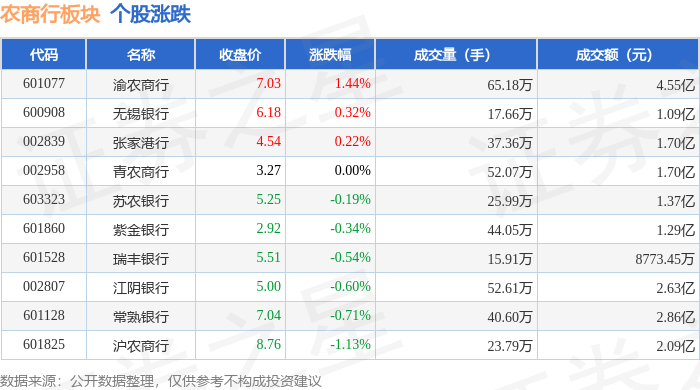
农商行板块10月27日跌0.13%,沪农商行领跌,主力资金净流入2473.66万元
Zheng Xing Xing Ye Ri Bao· 2025-10-27 08:25
Core Insights - The agricultural commercial bank sector experienced a slight decline of 0.13% on October 27, with the Shanghai Agricultural Commercial Bank leading the drop [1] - The Shanghai Composite Index closed at 3996.94, up 1.18%, while the Shenzhen Component Index closed at 13489.4, up 1.51% [1] Stock Performance - The closing prices and performance of key agricultural commercial banks are as follows: - Yunnan Agricultural Commercial Bank (601077) closed at 7.03, up 1.44% with a trading volume of 651,800 shares and a transaction value of 455 million [1] - Wuxi Bank (600908) closed at 6.18, up 0.32% with a trading volume of 176,600 shares and a transaction value of 109 million [1] - Zhangjiagang Bank (002839) closed at 4.54, up 0.22% with a trading volume of 373,600 shares and a transaction value of 170 million [1] - Other banks like Su Nong Bank (603323) and Zijin Bank (601860) saw declines of 0.19% and 0.34% respectively [1] Fund Flow Analysis - The agricultural commercial bank sector saw a net inflow of 24.73 million from institutional investors and 41.41 million from retail investors, while retail investors had a net outflow of 66.14 million [1] - Detailed fund flow for specific banks indicates: - Jiangyin Bank (002807) had a net inflow of 9.34 million from institutional investors and a net outflow of 18.65 million from retail investors [2] - Wuxi Bank (600908) had a net inflow of 8.72 million from institutional investors and a net outflow of 10.73 million from retail investors [2] - Other banks like Zijin Bank (601860) and Yunnan Agricultural Commercial Bank (601077) also experienced mixed fund flows with significant retail outflows [2]
行业深度报告:零售风险及新规影响有限,兼论信贷去抵押化
KAIYUAN SECURITIES· 2025-10-27 05:44
Investment Rating - The investment rating for the industry is "Positive" (maintained) [1] Core Insights - The report highlights that retail non-performing loan (NPL) rates and generation rates are currently high, indicating ongoing pressure on bank profitability. Despite a low overall NPL rate, the retail sector shows signs of risk, with a marginal increase in the NPL rate to 1.28% [14][15] - The transition period for new risk regulations is nearing its end, with concerns about the impact on banks' provisioning levels. However, the report suggests that the actual impact may be less severe than market expectations [16] - The trend of de-collateralization in bank lending is evident, driven by both business characteristics and strategic choices made by banks to reduce reliance on collateralized loans [17] Summary by Sections 1. Retail NPL and Generation Rates - The retail NPL rate has increased to 1.28%, with a steepening curve indicating ongoing risk. The generation rate for retail loans remains high, with significant increases noted in certain banks [14][18] - The report indicates that while the overall NPL rate is low, the divergence between overdue and NPL indicators suggests underlying risks in the retail sector [19] 2. Impact of New Risk Regulations - The new risk regulations will require banks to classify impaired loans as NPLs, potentially increasing reported NPL rates. However, the report anticipates that the actual provisioning pressure may be manageable [16][17] 3. De-Collateralization in Lending - The report notes a significant decline in the proportion of collateralized loans, with banks shifting towards non-collateralized lending strategies. This shift is influenced by the need to manage risk more effectively [17][18] 4. Investment Recommendations - The report recommends certain state-owned banks due to their customer base advantages and manageable retail risk pressures. It also highlights specific banks such as CITIC Bank and Agricultural Bank of China as beneficiaries of this trend [6]





