Merck

Search documents
Mizuho's Jared Holz: There's not much value left in vaccine stocks
CNBC Television· 2025-09-19 15:40
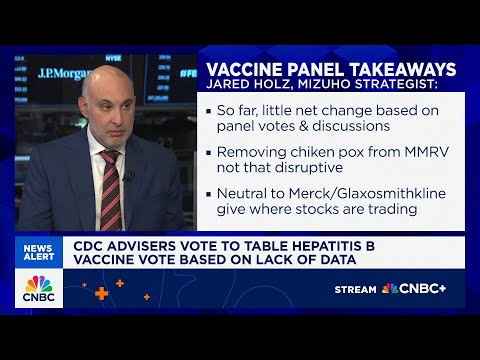
Meanwhile, an RFK Junior back vaccine panel now pushing for new restrictions on a combination shot for children, changing the current recommendations that allow children under four to receive the MMR vaccine. And this morning, uh the uh hepatitis B vaccine vote also was put off. They cited a lack of data, a vote expected later, also on COVID shot recommendations.All right, let's try and make sense of all this. Missouo healthcare sector strategist Jared Holles joins us here at Post 9. I guess from an investo ...


Merck wins EU backing for Keytruda injectable (MRK:NYSE)
Seeking Alpha· 2025-09-19 11:40
Group 1 - Merck announced that the European Medicines Agency (EMA) endorsed an injectable version of its cancer therapy Keytruda (pembrolizumab) [3] - The endorsement comes from an expert panel within the EMA, specifically the Committee for Medicinal Products for Human Use (CHMP) [3] - This development is significant for Merck as Keytruda is a blockbuster drug in its portfolio [3]

EMA committee recommends approval for injectable version of Merck's Keytruda
Reuters· 2025-09-19 11:15
Core Viewpoint - The European Medicines Agency's committee has recommended the approval of a new formulation of Merck's cancer therapy Keytruda, which can be administered subcutaneously, potentially enhancing patient convenience and treatment adherence [1] Company Summary - Merck's Keytruda is a leading cancer therapy, and the new formulation aims to provide an alternative administration route that may improve patient experience [1] Industry Summary - The approval of subcutaneous formulations in cancer therapies reflects a growing trend in the pharmaceutical industry to enhance drug delivery methods, which could lead to increased market competitiveness and patient accessibility [1]

Merck Receives Positive EU CHMP Opinion for ENFLONSIA™ (clesrovimab) for the Prevention of Respiratory Syncytial Virus (RSV) in Infants During Their First RSV Season
Businesswire· 2025-09-19 10:50
Core Viewpoint - Merck has received a positive opinion from the European Medicines Agency's Committee for Medicinal Products for Human Use (CHMP) regarding ENFLONSIA (clesrovimab) for the prevention of Respiratory Syncytial Virus (RSV) in infants during their first RSV season [1] Group 1 - The positive CHMP opinion is a significant step towards potential approval for ENFLONSIA in the European market [1] - ENFLONSIA is specifically aimed at preventing RSV, which is a major cause of respiratory illness in infants [1] - The approval could enhance Merck's portfolio in the pediatric infectious disease market [1]
Daiichi Sankyo (OTCPK:DSKY.F) Update / Briefing Transcript
2025-09-18 00:02
Summary of Daiichi Sankyo Update / Briefing on September 17, 2025 Company and Industry Overview - **Company**: Daiichi Sankyo - **Industry**: Oncology, specifically focusing on small cell lung cancer (SCLC) and related therapies Key Points and Arguments 1. **Unmet Medical Need in SCLC**: Small cell lung cancer has a high unmet medical need, particularly in extensive stage small cell lung cancer (ES-SCLC), which accounts for approximately 70% of SCLC cases [1][2] 2. **Recent Drug Approvals**: The field has seen new drug approvals, including lurbinectedin in 2020 and tarlatamab in 2024, alongside traditional chemotherapy agents [2] 3. **IEDxB Program Introduction**: The IEDxB program targets B7-H3, an antigen expressed in many cancers but absent in normal cells, presenting a broad opportunity for development [3] 4. **Phase One Trial Results**: The completed phase one trial of IEDxB showed a robust overall response rate (ORR) of 52% and a progression-free survival (PFS) of 6.9 months, indicating strong efficacy across various tumor types [4][5] 5. **Phase Two Study in ES-SCLC**: The phase two study in relapsed ES-SCLC demonstrated a confirmed response rate of 48.2% and a median duration of response of 5.3 months, with a PFS of 4.9 months and overall survival (OS) of 10.3 months [9][10] 6. **Activity in Brain Metastases**: IEDxB showed a response rate of 46% in patients with brain metastases, which is significant given the challenges of treating such cases [9][10] 7. **Safety Profile**: The safety profile of IEDxB is manageable, with an interstitial lung disease (ILD) rate of 12.7%, primarily low grade [9][10] 8. **Breakthrough Therapy Designation**: IEDxB received breakthrough therapy designation from the FDA, which may expedite the review process and approval timeline [20][54] 9. **Combination Studies**: Ongoing studies are exploring combinations of IEDxB with other therapies, including immune checkpoint inhibitors and bispecific agents, to enhance treatment efficacy [11][12][30] 10. **Competitive Landscape**: IEDxB is positioned favorably against competitors like tarlatamab, with a different mechanism of action and a distinct safety profile, which may influence physician prescribing choices [22][24] Additional Important Content 1. **Patient Demographics**: The study population primarily consisted of male patients, with 28% having brain metastases and 50% receiving IEDxB as first-line therapy [7] 2. **Future Development Plans**: Daiichi Sankyo plans to expand IEDxB's application to other cancers, including prostate and vaginal cancers, and is conducting multiple combination studies to explore its full potential [11][12][28] 3. **Regulatory Strategy**: The company is optimistic about the regulatory submission plans due to the breakthrough designation and the completion of pivotal trials [27][54] 4. **Biomarker Strategy**: Current data suggests that a specific biomarker for B7-H3 may not be necessary in SCLC, as the drug shows activity across a broad patient population [32][33] This summary encapsulates the critical insights from the Daiichi Sankyo briefing, highlighting the company's focus on innovative therapies for small cell lung cancer and its strategic positioning in the oncology market.
Merck: Buy This Dividend Powerhouse While It's Cheap (NYSE:MRK)
Seeking Alpha· 2025-09-16 17:22
Core Insights - Many income stocks, particularly in the real estate and pharmaceutical sectors, are currently undervalued despite discussions of potential interest rate cuts that could enhance the attractiveness of dividend stocks [2] Group 1: Investment Focus - The focus is on income-producing asset classes that provide sustainable portfolio income, diversification, and inflation hedging opportunities [1] - The investment strategy emphasizes defensive stocks with a medium- to long-term horizon [2] Group 2: Market Conditions - The current market environment shows that income stocks remain beaten down in price, indicating potential investment opportunities [2]

Merck: Buy This Dividend Powerhouse While It's Cheap
Seeking Alpha· 2025-09-16 17:22
Core Viewpoint - Many income stocks, particularly in the real estate and pharmaceutical sectors, are currently undervalued despite discussions of potential interest rate cuts that could enhance the attractiveness of dividend stocks [2] Group 1: Income Stocks - Income stocks in the real estate and pharmaceutical sectors remain beaten down in price [2] - Potential interest rate cuts may make dividend stocks more appealing to investors [2] Group 2: Investment Focus - The focus is on income-producing asset classes that provide sustainable portfolio income, diversification, and inflation hedging [1]
MRK, Daiichi's ADC Drug Gets FDA Breakthrough Tag for Ovarian Cancer
ZACKS· 2025-09-16 16:21
Core Insights - Merck and Daiichi Sankyo received FDA Breakthrough Therapy Designation for R-DXd, aimed at treating platinum-resistant epithelial ovarian, primary peritoneal, or fallopian tube cancers expressing CDH6 in patients previously treated with Avastin [1][7][10] Group 1: FDA Breakthrough Therapy Designation - The FDA's Breakthrough Therapy Designation for R-DXd accelerates the development and review process for drugs addressing serious conditions, indicating potential significant improvement over existing treatments [2] - The designation was based on data from the ongoing phase II/III REJOICE-Ovarian01 study and a phase I study, with results expected to be presented at an upcoming medical conference [3][7] Group 2: Merck's Investment and Collaboration - Merck acquired global co-development and co-commercialization rights to R-DXd and two other ADCs from Daiichi Sankyo for a total potential consideration of up to $22 billion, while Daiichi Sankyo retains exclusive rights for development in Japan [5][8] - The collaboration has expanded to include MK-6070, a T-cell engager targeting DLL3, obtained from Harpoon Therapeutics [8] Group 3: ADC Market and Competition - ADCs are viewed as a disruptive innovation in the pharmaceutical industry, enhancing cancer treatment by delivering cytotoxic drugs directly to tumors [11] - Daiichi Sankyo is developing several ADCs across various cancers, including Enhertu, which is approved for multiple indications [12] - Pfizer has entered the ADC market through the acquisition of Seagen for $43 billion, adding four ADCs to its portfolio, which have significantly contributed to its revenues [13][14]
Is Merck (MRK) a Buy as Wall Street Analysts Look Optimistic?
ZACKS· 2025-09-16 14:31
Core Viewpoint - The article discusses the reliability of brokerage recommendations, particularly focusing on Merck (MRK), and highlights the potential misalignment of interests between brokerage analysts and retail investors [1][5][10]. Group 1: Brokerage Recommendations for Merck - Merck has an average brokerage recommendation (ABR) of 1.96, indicating a consensus between Strong Buy and Buy based on 26 brokerage firms [2]. - Out of the 26 recommendations, 13 are Strong Buy and one is Buy, representing 50% and 3.9% of all recommendations respectively [2]. Group 2: Limitations of Brokerage Recommendations - Solely relying on brokerage recommendations for investment decisions may not be advisable, as studies indicate they often fail to guide investors effectively towards stocks with high price appreciation potential [5][10]. - Brokerage analysts tend to exhibit a strong positive bias in their ratings due to vested interests, leading to a disproportionate number of favorable ratings compared to negative ones [6][10]. Group 3: Zacks Rank as an Alternative - The Zacks Rank, a proprietary stock rating tool, categorizes stocks into five groups and is considered an effective indicator of near-term stock price performance [8][11]. - Unlike the ABR, the Zacks Rank is based on earnings estimate revisions, which have shown a strong correlation with stock price movements [11][13]. - The Zacks Rank is updated more frequently than the ABR, making it a more timely tool for predicting future stock prices [13]. Group 4: Current Status of Merck - The Zacks Consensus Estimate for Merck's earnings remains unchanged at $8.93, suggesting stable analyst views on the company's earnings prospects [14]. - Due to the unchanged consensus estimate and other factors, Merck currently holds a Zacks Rank of 3 (Hold), indicating a cautious approach despite the Buy-equivalent ABR [15].
Verona Pharma (VRNA) Rebounded from Challenging Q1
Yahoo Finance· 2025-09-16 12:14
Group 1 - ClearBridge Investments released its second-quarter 2025 investor letter for the ClearBridge Small Cap Strategy, highlighting volatility in small-cap stocks during the quarter [1] - The Russell 2000 Index rebounded 10% from its November 2024 record highs, driven by growth, momentum, high-beta, and low-quality stocks, but underperformed compared to the Russell 1000 Index, which returned 11.1% [1] - The ClearBridge Small Cap Strategy underperformed its benchmark during this period [1] Group 2 - Verona Pharma plc (NASDAQ:VRNA) was highlighted as a top contributor in the ClearBridge Small Cap Strategy, with a one-month return of 0.55% and a 52-week gain of 252.69% [2][3] - As of September 15, 2025, Verona Pharma's stock closed at $106.37 per share, with a market capitalization of $9.039 billion [2] - The company received favorable FDA designation for its Ohtuvayre drug treatment for chronic obstructive pulmonary disease, which contributed to its stock performance [3] Group 3 - Merck announced plans to acquire Verona Pharma for $10 billion, which bolstered market sentiment towards the company [4] - At the end of the second quarter, 59 hedge fund portfolios held shares of Verona Pharma, an increase from 51 in the previous quarter [4] - Despite the potential of Verona Pharma, the company is not among the 30 most popular stocks among hedge funds, with some analysts suggesting that certain AI stocks may offer greater upside potential [4]