Tukysa

Search documents
辉瑞发布2026年战略规划,重申营收与利润指引
Jing Ji Guan Cha Wang· 2026-02-13 19:30
Financial Performance - The company reiterated its revenue guidance for 2026, expecting total revenue between $59.5 billion and $62.5 billion, with approximately $5 billion from COVID-related products and an impact of about $1.5 billion from patent expirations. Adjusted earnings per share guidance is set at $2.80 to $3.00 [2] Product Development Progress - The company plans to initiate around 20 key clinical trials in 2026, with 10 focused on obesity assets, including the further development of the long-acting GLP-1 receptor agonist PF-3944 (MET-097i), which has shown significant weight loss effects in its phase 2b study [3] - In oncology, Padcev (enfortumab vedotin) in combination with pembrolizumab received FDA approval in November 2025 for perioperative treatment of bladder cancer, while Tukysa and Braftovi have shown positive efficacy in breast and colorectal cancer trials [3] Strategic Initiatives - In November 2025, the company completed the acquisition of Metsera for approximately $7 billion, aimed at strengthening its pipeline in obesity and metabolic diseases, marking its entry into this high-growth area [4] - The company continues to expand its pipeline through collaborations, such as the agreement with YaoPharma for small molecule GLP-1 receptor agonists, although this is still in the early stages [4] Operational Efficiency - The adjusted sales cost ratio decreased to 24.2% in 2025, with sales and administrative expenses declining by 7% year-over-year, reflecting the company's ongoing efforts to enhance operational efficiency through digitalization and resource optimization [5]

辉瑞发布2025年财报及2026年战略规划
Jing Ji Guan Cha Wang· 2026-02-13 13:35
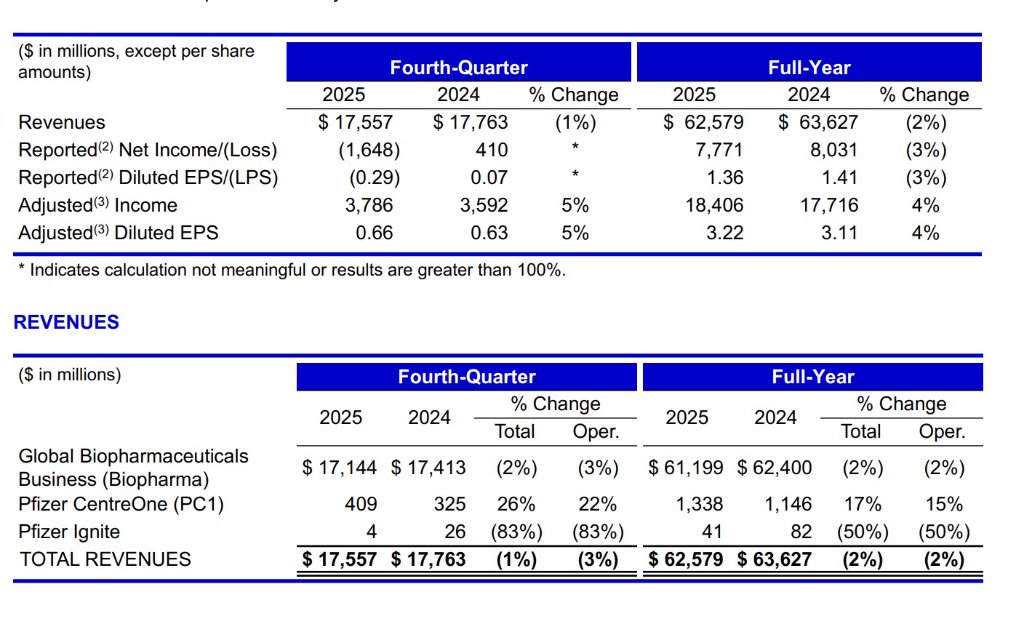
Financial Performance - In Q4 2025, the company reported revenue of $17.56 billion, with a 9% year-over-year growth in non-COVID business [1] - Total revenue for the year 2025 was $62.6 billion, with a 6% growth in core non-COVID business [1] - The company reaffirmed its revenue guidance for 2026, projecting between $59.5 billion and $62.5 billion, including approximately $5 billion from COVID-related products and accounting for about $1.5 billion impact from patent expirations [1] - Adjusted earnings per share guidance for 2026 is set between $2.80 and $3.00 [1] Product Development Progress - In 2026, the company plans to initiate around 20 key clinical trials, with 10 focused on obesity assets [2] - The Phase 2b study of the ultra-long-acting GLP-1 receptor agonist PF-3944 (MET-097i) has achieved its primary endpoint [2] - The oncology sector has seen several regulatory breakthroughs, including FDA approval in November 2025 for Padcev in combination with pembrolizumab for perioperative treatment of bladder cancer [2] - Tukysa and Braftovi have shown significant efficacy in trials for breast and colorectal cancers [2] Strategic Initiatives - In November 2025, the company completed the acquisition of Metsera, with a total transaction value of approximately $7 billion, aimed at strengthening its pipeline in obesity and metabolic diseases [3] - The company has improved operational efficiency through cost control, with the adjusted sales cost ratio decreasing to 24.2% in 2025, and sales and administrative expenses declining by 7% year-over-year [3]
辉瑞2025年第四季度营收175.6亿美元,非新冠业务增长9%,26全年营收指引595-625亿美元|财报见闻
Hua Er Jie Jian Wen· 2026-02-03 20:11
Core Insights - Pfizer demonstrated robust operational resilience during its strategic transformation phase, with total revenue reaching $62.6 billion in 2025, reflecting a 6% growth in core business excluding COVID-related products [1][4] - The company maintained its 2026 performance guidance while revealing an active product pipeline, expecting to initiate approximately 20 key clinical trials in 2026, laying the foundation for long-term growth [1][4] Financial Performance - Total revenue for Q4 2025 was $17.6 billion, a 1% decrease from Q4 2024, while full-year revenue decreased by 2% to $62.6 billion [2] - Adjusted diluted EPS for Q4 was $0.66, a 5% increase year-over-year, and for the full year, it reached $3.22, up 4% [2][3] - The adjusted sales cost ratio improved to 24.2%, down from 25.8% in 2024, indicating enhanced cost management [8] Business Segments - Non-COVID product lines showed strong structural growth, with cardiovascular and vaccine segments leading the way; Eliquis generated $8 billion in revenue, a growth of 8% [4][5] - The oncology business achieved $16.8 billion in revenue, an 8% increase, with key products like Ibrance and Xtandi maintaining strong market positions despite competition [6] - COVID-related product revenues significantly declined, with Comirnaty and Paxlovid generating $4.4 billion and $2.4 billion respectively, down 18% and 59% year-over-year [7] Strategic Initiatives - Pfizer completed the acquisition of Metsera for approximately $7 billion, marking its entry into the obesity and metabolic disease treatment market [9] - The company is advancing its obesity pipeline, with promising results from the clinical trials of its long-acting GLP-1 receptor agonist [10] - Multiple oncology products received regulatory breakthroughs, enhancing the competitive edge of Pfizer's oncology portfolio [11][12] 2026 Outlook - Pfizer projects 2026 revenue between $59.5 billion and $62.5 billion, including approximately $5 billion from COVID-related products [13] - The company plans to maintain a focus on reducing debt levels and balancing its capital structure, with no share buybacks planned for 2026 [13]

Health Rounds: Pfizer drug delays progression of advanced breast cancer in trial
Reuters· 2025-12-12 12:24
Core Insights - Pfizer's Tukysa has been shown to significantly delay disease progression in patients with HER2-positive metastatic breast cancer who responded well to initial treatment [1] Group 1: Drug Efficacy - Tukysa added to maintenance therapy resulted in a notable delay in disease progression for patients with HER2-positive metastatic breast cancer [1]
X @Bloomberg
Bloomberg· 2025-12-10 13:52
Pfizer’s Tukysa, when given as part of the initial treatment for an advanced form of breast cancer, delayed tumor growth by more than eight months, according to a study that may expand its use https://t.co/XjpGcBOHzS ...
2 Healthcare Stocks for Beginner Investors With a 20-Year Time Horizon
The Motley Fool· 2025-11-22 14:20
Core Viewpoint - The healthcare sector presents significant investment opportunities for long-term investors, particularly in stocks that demonstrate growth potential and resilience against market fluctuations [2]. Group 1: Pfizer - Pfizer has experienced a transformative period, shifting from slow growth to a surge in revenue due to the success of its COVID-19 vaccine developed with BioNTech [4]. - The company has strategically utilized profits from its COVID-19 products to acquire other firms, including a pivotal $43 billion acquisition of Seagen in 2023, enhancing its oncology portfolio with four approved cancer therapies [5][6]. - Pfizer's recent product launches include a range of treatments such as the RSV vaccine Abrysvo and the migraine treatment Nurtec, which are expected to drive future growth [7]. - The company reported total revenue of approximately $45 billion in the first nine months of 2025, with a 24% year-over-year increase in GAAP net income to $9.4 billion [10]. - Pfizer has a strong dividend history, delivering over $7 billion in cash dividends in the first nine months of 2025, with a current yield close to 7% [11]. - The company is focusing on non-COVID growth areas, including oncology and cardiometabolic treatments, while also pursuing acquisitions to counteract patent expirations [9][12]. Group 2: Viking Therapeutics - Viking Therapeutics is a clinical-stage biopharmaceutical company with its value largely dependent on successful clinical trials and regulatory approvals [13]. - The lead candidate, VK2735, has shown promising results in early trials for weight loss and diabetes improvement, targeting both GLP-1 and GIP receptors [14][15]. - The injectable formulation of VK2735 is in phase 3 trials and has demonstrated significant weight reduction, positioning it competitively against existing treatments [17]. - Viking has a diversified pipeline, including candidates for metabolic liver disease and a rare genetic condition, which may reduce reliance on a single product's success [18][19]. - The company ended Q3 2025 with over $715 million in cash, providing stability for ongoing research and development without immediate fundraising concerns [19][20].


Immunome (NasdaqCM:IMNM) FY Conference Transcript
2025-11-11 14:32
Summary of Immunome FY Conference Call (November 11, 2025) Company Overview - **Company**: Immunome (NasdaqCM:IMNM) - **Focus**: Standalone pure-play cancer company specializing in targeted therapies, including antibody-based therapies, radioligands, and small molecules [1][1] Key Points on Varegacestat - **Asset**: Varegacestat, a gamma-secretase inhibitor, is nearing completion of phase three clinical trials for desmoid tumors [2][2] - **Market Opportunity**: The commercial opportunity in desmoid tumors is substantial, with approximately 1,650 new cases per year in the US and a prevalence of about 30,000 [9][15] - **Differentiation**: Varegacestat is expected to differentiate itself from Ogsivo (nirogacestat) due to better efficacy and dosing convenience (once daily vs. twice daily) [10][10][22][22] - **Phase 2 Data**: Phase 2 data indicated a significant improvement over nirogacestat, with a median tumor volume reduction that was 20-25% better [10][10] - **Regulatory Readiness**: The company is well-prepared for regulatory submission and product launch, with a strong team in place [14][14] Clinical Trial Insights - **Enrollment**: Enrollment for the phase 3 trial was completed in February 2024, with data expected to be released soon [11][11] - **Data Monitoring**: A Data Safety Monitoring Board (DSMB) has been overseeing the trial, ensuring safety and compliance [24][24] - **Comparison with Competitors**: The trial design and patient enrollment criteria are nearly identical to those used in SpringWorks' trial for nirogacestat, which is considered the gold standard [17][18] ADC Development - **ROR1 ADC**: Immunome is developing an antibody-drug conjugate (ADC) targeting ROR1, utilizing a proprietary payload (HC74) [27][27] - **Technology Differentiation**: The ADC aims to improve upon existing technologies by addressing common resistance pathways and enhancing permeability for better therapeutic activity [32][32][33][33] - **Future Pipeline**: The company plans to introduce additional ADCs in 2026 and 2027, with a focus on high internalization antibodies [34][34] Market Potential - **Revenue Potential**: A drug targeting 3,000 patients could generate over a billion dollars in revenue, with a significant number of treatable patients available in the US and Europe [15][15] - **Patient Compliance**: The once-daily dosing of Varegacestat is expected to improve patient compliance compared to competitors [10][10] Conclusion - Immunome is positioned to capitalize on the growing market for targeted cancer therapies, with a strong focus on developing innovative treatments that offer significant advantages over existing options. The upcoming data release for Varegacestat is highly anticipated and could be a pivotal moment for the company.

一周财报预览丨AMD、Palantir、辉瑞、 Realty Income 等集体来袭
美股研究社· 2025-11-03 10:33
Core Insights - The upcoming earnings season from November 3 to November 7 will cover a diverse range of sectors, including semiconductors, cloud software, artificial intelligence, consumer retail, healthcare, energy, media, and cryptocurrency, providing a comprehensive view of corporate performance this quarter [1][5]. Semiconductor and AI Infrastructure - Key companies such as AMD, Qualcomm, Supermicro, ON Semiconductor, Arista Networks, and Skyworks will report earnings, influencing market expectations for AI server demand, edge computing, and smartphone recovery cycles [2]. - AMD is expected to show over 27% year-on-year growth in revenue and profit, with a consensus revenue forecast of $8.75 billion [10][12]. Cloud, Software, and AI Platforms - Companies like Palantir, The Trade Desk, Unity Software, and Datadog will reflect the progress of AI applications and enterprise budget trends, with Palantir expected to report a revenue of $1.09 billion, marking a growth of over 50% year-on-year [6][8]. Consumer and Services Sector - Major players including McDonald's, Airbnb, and Uber will provide insights into consumer resilience and discretionary spending, with McDonald's expected to report a revenue of $7.09 billion, reflecting a slight growth of over 3% [16][18]. Healthcare and Biotechnology - Pfizer, Moderna, and Amgen will discuss drug pricing and demand for GLP-1 drugs, with Pfizer's revenue forecast at $16.52 billion, despite a projected 40% decline in earnings per share [13][15]. Energy, Refining, and Commodities - Companies like ConocoPhillips and BP will update on global supply and commodity pricing, with ConocoPhillips expected to report a revenue of $8.44 billion, reflecting a decline of over 20% [22][24]. Financial, Real Estate, and Asset Management - Firms such as Realty Income and Simon Property Group will clarify credit demand and commercial real estate risks, with Realty Income's revenue forecast at $0.51 billion [4]. Media, Gaming, and Streaming - Warner Bros. Discovery and Spotify will highlight trends in media consumption, while cryptocurrency-related companies like Marathon Digital will also report [4]. Industrial and Materials - Companies including DuPont and Archer Daniels Midland will provide key signals regarding manufacturing health and agricultural demand, with DuPont's revenue expected to be $3.25 billion [4].



MRK, Daiichi's ADC Drug Gets FDA Breakthrough Tag for Ovarian Cancer
ZACKS· 2025-09-16 16:21
Core Insights - Merck and Daiichi Sankyo received FDA Breakthrough Therapy Designation for R-DXd, aimed at treating platinum-resistant epithelial ovarian, primary peritoneal, or fallopian tube cancers expressing CDH6 in patients previously treated with Avastin [1][7][10] Group 1: FDA Breakthrough Therapy Designation - The FDA's Breakthrough Therapy Designation for R-DXd accelerates the development and review process for drugs addressing serious conditions, indicating potential significant improvement over existing treatments [2] - The designation was based on data from the ongoing phase II/III REJOICE-Ovarian01 study and a phase I study, with results expected to be presented at an upcoming medical conference [3][7] Group 2: Merck's Investment and Collaboration - Merck acquired global co-development and co-commercialization rights to R-DXd and two other ADCs from Daiichi Sankyo for a total potential consideration of up to $22 billion, while Daiichi Sankyo retains exclusive rights for development in Japan [5][8] - The collaboration has expanded to include MK-6070, a T-cell engager targeting DLL3, obtained from Harpoon Therapeutics [8] Group 3: ADC Market and Competition - ADCs are viewed as a disruptive innovation in the pharmaceutical industry, enhancing cancer treatment by delivering cytotoxic drugs directly to tumors [11] - Daiichi Sankyo is developing several ADCs across various cancers, including Enhertu, which is approved for multiple indications [12] - Pfizer has entered the ADC market through the acquisition of Seagen for $43 billion, adding four ADCs to its portfolio, which have significantly contributed to its revenues [13][14]

MRK, Daiichi Begin Phase III Breast Cancer Study With ADC Candidate
ZACKS· 2025-08-28 16:16
Group 1: Study Initiation and Objectives - Merck and Daiichi Sankyo have initiated the phase III HERTHENA-Breast04 study to evaluate the investigational HER3-directed ADC, patritumab deruxtecan (HER3-DXd), for treating specific breast cancer patients [1][2] - The study will compare HER3-DXd against an investigator's choice of treatment in patients with unresectable locally advanced or metastatic hormone receptor positive, HER2 negative breast cancer who have progressed after endocrine and CDK4/6 inhibitor therapy [2] - The primary endpoints of the study include progression-free survival and overall survival, while secondary endpoints encompass objective response rate, duration of response, and safety [3] Group 2: Clinical Development and Collaboration - The HERTHENA-Breast04 study is based on promising data from previous studies, including ICARUS-Breast01, where HER3-DXd showed positive responses in metastatic breast cancer patients [3] - Merck has acquired global co-development and co-commercialization rights to two additional ADCs from Daiichi Sankyo for a total potential consideration of up to $22 billion, although Daiichi retains exclusive rights for development in Japan [10] - Merck has also expanded its collaboration with Daiichi to co-develop MK-6070, an investigational T-cell engager targeting DLL3, obtained from Harpoon Therapeutics [11] Group 3: ADC Market and Competition - ADCs are viewed as a disruptive innovation in the pharmaceutical industry, enhancing cancer treatment by using antibodies to deliver cytotoxic drugs directly to tumors [13] - Daiichi Sankyo is actively developing several ADCs across various cancer types, including Enhertu, which is marketed in partnership with AstraZeneca and approved for multiple indications [14] - Pfizer has entered the ADC market through the acquisition of Seagen for $43 billion, adding three ADCs to its portfolio that have significantly contributed to its revenues [15][16]