IBM

Search documents
AI基础设施双雄表现分化:CoreWeave(CRWV.US)飞涨 Nebius(NBIS.US)静待其时
智通财经网· 2025-06-24 06:53
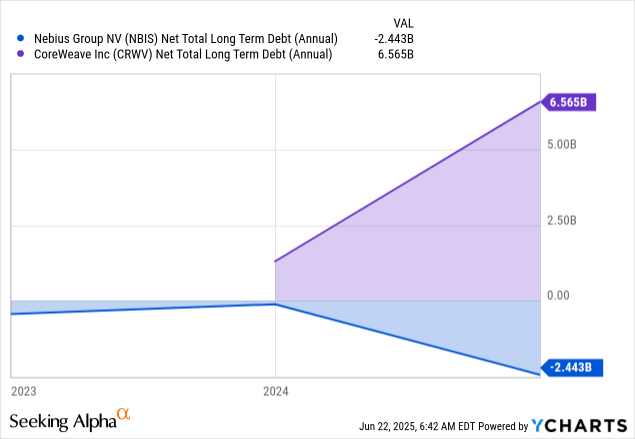
Core Insights - Nebius (NBIS.US) has seen a stock price increase of approximately 125% since April, but this is significantly lower than CoreWeave's (CRWV.US) 369% rise during the same period, raising questions about Nebius's market perception despite its strong fundamentals [1] - CoreWeave's revenue for Q1 2025 grew by 420% year-over-year to $982 million, while Nebius reported revenue of approximately $55 million, highlighting a stark contrast in scale and market recognition [1][2] - CoreWeave is perceived as a "purer" AI infrastructure player, focusing on large-scale AI computing tasks, while Nebius is seen as a more diversified technology company due to its Yandex background [2] Financial Performance - CoreWeave has a low float of shares, which can amplify price movements during demand surges, while Nebius's valuation remains relatively low despite its strong fundamentals [2] - CoreWeave's aggressive capital strategy has raised $2.6 billion through various funding rounds, while Nebius has a healthier balance sheet with $5.4 billion from the sale of Yandex assets and minimal debt [3] - As of Q1 2025, CoreWeave reported an adjusted EBITDA of $606 million with a 62% profit margin, whereas Nebius reported an adjusted EBITDA of -$62.6 million and a net loss of $113.6 million, indicating a significant execution gap [6] Customer Base and Market Position - CoreWeave's revenue is heavily reliant on a few large clients, with 77% of its income coming from two customers, including Microsoft, which contributes 62% [5] - Nebius has diversified its customer base across over 20 industries, reducing risk despite lacking high-profile contracts like those of CoreWeave [5] - Geographical factors also play a role, as CoreWeave's U.S. headquarters aligns it closely with American AI labs, while Nebius has only recently gained attention from U.S. investors after relocating its headquarters to the Netherlands [5] Future Catalysts - Nebius is approaching a potential breakeven point, with management expecting to achieve positive adjusted EBITDA in the second half of 2025, which could shift market sentiment [7] - The recent issuance of $1 billion in convertible bonds and a cash reserve of $1.45 billion provide Nebius with ample growth capital without resorting to dilutive financing [7] - Nebius plans to release industry-specific AI infrastructure products, which may help it stand out among general cloud providers and attract larger contracts [7] Summary - Nebius possesses unique advantages, including undervalued quality assets, ample cash reserves, and a promising execution strategy, positioning it as a potential "invisible winner" in the AI sector [7]


IBM and RIKEN Unveil First IBM Quantum System Two Outside of the U.S.
Prnewswire· 2025-06-24 01:00
Core Insights - IBM has launched its first Quantum System Two outside the United States, co-located with RIKEN's supercomputer Fugaku in Japan, marking a significant milestone in quantum computing [1][4] - The IBM Quantum System Two is powered by the 156-qubit IBM Quantum Heron processor, which has demonstrated a two-qubit error rate of 3x10^-3, significantly improving performance over the previous generation [1][2] - The integration of quantum and classical computing systems aims to enhance research capabilities in advanced algorithms, particularly in fundamental chemistry problems [2][3] Company Developments - The IBM Quantum System Two was officially launched on June 24, 2025, during a ceremony attended by key figures from IBM and RIKEN, highlighting the collaboration between the two organizations [4][5] - The connection between IBM's quantum system and Fugaku allows for the development of hybrid workflows that leverage the strengths of both quantum and classical computing [3][5] Research and Innovation - The collaboration aims to discover algorithms that provide quantum advantage, enabling faster, cheaper, or more accurate solutions compared to classical methods [6] - Recent research featured in Science Advances demonstrates the potential of near-term quantum computers to model complex systems, such as the electronic structure of iron sulfides, which is crucial for various chemistry applications [6]


Will IBM's Growing AI Prowess Deliver Sustainable Growth?
ZACKS· 2025-06-23 16:31
Core Insights - IBM is establishing itself as a significant player in the global AI market, leveraging innovations in hybrid cloud and AI to enhance business processes for clients in 175 countries across various industries [1] Group 1: AI Innovations and Tools - IBM has launched the first integrated software that combines AI security and governance, known as IBM watsonx.governance, to ensure responsible AI use [2] - The Guardium AI security tool has been enhanced to detect new AI use cases in cloud environments, providing better visibility and protection in a decentralized AI ecosystem [3] Group 2: Strategic Collaborations - IBM is collaborating with SAP to integrate generative-AI technology in the retail sector and is also working with The All England Lawn Tennis Club to enhance fan engagement during Wimbledon [4] Group 3: Market Trends and Growth Projections - According to an IDC report, the global AI market is projected to grow from $235 billion in 2024 to $631 billion by 2028, reflecting a compound annual growth rate of 27% [5] Group 4: Competitive Landscape - IBM faces competition from Microsoft, which is expanding its generative-AI capabilities through partnerships and has over 60,000 Azure AI customers [6] - Amazon has introduced its generative-AI platform, Amazon Bedrock, which offers a flexible and scalable solution for AI applications, posing a challenge to IBM [7] Group 5: Financial Performance - IBM's stock has increased by 60.6% over the past year, significantly outperforming the industry growth of 5.8% [8] - The current price/earnings ratio for IBM is 24.9, higher than the industry average of 21.74 [10] - The Zacks Consensus Estimate for IBM's earnings for 2025 has seen an upward revision over the past 60 days, indicating positive market sentiment [11]
IBM remains top software name as with AI, quantum momentum driving upside, Wedbush says
Proactiveinvestors NA· 2025-06-20 17:16
Group 1 - Proactive provides fast, accessible, informative, and actionable business and finance news content to a global investment audience [2] - The news team covers medium and small-cap markets, as well as blue-chip companies, commodities, and broader investment stories [3] - Proactive's content includes insights across various sectors such as biotech, pharma, mining, natural resources, battery metals, oil and gas, crypto, and emerging technologies [3] Group 2 - Proactive adopts technology enthusiastically, utilizing decades of expertise and experience among its content creators [4] - The company employs automation and software tools, including generative AI, while ensuring all content is edited and authored by humans [5]

The Rise of Mobile Device Management Market: A $22.0 billion Industry Dominated by Tech Giants - VMware (US) and Microsoft (US)| MarketsandMarkets™
GlobeNewswire News Room· 2025-06-20 13:30
Market Overview - The global Mobile Device Management (MDM) Market is projected to grow from USD 6.9 billion in 2022 to USD 22.0 billion by 2027, reflecting a Compound Annual Growth Rate (CAGR) of 26.1% during the forecast period [1]. Market Dynamics Drivers - The growth of the mobile workforce within enterprises is a significant driver for the MDM market [5]. - The proliferation of new mobile devices is contributing to the increased demand for MDM solutions [5]. - Network access control initiated by MDM enhances security for corporate data [5]. - Increased productivity and employee satisfaction are also driving the adoption of MDM solutions [5]. - The trend of Bring Your Own Device (BYOD) is further propelling the need for MDM [5]. - Compliance with stringent government regulations is a key factor influencing MDM adoption [5]. - Security issues associated with devices necessitate robust MDM solutions [5]. - The advent of 5G technology is expected to transform the importance of mobile devices, thereby impacting MDM [5]. - Leveraging User and Entity Behavior Analytics (UEBA) into MDM solutions is becoming increasingly important [5]. - The adoption of cloud-based technology is boosting the usage of MDM solutions [5]. Restraints - Specific restraints were not detailed in the provided content. Opportunities - The report indicates potential growth opportunities in the MDM market, particularly in the Solutions segment, which is expected to capture a larger market share by 2027 due to the increasing adoption of MDM solutions [3]. Competitive Landscape - The MDM market features a diverse ecosystem with key players including VMware, Microsoft, IBM, Blackberry, Citrix, Google, Cisco, Samsung, Micro Focus, and ZOHO [5][6]. - MDM solutions enable IT teams to control and distribute security policies to mobile devices accessing sensitive corporate data, ensuring network security [6]. - Organizations are increasingly turning to MDM for enhanced data and network security and improved employee productivity [6].


IBM vs. Oracle: Which Hybrid Cloud Stock Offers Better Growth?
ZACKS· 2025-06-19 14:10
Core Insights - IBM and Oracle are key players in the hybrid cloud infrastructure and database services market, with both companies focusing on hybrid cloud and AI to meet evolving enterprise demands [3][4][10] Group 1: IBM - IBM is expected to benefit from strong demand for hybrid cloud and AI, which will drive growth in its Software and Consulting segments [4] - The company has made strategic acquisitions, including HashiCorp, StreamSets, and webMethods, to enhance its hybrid multi-cloud capabilities and AI platform [5] - Despite growth potential, IBM faces significant competition from Amazon Web Services and Microsoft Azure, along with challenges related to pricing pressure and a complex business model transition [6] Group 2: Oracle - Oracle's cloud infrastructure business has shown robust growth, with Infrastructure-as-a-Service revenue increasing by 51% to $10.2 billion and total cloud services rising by 24% year over year to $24.5 billion [7] - The company anticipates cloud infrastructure revenues to grow over 70% in fiscal 2026, driven by enterprises migrating critical workloads to the cloud [7][9] - Oracle's multi-cloud strategy introduces technical complexities and operational risks, which could impact service reliability and customer satisfaction [11] Group 3: Comparative Analysis - Over the past year, IBM's share price increased by 62.9%, outperforming the industry growth of 4%, while Oracle's shares rose by 47.5% [15] - IBM's forward P/E ratio is 25.11, which is lower than Oracle's 31.27, indicating a more attractive valuation for IBM [17] - Both companies are projected to improve sales and profits in 2025, but IBM's better price performance and valuation metrics suggest it may be a more favorable investment option compared to Oracle [20]


Why IBM Is the Best Quantum Computing Stock to Buy Right Now
The Motley Fool· 2025-06-19 11:20
Core Insights - Quantum computing has the potential to solve problems that are currently impossible for traditional supercomputers due to the unique properties of quantum qubits [1] - Current quantum computers are not yet capable of solving real-world problems faster than traditional computers, with notable benchmarks lacking practical applications [2] - Error correction remains a significant challenge in quantum computing, as qubits are fragile and prone to errors during computations [4] Company Developments - IBM aims to achieve full-scale quantum error correction by 2029 and true quantum advantage by the end of 2026, supported by a clear roadmap [6] - IBM's Nighthawk quantum processor, set to release this year, will feature 120 qubits and 5,000 quantum gates, with plans for future iterations to enhance capabilities [7] - The development of Starling, a fault-tolerant quantum computer, is planned for 2028, with a roadmap that includes three iterations of quantum chips leading up to its release [8][9] Market Potential - The economic value generated by quantum computing is estimated to reach $850 billion by 2040, with the market for quantum hardware and software potentially worth $170 billion [11] - IBM's current stock valuation appears reasonable given the potential of quantum computing, trading at approximately 19 times free cash flow based on the company's outlook for 2025 [12] - The company's hybrid cloud and artificial intelligence businesses are currently driving growth, while quantum computing is expected to contribute significantly in the 2030s and beyond [12]

IBM still has room to run, says BofA as it lifts price target
Proactiveinvestors NA· 2025-06-18 16:16
Company Overview - Proactive is a financial news publisher that provides fast, accessible, informative, and actionable business and finance news content to a global investment audience [2] - The company has a team of experienced news journalists who produce independent content across various financial markets [2] Market Focus - Proactive specializes in medium and small-cap markets while also covering blue-chip companies, commodities, and broader investment stories [3] - The content includes insights into sectors such as biotech and pharma, mining and natural resources, battery metals, oil and gas, crypto, and emerging digital and EV technologies [3] Technology Adoption - Proactive is committed to adopting technology to enhance its content creation and workflow processes [4] - The company utilizes automation and software tools, including generative AI, while ensuring that all published content is edited and authored by humans [5]

Generative Artificial Intelligence (AI) in Digital Marketing Market Opportunities and Strategies Report 2025-2034: Top 10 Players Control Just 15.2%, with IBM Leading at 3.48% Share
GlobeNewswire News Room· 2025-06-18 14:42
Core Insights - The global generative artificial intelligence (AI) in digital marketing market is projected to grow significantly, reaching approximately $35.12 billion by 2034 from $2.48 billion in 2024, with a compound annual growth rate (CAGR) of around 30.3% [3][15]. Market Overview - The market has experienced a CAGR of 30.83% from 2019 to 2024 and is expected to continue growing at a rate of 30.69% from 2024 to 2029 [3]. - Growth drivers include increased adoption of digital channels, e-commerce expansion, and advancements in AI technology, while challenges include data privacy concerns and reliance on high-quality data [4]. Regional Analysis - North America accounted for the largest share of the market in 2024, with 33.66% or $836.05 million, followed by Asia-Pacific and Western Europe [6]. - Asia-Pacific and the Middle East are expected to be the fastest-growing regions, with projected CAGRs of 36.09% and 33.70% respectively [6]. Market Segmentation - The software segment dominated the market in 2024, accounting for 63.56% or $1.57 billion, while the services segment is anticipated to grow the fastest at a CAGR of 33.47% from 2024 to 2029 [7]. - Content generation was the largest application segment, making up 32.93% or $817.81 million, with a projected CAGR of 35.79% during 2024-2029 [8]. - Search engine marketing led the channel segmentation, representing 47.88% or $1.18 billion, with mobile marketing expected to grow at the fastest rate of 38.02% [9]. Competitive Landscape - The market is fragmented, with the top ten competitors holding only 15.2% of the total market share in 2023. IBM is the largest player with a 3.48% market share, followed by Google and Microsoft [5]. - Major companies in the market include IBM, Google, Microsoft, Meta, and Amazon, among others [18]. Opportunities and Strategies - Significant opportunities are expected in the software segment, with an anticipated gain of $4.05 billion in global annual sales by 2029, particularly in search engine marketing and content generation [10]. - Companies are advised to focus on developing innovative AI-powered advertising tools and strategic collaborations to enhance marketing efficiency [11][12].





IBM Introduces Industry-First Software to Unify Agentic Governance and Security
Prnewswire· 2025-06-18 12:00
Core Insights - IBM has announced new software integrations aimed at enhancing AI security and governance for enterprises, marking a significant step in managing risks associated with AI systems [1][2][3] Group 1: AI Security and Governance Integration - The new capabilities integrate IBM's watsonx.governance and Guardium AI Security, providing a unified solution for managing security and governance risks related to AI [2][3] - The integration allows enterprises to validate compliance against 12 different frameworks, including the EU AI Act and ISO 42001 [3] Group 2: Enhanced Detection and Risk Mitigation - IBM has collaborated with AllTrue.ai to enhance Guardium AI Security, enabling detection of new AI use cases in various environments, thus broadening visibility and protection [4] - Recent updates include automated red teaming to identify vulnerabilities and custom security policies to mitigate risks like code injection and data leakage [5] Group 3: Lifecycle Governance and Compliance - IBM watsonx.governance can now monitor AI agents throughout their lifecycle, with features to evaluate metrics such as answer relevance and context relevance [8] - Compliance Accelerators provide pre-loaded regulations and standards, helping users identify obligations relevant to their AI use cases [10] Group 4: Consulting Services for Responsible AI - IBM Consulting Cybersecurity Services is introducing new services to support organizations in scaling AI responsibly, focusing on secure practices and governance guidance [11] Group 5: Availability and Broader Impact - The new capabilities are also available on AWS data centers in India, enhancing model monitoring for clients [12] - These innovations align with IBM's broader suite of watsonx AI solutions, aimed at accelerating the responsible and secure impact of generative AI [12]