
BTR

Search documents
X @Michaël van de Poppe
Michaël van de Poppe· 2025-11-05 14:00
Many #Altcoins have been printing new lows, but $BTR didn't.They keep delivering, as their TVL keeps expanding.On top of that, it's holding onto crucial levels and therefore, it's a good chart.I'm sure this one will start to run back upwards the moment that the markets settle. ...
X @Michaël van de Poppe
Michaël van de Poppe· 2025-10-31 12:45
This one remains one of the strongest set-ups.Immediately reversing after the correction yesterday and on edge of a breakout upwards.It's $BTR.I've mentioned it several times, but the #Bitcoin ecosystem is a strong one to be keeping an eye on.I think that many projects are heavily mispriced and this is one of them. ...
X @Michaël van de Poppe
Michaël van de Poppe· 2025-10-25 10:45
Market Trend - The Bitcoin ecosystem is highlighted as a prime investment area [1] - The Bitcoin ecosystem is considered a core pillar for venture capital investments [1] Investment Opportunity - $BTR is showing strong chart performance with a bounce from support [1] - $BTR is currently challenging a crucial resistance zone [1] - Expectation for $BTR to run upwards towards the year's end [1]
全球储能_投资者是否应追涨电池类股票-Global Energy Storage_ Should investors chase the rally in battery stocks_
2025-10-21 13:32
Summary of Global Energy Storage Conference Call Industry Overview - The battery value chain in China has experienced a significant surge in demand, with a year-on-year increase of 50% in 2025, leading to a rally in stock prices across the sector, particularly for battery cell makers, LFP cathodes, and electrolytes, which saw gains of 60-80% [1][15] - Battery demand is projected to grow by 45% year-on-year, reaching 1.7 TWh for the full year 2025, driven by lower battery costs, strong EV product lineups, and increasing needs for power and energy storage systems (ESS) [1][11] Key Financial Metrics - Battery cell prices have rebounded by 10%, with NMC battery cell prices increasing by 5%-15% and LFP prices by 7% [2][23] - Average utilization rates for Chinese battery companies reached a historical high of 97% in the first half of 2025, indicating strong operational efficiency [2][30] Demand and Supply Dynamics - The gap between battery demand growth (35-40%) and capacity expansion (25-30%) is widening, suggesting potential capacity constraints that could drive margins back to cyclical highs [3][32] - The demand for ESS is doubling in China and increasing by 50-60% in Europe and the US, with LFP batteries being the dominant technology benefiting Chinese companies [7][9] Earnings and Growth Projections - CATL is expected to deliver 42% earnings growth for 3Q25, with battery sales growth between 35% and 40% year-on-year [4][5] - Despite an expected decline in average selling prices (ASP) by 8% year-on-year, there is potential for upside due to recent increases in battery cell prices [4] Investment Implications - The rally in battery stocks is expected to continue, supported by strong earnings momentum and high utilization rates [3][7] - Tactical trades in companies involved in LFP cathode material, electrolytes, and lithium are favored due to anticipated strong earnings growth [7] Competitive Landscape - CATL remains the top pick within the battery value chain, with strong potential for continued re-rating despite geopolitical concerns [5] - Other notable companies include Hunan Yuneng (LFP cathode), Ronbay (NMC cathode), and Tinci Materials (electrolyte), which have shown significant improvements in plant utilization [5][15] Price Trends and Market Conditions - The price of lithium has rebounded from a low of US$8.2k/ton in July to US$10.1k/ton, reflecting a stable supply-demand balance [2][25] - Battery cell prices have shown a clear rebound since April, driven by supply tightness in LFP and ESS battery cells [23][24] Utilization and Operational Data - Companies reported high levels of utilization and expect sequential improvements in revenue growth and margins for the second half of 2025 and into 2026 [30][31] - Utilization rates across the battery value chain ranged from approximately 50% to 80% in Q3 2025, with significant improvements noted in the electrolyte, cathode, and separator sectors [35] Conclusion - The battery industry is poised for continued growth, driven by strong demand, improving prices, and high utilization rates, making it an attractive sector for investment opportunities [1][7][11]

X @Michaël van de Poppe
Michaël van de Poppe· 2025-10-01 14:00
$BTR is making progress!They are holding up on a strong support and started an uptrend since listing.They've also been listed on Bithumb, which is a great step forward in attracting more liquidity towards the token.#Bitcoin Fi is a big market and I think it's a key component of the next bull market, that's why we've invested in @BitlayerLabs. ...
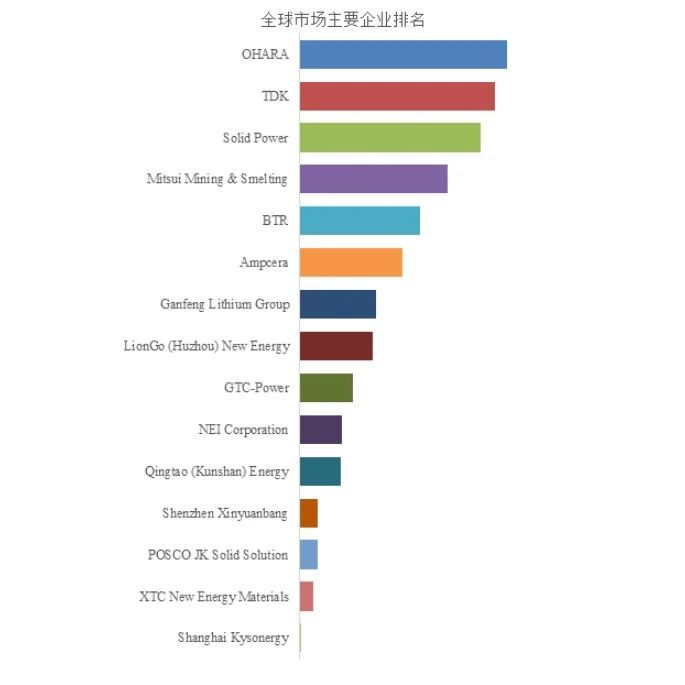
全球固态电池电解质市场前15强生产商排名及市场占有率
QYResearch· 2025-07-02 10:22
Core Viewpoint - Solid electrolytes are the core component that differentiates solid-state batteries from traditional liquid batteries, focusing on their technological development and market potential [1][9][17]. Market Overview - The global solid electrolyte market for solid-state batteries is projected to reach $3.31 billion by 2031, with a compound annual growth rate (CAGR) of 101.0% over the coming years [1]. - The top five manufacturers are expected to hold approximately 58.0% of the market share in 2024 [5]. Market Drivers - **Demand from New Energy Vehicles**: The penetration rate of electric vehicles in China is expected to exceed 50%, driven by policies such as vehicle replacement incentives and the EU's ban on fuel vehicles by 2035 [9][15]. - **Energy Storage Industry Growth**: The global demand for energy storage systems is growing at a CAGR of over 30%, with solid-state batteries being favored for their high safety and longevity [10][11]. - **Emerging Fields**: New applications in low-altitude economies, such as eVTOLs, require high energy density and safety, making solid-state batteries the preferred choice [12][13]. - **Policy and Capital Support**: Government initiatives and significant capital inflows are driving the development of solid-state batteries, with China and the EU investing heavily in this technology [14][16]. Future Outlook - The solid electrolyte market is expected to experience explosive growth due to technological breakthroughs, cost reductions, and supportive policies [17]. - Leading companies are likely to dominate the next generation of battery technology through monopolization, industry chain integration, and global expansion [17].

全球储能:LMR会是LFP的杀手吗?
Bernstein· 2025-06-11 04:25
Investment Rating - The report rates CATL as "Outperform" and LGES as "Market-Perform" while POSCO Future M and other Korean companies are rated "Underperform" [6][7]. Core Insights - Lithium-Manganese-Rich (LMR) battery technology is positioned as a potential disruptor to the Lithium Iron Phosphate (LFP) market, particularly in the entry-level EV segment outside of China [1][9]. - LMR technology combines the safety and cost-effectiveness of LFP with the high energy density of NMC, achieving specific capacities of 250-280 mAh/g and cell-level energy densities around 300 Wh/kg, with potential optimization to 320 Wh/kg [2][15]. - Despite its advantages, LMR faces challenges in cycle life, voltage stability, and scalability, which need to be addressed for successful commercialization [3][15]. Summary by Sections LMR Technology Overview - LMR technology is a balanced approach between LFP and NMC, offering a theoretical cost of approximately US$55/kWh, which is about 15% higher than LFP but 20% cheaper than NMC [4][35]. - The technology does not rely on scarce resources like nickel and cobalt, reducing supply chain vulnerabilities and enhancing recycling potential [3][26]. Market Dynamics - Korean companies are focusing on LMR for entry-level EVs, while Chinese firms target higher-end applications, with significant advancements expected in commercialization by 2025-2028 [5][51]. - The report expresses skepticism about LMR's ability to replace LFP, suggesting that hybrid packs combining LFP and NMC may be a more effective solution [5][7]. Competitive Landscape - The lithium-ion battery industry is dominated by LFP and NMC chemistries, with LFP currently holding a 68% market share in China, while LMR is gaining traction in Western markets [29][31]. - Companies like POSCO Future M and Umicore are making strides in LMR technology, with plans for mass production and collaboration with global automakers [50][51]. Cost and Performance Metrics - LMR batteries are expected to provide a 35% improvement in energy density over current mainstream LFP products, making them a compelling option for mid-range EVs [24][26]. - The cost structure of LMR is competitive, with a breakdown showing that manganese's lower price compared to cobalt and nickel contributes to its cost-effectiveness [48][35]. Future Outlook - The report anticipates that LMR technology will play a significant role in the transition to more sustainable and cost-effective EV battery solutions, particularly in markets outside of China [27][31].