
Campbell's

Search documents
Target to remove synthetic color from cereals by May end
Reuters· 2026-02-27 12:51
Core Insights - Target will exclusively sell cereals without certified synthetic colors by the end of May, aligning with a broader industry trend towards eliminating artificial dyes [1] Company Actions - Target has collaborated with national and owned-brand partners to reformulate products as necessary, applying this decision to both in-store and online cereals [1] - The move positions Target ahead of competitors like General Mills, which plans to phase out artificial colors by 2027, and Walmart, which aims to remove synthetic dyes from its U.S. private-label foods by January 2027 [1] Industry Context - Major packaged food companies, including PepsiCo, Campbell's, and Conagra Brands, announced last year their intentions to reduce artificial dyes in response to health initiatives [1] - The shift towards healthier product offerings is driven by increasing consumer demand for healthier lifestyles, as noted by Target's chief merchandising officer [1]


Coca-Cola Stock Is Interesting, but Here's What I'd Buy Instead
The Motley Fool· 2026-02-25 09:15
Core Viewpoint - Investors are increasingly favoring established companies like Coca-Cola for passive income amid market uncertainty, but Campbell's is presented as a more attractive investment option due to its valuation and dividend yield [1][2]. Coca-Cola - Coca-Cola has a strong history of increasing dividends for 64 consecutive years, currently offering a yield of 2.6% [1]. - The stock price of Coca-Cola increased by 12.3% in 2025 and is up 14.2% year-to-date, significantly outperforming the S&P 500's return of 0.9% [2]. - Coca-Cola's market cap stands at $347 billion, with a gross margin of 61.75% and a dividend yield of 2.53% [8][9]. - The company remains heavily reliant on its soft drink products, which accounted for 69% of its worldwide case volume in 2025, with its trademark cola making up 42% of U.S. unit case volume [6][7]. Campbell's - Campbell's is diversified beyond soup, owning various meal and snack brands, and is focusing on health-conscious products [4]. - The current market cap for Campbell's is $8.1 billion, with a gross margin of 29.84% and a dividend yield of 5.72% [5][6]. - Campbell's has a forward price-to-earnings ratio of 11.1, significantly lower than Coca-Cola's 24.7, indicating it is undervalued [9]. - The company has maintained or raised its dividend every year since 2002, currently yielding 5.8%, which is substantially higher than Coca-Cola's yield [13][14]. - Despite challenges in passing costs to consumers, Campbell's generates sufficient free cash flow to cover its dividend, with a payout ratio similar to Coca-Cola's [11].


Jim Cramer on PepsiCo’s Recent Rally: “Maybe Something’s Going On”
Yahoo Finance· 2026-02-03 12:23
Group 1 - PepsiCo's snack division, Frito-Lay, is struggling due to the impact of GLP-1 weight loss drugs, prompting concerns about the company's future performance [1] - CEO Ramon Laguarta may take significant actions to reduce the company's reliance on snacks, indicating potential strategic shifts [1] - Despite these challenges, PepsiCo's stock closed nearly five points higher, suggesting market optimism or a broader positive trend following a strong quarter from Colgate [1] Group 2 - The market is currently seeing declines in traditional safety stocks, with PepsiCo down over 8% for the year, although it has a 4% yield and is under pressure from an activist firm [3] - Comparatively, other companies like Conagra have experienced even steeper declines, with a nearly 33% drop, highlighting the challenging environment for food and beverage stocks [3]

America's 50 most iconic brands, from Main Street to Silicon Valley
Yahoo Finance· 2026-02-02 17:43
Core Insights - The article highlights the significant American companies that have shaped the nation's identity and economy as it approaches its 250th birthday, emphasizing their cultural and historical impact rather than just financial metrics [1][2]. Group 1: Visa - Visa was established in 1958 as BankAmericard, launching the first consumer credit card in the U.S. [3][6] - The company rebranded as Visa in 1976 and went public in 2008, currently holding a market cap of $632 billion [4][6]. - Visa operates in over 220 countries and territories, accepted at more than 175 million merchants [7]. Group 2: Meta (Facebook) - Facebook was founded in 2004 by Mark Zuckerberg and quickly grew to 1 billion users by 2012, later rebranding to Meta in 2021 [9][13][14]. - The platform has faced controversies regarding user data and misinformation but remains a dominant social media service with over 3 billion regular users [15]. Group 3: Boeing - Boeing, established in 1916, is a leading aerospace company known for producing commercial jets and military aircraft [15][16]. - The company has faced challenges in recent years, including safety allegations and COVID-19 impacts, but continues to be a major player in the industry with a market cap of $185 billion [20][21]. Group 4: Tesla - Tesla was founded in 2003, with Elon Musk joining in 2004, and has become synonymous with electric vehicles, launching the Model 3 in 2017 as the best-selling electric car [23][27]. - The company has a market cap of $1.4 trillion and is recognized for driving electric vehicles into the mainstream [28]. Group 5: Patagonia - Patagonia was founded in 1973 by Yvon Chouinard, known for its commitment to sustainability and donating 1% of sales to environmental causes [30][33]. - The company has expanded from climbing gear to a wide range of outdoor apparel and is estimated to have a market cap of $3 billion [33]. Group 6: Intel - Intel was founded in 1968 and became a leader in semiconductor technology, introducing the first programmable microprocessor in 1971 [34][35]. - The company has maintained a significant market presence, controlling approximately 75% of the CPU market as of 2025 [38]. Group 7: HP - HP was established in 1939, initially focusing on sound equipment and later becoming a leader in personal computers and printers [40][42]. - The company split into HP Inc. and Hewlett Packard Enterprises in 2015, with HP Inc. having a market cap of $18 billion [45]. Group 8: Nike - Nike was founded in 1964 as Blue Ribbon Sports and rebranded in 1971, becoming a dominant player in the sportswear market with a 14% share in 2024 [46][50]. - The company gained fame through its endorsement deal with Michael Jordan, significantly boosting its brand recognition [48]. Group 9: Kodak - Kodak was founded in 1888 and became a pioneer in photography, introducing innovations like roll film and the first digital camera [51][54]. - The company filed for bankruptcy in 2012 and now focuses primarily on commercial printing and imaging [56]. Group 10: IBM - IBM was established in 1911 and became synonymous with computing, initially focusing on tabulating machines and later dominating the PC market [59][62]. - The company has shifted its focus to consulting, software, and cloud computing, with a market cap of $291 billion [67]. Group 11: Paramount Pictures - Paramount Pictures, founded in 1912, is recognized as the longest-operating major studio in Hollywood, producing numerous iconic films [68][70]. - The studio has undergone various mergers and continues to be a significant player in the entertainment industry with a market cap of $12 billion [74]. Group 12: Netflix - Netflix was founded in 1997 as a DVD rental service and transitioned to streaming in 2007, becoming a leader in the industry [77][80]. - The company has a market cap of $351 billion and announced plans to acquire Warner Bros. Discovery in 2025 [81]. Group 13: FedEx - FedEx was founded in 1971, revolutionizing overnight delivery with a centralized hub model [83][84]. - The company has introduced several innovations in the shipping industry and has a market cap of $74 billion [88]. Group 14: Motown - Motown Records, established in 1959, played a crucial role in integrating Black artists into mainstream pop music [91][92]. - The label produced numerous hits and helped launch the careers of many iconic artists, although it faded in prominence during the 1970s [94][96]. Group 15: PepsiCo - PepsiCo was formed in 1965 through the merger of the Pepsi-Cola Company and Frito-Lay, becoming a leading global food and beverage brand [99][100]. - The company is known for its innovative marketing strategies and has a significant rivalry with Coca-Cola [101]. Group 16: Levi Strauss - Levi Strauss, founded in 1853, is known for creating the first riveted blue jeans, which have become a cultural staple [104][106]. - The company continues to sell a wide range of apparel and remains a significant player in the fashion industry [106]. Group 17: Microsoft - Microsoft was founded in 1975 and became a leader in software development, particularly with its Windows operating system [109][110]. - The company has expanded into gaming, cloud services, and AI, with a market cap of $7.8 billion [112]. Group 18: The Home Depot - The Home Depot was established in 1978, focusing on providing a wide range of building supplies and home improvement products [115][116]. - The company has a strong commitment to community initiatives, particularly supporting veterans, and has a market cap of $3.2 trillion [118]. Group 19: WK Kellogg Company - WK Kellogg Company was formed from the original Kellogg's brand, known for its iconic cereals and snacks [121][123]. - The company underwent a reorganization in 2023, with its cereal business spun off into a new entity [123].
2025年美股最强Top 10,存储占了3只
Hua Er Jie Jian Wen· 2026-01-01 09:43
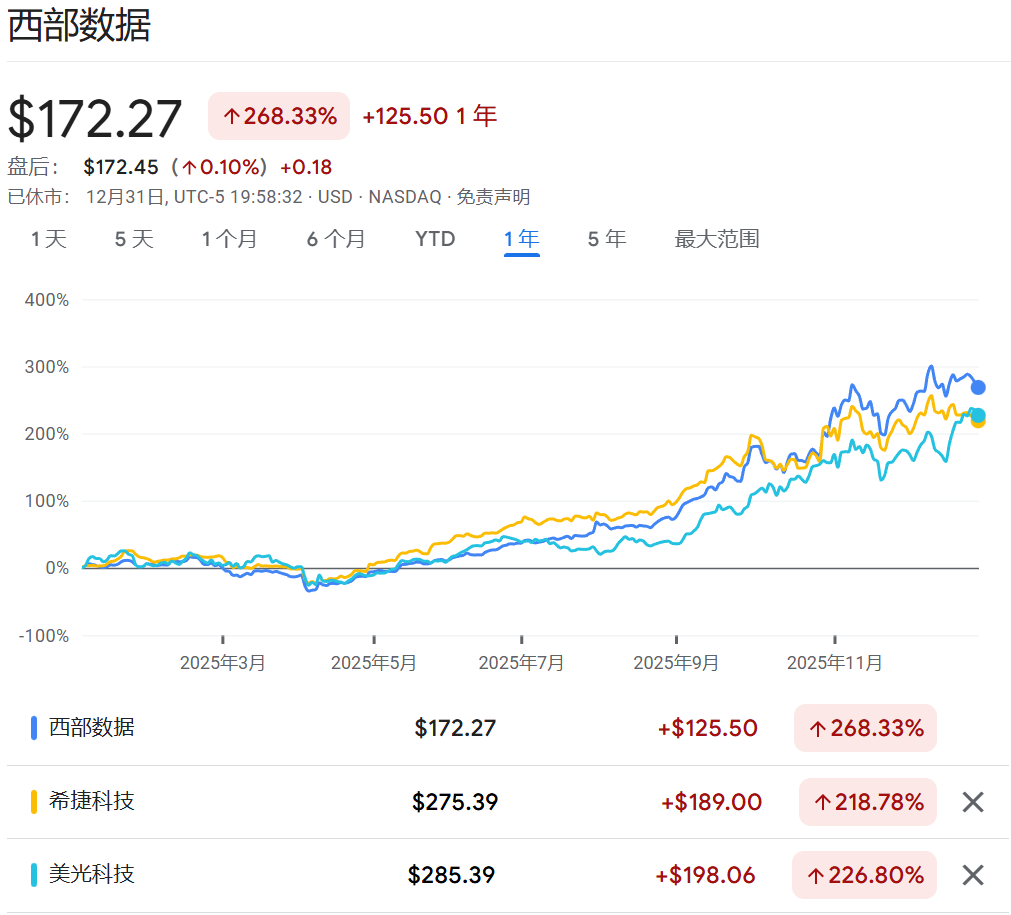
Core Insights - The AI investment theme has significantly expanded, with data storage companies emerging as major beneficiaries in 2025, highlighted by strong stock performances from Western Digital, Micron Technology, and Seagate Technology [4][5][11]. Group 1: Data Storage Companies Performance - Western Digital emerged as the biggest winner in the S&P 500 for 2025, with a stock price increase of 268%, driven by strong demand for high-capacity, low-cost storage from AI data centers [5]. - Seagate Technology also performed well, with a 219% increase in stock price, benefiting from a significant rise in demand for high-margin hard drive products [8]. - Micron Technology recorded a 227% stock price increase, capitalizing on the AI data surge, with its financial performance exceeding market expectations [11]. - SanDisk, newly included in the S&P 500, saw a remarkable 559% increase in stock price, reinforcing the notion that storage is a critical need for AI [14]. Group 2: Market Trends and Shifts - The year 2025 marked a shift in market leadership from computing chips and large model platforms to data storage, data center construction, cooling, and power sectors, indicating a transition in AI investment logic from "technological breakthroughs" to "infrastructure arms race" [17]. - The significant capital expenditure commitments from major cloud service providers, exceeding $440 billion for AI infrastructure over the next 12 months, have created unprecedented demand for storage device manufacturers [4]. Group 3: Traditional Sectors Under Pressure - Traditional sectors, particularly consumer stocks, faced significant challenges in 2025 due to economic uncertainty and tariff concerns, with notable declines in companies like Clorox and Lamb Weston Holdings [18]. - The retail sector also suffered, with Deckers Outdoor and Lululemon Athletica experiencing substantial stock price drops, ending long streaks of growth [18][20]. - The healthcare sector, despite expectations of benefiting from policy changes, underperformed, with Molina Healthcare and UnitedHealth Group seeing significant declines [20].
X @Bloomberg
Bloomberg· 2025-12-03 12:35
Campbell’s missed a chance to turn soup bashing into good PR, says @bethkowitt (via @opinion) https://t.co/eSXXtfkcAV ...
The Score: Campbell's, Kohl's, Alphabet and More Stocks That Defined the Week
WSJ· 2025-11-28 19:51
Core Viewpoint - The article highlights significant stock movements of major companies in response to recent news events [1] Company Movements - Several major companies experienced notable stock fluctuations due to various news developments [1]


X @The Wall Street Journal
The Wall Street Journal· 2025-11-27 09:35
Campbell’s soup is a staple of American childhood, sick days and holiday casserole recipes—and this week, it’s at the center of a hot debate https://t.co/4bWFPg9hSt ...
Here's What's Really in a Can of Campbell's Chicken Soup
WSJ· 2025-11-27 00:12
Core Viewpoint - Campbell's has terminated an executive for allegedly stating that the company relies on unhealthy ingredients, prompting the company to defend its most recognized products [1] Company Summary - The executive's comments have raised concerns about the health implications of Campbell's ingredients, leading to a public relations challenge for the company [1] - In response, Campbell's is actively defending the quality and health aspects of its well-known product line [1]

X @The Wall Street Journal
The Wall Street Journal· 2025-11-26 19:52
Breaking: Campbell’s has fired the executive allegedly caught on tape saying the company made “highly processed food” for “poor people” https://t.co/uBhHwrHhQ7 ...